Vip access

 Favourites


















January 2026
The Empire Style: Napoleon’s Legacy in Furniture Design

The most powerful man in Europe understood that furniture could serve as propaganda. When Napoleon Bonaparte crowned himself Emperor in 1804, the former royal palaces of France stood empty, stripped of their contents during the Revolution. Napoleon set about refurnishing them on a scale that rivalled the Bourbons themselves, spending between thirteen and seventeen million francs on furniture for the imperial residences in barely a decade. The result was not simply a new fashion but an instrument of state: empire style furniture, designed by architects rather than craftsmen, drew its forms directly from ancient Rome and Egypt and proclaimed through every gilt bronze mount and mahogany surface the legitimacy of a self-made dynasty.
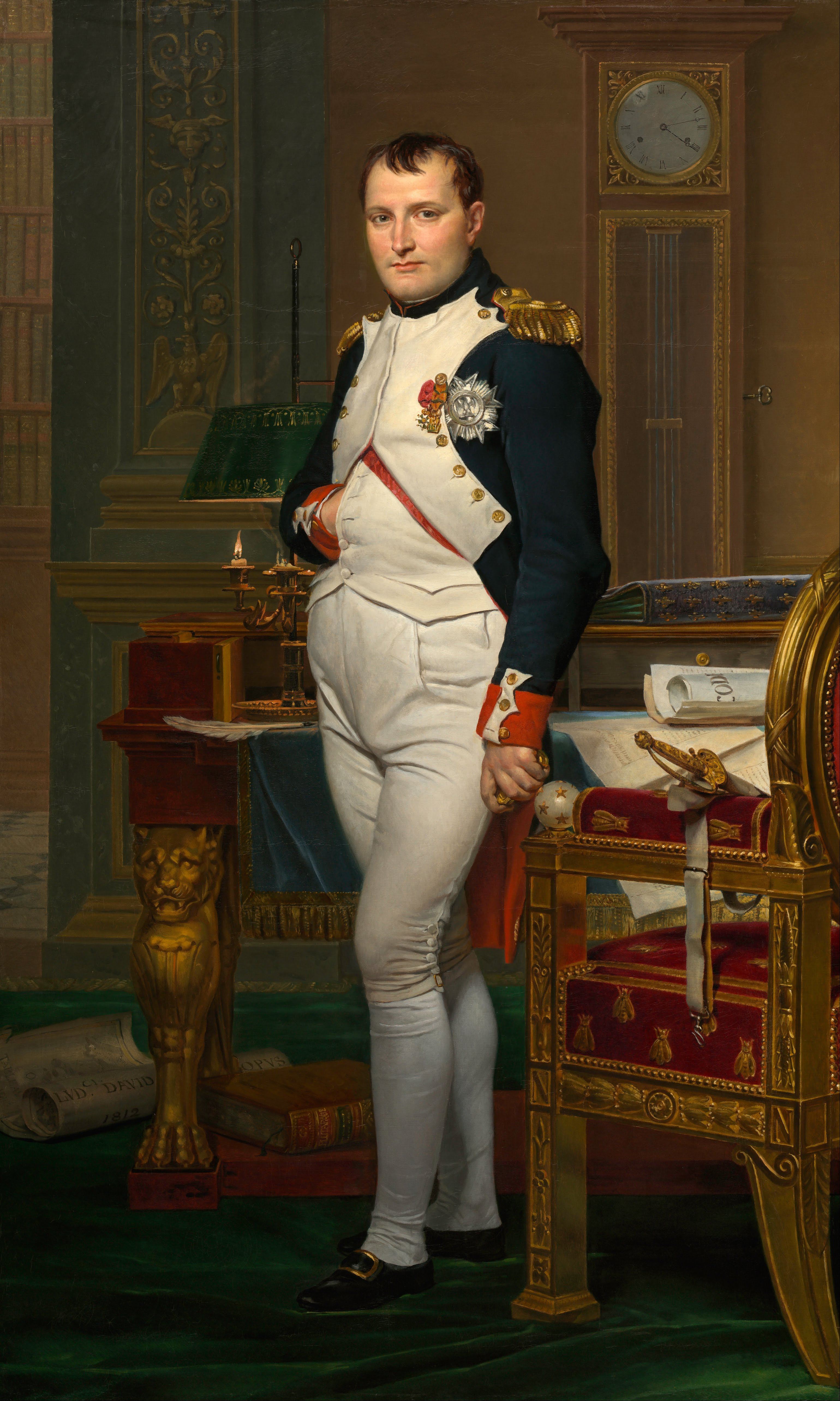
Jacques-Louis David, The Emperor Napoleon in his Study at the Tuileries, 1812 (National Gallery of Art, Washington D.C.)
The style had been gathering since the 1790s, when the upheaval of revolution paradoxically accelerated a taste for classical severity that had been developing for a decade before the Bastille fell. Percier and Fontaine, the two architects who would define the Empire vocabulary, had studied ancient originals in Italy and brought back an uncompromising vision of antiquity revived in its original purity. Their designs, executed by the greatest cabinet-making dynasty in Parisian history, would spread from the Tuileries to the courts of Europe and as far as the drawing rooms of New York.
From Revolution to Empire
The French Revolution ended the absolute rule of the Bourbon kings, but it affected the evolution of furniture less profoundly than has frequently been claimed. The new patrons, the wealthy bourgeoisie, were content with Louis XVI furniture from former days, and the spirit of the Ancien Regime survived until the end of the eighteenth century. As Helena Hayward wrote, “the Revolution was rather a period of arrested development. It was not until the Empire that craftsmanship in furniture-making took on a new lease of life, but by then the social atmosphere had changed.”
The intervening style, known as Directoire after the only stable government of the period, was in fact the expression of a taste for classical forms that had developed several years before the Revolution. The painter Jacques-Louis David had designed austerely classical furniture for his studio as early as 1788, reflecting an academic approach to antiquity that would triumph under the Empire. Winged sphinxes, eagles, and antique-style tripods anticipated the forms to come, while the rear legs of chairs adopted the “sabre” type, not a reference to military swords but a modernisation of the legs of ancient Greek klismoi, seen painted on vases from as early as the fifth century BC.
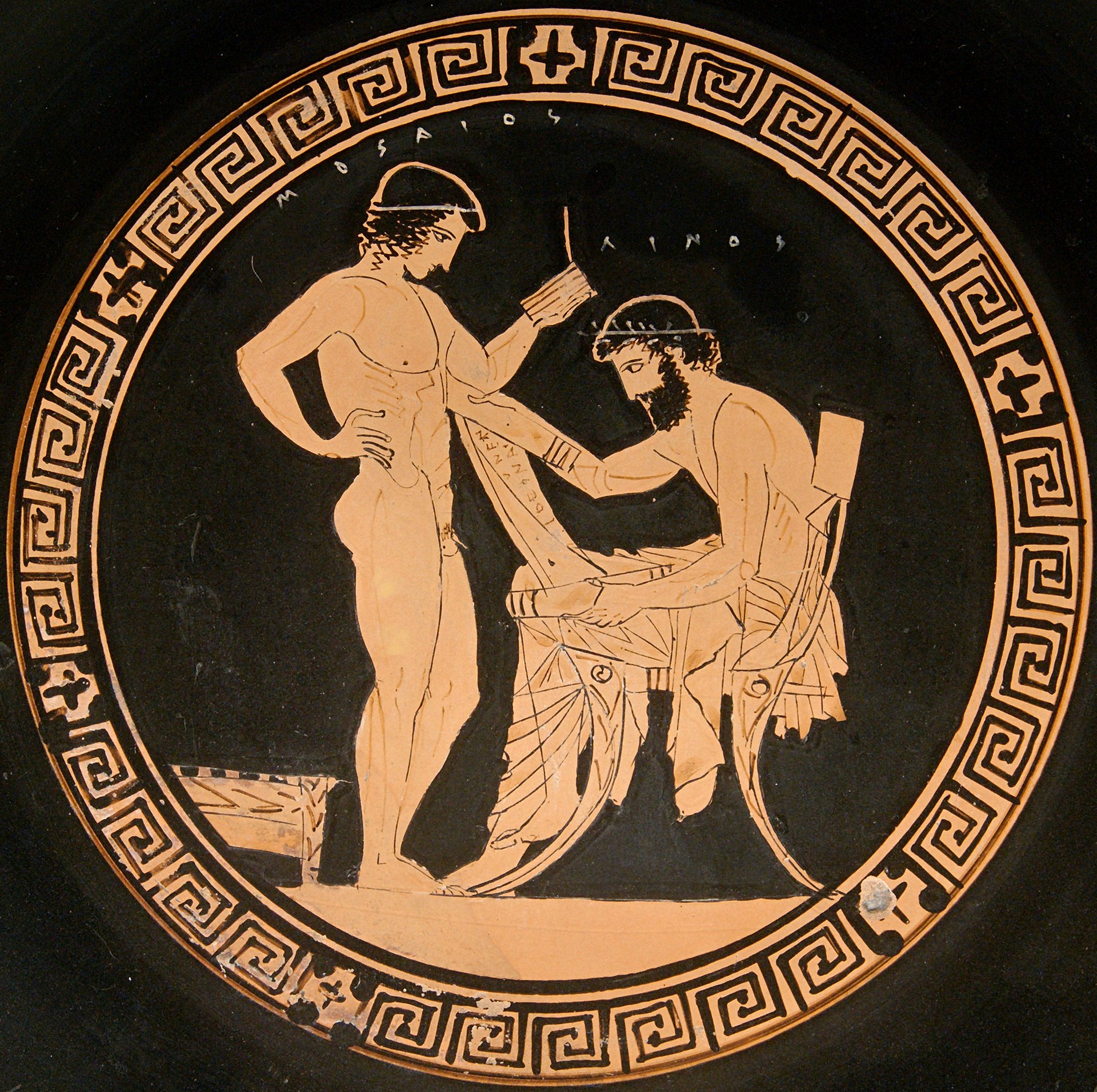
Linus teaches the letters to Musaeus on the tondo of a kylix, Eretria Painter, circa 330/35 BC. (Paris, Louvre). Showing an ancient Greek klismos chair.
A critical institutional change accompanied this aesthetic shift. The abolition of the guilds in 1791 eliminated the rigid separation between menuisier and ebeniste that had governed Parisian furniture-making for generations. Georges Jacob, the most inventive chair-maker of the later eighteenth century, seized the opportunity to begin making case furniture as well, a practice previously outlawed. His sons would continue the workshop into the Empire period, and the Jacob dynasty they founded would become the most important supplier of furniture to Napoleon’s court.
Percier, Fontaine and the Architecture of Furniture
The Empire style was shaped less by cabinet-makers than by two architects: Charles Percier and Pierre-Francois-Leonard Fontaine. Having studied classical originals in Italy, they approached furniture not as craft but as architecture in miniature, reviving antiquity in what Hayward called “all its original purity” rather than adapting it freely as earlier designers had done. Their first major commission was the Chateau de Malmaison, acquired by Josephine Bonaparte and made ready in record time under their supervision. They designed the furniture, executed by the Jacob brothers, as well as the interior decoration for the music room and the library, rooms with columns and panelling of mahogany that are still intact today. The interiors at Malmaison, immediately acclaimed for their elegance, decisively influenced the cabinet-maker’s art during the years surrounding the opening of the Empire period.
Their pattern book, the Recueil de Decorations Interieures, published in Paris in 1801 and re-issued in 1812, codified the new vocabulary. In this work, which had a considerable influence across France and most of Europe, furniture was given pride of place. The Recueil established what Hayward described as “an official art, to which heavy forms lend a slightly theatrical air,” evoking “a sense of majestic grandeur, reflecting Napoleon’s genius for building and his nostalgia for the proud splendour of ancient Rome.”
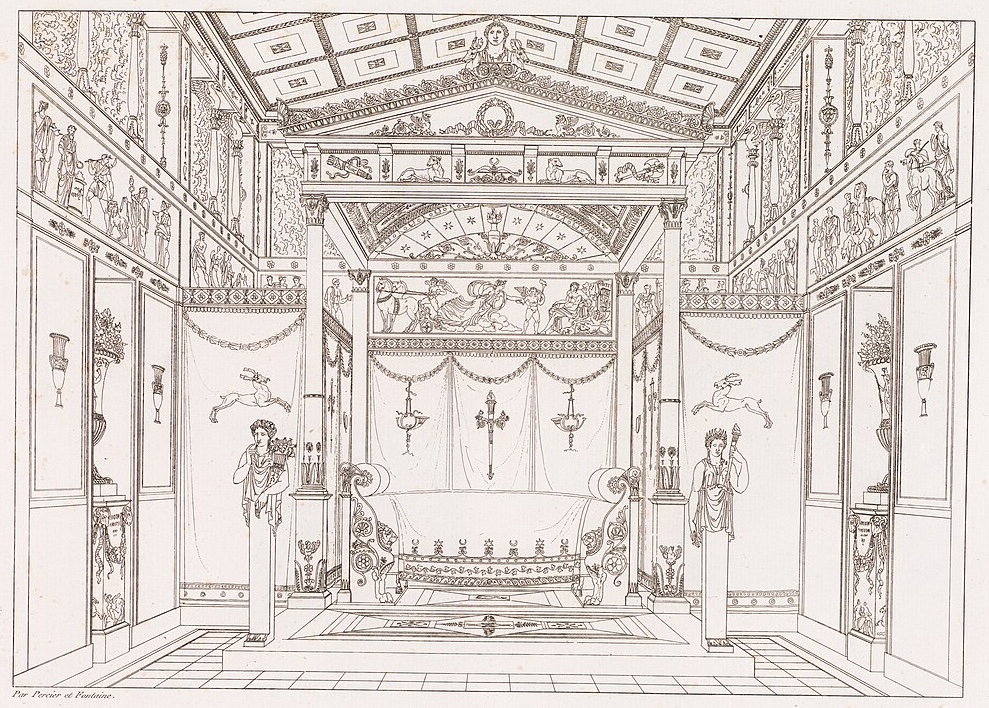
Charles Percier and Pierre François Léonard Fontaine, Bedchamber Design from Recueil de Décorations Intérieures, 1812, Etching.
Percier and Fontaine were not alone in shaping the Empire vocabulary. Vivant Denon, the archaeologist and engraver who became director of the Musee Napoleon in the Louvre, published his Voyage dans la Basse et Haute-Egypte in 1802, inspiring the Egyptian motifs that became an essential feature of fashionable taste. For middle-class patrons, Pierre de La Mesangere published his Collection de Meubles et Objets de gout between 1802 and 1835, with approximately four hundred plates that made the features of Napoleonic furniture familiar well beyond the imperial palaces. Hayward characterised the contrast well: “The delicious simplicity of La Mesangere makes a pleasing contrast with the splendid architectural severity of Percier and Fontaine.”
Napoleon’s Imperial Workshops
French furniture achieved exceptional brilliance in the Napoleonic era. Paris became once again the most important centre for fine cabinet-making and set the tone for the rest of Europe, a supremacy made possible by Napoleon’s generous patronage and by the military conquests that carried the style to every corner of the Continent. Between 1800 and 1813, over ten thousand workmen earned their living in the Paris furniture industry, employed by no fewer than eighty-eight workshops.
The dominant firm was Jacob-Desmalter, founded when Francois-Honore-Georges Jacob-Desmalter took over his father’s business with his older brother in 1796. By the height of the Empire, he employed three hundred and fifty workmen in his workshops in the Rue Meslee, near the Porte Saint-Denis. His annual output reached the value of seven hundred thousand francs, a third of which was destined for export, and the stock in his warehouses was worth a further five hundred thousand francs. He was, quite simply, the most fashionable cabinet-maker in Paris.
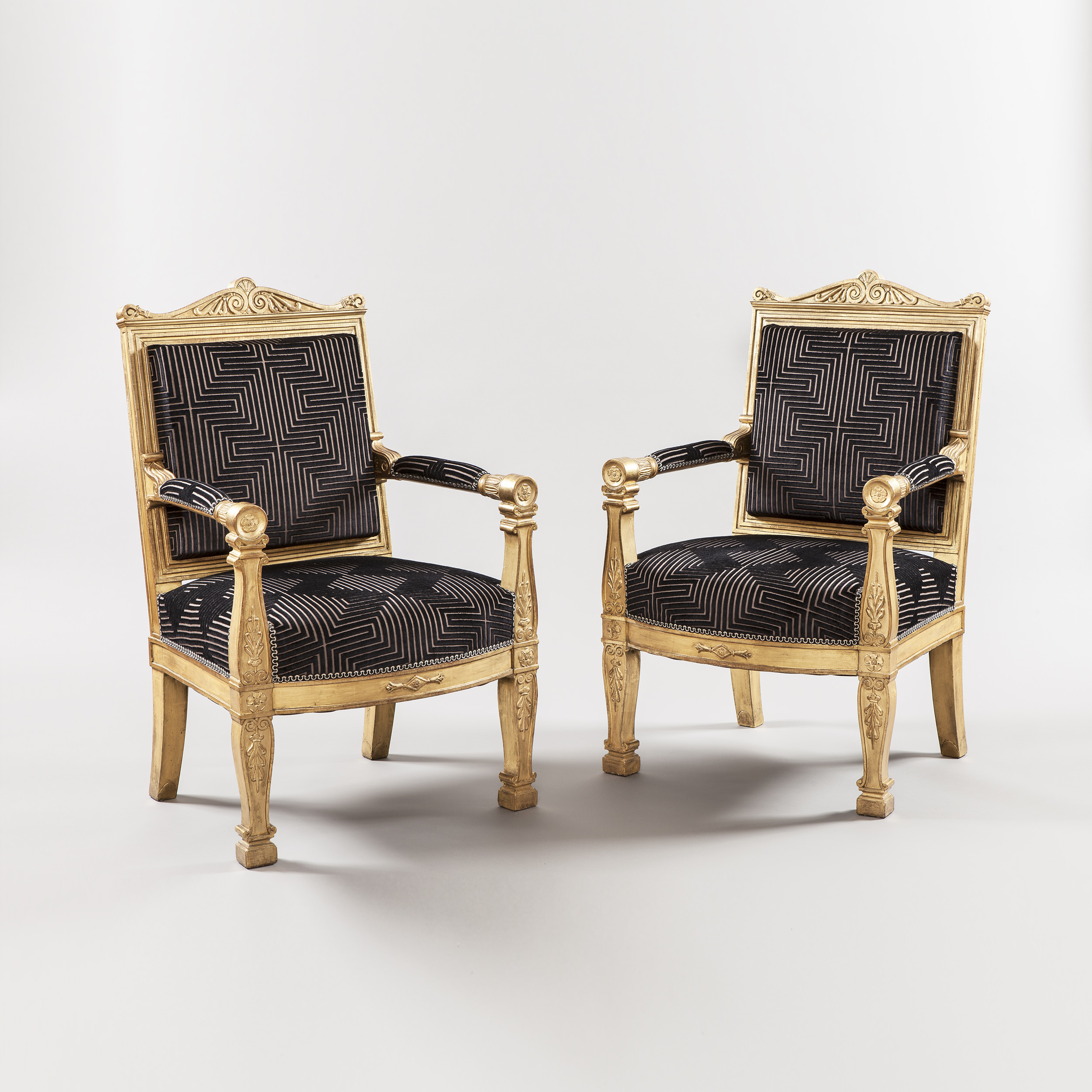
A Pair of Empire Period French Fauteuils, firmly attributed to François-Honoré-Georges Jacob-Desmalter, circa 1810. Butchoff Antiques.
Napoleon’s programme of refurnishing the former royal residences was both a political act and an economic stimulus. In reviving the grand policy so successfully pursued by the Bourbons in favour of the furniture industry, he emptied the treasury at a remarkable rate: the general inventory of the Mobilier de la Couronne between 1810 and 1811 records expenditure of between thirteen and seventeen million francs on furniture for the imperial palaces. Over half a million francs were paid to Jacob-Desmalter for the Palais des Tuileries alone. The Garde-Meuble Imperial supervised every commission, and the residences that survive, Fontainebleau, Compiegne, Trianon, and the Elysee among them, still bear witness to the tremendous scale of the enterprise.
The Defining Forms of Empire Furniture
In form and proportion, Empire furniture did not differ radically from that made under the Consulate, although it tended progressively to become heavier and more majestic. Novelty was expressed in the ornamental features of the veneering and marquetry and, above all, in the design of the gilt bronze mounts, whose delicacy and elegance gradually coarsened towards 1815. Mahogany was the favoured wood, its plain, lustrous surfaces providing a foil for the sculptural bronzes that defined the style. The continental blockade from 1806 prevented the importation of mahogany from the English colonies, exaggerating its value and intensifying the use of indigenous woods including walnut, oak, elm, ash, maple, and beech, the last of which was admirably suited for gilding.
The console table became a specifically Napoleonic piece of furniture, retaining its rectangular shape but replacing columns and pilasters with supports in the form of classical fauna: griffins, sphinxes, caryatids, and Egyptian busts. Commodes, by contrast, lost their distinctive personality to become integrated with the surrounding furnishings, borrowing ornamental motifs from the fireplace and becoming utilitarian rather than decorative. In comfortably furnished rooms, the commode was faithfully accompanied by the indispensable fall-front secretaire.
Bedroom furniture was particularly inventive. The lit en bateau earned tremendous popularity, its boat-shaped end-pieces curved and flaring outwards in the form of swans’ necks. A famous example belonged to the beautiful Juliette Recamier, its simple mahogany surfaces and elegant lines enhancing the effect of the gilt bronze mounts. The psyche, or cheval-glass, with its mirror mounted on pivots, became a standard piece of the well-furnished bedchamber.
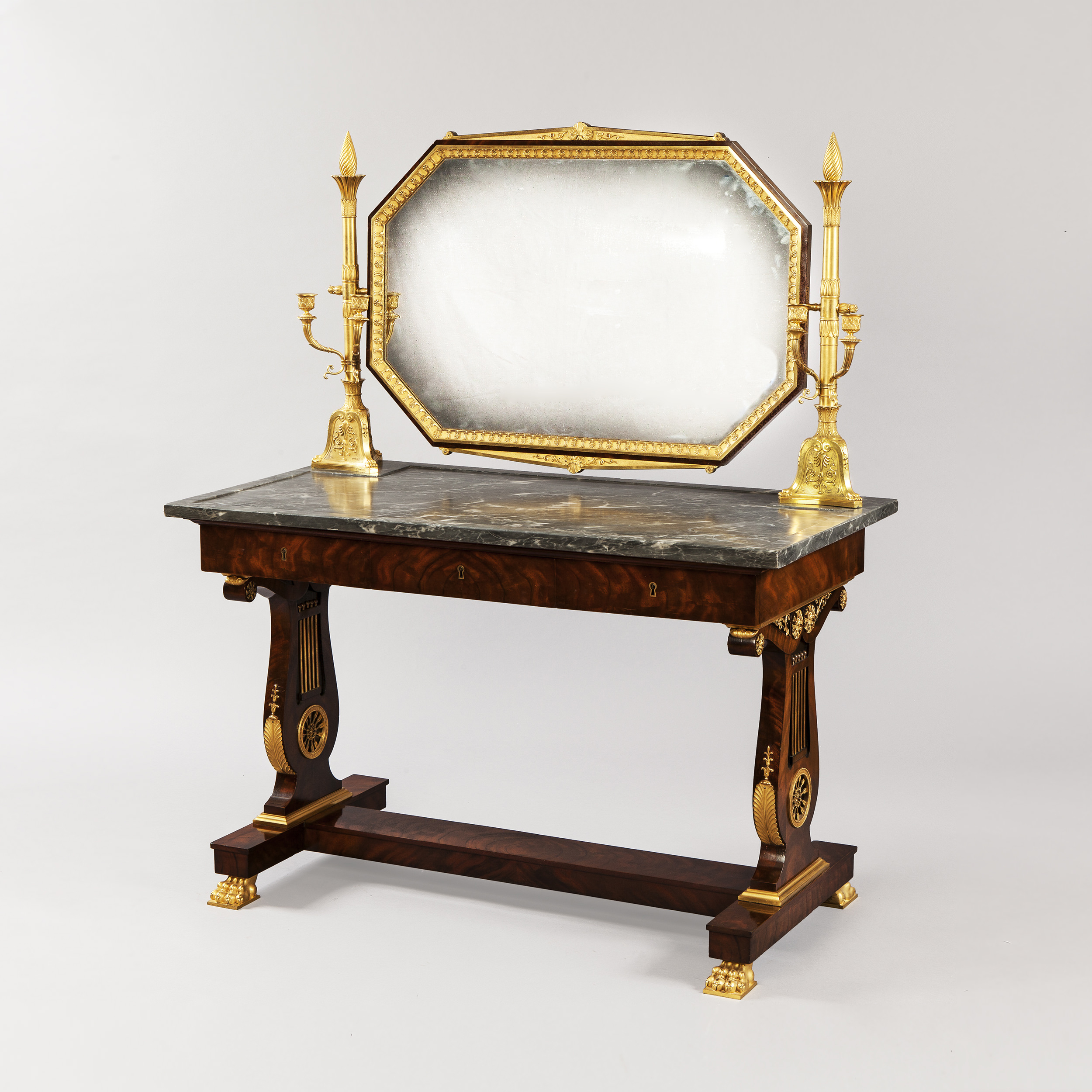
A superb example showing the inventive nature of French Empire bedroom furniture. Dressing Table firmly attributed to François-Honoré-Georges Jacob-Desmalter, circa 1810. Butchoff Antiques.
Seat furniture evolved steadily. Chairs initially conserved their scroll backs from the Consulat period, but the rectangular back, either plain or upholstered, gradually became the standard form. The curved-back chair en gondole proved especially appealing, and fine examples survive in Josephine’s dressing room at Fontainebleau and in Marie-Louise’s boudoir at Compiegne. Small, round gueridons were welcomed for their practical advantage in rooms where people gathered, and they remained in favour throughout the Napoleonic period and beyond.
Empire Across Europe
The Empire style spread rapidly beyond the frontiers of France. Developing from the classicism of Louis XVI, the new style achieved an air of academic formality, shedding any sense of feminine elegance and concentrating upon severe lines and often somewhat heavy forms. Napoleon’s military conquests played a considerable part in carrying the style to every corner of Europe and as far afield as Russia.
In England, the parallel development became known as the Regency. Thomas Hope, a wealthy banker and talented connoisseur, published his Household Furniture and Interior Decoration in 1807 as a record of his house in Duchess Street, London. Hope is believed to have designed the furniture himself, and his book established what came to be known as the “English Empire” style: articles severely rectilinear in shape, with plain surfaces of mahogany veneer relieved with small ormolu ornaments of classical motifs such as honeysuckle, palmette, lotus and acanthus leaves, wreaths, and figures of chimerae or sphinxes.
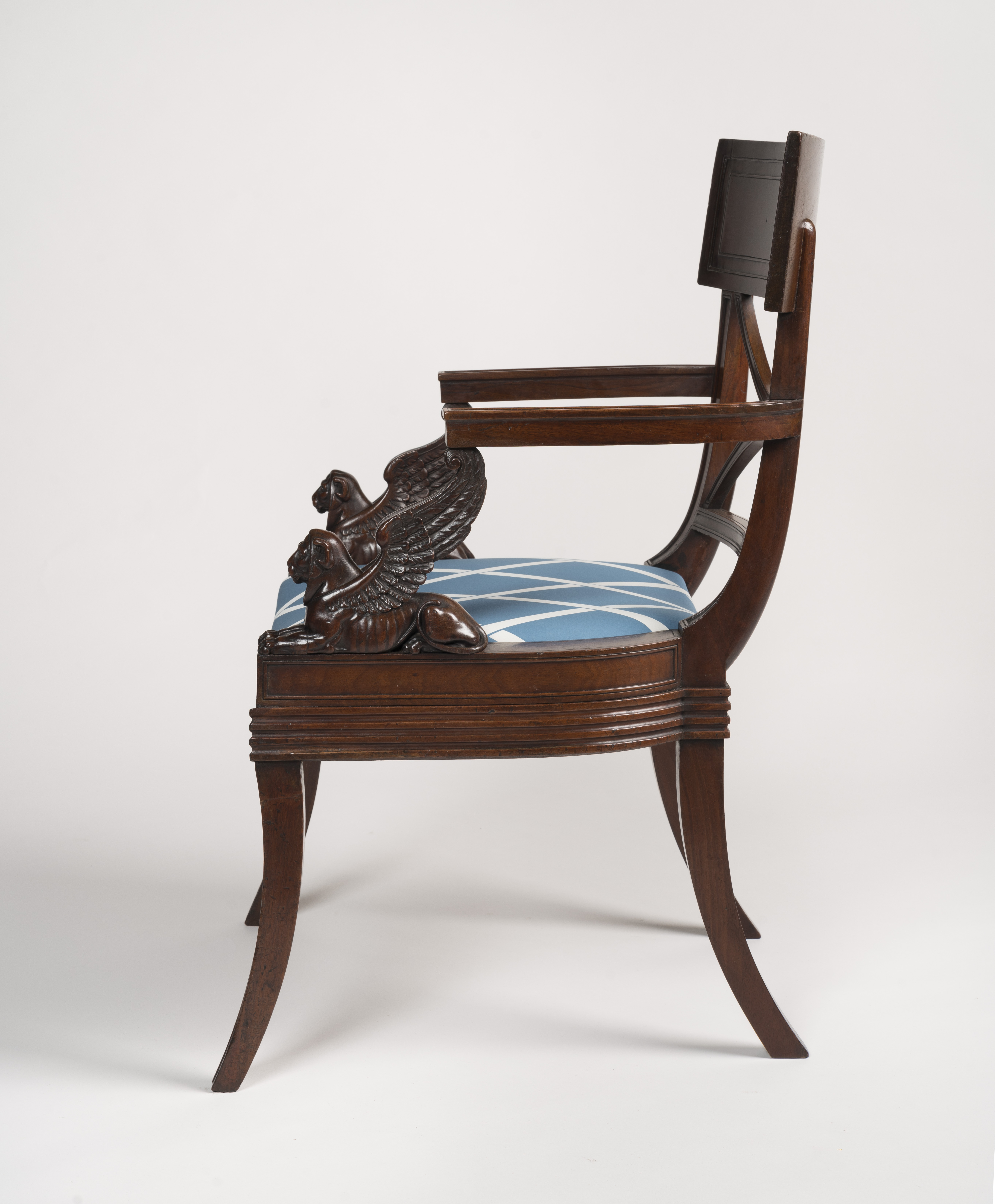
One of pair of Regency Armchairs after the design of Thomas Hope showing the direct influences of French empire designers such as Percier & Fontaine as well as Classical Antiquity. Butchoff Antiques.
In the German territories, the style was adapted to local traditions. For the Wurzburg Residenz, Johann Valentin Raab provided furniture less severe than its Parisian counterparts, giving more prominence to carved and gilt decorative features. In Vienna, cabinet-makers favoured finely cast and chased gilt bronze mounts. Yet the Empire style barely survived the end of imperial power. The wars had impoverished the middle classes, and from the severe contours of Empire furniture a more relaxed and intimate bourgeois style was evolved, known as Biedermeier.
In Russia, craftsmen in St Petersburg produced chairs showing an interesting compromise between the designs of Jacob-Desmalter and those of Sheraton. In America, the Scottish-born Duncan Phyfe became the most important name in establishing the Empire style in New York, his interpretations of English Regency forms so individual that he can be credited with having evolved a highly personal style.
The Undervalued Style
The Empire was not revived in the nineteenth century with anything like the intensity of the styles of the Ancien Regime. Makers and their patrons looked back instead to the furniture of the three Louis, and the severe masculinity of Napoleonic design fell from fashion almost as swiftly as the Emperor himself. Yet it never disappeared entirely. In the last two decades of the nineteenth century, firms such as Krieger produced mahogany furniture with gilt bronze mounts inspired directly by the designs of Percier and Fontaine, supplying clients from Florida to Argentina with Empire-style pieces that demonstrated the international appeal of the Napoleonic vocabulary.
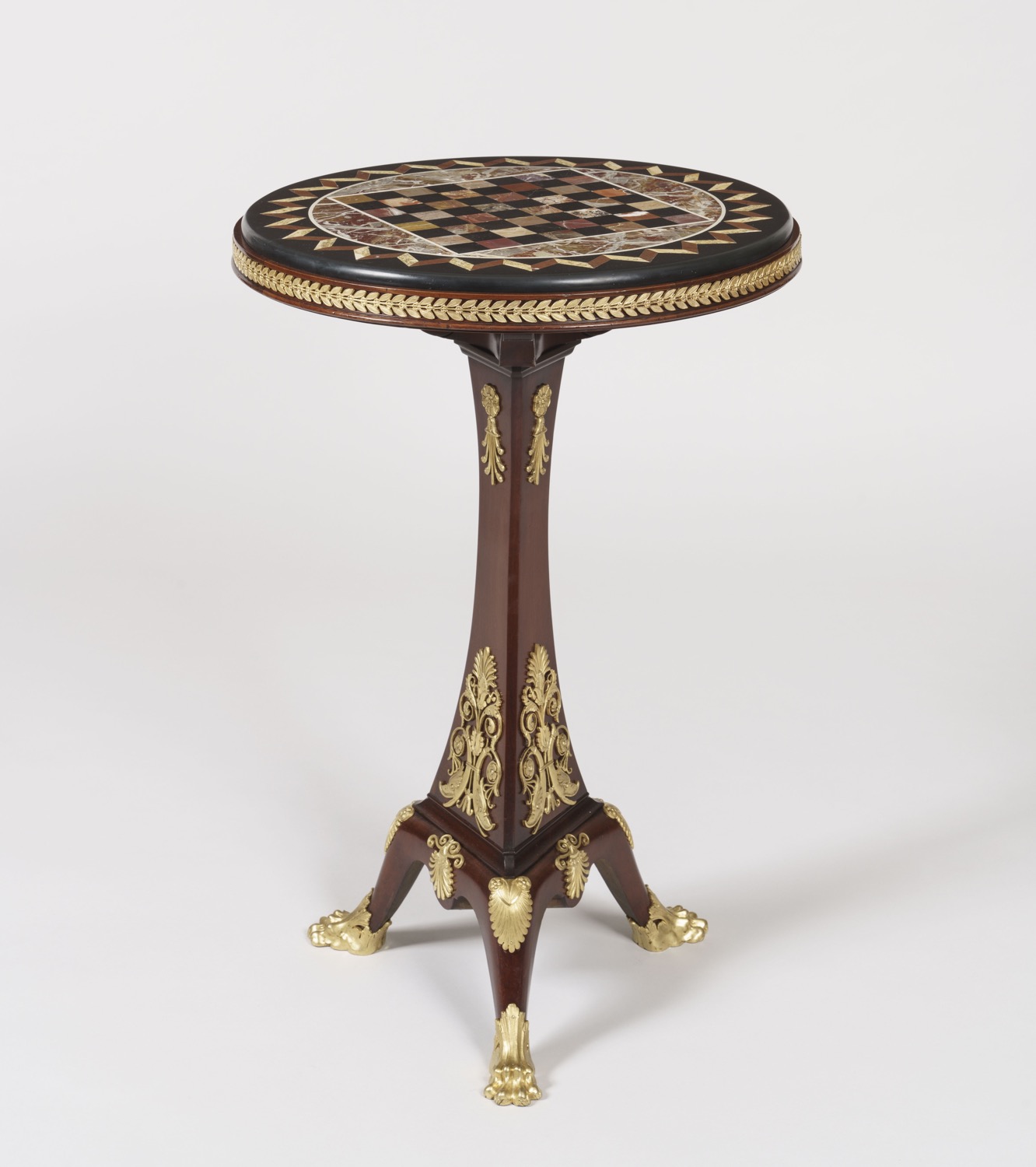
An Empire Revival chess table, attributed to Maison Kriéger, circa 1870. Previously with Butchoff Antiques.
That appeal persists today, and for good reason. Empire furniture offers an architectural gravitas that few other styles can match. The strong geometric forms, dark woods, and sculptural ormolu mounts read as serious and grounding in a scheme, qualities that interior designers deploy to particular effect in studies, libraries, and formal dining rooms. The clean lines prove surprisingly compatible with modern and contemporary art, and the robust construction that characterised furniture built for imperial palaces makes Empire pieces forgiving of daily use in working rooms, practical furniture rather than objects for display.
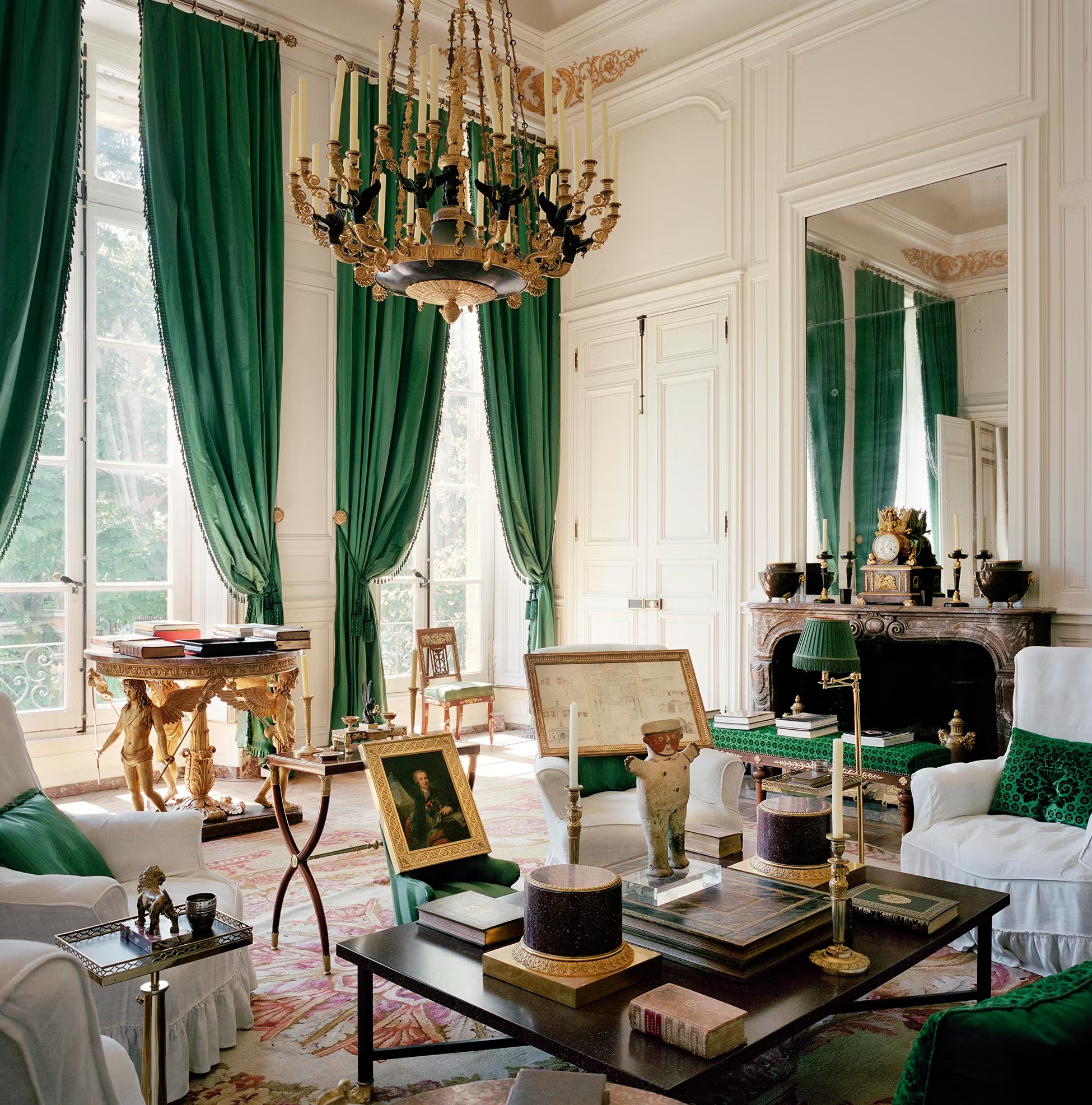
The Empire salon at the Paris home of the legendary Hubert de Givenchy.
Where Rococo furniture succeeds through movement and asymmetry, Empire furniture anchors a room through stillness and geometry. A single console table or pair of gueridons, placed against a well-chosen wall colour, can define an entrance hall with an authority that few other periods achieve. The style’s relative undervaluation compared to Louis XV and Louis XVI furniture makes it, for discerning collectors and designers alike, one of the more compelling opportunities in the current market.
written by Rainier Schraepen