Vip access

 Favourites


















February 2026
The Grand Tour: From Roman Ruins to British Drawing Rooms

The Grand Tour: From Roman Ruins to British Drawing Rooms
Discover how the Grand Tour shaped British taste, from Florentine pietre dure and Roman micromosaics to the revolution in furniture design led by Robert Adam.
Discover how the Grand Tour shaped British taste, from Florentine pietre dure and Roman micromosaics to the revolution in furniture design led by Robert Adam.
The Grand Tour was the most consequential shopping trip in the history of European taste. From the late seventeenth century onwards, young men of wealth and standing crossed the Alps to immerse themselves in the classical world, returning with crates of marble, mosaic, bronze, and hardstone that would reshape the interiors of their country houses and, in time, the entire direction of British design. Italy was the destination that mattered. Florence offered the pietre dure workshops of the Medici; Rome offered antiquities, micromosaics, and the friendship of artists who would paint your portrait among the ruins; Naples, after the excavations at Herculaneum began in 1738, offered a direct encounter with the ancient world preserved beneath volcanic ash.
The objects these travellers brought home served as proofs of cultivation and symbols of taste, and in the hands of architects like Robert Adam they became the raw material for a revolution in furniture and interior design that would sweep through every level of the English trade. The Grand Tour created a market for classical taste that would shape European decorative arts for the next two centuries.
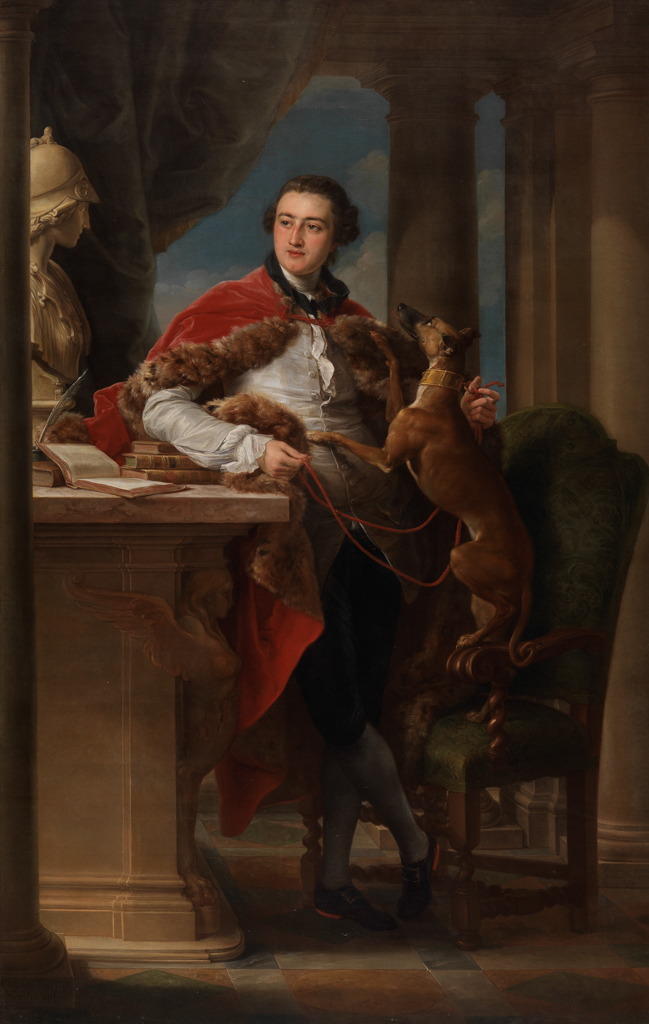
Pompeo Batoni, The Seventh Earl of Northampton, 1758 (Fitzwilliam Museum, Cambridge). One of dozens such portraits that served as both souvenir and social credential.
The Treasures of Florence
The workshops that produced the Grand Tour's most coveted objects had their origins in the ambitions of the Medici. The Opificio delle Pietre Dure, or Grand Ducal workshops, were established in Florence in 1580 by Francesco I de'Medici, initially to furnish a dynastic mausoleum of extraordinary splendour. When that project stalled, the Medici turned their craftsmen's skills to commerce. They arranged in the Uffizi gallery a display of the exquisite figures and inlaid panels made for the mausoleum's altar, in order to tempt the grandest of grand tourists to commission similar works to take home with them. Many succumbed, including the diarist John Evelyn, who bought nineteen panels of pietre dure mosaic and had them made up into a cabinet, now at Christ Church, Oxford. Others acquired panels for caskets and cabinets, or bought whole table tops of these rich and glowing materials, inlaid with tiny laminae of agates, jasper, lapis lazuli, and chalcedony.
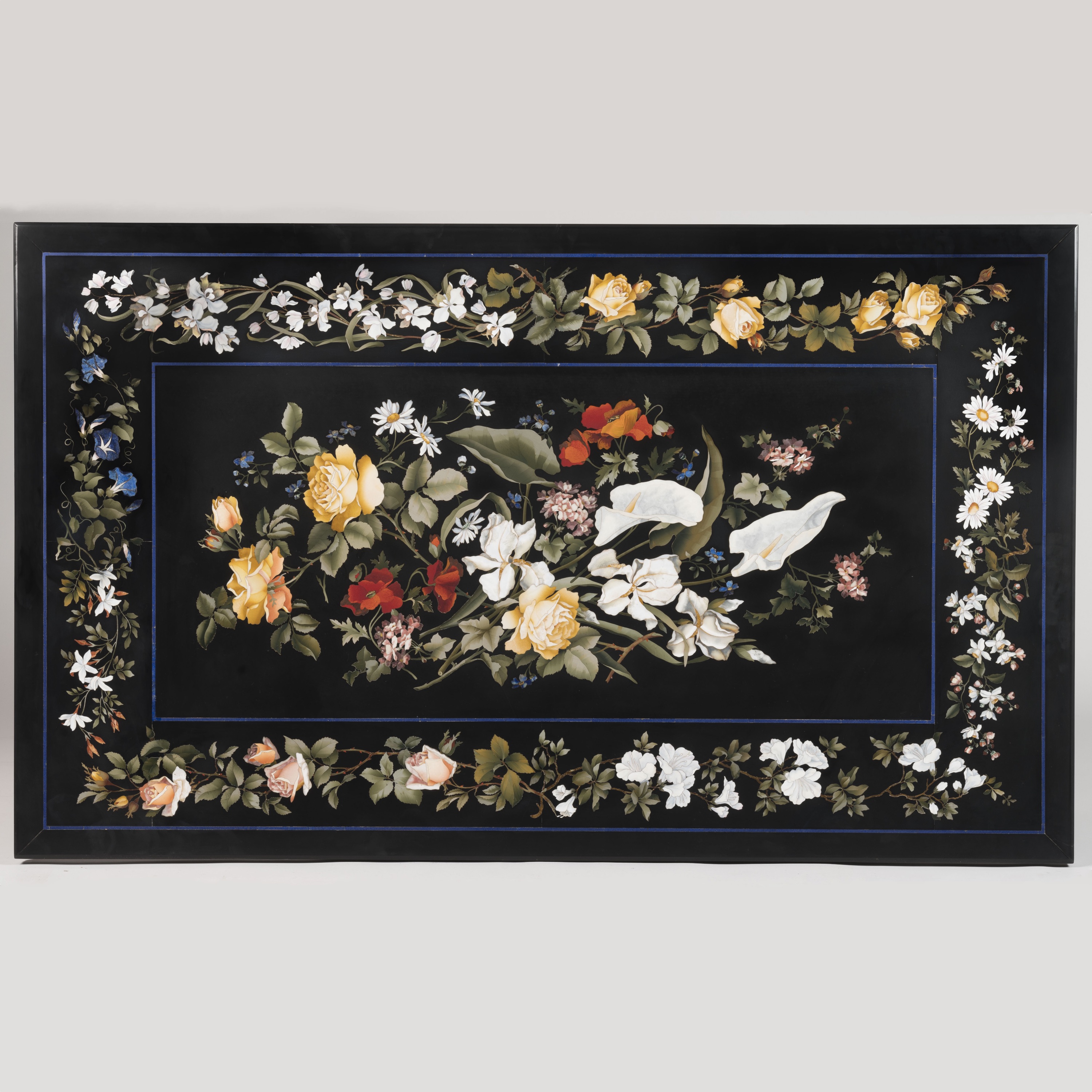
This table top is attributed to Gaetano Bianchini, who trained at the Opficio delle Pietre Dure and set up his own private workshop in Florence around 1825. Image: Butchoff Antiques, London.
Pietre dure, however, was expensive beyond the reach of most travellers. Imitations made in scagliola paste became increasingly popular as an alternative. Enrico Hugford, the Abbot of Vallombrosa, developed a technique that enabled him to use scagliola pastes as paints capable of great delicacy of tone. He and his pupils, Lamberto Cristiano Gori and Pietro Belloni, produced numerous pictures and table tops in this substance, especially for export to England. A surviving example, a scagliola table top made for an English grand tourist named Mr. East, demonstrates how effectively the technique could imitate the colour and lustre of true hardstone at a fraction of the cost. The scagliola tops made in the second half of the eighteenth century follow the gradual change in style from the late Baroque to Neo-Classicism, their wayward cartouches and carelessly strewn flowers giving way to correct architectural motifs, still-lifes of Etruscan vases, and upright figures of Grecians and Romans.
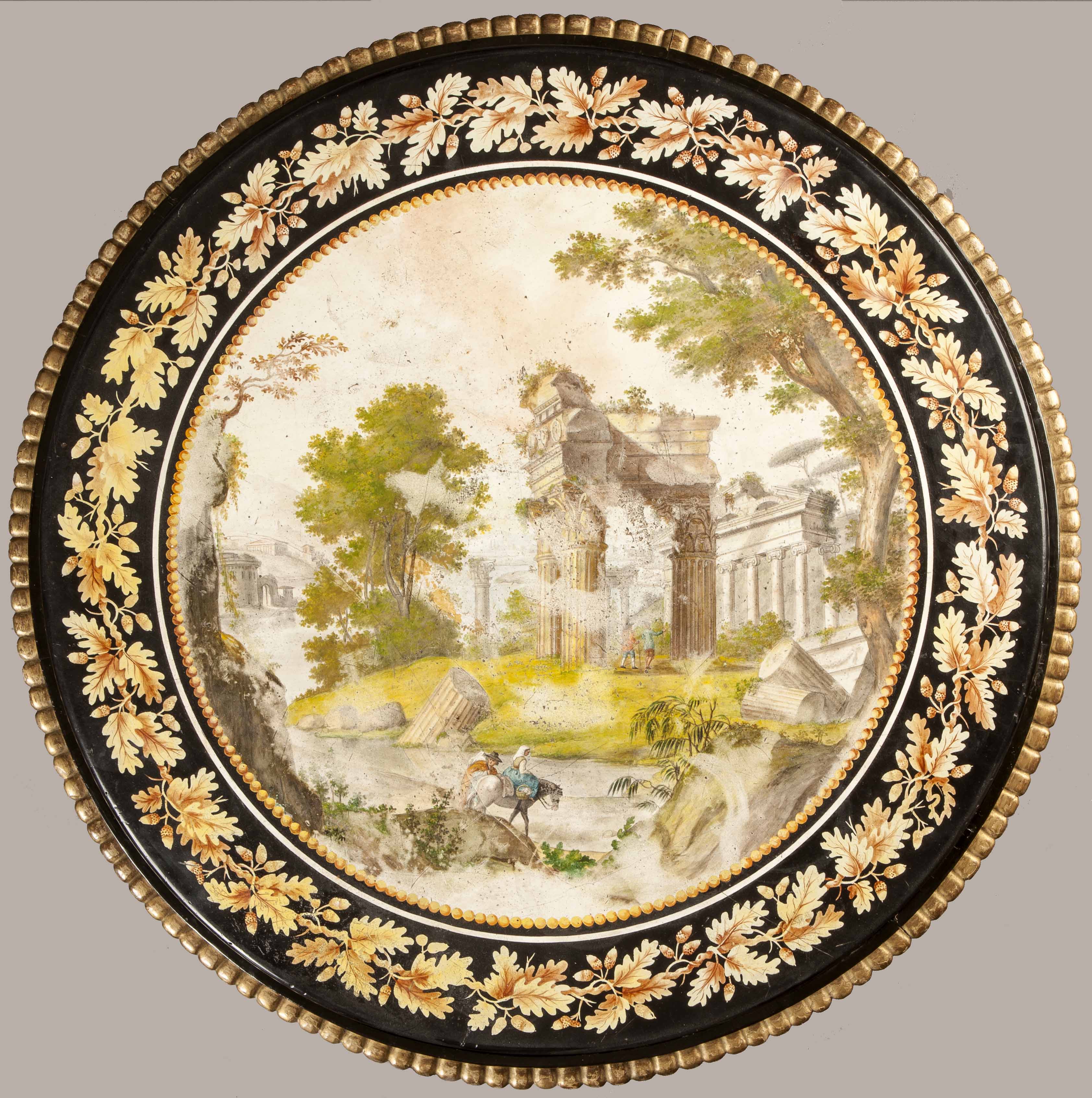
Almost certainly by Pietro Della Valle, this scagliola table top (circa 1825) shows the incredible range of the technique, which involved creating a paste which could be applied as paint to mimic brushwork and could equally imitate hardstone inlay (as seen on the pearl border and the oak garland). Previously with Butchoff Antiques.
Rome and the Art of the Souvenir
If Florence was the Grand Tour's workshop, Rome was its theatre. The city offered not only the ruins of antiquity but a thriving industry of artists and craftsmen who catered to the tastes and vanities of wealthy visitors. Pompeo Batoni painted portrait after portrait of young Englishmen posed against classical backgrounds, their confidence and their new acquisitions equally on display. The 7th Earl of Northampton sat for Batoni in 1758, surrounded by furnishings that reflected the archaeological taste of the moment, one of dozens of such portraits that served as both souvenir and social credential.
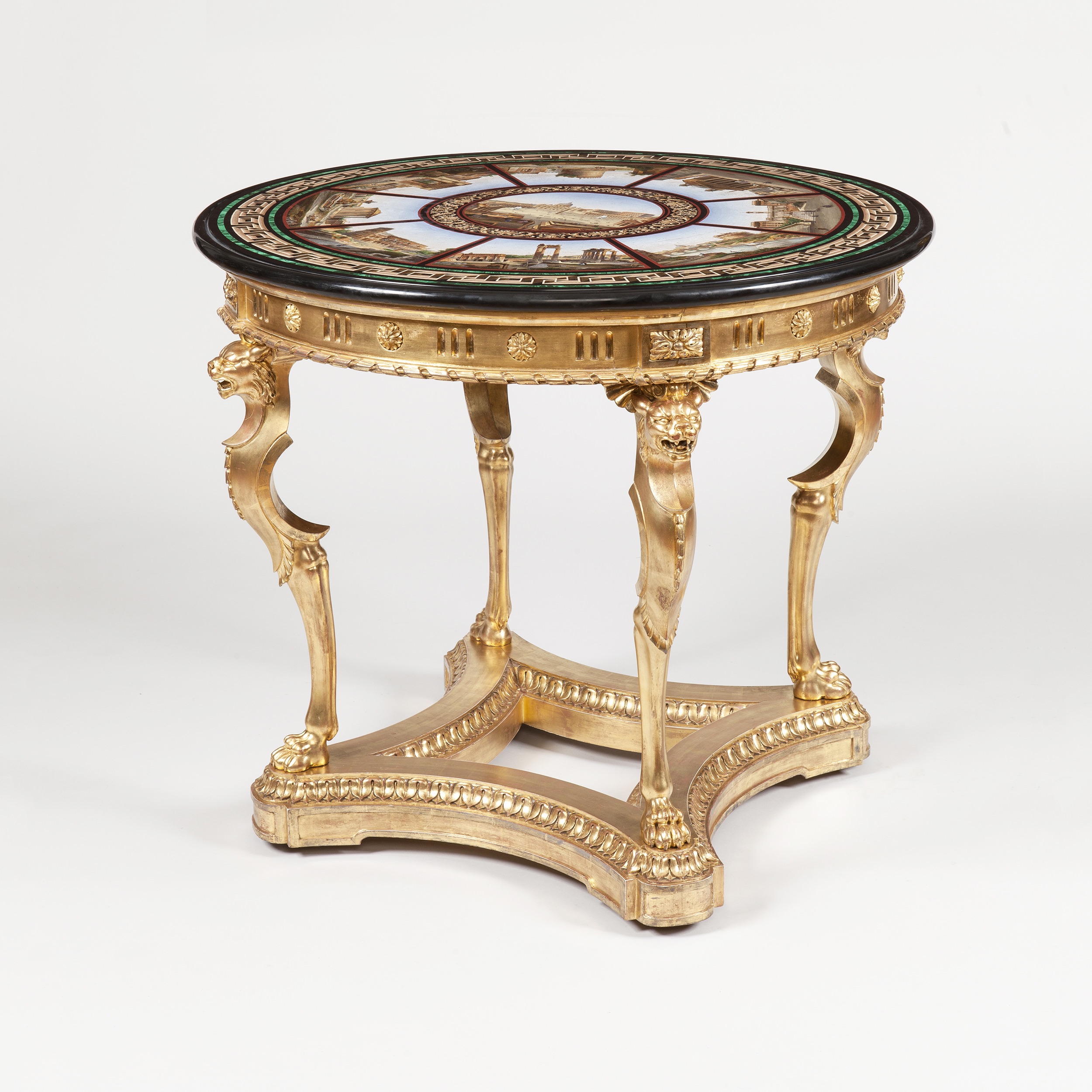
The ultimate Grand Tour souvenir: a large micromosaic table with views of Rome. This table was acquired by the 6th Earl of Macclesfield on his Grand Tour. Butchoff Antiques.
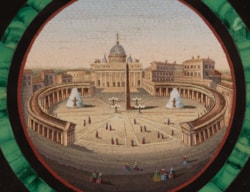
The most distinctive Roman contribution to Grand Tour collecting was the micromosaic. The Vatican Mosaic Workshop had been established in the sixteenth century, and from the 1770s its craftsmen developed a technique of assembling minute tesserae into panels of astonishing intricacy, depicting views of the Forum, St Peter's, and classical subjects drawn from the collections of the great Roman museums. These panels were set into table tops, snuff boxes, and jewellery, their quality and detail far surpassing anything that could be produced outside Italy. The designs drew on celebrated antique originals: one surviving table top combines a roundel based on the Doves of Pliny in the Capitoline Museums with a floral bouquet copied from a Roman mosaic floor in the Pio-Clementino Museum.
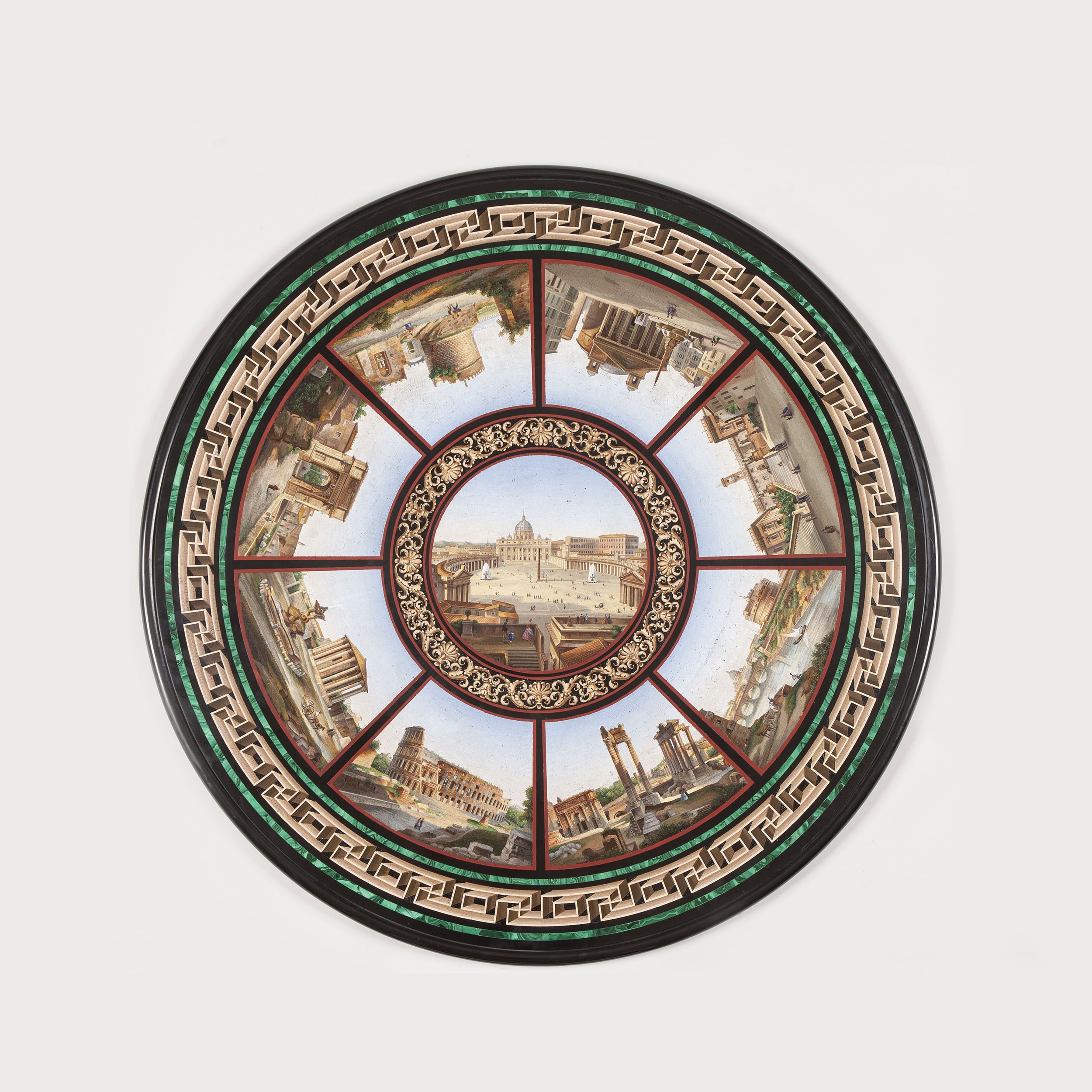
The top of the Grand Tour table is one of the greatest micromosaic tabletops in private hands, attributed to Cesare Roccheggiani, with a diameter of 90cm and using tens of thousands of small coloured tesserae depicting views of Rome. Butchoff Antiques.
Bronze reductions of classical sculpture offered another category of portable antiquity. In Rome, the founders Zoffoli and Righetti produced small-scale bronzes of celebrated antique works, including the Medici Vase from the Uffizi and the Borghese Vase now in the Louvre. In Paris, Ferdinand Barbedienne and his partner Achille Collas later industrialised this tradition, using a mechanical reduction machine to produce bronze copies of Greek and Roman originals that made the Apollo Belvedere and the Venus de Milo available to collectors across Europe.
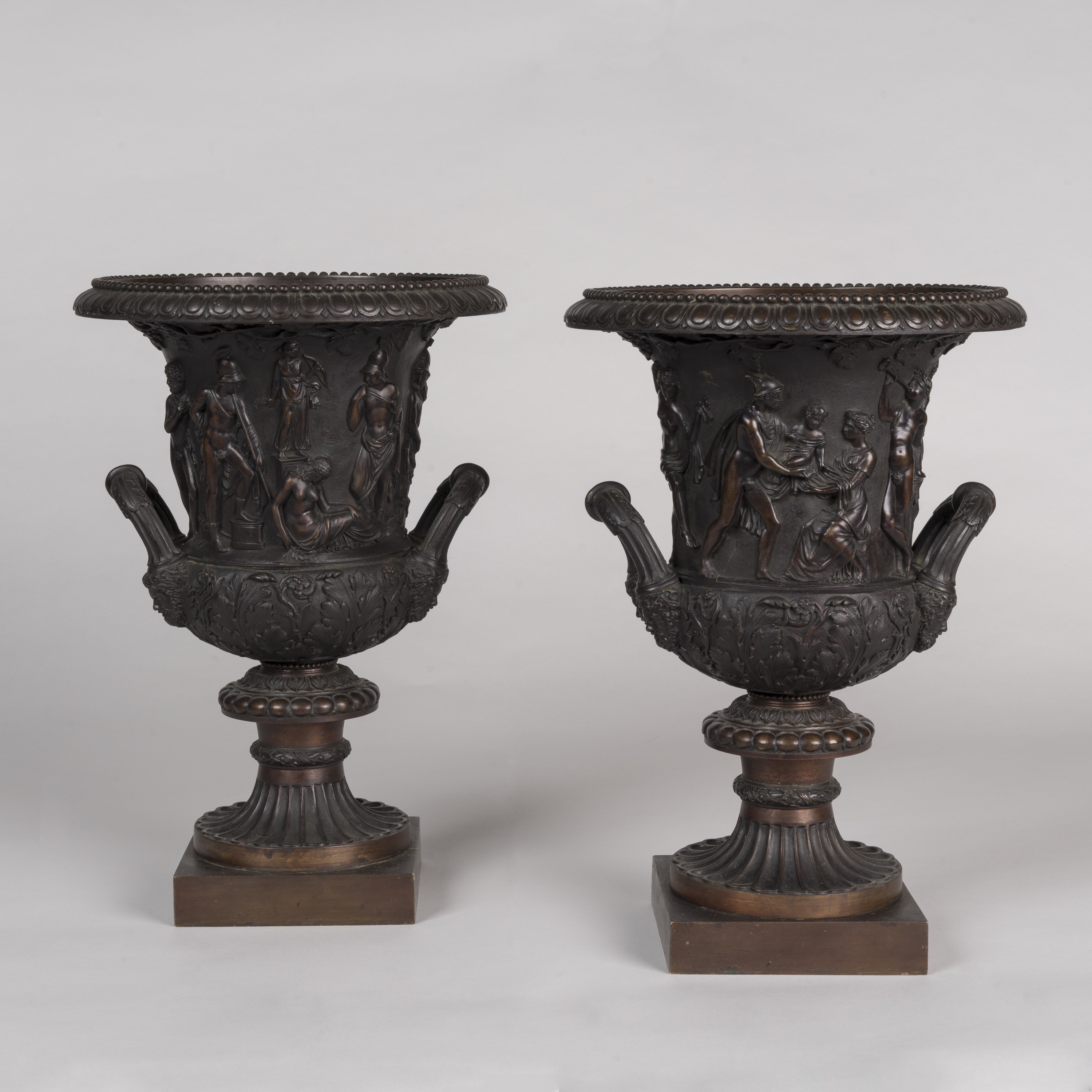
Reductions of the famous Medici & Borghese vases were made in Italy, as well as in France (such as the illustrated pair) throughout the 19th century. Butchoff Antiques.
Piranesi, Adam and the Revolution in British Taste
The Grand Tour's most far-reaching legacy was not an object but an idea: that the decorative arts of ancient Rome could be revived, in modern materials and for modern uses, with a fidelity that earlier generations had never attempted. The man who made this idea irresistible was Giovanni Battista Piranesi, the Roman engraver and archaeologist whose dramatic views of ancient ruins were published and distributed widely throughout Europe. Piranesi revitalised images of ancient Rome by adding details of his own invention, and subsequent publications such as Robert Wood's Ruins of Palmyra and Ruins of Balbec further fuelled the thirst for antiquity across the Continent.
In the 1750s, Piranesi's vision of romantic archaeology inspired a brief vogue for ruin rooms furnished with stools in the form of broken columns and sofas resembling antique sarcophagi. More lastingly, Piranesi became a close friend of the young Scottish architect Robert Adam during Adam's four years of architectural study in Rome. Soon after his return in 1758, Adam was making a sensation in the fashionable world with interiors created in a novel decorative style. Where the Palladian architects of the first half of the century had favoured solemn and ponderous classical forms, the decorations of Robert Adam were in the manner of the delicate stucco reliefs in the baths, tombs, and villas of ancient Rome. He was also extremely fond of the brightly painted motifs known as grotesques, with which Raphael and his pupils had decorated the loggias of the Vatican and the walls of the Villa Madama.
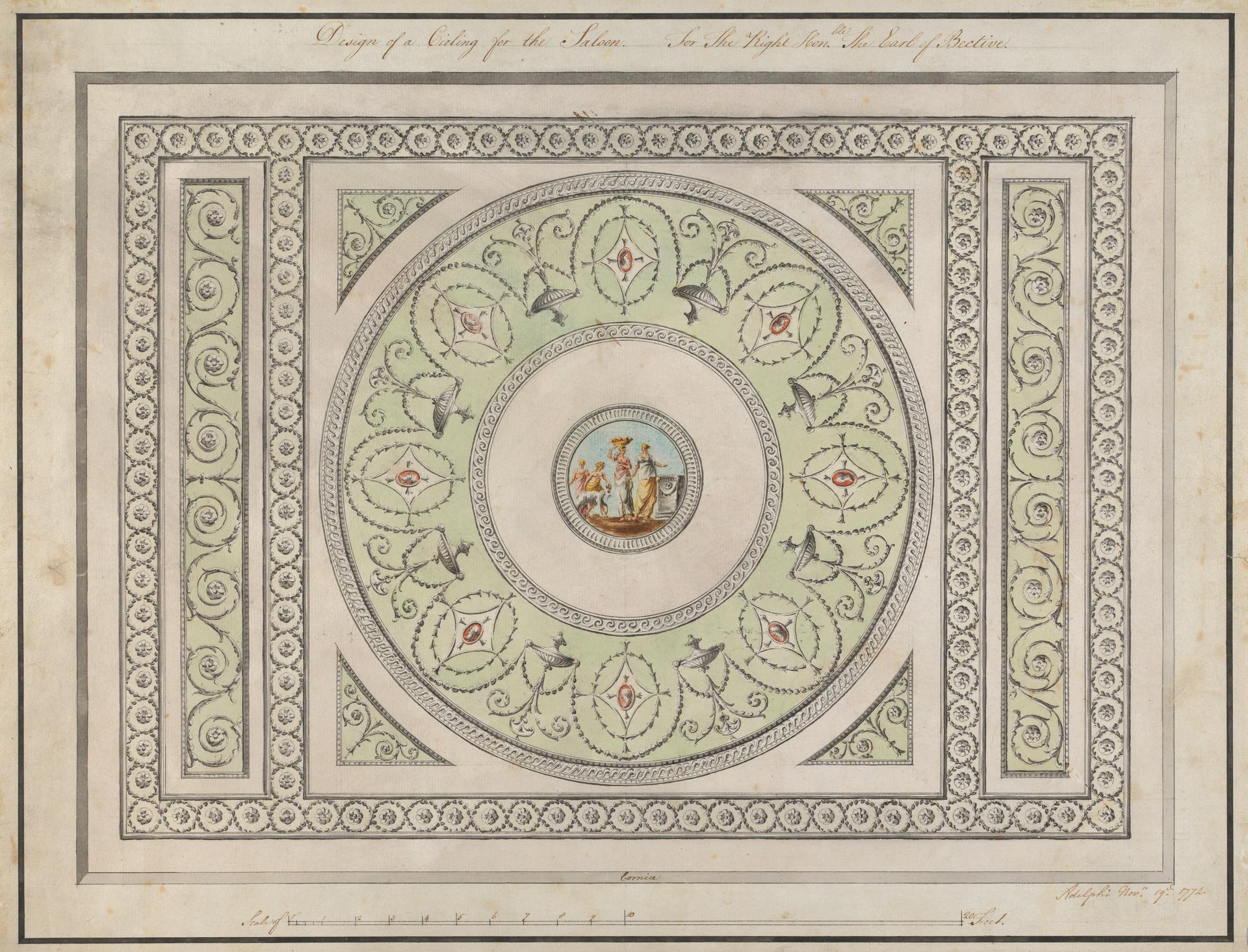
Robert Adam, design for a ceiling for Headfort House, Ireland (1772). Yale Center for British Art.
The year 1762 was crucial. It was then that Adam turned his attention to furniture design, and his influence was to hasten a revolution in fashionable taste. That revolution spread rapidly from the great houses through every class of the furniture trade, carried by the principal craftsmen who had worked for Adam and his clients: Samuel Norman, William France, John Linnell, Ince and Mayhew, and Thomas Chippendale among them. An earlier generation had blazed the trail. William Kent spent approximately ten years in Italy from 1709, and in the furniture he later designed for English houses one may often see the reflection of the great carved and gilt tables and the magnificently hung beds he had seen in Italian palaces.
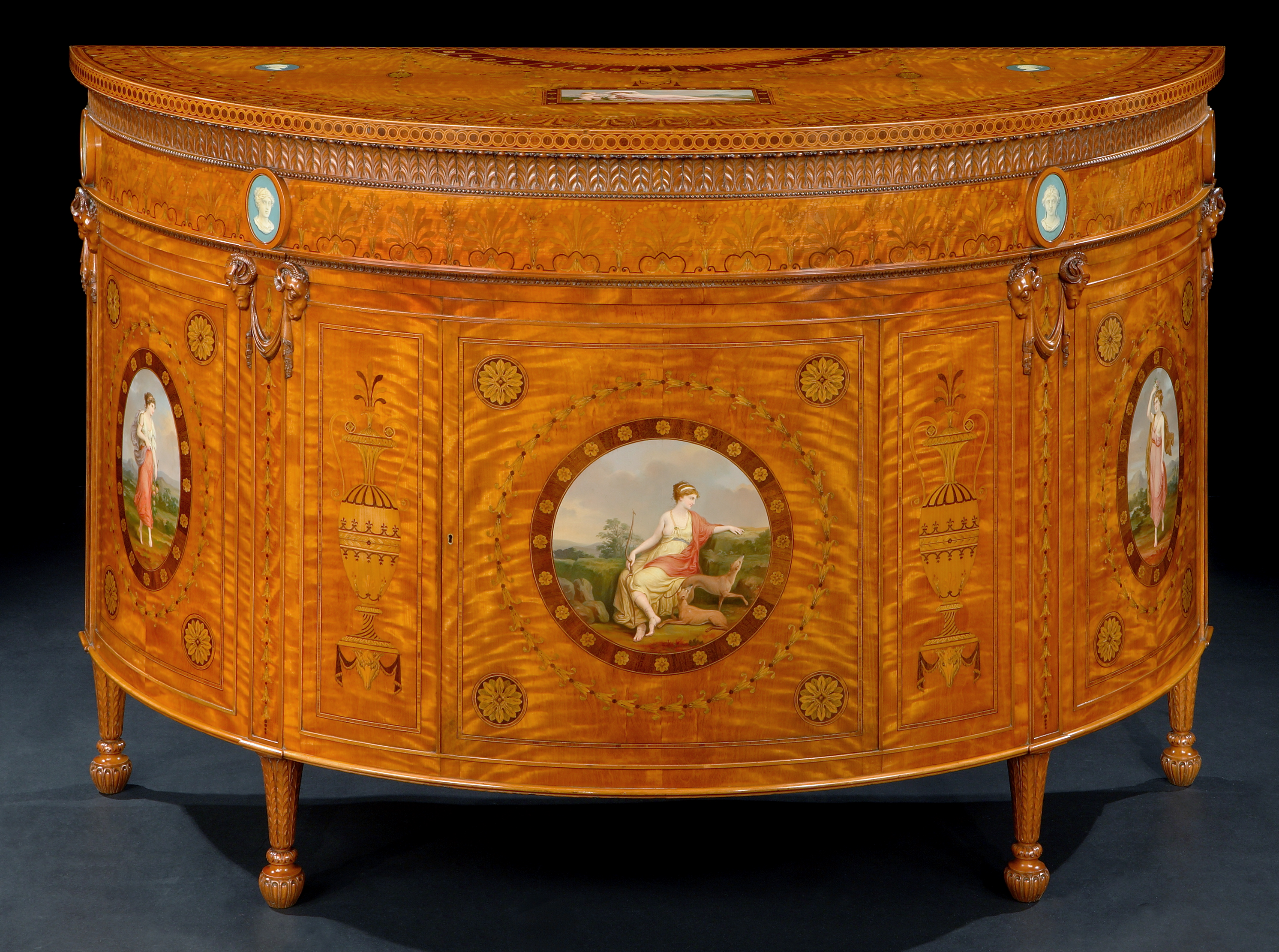
This commode was made in the 19th century, after the original design of Robert Adam for the Countess of Derby in 1774. Previously with Butchoff Antiques.
The Grand Tour Table
The furniture form most intimately associated with the Grand Tour is the centre table with an Italian marble or hardstone top. These exquisitely inlaid marble tops were expensive souvenirs, often bought directly by the traveller from the maker or retailer in Florence or Rome and shipped back to England, where a suitable base was made to receive them. The tops contained a colourful variation of specimen stones, including lapis lazuli, malachite, porphyry, breccia marble, agates, and verde antico, and they remain among the most sought-after of all Grand Tour acquisitions.
The English trade in fitting imported tops to locally made bases became a thriving industry. From the 1820s, Gillows were making expensive rosewood supports for Italian specimen marble tops brought back by wealthy travellers. George Morant of New Bond Street produced designs for bases with winged griffin supports on lion paw feet, specifically intended for pietre dure tops. Taprell, Holland and Son supplied a parcel-gilt burr walnut base for an unusually large imported marble top attributed to Alfonso Cavamelli of Rome, measuring over four feet in diameter (sold by Butchoff Antiques). The extravagance of some commissions was remarkable: the carved rosewood tripod base made by Robert Strahan of Dublin was designed specifically for a pietre dure marble top by Joseph Darmanin of Malta, bearing the arms of General Robert King, 1st Viscount Lorton of Boyle.
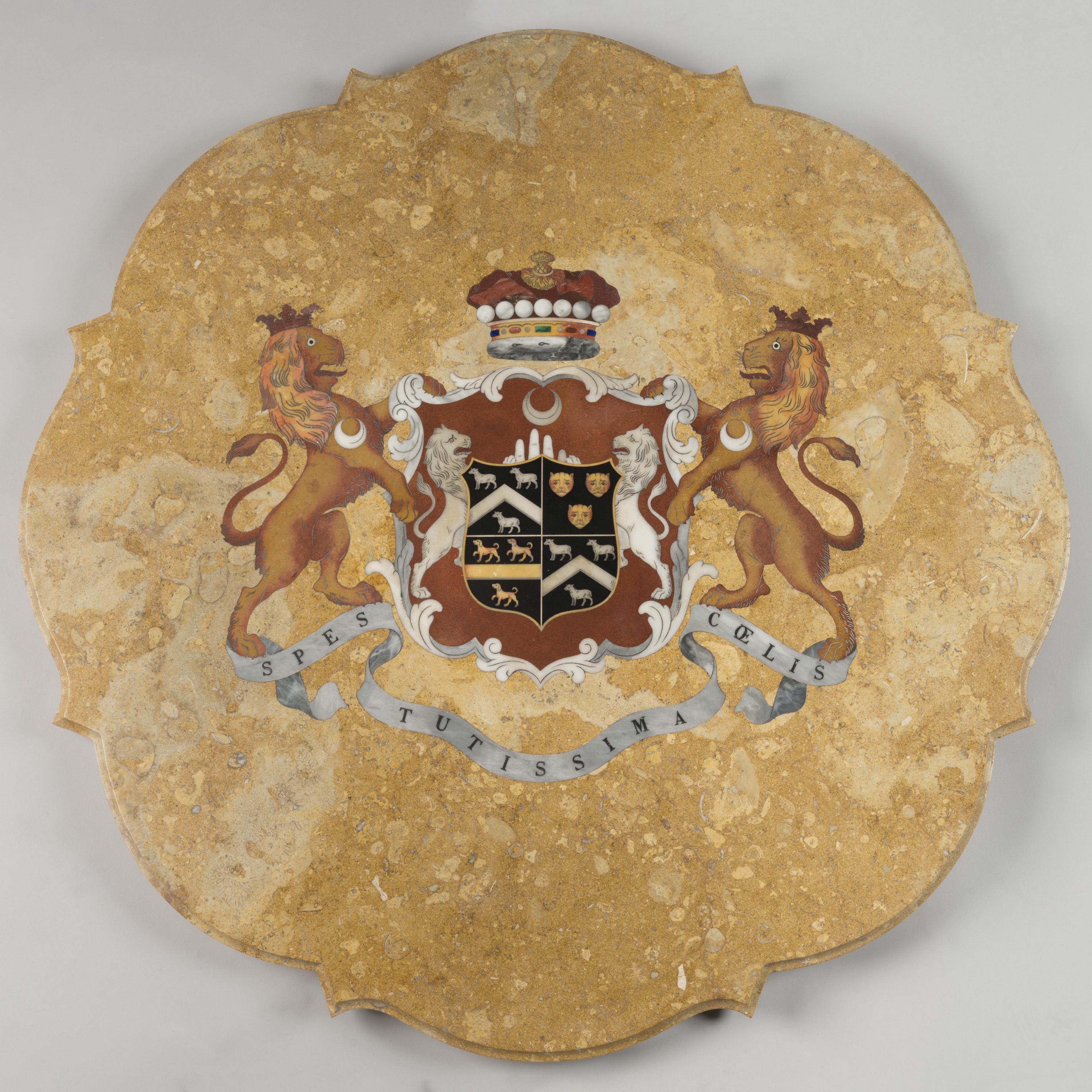
This tabletop, made by Darmanin of Malta for an Irish nobleman, circa 1830, sits on its own custom-made mahogany base made to Strahan, Dublin's top furniture maker at the time. Butchoff Antiques.
The trade could involve spectacular historical pieces. The 3rd Earl of Warwick purchased a pietre dure tabletop bearing the arms and attributes of the patrician Grimani family, a pinnacle in the history of hardstone decoration, and ordered a new frame in the Elizabethan Revival style to support it at Warwick Castle in 1829, the Grimani family having retained the original giltwood base. The transmission from ancient original to English furniture could also be remarkably direct: the architect Henry Holland sent Charles Heathcote Tatham to Rome in the 1790s to collect classical fragments and execute drawings to be used as design sources, and the furniture made for Holland's projects was the work of Marsh and Tatham, whose co-founder Thomas Tatham was C.H. Tatham's brother.
Stone, Bronze, and Mosaic
The Grand Tour ended as a social institution in the early nineteenth century, overtaken by the railways and the democratisation of European travel. But the objects it produced have never lost their appeal, and for reasons that go beyond historical curiosity. A pietre dure table top, with its geometric arrangement of lapis lazuli, malachite, porphyry, and agate, reads as both deeply historical and strikingly modern in its palette. These pieces sit comfortably in contemporary schemes precisely because their appeal is rooted in material beauty and craftsmanship rather than in a single period aesthetic.
For interior designers, Grand Tour objects offer a particular versatility. A micromosaic panel or specimen marble top introduces colour, texture, and a sense of permanence that few other categories of antique can match. Where a piece of period furniture anchors a room in a specific era, a Grand Tour table or bronze transcends period boundaries, serving as a bridge between old and new. The robust materials, stone, bronze, and mosaic, are inherently forgiving of daily use, and the scale of many Grand Tour tables makes them practical as well as decorative.
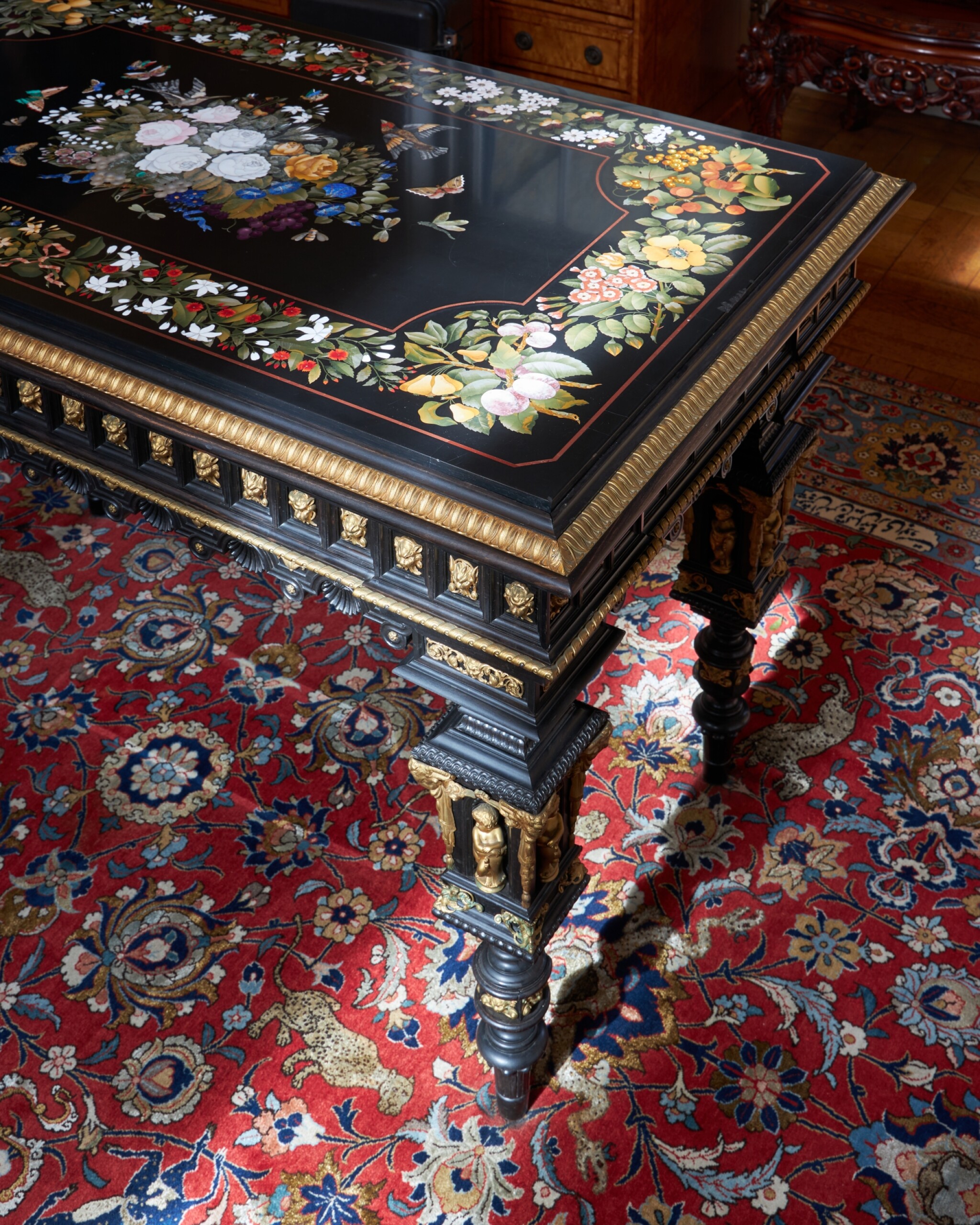
A florentine hardstone table, seen in the home of Freddie Mercury, stands beautifully in the room surrounded by satinwood furniture and antique carpets. Image courtesy of Sotheby's.
The craftsmanship involved in the finest Grand Tour pieces cannot be replicated today at comparable quality or cost. Micromosaic panels from the Vatican Workshop, scagliola tops by the Hugford school, and pietre dure table tops from the Opificio represent techniques perfected over generations and now largely extinct. For discerning collectors, this combination of irreplaceable craftsmanship, material richness, and cross-period versatility makes Grand Tour objects one of the most rewarding areas of the antiques market.
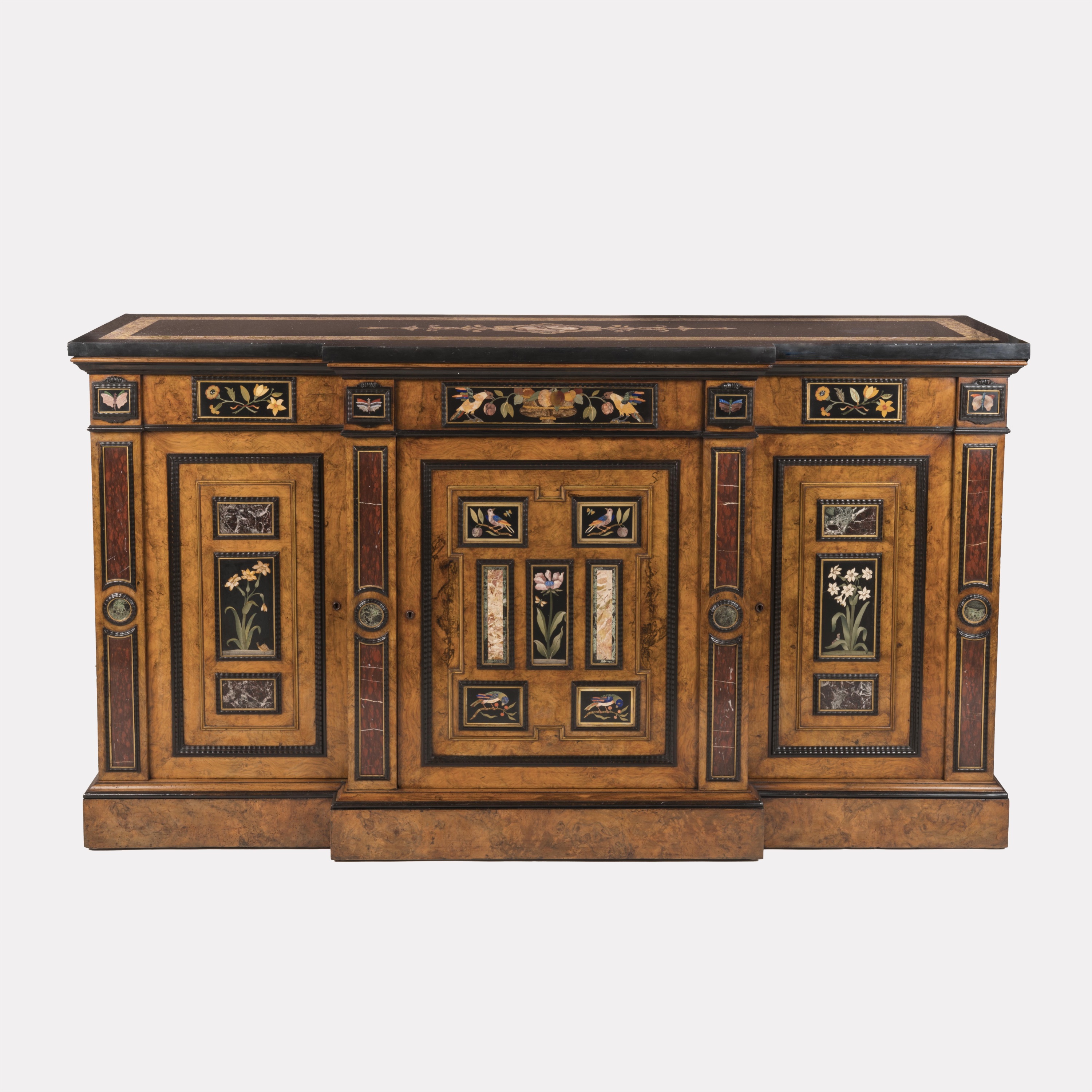
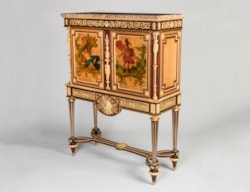
An 1840s cabinet, custom-made to incorporate a collection of 18th century Florentine pietre dura panels. Undoubtedly the centrepiece of a collector's home. Butchoff Antiques.
Written by Rainier Schraepen