Vip access

 Favourites


















June 2026
Furniture ABC’s: F is for Fauteuil

Furniture ABC’s: F is for Fauteuil
From Versailles to the modern drawing room, the fauteuil shaped three centuries of European seating. Discover the history of France's most celebrated armchair.
Few pieces of furniture have proved as versatile, or as eloquent, as the French fauteuil. The open-armed upholstered chair that first took its distinctive form in the salons of seventeenth-century Paris has remained a staple of the European interior for more than three hundred years, surviving every revolution in taste from Baroque grandeur to Neoclassical restraint and emerging, in each successive period, with its essential character intact. More than any other piece of furniture, the fauteuil represents the convergence of the woodcarver’s art, the gilder’s skill, and the upholsterer’s craft in the service of civilised living.
The word itself carries the weight of that history. Fauteuil derives from the Old French faldestoel, a folding seat of Germanic origin, but by the reign of Louis XIV it had come to denote something far more permanent and imposing: a formal armchair with an upholstered seat and back, open arms, and a carved wooden frame, designed to take its place in the most important rooms of the most important houses in Europe. To understand the fauteuil is to understand something fundamental about the way the French conceived of furniture, not as mere equipment for daily life but as an art form in its own right, governed by the same principles of proportion, harmony, and refinement that ruled their architecture and their painting.
A Chair by Any Other Name
The fauteuil occupies a precise place in the taxonomy of French seating. It is distinguished from the chaise, a side chair without arms, and from the bergere, an armchair whose sides are closed with upholstered panels and which is furnished with a thick loose cushion. The fauteuil’s arms are open, allowing the sitter’s clothing to fall freely, a practical consideration in an age of wide skirts and elaborately embroidered coats. Two principal variants developed over the course of the eighteenth century. The fauteuil a la reine has a flat, square back and was designed to stand against a wall, its rear left unfinished. The fauteuil en cabriolet has a curved back shaped to the human body, and because it was intended to be placed freely in a room, it was finished on all sides, a distinction that tells us something important about the way the French used their furniture and arranged their interiors.
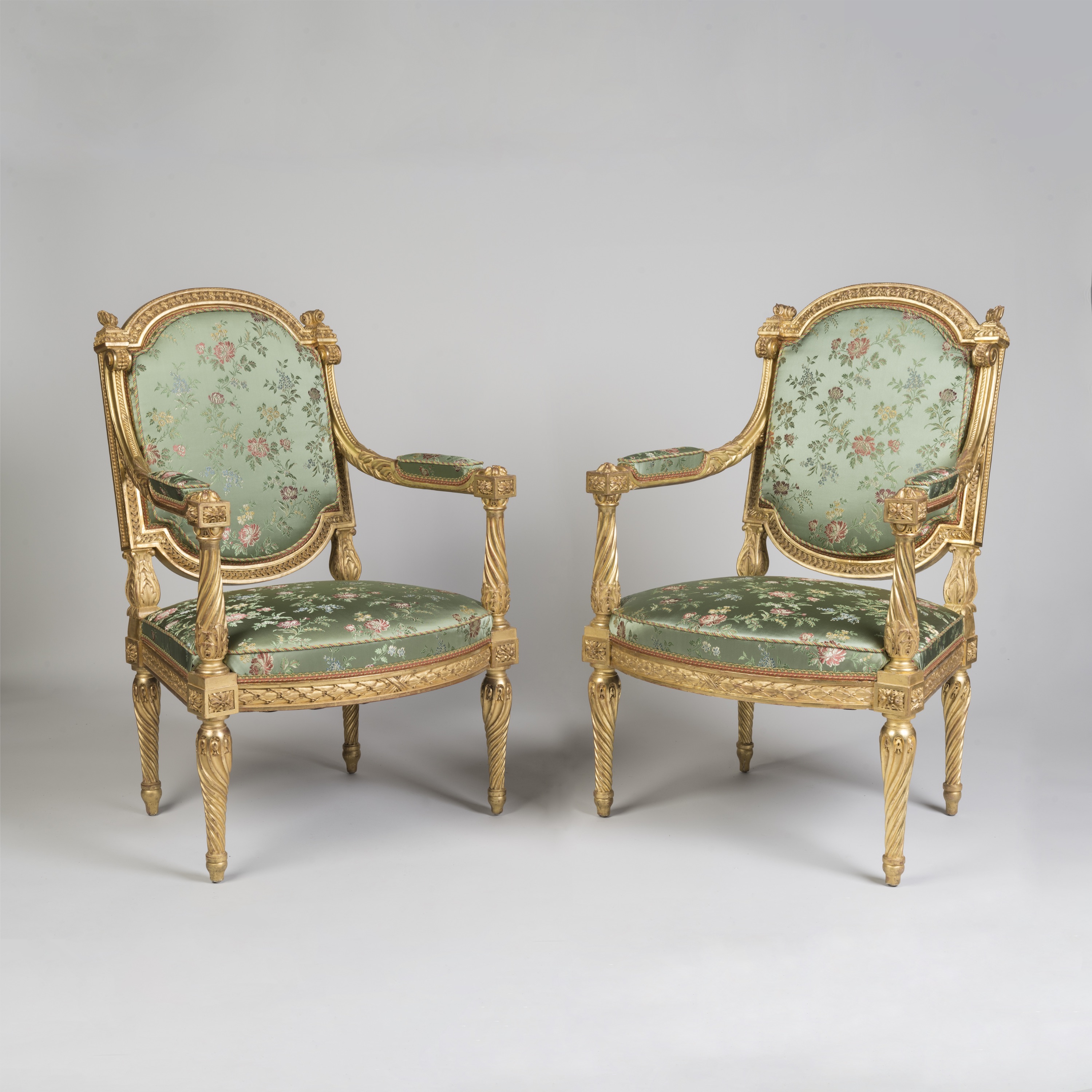
A pair of Fauteuils à la Reine, late 19th century, originally designed by Jean-Baptiste-Claude Sené in the 18th century. With their square backs, this type of fauteuil was intended to be placed against the wall. Butchoff Antiques, London.
The family of forms that grew up around the fauteuil was remarkably inventive. The fauteuil de bureau had a curved front rail to accommodate the sitter at a writing desk, sometimes with a supplementary leg for support. The fauteuil de toilette was a lower chair designed for use at the dressing table. The duchesse brisee was a day-bed in two or three parts that could be separated into an armchair and footrest. The veilleuse was a deep chair with an undulating back, made in pairs for either side of the fireplace. The marquise was a wide seat for two, the canape a settee with a high unbroken back, and the sultane a settee with two rolled-over ends whose name betrayed the period’s fascination with the exotic East. Each of these forms answered a specific social need, and together they furnished the rooms of eighteenth-century France with a variety and sophistication that no other country could match.
The Theatre of Etiquette
The fauteuil acquired its political significance under Louis XIV, when the rituals of court life at Versailles transformed every object in the state apartments into an instrument of royal authority. The right to sit in a fauteuil in the King’s presence was among the most jealously guarded privileges of the French court. Duchesses were permitted a tabouret, a low upholstered stool. Lesser nobles stood. Foreign ambassadors were received in rooms where the arrangement of seating declared, with merciless precision, the relative standing of every person present. Grand state furniture was part of the theatre of etiquette; the furniture and decoration helped to distinguish the state apartments from the private rooms and to regulate the elaborate hierarchy on which the entire system of Versailles depended.
The fauteuils of the Louis XIV period reflected this formality in their construction. The framework was of plain wood, the seat and back upholstered in leather or rich textile and fixed with brass-headed nails. Arms terminated decoratively in the heads of lions, rams, or female busts, carved with the same monumental vocabulary that Le Brun had established for the decoration of the palace itself. Backs were initially low and rectangular, but state chairs required greater height, and by the end of the century the taller back had become general. The stretchers that connected the legs were often elaborately carved and gilded, and the whole effect was one of architectural solidity, a chair conceived less for comfort than for ceremony. It was only with the death of the Sun King in 1715 and the removal of the court to Paris under the Regence that the fauteuil began its transformation from an object of state into an object of pleasure.
The Rococo Flowering
The reign of Louis XV released the fauteuil from the constraints of ceremony. The sinuous armchair en cabriolet, with its curved back shaped to the body and its flowing cabriole legs, perfectly reflected the new desire for informal living that swept through the salons of Paris after 1720. The straight line disappeared almost entirely. Legs curved outward in a continuous sweep from seat rail to floor, their knees carved with shells, foliage, and scrollwork. Backs were rounded and padded, arms set back from the front of the seat to accommodate the widening skirts of the period, and every surface was enlivened with naturalistic carving of flowers, acanthus, and rocaille ornament that gave the style its name.
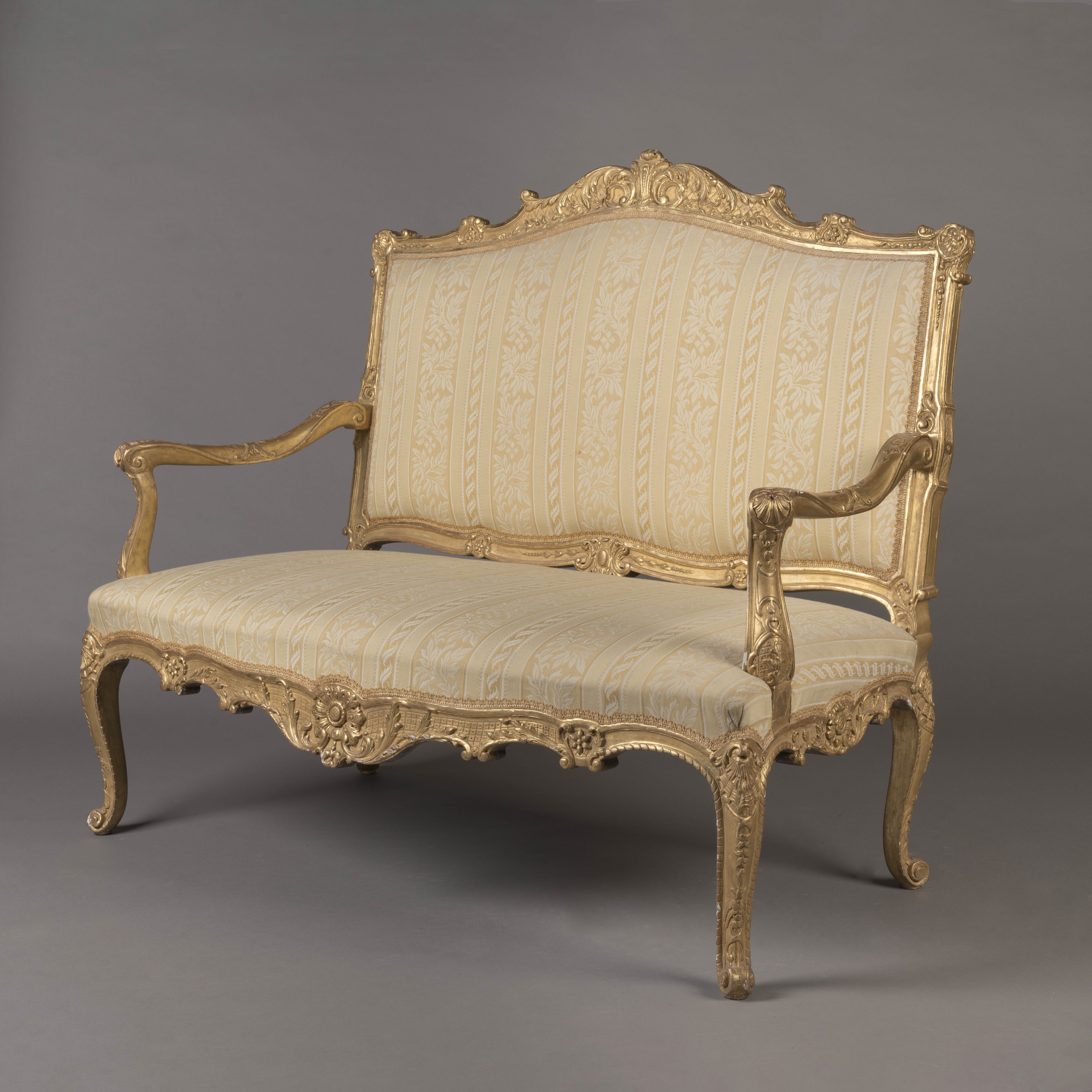
Echoing the curves of fauteuils, the canapé of the Louis XV period is carved with a plethora rococo motifs, with a single unbroken back and flowing arms which are positioned away from the front to allowing room for women's skirts. Butchoff Antiques, London.
The proliferation of specialised seating forms during this period was without precedent. The bergere, with its deep cushion and enclosed upholstered sides, became the preferred chair for reading and conversation. Veilleuses, deep armchairs with gently undulating backs, were made in pairs and placed on either side of the fireplace. The marquise offered a wide seat for two, while the canape provided a settee with a high, unbroken back and flowing arms that echoed the curves of the fauteuil beside it. Frames were painted in colours of extraordinary delicacy: pale blue, sea-green, lilac, jonquil, or white enriched with gold. Where greater richness was desired, two-colour schemes were employed, blue and white, green and white, pink and green, pink and white, or yellow and silver, creating an effect of lightness and gaiety that was the very opposite of the sombre grandeur of Versailles. It was an age in which the chair ceased to be a piece of architecture and became, for the first time, a piece of sculpture.
The Menuisiers
The making of fauteuils in France was governed by a system of guild regulation that drew a sharp distinction between two branches of the woodworking trade. The menuisier worked in solid wood, carving and assembling the frames of chairs, beds, and panelling. The ebeniste worked in veneered furniture, constructing the commodes, bureaux, and cabinets for which French cabinetmaking is equally celebrated. The two trades were strictly separated, and a master in one was forbidden from practising the other. From 1743, the Jurande des menuisiers ebenistes insisted that every piece of furniture bear the maker’s stamp, and inspectors visited workshops four times a year to enforce standards, confiscating any work judged substandard.
The great menuisiers were often French-born and worked in family dynasties that passed skills and workshop practices from father to son across generations. The Tilliard family, active from 1685, created deep, wide bergeres with frames of beech carved with rococo cartouches, foliage, and scrolls, their splayed arm-posts flowing into the curve of the seat rail with an ease that made the joint invisible. Jean-Baptiste Lebas, who became a master in 1756, served as menuisier to Madame du Barry and the Comte d’Artois, producing duchesses brisees with carved scrolled mouldings and flowers of exceptional refinement. Pierre Nogaret, working in Lyon rather than Paris, achieved a quality close to the capital’s finest craftsmen but with more relaxed contours and a florid ornament that gave his chairs a distinctly provincial warmth. The most inventive of all was Georges Jacob, whose career spanned the transition from Louis XV through Louis XVI to the Directoire and Empire, adapting his style to each successive change of taste with a fluency that no contemporary could rival. Jean-Baptiste Sene, who became a master in 1769, perfected the spirally fluted and tapering leg that would become the hallmark of the Neoclassical fauteuil, lending the form a lightness and architectural clarity that marked the definitive break with the Rococo.
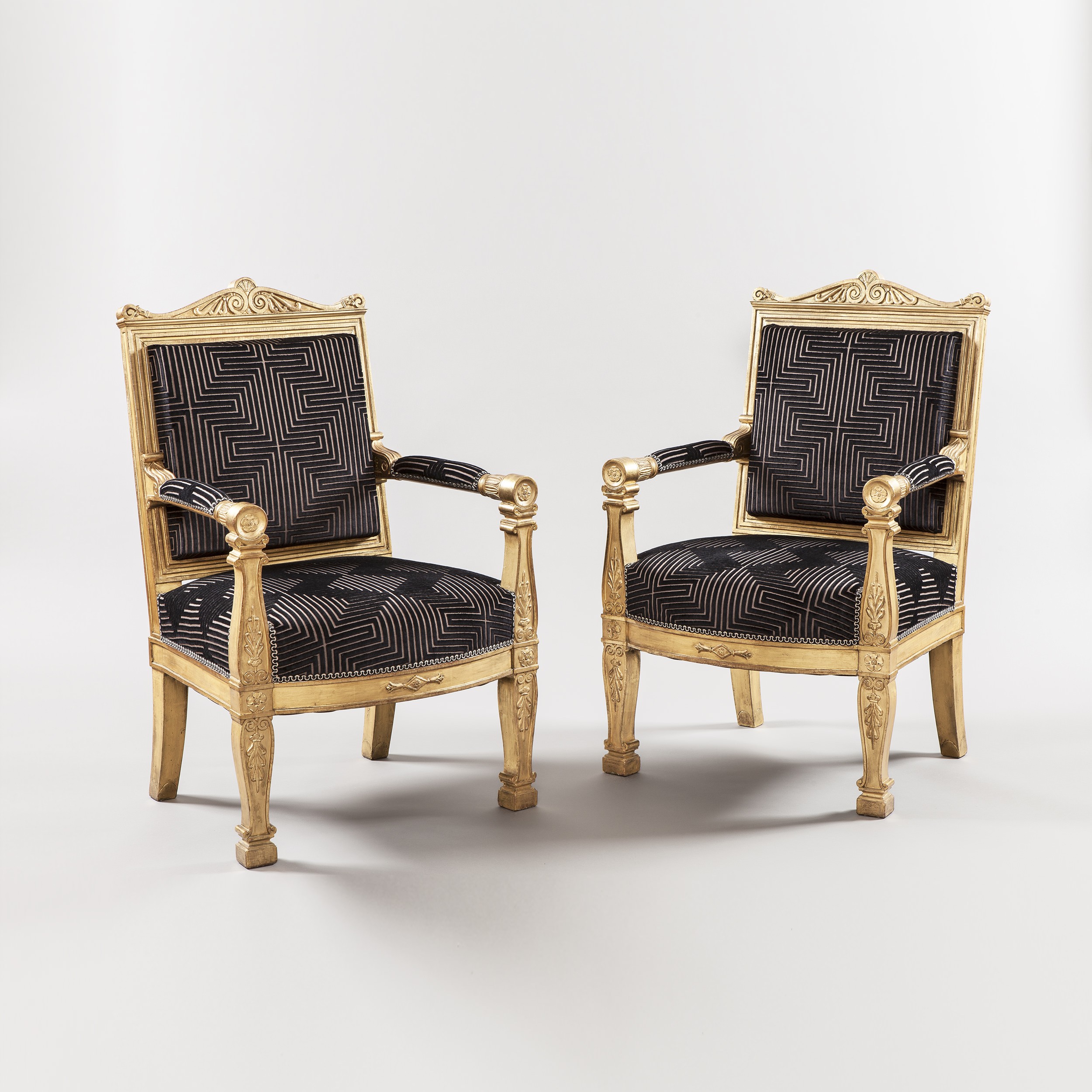
An example of Jacob's genius, made during the French Empire period, circa 1810, of fantastic architectural proportion and carved with Greco-Roman scrolls. Butchoff Antiques, London.
Classical Order
The discovery of the buried cities of Herculaneum and Pompeii in the middle of the eighteenth century sent a wave of classical enthusiasm through the decorative arts of Europe, and the fauteuil was among the first forms to register the change. The sinuous curves of the Rococo gave way to straight lines, the cabriole leg to a tapering column, and the naturalistic carving of shells and flowers to the disciplined ornament of fluting, reeding, ribbon-tied laurel, and the Greek key. The transformation was not abrupt. Through the 1760s, a transitional style combined elements of both vocabularies, retaining the curved back of the Louis XV fauteuil while straightening the legs and introducing classical motifs. By 1770, the new style was fully established, and the fauteuil entered one of its most refined and harmonious periods.
The frames of Louis XVI fauteuils were lighter than their predecessors, their proportions more architectural, their ornament more restrained. Legs were round or square in section, tapering toward the foot and decorated with vertical fluting or spiral reeding that emphasised their columnar character. Backs were oval, round, or rectangular, framed by a delicate moulding of beading or ribbon. The junction of leg and seat rail was often marked by a small carved rosette or paterae, a detail borrowed directly from classical architecture. Mahogany, which became generally fashionable in the 1780s, began to appear alongside the traditional painted and gilded beech, lending the fauteuil a darker, more masculine character that anticipated the severity of the Directoire. Gilt-bronze mounts, though more commonly associated with case furniture, were occasionally applied to the finest chairs, adding points of brilliance to the carved frame. The cost of such refinement was considerable: gilt-bronze mounts could account for as much as two-thirds of the total price of a piece, a reminder that even the most apparently simple Neoclassical chair might represent a substantial investment in materials and craftsmanship. In the nineteenth century, Henry Dasson, whose skills as a bronzier were unmatched in his generation, produced Louis XVI-style fauteuils of extraordinary quality, their mounts cast and chased with a precision that rivalled the originals.
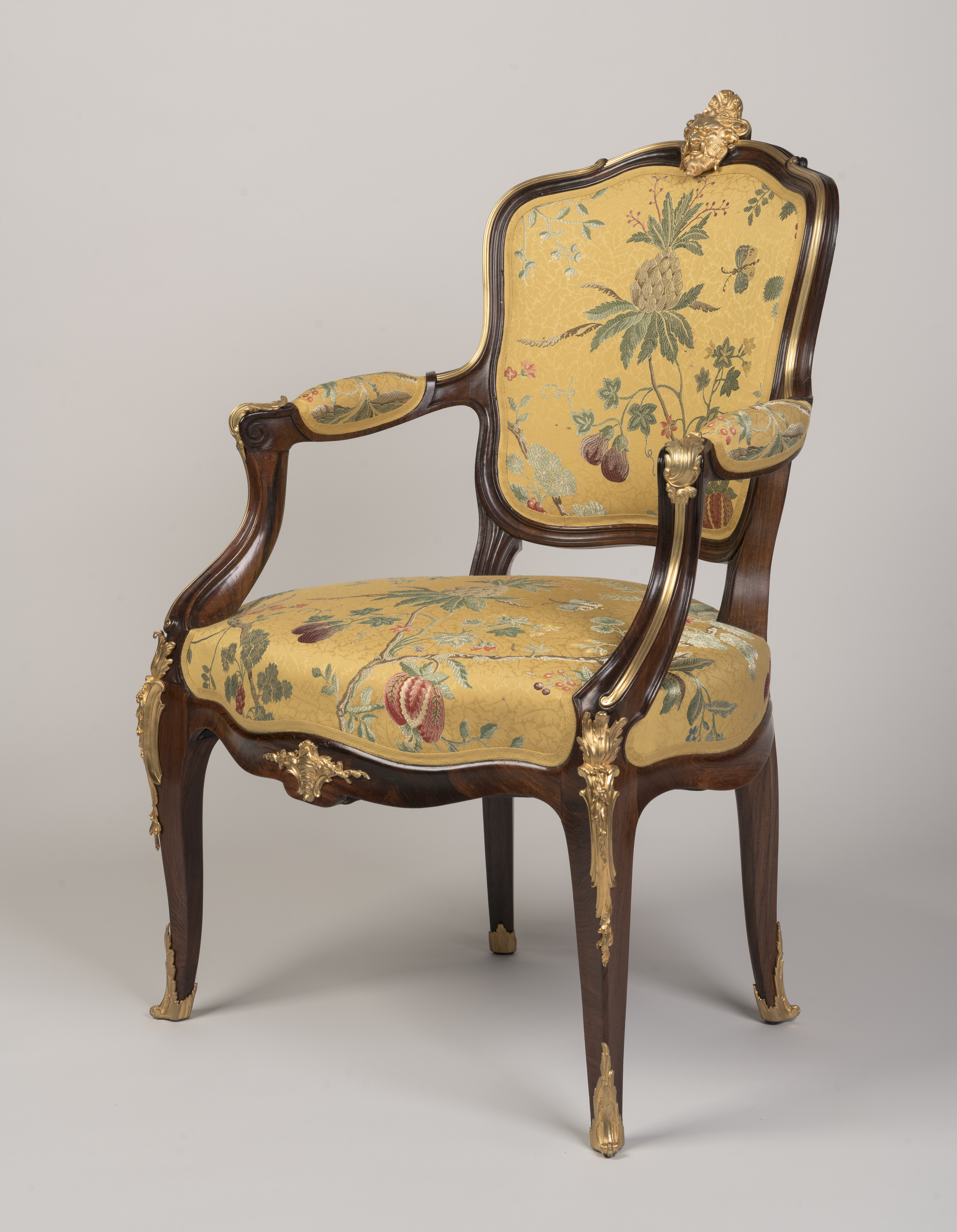
Ormolu mounts, such as those on this fauteuil de bureau by François Linke, added considerable cost to a fauteuil, sometimes accounting for as much as two-thirds of the total price. Butchoff Antiques, London.
Silk, Tapestry, and Gilt
The beauty of a fauteuil depended as much on its covering as on its frame, and the choice of upholstery was governed by considerations of status, fashion, and the room in which the chair was to stand. Silk was the primary fabric for the finest fauteuils, its lustre and drape sharing in the harmony of the carved and gilded frame. Tapestry, woven at the Gobelins or at Beauvais to designs that complemented the decorative scheme of the room, was used less frequently but to magnificent effect, transforming the seat and back of a chair into miniature pictures of pastoral scenes, mythological subjects, or sprays of flowers. Velvet and damask served rooms of particular richness, while brocade, with its raised patterns of silk and gold thread, gave the fauteuil a surface that caught and reflected candlelight. For chairs in everyday use, Morocco leather and cane offered a more practical alternative, their coverings fixed to the frame with decorative brass-headed nails whose regular spacing became a design element in its own right.
The frame itself underwent its own transformation at the hands of the gilder and the painter. Beech was the wood of choice for most menuisiers, its close grain lending itself to the sharp, precise carving that the finest fauteuils demanded. The carved frame might be left in natural wood, but more often it was gilded with gold leaf or painted in one of the subtle colour schemes that gave French interiors their distinctive character. Gilding required the application of many layers of gesso, each carefully sanded, before the gold leaf was laid and burnished to a warm reflective finish. Painted frames demanded equal skill: the colours had to be mixed to complement the upholstery, the walls, and the other furniture in the room, achieving that unity of effect that the French called ensemble and that remained the governing principle of their interior decoration from Louis XIV to the Revolution. The relationship between chair-maker, gilder, upholsterer, and decorator was one of close collaboration, each trade contributing its particular expertise to an object whose final appearance was the product of many hands working to a single design.
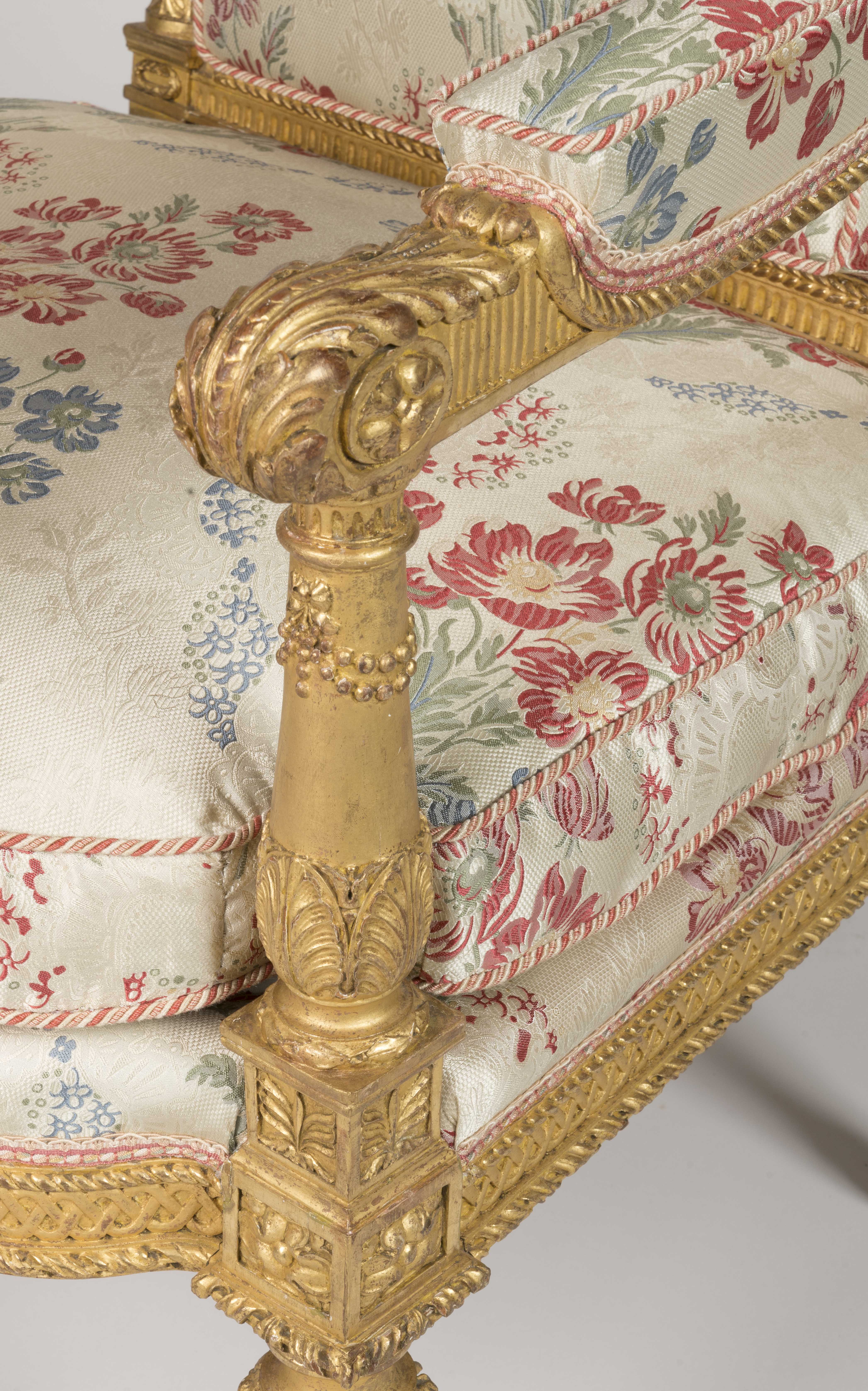
Beautifully carved, carefully gilded, and upholstered with fine silk, an armchair such as this one designed by Sené involved the close collaboration of several craftsmen, each a master of their own speciality. Butchoff Antiques, London.
From Paris to London
The influence of the French fauteuil extended far beyond the borders of France. In England, the open-armed chair in the French taste became a staple of fashionable interiors from the Restoration onwards, and by the middle of the eighteenth century the leading London makers were producing chairs that drew freely on Parisian models while adapting them to English preferences for comfort and informality. Thomas Chippendale illustrated numerous “French chairs” in his Director of 1754, acknowledging the debt openly, and the carved and gilded armchairs that furnished the great houses of the Georgian period owed their proportions and their decorative vocabulary to the fauteuils of Louis XV. In the Regency period, firms such as Marsh and Tatham, operating from Mount Street in London and supplying the Prince of Wales at Carlton House and the Brighton Pavilion, produced giltwood chairs in the Greek Revival style that combined French techniques of carving and upholstery with the archaeological severity of the new classicism. Later in the century, Edwards and Roberts made a speciality of reproducing Louis XV furniture for the English market, their fauteuils and bergeres demonstrating a command of French forms that few London workshops could equal. By 1814, Marsh and Tatham employed twenty-two interior designers, decorators, painters, carpenters, and upholsterers, a scale of operation that reflected the complexity of producing finished seating furniture to the highest standard.
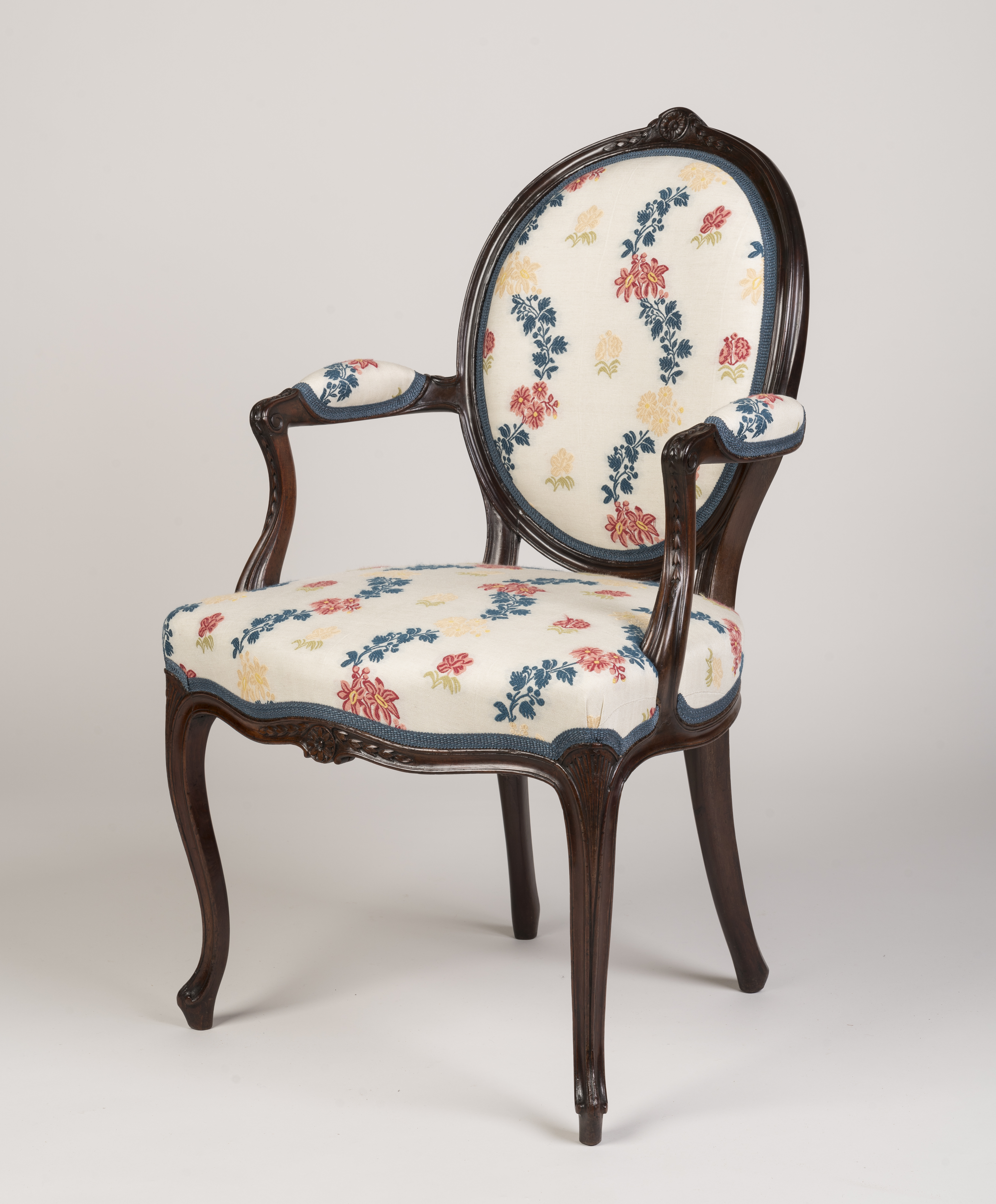
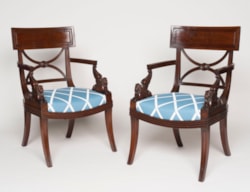
Made in England around 1775, this mahogany George III armchair (one of a pair) is related to those made by Thomas Chippendale, who freely borrowed from French fauteuils en cabriolet, with its open arms, curved backrest, and cabriole legs. Butchoff Antiques, London.
The fauteuil’s journey through the centuries has been one of remarkable continuity. The forms established under Louis XV and Louis XVI have been reproduced, reinterpreted, and adapted by every subsequent generation of furniture makers, from the great Parisian houses of the nineteenth century to the workshops that supply designers and collectors today. The bergère still stands beside the fireplace. The canapé still anchors the drawing room. The fauteuil en cabriolet, with its curved back and open arms, still takes its place at the writing desk or the dressing table, as perfectly suited to its purpose as it was when the menuisiers of the Faubourg Saint-Antoine first set chisel to beech two hundred and fifty years ago. What the French understood, and what gives their seating furniture its lasting authority, is that a chair is not simply something to sit on. It is a frame for the human figure, and when that frame is carved, gilded, and upholstered with the skill and taste that the fauteuil represents, it becomes one of the most civilised objects that the decorative arts have produced.
Written by Rainier Schraepen