Vip access

 Favourites


















September 2026
Louis XVI: The Return to Classical Order

Louis XVI furniture from 1774 to 1792: Riesener's marquetry, Marie Antoinette's Trianon style and the nineteenth-century revival of the Neoclassical reign.
On 10 May 1774, Louis XV died at Versailles and his nineteen-year-old grandson succeeded him as Louis XVI. The new king inherited a court whose taste was already shifting away from the Rococo of his grandfather’s reign, and the cabinetmaker who would supply Marie Antoinette’s most important commissions had already been at work in Paris for two decades. Jean-Henri Riesener had arrived in the city from his native Westphalia in 1754 and entered the workshop of Jean-François Oeben at the Manufacture des Gobelins. Within twenty years he would be ébéniste du roi to the new king, the principal cabinetmaker to the queen, and the maker of furniture so technically refined that pieces from his workshop are still considered the highest achievement of French eighteenth-century cabinetmaking. The career of Riesener, more than that of any other figure, defines the Louis XVI style: its origins in late Rococo training, its rapid embrace of the new classical taste after 1770, its peak in the queen’s commissions of the 1780s, and its sudden eclipse with the fall of the monarchy in 1792.
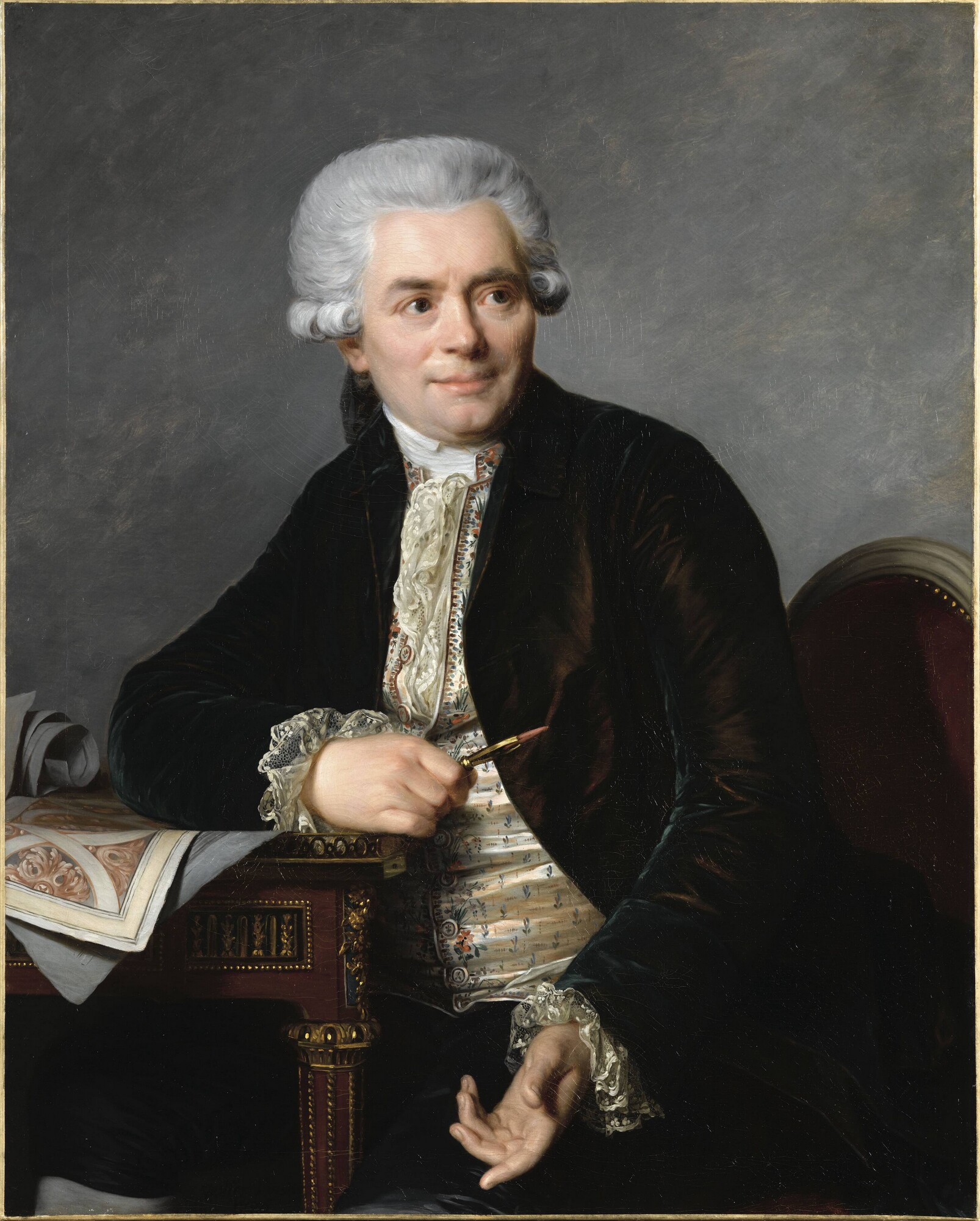
Portrait of Jean-Henri Riesener by Antoine Vestier, 1786. © RMN-GP (Château de Versailles) / © Gérard Blot
Louis XVI furniture takes its name from the king who reigned from 1774 to 1792, but the style itself was already established by the time he came to the throne. The shift from Rococo to Neoclassicism had been underway for roughly a decade, prompted by the archaeological discoveries at Pompeii and Herculaneum and by a wider French intellectual mood that had grown impatient with the asymmetry, whimsy and curve of the previous reign. Curves straightened, ornament was disciplined, and the visual vocabulary of antiquity, columns, friezes, urns and acanthus, replaced the rocaille shellwork of Madame de Pompadour’s generation. By 1780 the new style had become the standard vocabulary of Parisian luxury.
Pompeii and the Antique Imagination
The shift in French taste was set in motion not by a designer but by an archaeologist. Excavations at Herculaneum began in 1738 under the patronage of Charles VII of Naples, followed a decade later by the systematic clearing of Pompeii from 1748 onwards. The objects coming up from the ash were domestic in scale. Three-legged braziers, painted wall fragments and small bronze lamps suggested a Roman world far more finely detailed than the grand monuments familiar from above ground, and engraved records of the finds began circulating among the educated classes from the 1750s. The Comte de Caylus’s seven-volume "Recueil d’antiquités", published between 1752 and 1767, gave Parisian designers a working library of classical motifs, and Johann Joachim Winckelmann’s writings on Greek art, translated into French during the 1760s, supplied the intellectual case that ancient art represented a moral and aesthetic standard for the present.
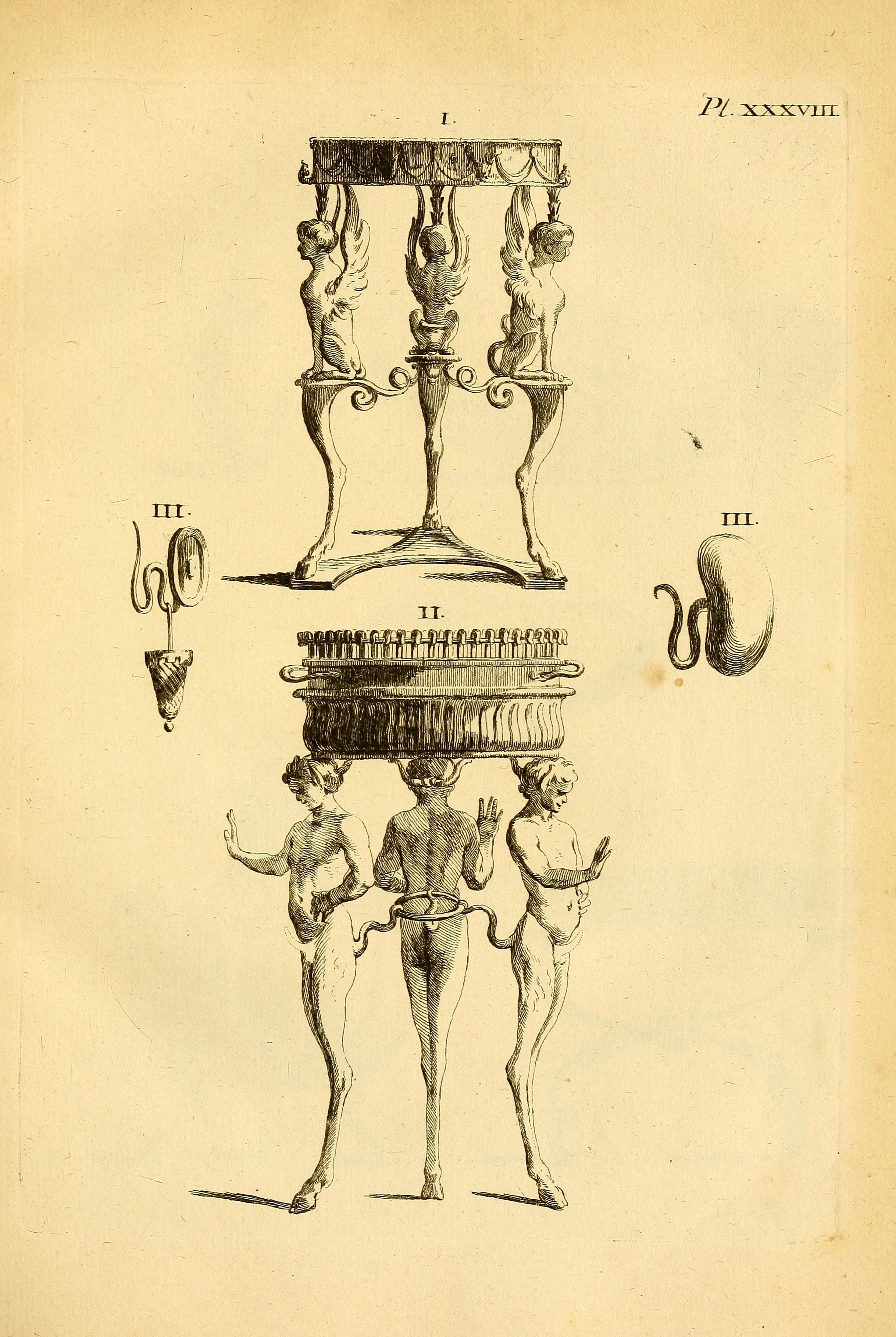
A plate from the Comte de Caylus' famous Recueil d'Antiquités which would inspire contemporary French furniture makers to produce similar tripod stands.
The intellectual case was made before the visual one. By the mid-1760s a recognisable "Goût grec" had emerged in the salons of Madame Geoffrin and her circle, applied to silver, ceramics and the decoration of small chambers more readily than to furniture itself. Curiously, the early Neoclassical taste was almost as often called "Etruscan" as "Greek", a confusion that arose because the painted walls of Pompeii and Herculaneum had been mistaken by some antiquaries for Etruscan work. Pompeian red, the terracotta-coloured ground used for painted walls, and the tripod-legged athénienne, a pedestal stand inspired by Roman incense burners, both entered the French decorative vocabulary in this period and remained in use throughout the reign of Louis XVI.
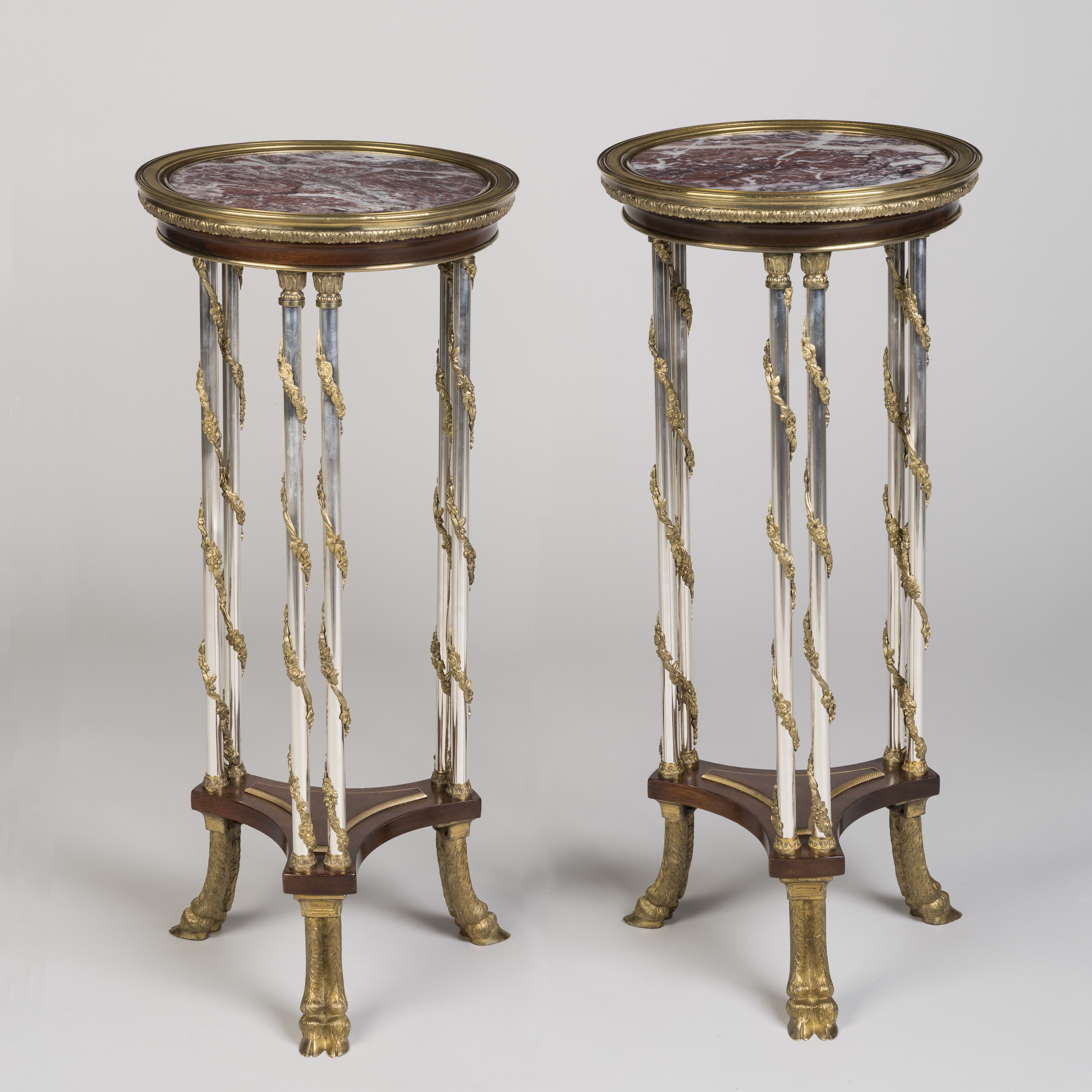
Inspired by Classical Antiquity, these ormolu and silvered guéridon tables in the Louis XVI style have straight columnar legs and hoof feet. Previously with Butchoff Antiques, London.
Translated into furniture, the new vocabulary was specifically architectural. The leg of a chair or commode became a column, fluted on its outer face and tapered to a foot rather than splaying as the cabriole had done. The lower edge of a commode acquired a frieze, the upper a cornice. Carved decoration was disciplined into Greek-key borders, anthemion friezes, ovolo and bead mouldings, and stylised acanthus leaves wrapping the bases of table legs and the corners of chests. Caryatids and term figures, female busts whose lower bodies tapered into a square pedestal, supplied a more theatrical option for the angles of side tables and console pieces. By the mid-1770s the principle was visible across every Parisian workshop of consequence.
The New Anatomy of French Furniture
The chair was the form in which the new style declared itself most plainly. The Louis XVI chair has an oval or circular back called a dossier en médaillon, framed with a simple moulding, the so-called perles (a string of small carved pearls) or a twisted-ribbon pattern. The arm meets the back at a right angle and is supported by a vertical post that aligns precisely with the front leg, giving the side elevation the look of a small architectural order. Where the leg meets the seat rail, a small square block called a dé de raccordement is left visible and decorated with a single carved rosette. The leg tapers to a small foot and is fluted on its outer face, sometimes wrapped at the base with a stylised acanthus leaf. Stretchers between the legs were generally abandoned, since the geometric joints of the new construction were strong enough without them.
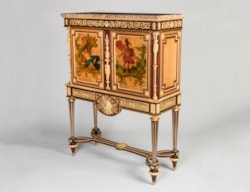
The case furniture acquired a comparable severity. The Louis XV commode, with its bombé front and concave sides, was replaced by a rectangular block whose centre panel was often brought slightly forward in a feature called a risalto, breaking the flat front into three vertical sections and giving the cabinetmaker a frame for three distinct marquetry compositions. Doors took the place of drawers in the commode à vantaux, while the secrétaire à abattant, a tall upright cabinet with a drop-front writing surface, presented an even larger plane for marquetry display. Smaller forms multiplied with the social demands of private apartments: the bouillotte table, a circular pedestal with a marble top and a brass gallery, made for the card game of the same name; and the console, semi-circular or rectangular, set against the wall beneath a pier glass with its laurel swags and acanthus carved on a single delicate frieze.
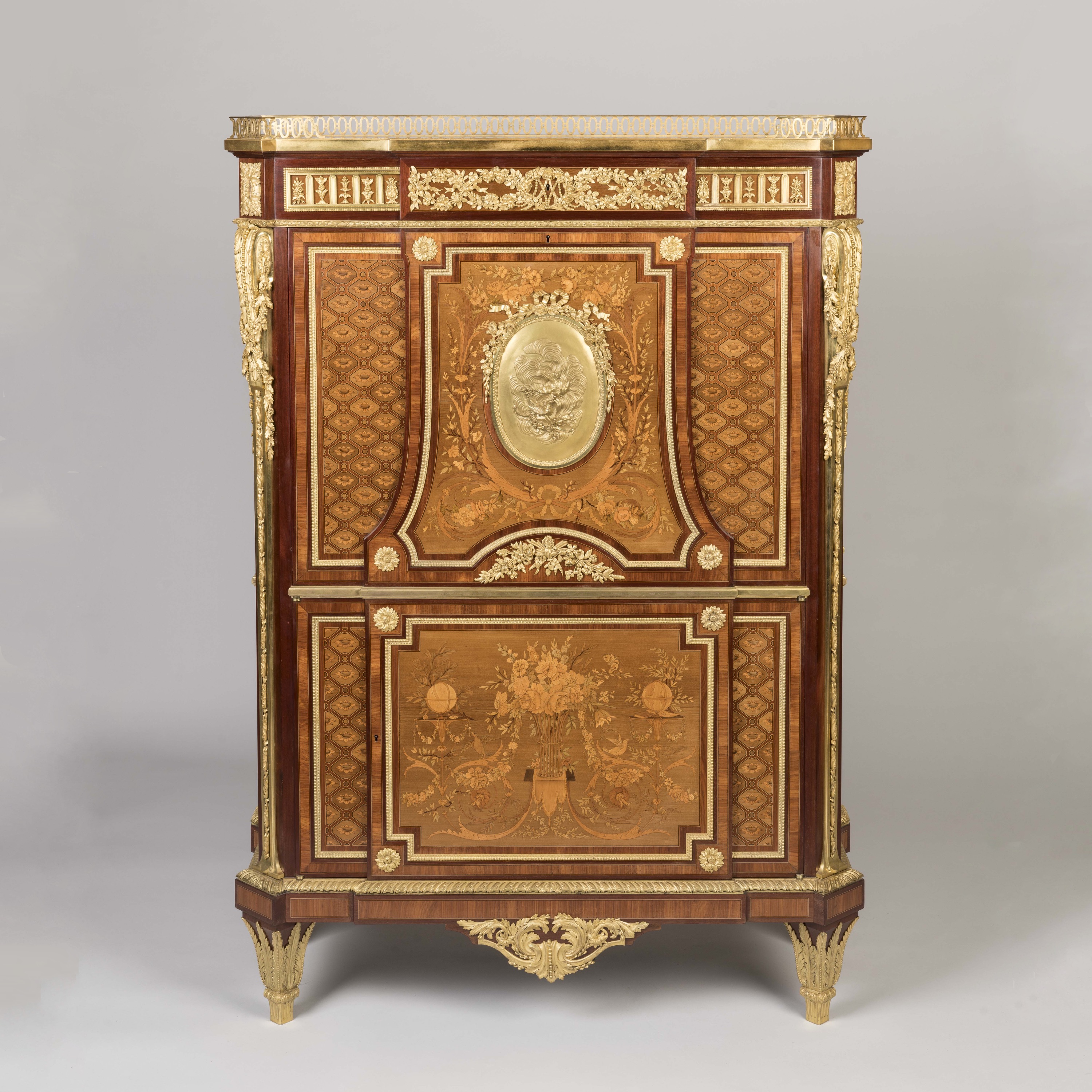
The ultimate Louis XVI style cabinet, inspired by original designs by Riesener for Marie Antoinette. This 19th century secrétaire à abattant by Paul Sormani has all the classic hallmarks of the Louis XVI period, including the breakfront risalto (or à ressaut) configuration which allow multiple large panels of marquetry to dominate alongside refined ormolu of stylised acanthus leaves. Butchoff Antiques, London.
The materials of the period favoured restraint over display. Mahogany, imported through the trans-Atlantic colonial trade, became the dominant timber for the finest pieces, prized for its straight grain and its capacity to take a fine carved profile without splitting. Less prestigious furniture was painted in soft pastels, the so-called Trianon gray and white, sometimes accented with gilding on the most prominent carvings. White Carrara marble was set into commode and table tops, providing the cool architectural surface the new geometry demanded. Gilt-bronze mounts were used with a precision the Rococo had not required, often confined to the corners and edges of a piece rather than spread across its surface. The cabinetmaker Martin Carlin began collaborating with the royal porcelain manufactory at Sèvres to set hand-painted porcelain plaques, depicting flowers, birds and pastoral scenes, directly into the wood of small writing desks and ladies’ cabinets. Surviving examples of Carlin’s work are now among the most prized objects in the Louvre, the Wallace Collection and the major American museums.
The King’s Ébénistes
The Parisian luxury trade was strictly divided by the Corporation des Menuisiers-Ébénistes. The menuisier, working in solid beech, walnut or mahogany, made chairs and bedsteads to be carved or painted; the ébéniste, working in veneers and marquetry over an oak carcase, made the case pieces, the commodes, secrétaires and bureaux that carried the most prestige. Both were required on admission as maîtres to brand their work with their own stamp, and a second mark, JME, applied by the jurés inspecting the finished piece, indicated that it had passed the guild’s quality control. The obligation had been universal since 1743, and these two marks remain the foundation on which serious attribution to the period still rests. The ébénistes du roi at the Louvre and the Gobelins were exempt from guild jurisdiction, but any stamped piece can usually be placed within a known career.
Jean-Henri Riesener, who had taken over Oeben’s workshop in the 1760s and married Oeben’s widow, was named ébéniste du roi early in the new reign and supplied the bulk of the royal furniture from 1774 until 1784. His marquetry was the finest of the century: panels of tulipwood, satinwood, sycamore and harewood, cut and shaded by acid-staining and hot-sand burning, set within geometric trellis grounds and bordered with bands of contrasting timbers. The bureau du roi, the great rolltop desk begun by Oeben for Louis XV in 1760 and completed by Riesener in 1769, was the supreme example of the late Rococo style, but his work for Marie Antoinette in the 1780s was wholly Neoclassical, with severe rectangular cases finished in solid mahogany and ornamented with finely cast and chased gilt-bronze mounts. Riesener fell from favour after 1784, when his prices were judged too high and the queen turned increasingly to Guillaume Beneman and to Adam Weisweiler.
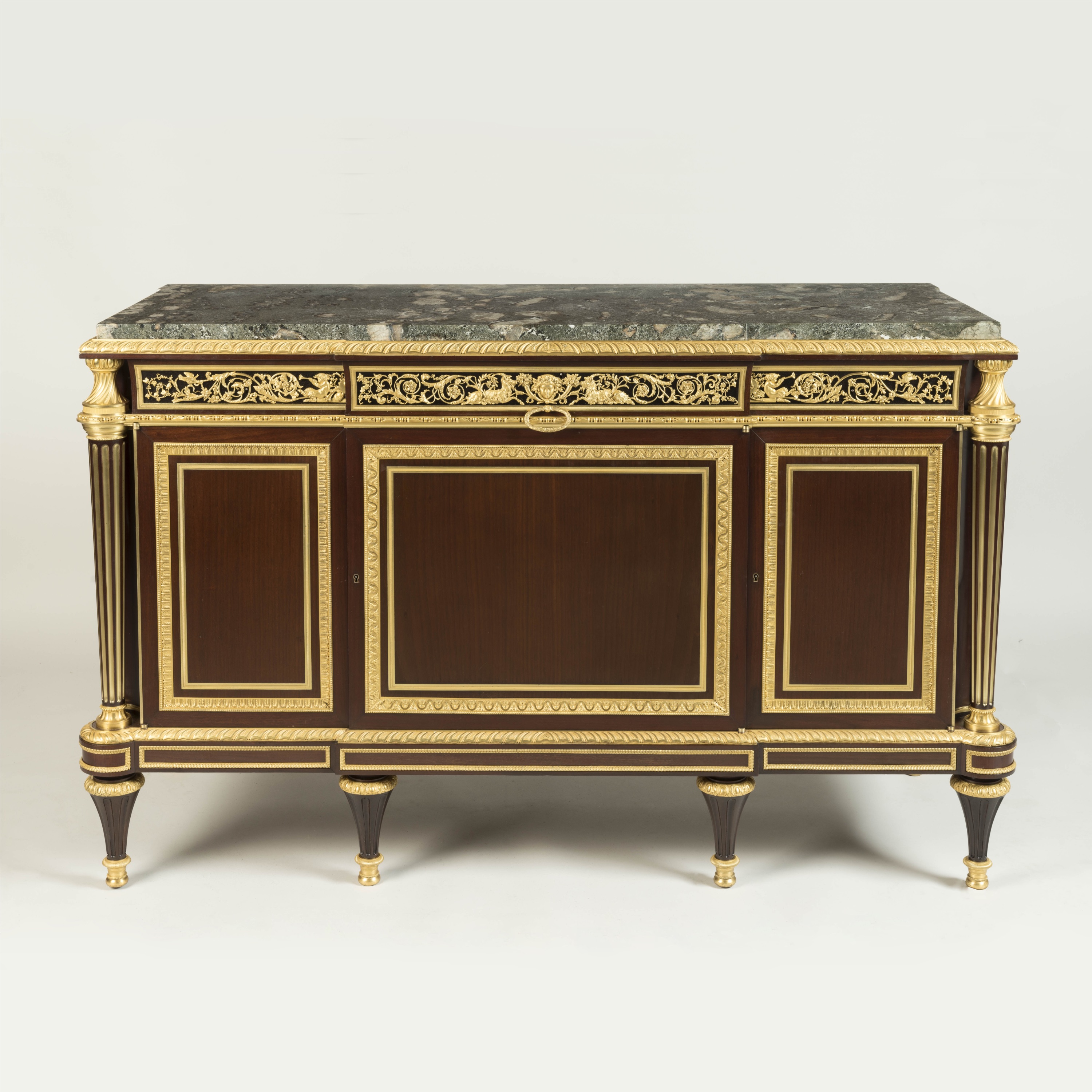
Commodes in the style of Adam Wesiweiler such as this one exemplify the more austere and architectural style that Marie Antoinette favoured in her final years at the Petit Trianon. Previously with Butchoff Antiques, London.
Georges Jacob was the dominant menuisier of the reign and the figure who fixed the Louis XVI chair as we now know it. He was the first significant Parisian craftsman to use mahogany for seating, where its density allowed the fluted column of the leg to be cut without snapping, and his workshop developed the open-work backrest carved with the lyres, sheaves of wheat or interlaced rings that became standard motifs of the queen’s apartments. David Roentgen, working principally from his workshops at Neuwied in the Rhineland and from a Parisian shop on the rue de Grenelle, supplied the king with elaborate mechanical desks whose hidden springs released drawers, raised mirrors and produced writing slopes at the touch of a concealed button. The king’s well-known interest in locks and mechanisms made Roentgen’s furniture a natural court taste. Martin Carlin specialised in the smallest and most precious pieces of the reign, the Sèvres-mounted ladies’ tables and bonheurs-du-jour already mentioned, and Adam Weisweiler, working into the 1790s, supplied the more austere and architectural late style that the queen preferred in her final years at the Petit Trianon.
Marie Antoinette’s Private Court
Louis XVI gave Marie Antoinette the Petit Trianon on his accession in 1774. The small neoclassical pavilion in the gardens of Versailles had been built in the 1760s for Madame de Pompadour, who died before its completion. It became, over the following decade, the queen’s private retreat from the formal court. The state apartments at the main palace were furnished for ceremony; the queen’s rooms at the Trianon were furnished for private use, with smaller and lighter pieces intended for reading, intimate suppers, music and conversation. The furniture made for the Trianon is the most personal product of the reign: pieces small enough for a private hand, finished in solid mahogany or cool gray paint, often with the queen’s monogram set into a roundel of marquetry or chased gilt-bronze.
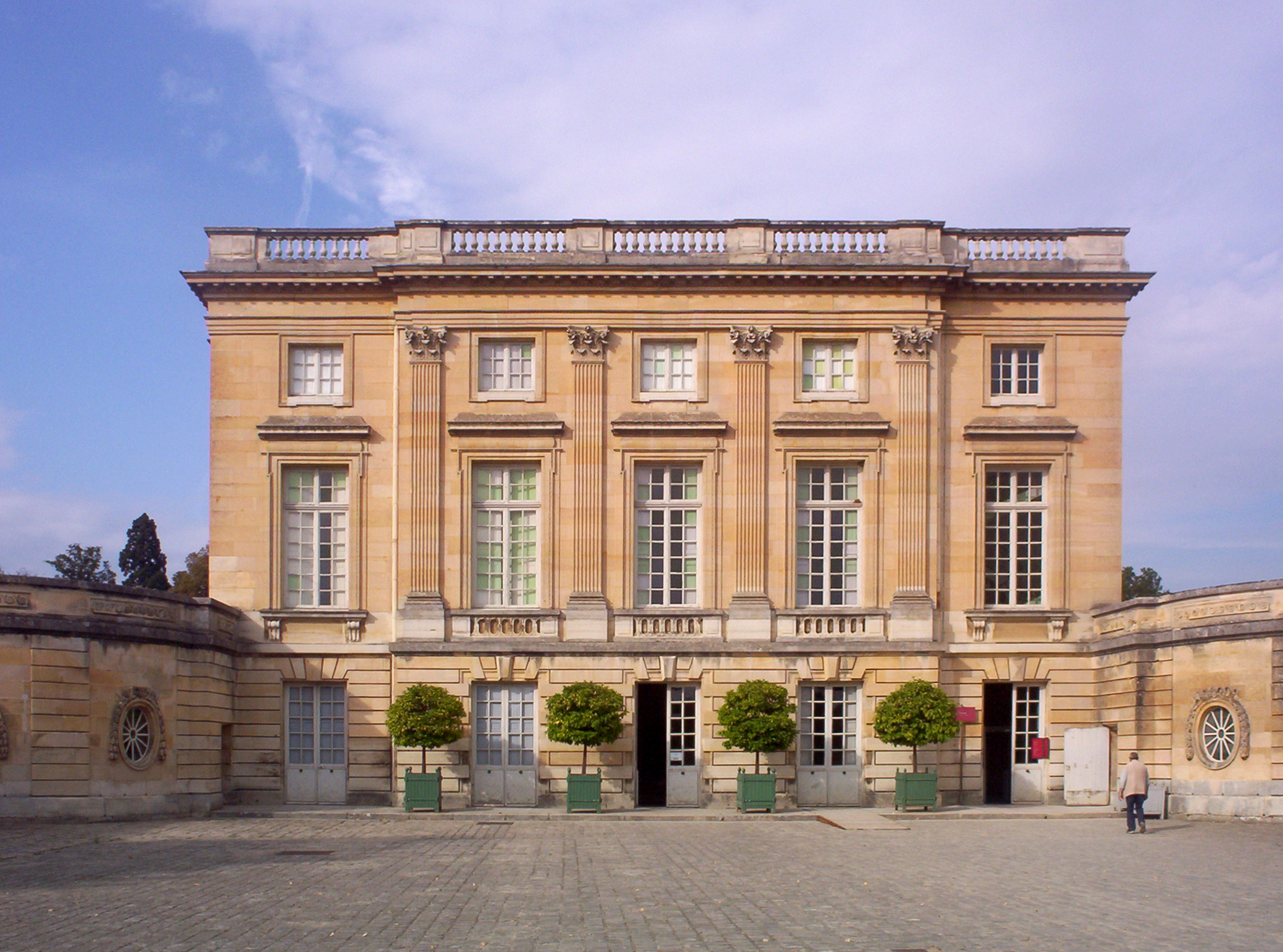
The façade of the Petit Trianon. Although built by Louis XV's architect for Madame de Pompadour, it would subsequently become a symbol of the Neoclassical Louis XVI style when Marie Antoinette furnished it in the final two decades of the 18th century.
The pastoral aesthetic developed further at the Hameau de la Reine, the picturesque hamlet of thatched cottages, dairy and mock farm built on the Trianon grounds between 1783 and 1786. Furniture made for these private spaces drew its motifs from a romanticised version of country life: sheaves of wheat tied with ribbon, garden rakes, watering cans and wicker baskets of flowers. Carved ribbon bows, the so-called Nœud de Ruban, sat at the cresting of mirrors and chair backs, twisted as if the carpenter had caught the moment a real ribbon was tied. Heavy floral festoons of roses, lilies and laurel hung from carved pegs across the friezes of console tables. The quiver of arrows, an emblem of Cupid often paired with a flaming torch, became a frequent motif on the chairs and small writing tables of the queen’s apartments. Many of the queen’s chairs themselves were supplied by Georges Jacob, whose openwork backrests, carved with lyres or oak garlands, set the standard for the private register of the reign.
The taste at the Trianon was lighter than the official Neoclassicism of the early reign, and noticeably influenced by English furniture-making, an enthusiasm the French called Anglomania. The queen and her circle preferred polished mahogany to gilded oak and structural visibility to applied ornament. The colour palette they favoured, a soft range of pale gray, white and dove, came to be called Trianon gray. Gilding, when it appeared, was confined to the most prominent carved details rather than coating an entire surface. By the late 1780s the Trianon style had become the recognised alternative to the heavier court Neoclassicism of the early reign.
From Revolution to Revival
The Louis XVI furniture trade did not survive the Revolution intact. The royal collections at Versailles, the Tuileries and the Petit Trianon were inventoried, dispersed and sold by the new Republic in a series of revolutionary sales beginning in 1793, organised to convert royal property into ready cash for the war effort. The marquetry commodes, gilt-bronze candelabra and Sèvres-mounted writing tables passed in their thousands from royal apartments into private hands across Europe. British and American buyers were prominent among the purchasers, and much of the finest Louis XVI furniture now in the great public collections of London, New York and Washington passed out of France in those years. The pieces that did not sell at price were sometimes burned for the gold in their ormolu, an act of iconoclasm that destroyed an unknown but substantial number of the period’s smaller objects.
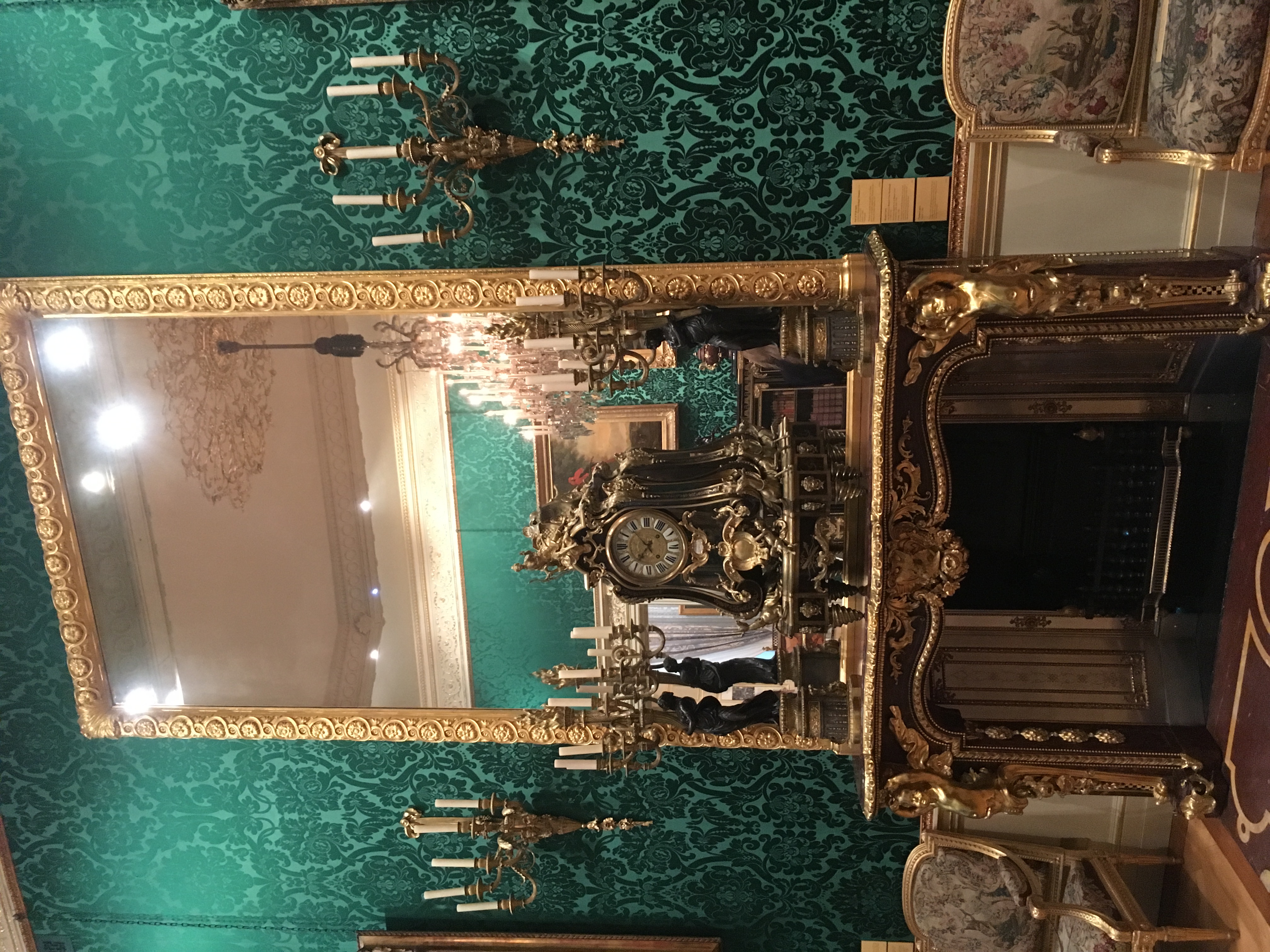
The Wallace Collection in London houses some of the greatest Ancien Régime furniture and decorative arts of the 18th century, much of it with direct ties to the French monarchy and eventually sold following the Revolution. Image is author's own.
The Allarde Law of 17 March 1791 abolished the corporate guilds and ended the requirement to be a maître ébéniste in order to make furniture commercially. Quality control collapsed almost immediately, and by the mid-1790s the Parisian trade was producing furniture of markedly lower technical standard than the work of the previous decade. One workshop survived this transition with its reputation enhanced. Georges Jacob retired in 1796 and passed the business to his sons, who renamed it Jacob Frères and later Jacob-Desmalter; the firm became the principal supplier to Napoleon and the imperial court, and the chairs and tables they produced after 1800 carried forward the discipline of the Louis XVI form into the heavier, more openly classical Empire style.
The strongest commercial revival of Louis XVI taste came not in France but later in the nineteenth century, on both sides of the Channel. From the 1850s onwards a generation of Parisian and London cabinetmakers, led by Henry Dasson, Paul Sormani, the Beurdeley dynasty, François Linke, Maison Krieger and Holland & Sons, produced furniture in the Louis XVI manner of a quality often equalling and occasionally surpassing the eighteenth-century originals. Most pieces in the Louis XVI taste circulating in the British and American markets today belong to this nineteenth-century revival rather than to the original reign, and the distinction matters greatly to value and provenance.
Originals and Revivals
The collector’s distinction between an original Louis XVI piece and a nineteenth-century revival turns on a small number of specific tests. The JME stamp, present on furniture passed by the guild between 1743 and the abolition of the corporations in 1791, is the principal documentary mark. Period construction methods, the use of hand-cut veneers, oak carcases joined by wedge-cut dovetails, mercury-gilded mounts in solid bronze, and shrinkage cracks consistent with two centuries of seasonal movement, are the principal physical ones. Notably, furniture experts including Christopher Payne and Jurgen Huber (senior conservator at the Wallace Collection) have pointed out the superior construction of 19th century revival pieces which achieve a level of perfection rarely seen in the 18th century
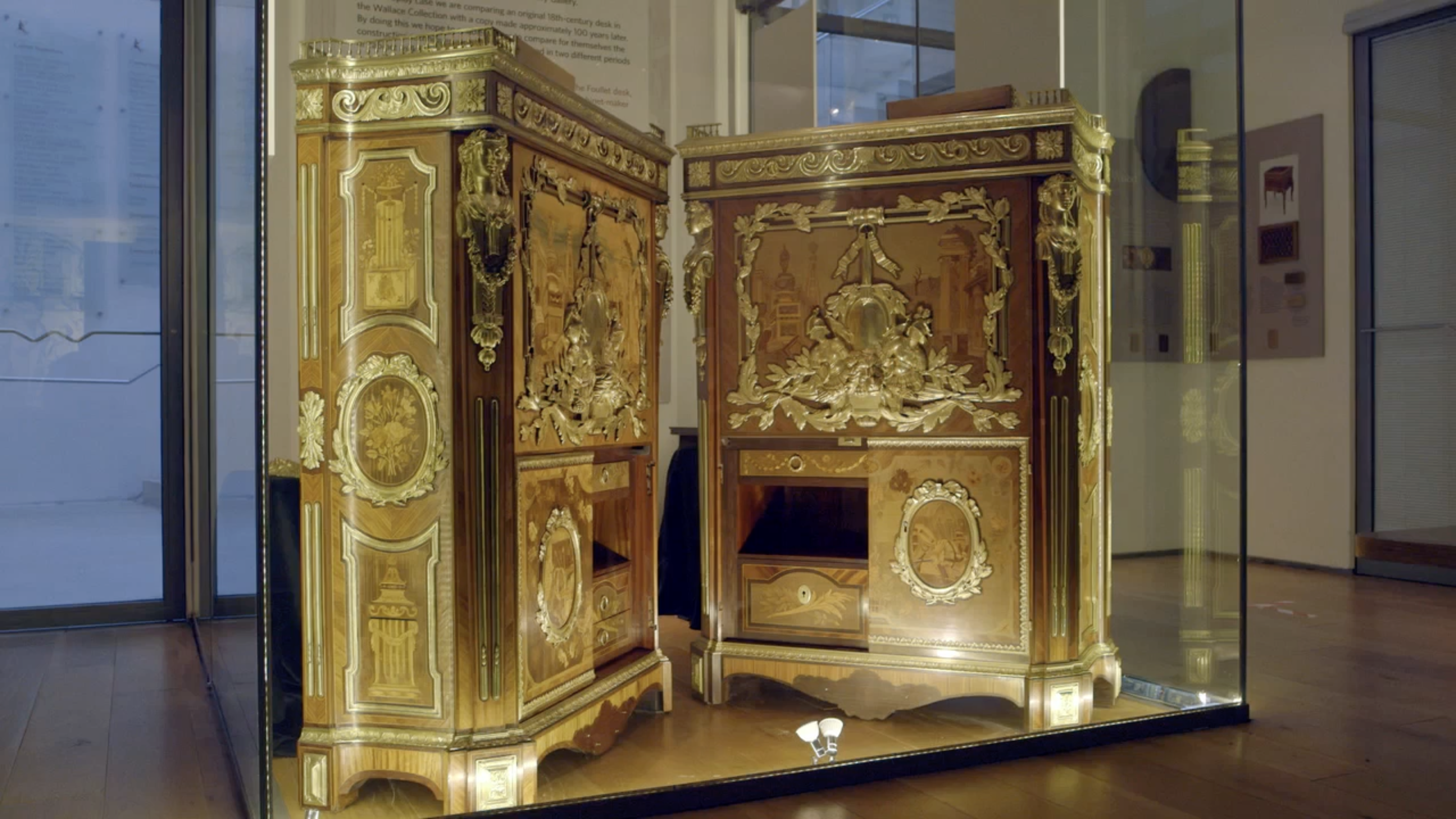
A close comparison at the Wallace Collection showing an 18th century fall-front secretaire by Pierre-Antoine Foullet (left) next to the only known 19th version (right), its construction surpassing the prototype. Available for sale at Butchoff Antiques, London.
Provenance carries the same weight here as in any other field of the decorative arts. Pieces with documented descent from a known eighteenth-century French collection, particularly those traceable to the royal sales of 1793 onwards, command a premium that no later piece, however finely executed, can match. The most accomplished revival makers, Dasson, Linke, Sormani, the Beurdeley firm, signed and dated their work with care, and a stamped revival cabinet from a named maker is a serious object in its own right, even where the underlying design copies a Riesener original. Both categories now circulate at the higher end of the British and American auction market: eighteenth-century originals as museum-grade objects, and named revival pieces by Dasson, Linke or Sormani as collector’s furniture in their own right.
Written by Rainier Schraepen