Vip access

 Favourites



















A Regency Period Games Table


A Regency Period Games Table
Dimensions: H: 29 in / 74 cm | W: 30 in / 76 cm | D: 19 in / 48 cm
PRICE: $45,800

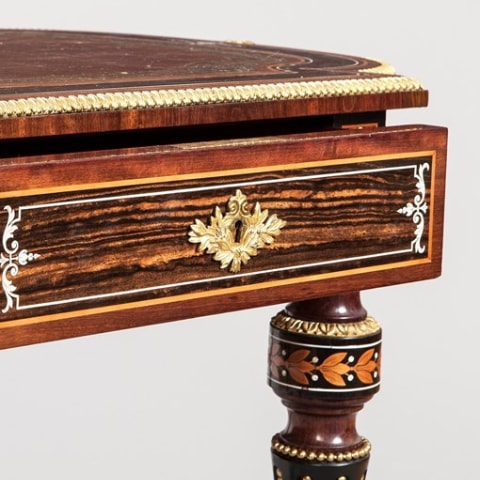
A Regency Period Games Table An extremely well-made piece of furniture from the Regency era, it employs finely figured rosewood, carved giltwood details and brass marquetry inlaid designs. The bookmatched top has a brass-inlaid border, incorporating two sliding panels operated with bronze cast handles and running along brass-tipped rails. These open to reveal a chess board, itself also sliding away to reveal the original leather embossed backgammon board, flanked by compartments for storage. The shallow frieze below the top is equally inlaid with brass designs on all four sides. The whole table is supported on a tapering four-sided pedestal with fine giltwood ornament on the corners terminating in scrolls and foliage. The pedestal rests on the quadripartite plinth of conforming brass marquetry with proudly carved lion paw feet concealing the original brass casters. English, circa 1820 The formal design and brass marquetry on this table is similar to that on the Creedy Park suite of furniture supplied by the London cabinet maker John Wellsman to Sir John Davie, 9th Baronet 1798-1824. The suite was supplied for the Drawing Room at Creedy Park Devon in 1820. It was included in a sale of Important English Furniture at Sotheby's London on 7th November 1997, lot 88.
From 1810, there was a renewed interest in brass inlay work, inspired by the masterful oeuvre of the late 17th and early 18th century French ébéniste André-Charles Boulle (1642-1732). The specialist 'buhl' worker first appeared in London between 1815 and 1820, with the earliest practitioners listed as 'buhl manufacturers' in commercial directories. Notable among these early exponents were John Wellsman, as well as Thomas Parker (active 1808-1830) of Air Street and Louis le Gaigneur of Edgware Road, who represented the vanguard of the English buhl revival movement.
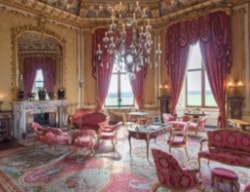
An exceptional example of Parker's work survives on a centre table, circa 1814-1830, featuring related gilt-metal Bacchic lion feet derived from classical antiquity. This distinguished piece is housed in the Green Drawing Room at Windsor Castle (RCIN 33461). Another firm specialising in buhl work and ancien régime-style furniture was Town and Emanuel, established at 103 New Bond Street from approximately 1830 until 1849. Their superb craftsmanship is exemplified by a games table incorporating mother-of-pearl, tortoiseshell, and gilt metal veneers, created in 1835 and now in the Royal Collection (RCIN 21622).
You may also like


A Games Table of the George IV Period Firmly Attributable to Gillow

A Near Pair of Walnut Card Tables in the Louis XV Manner

A Pair of Regency Card Tables

A Walnut Serpentine Card Table Firmly Attributed to Gillows

A Pair of George IV Card Tables Attributed to Morel & Seddon

A Pair of Irish George II Mahogany Card Tables
Recently viewed