Vip access

 Favourites


















Collection / Seating Furniture / Armchairs & Fauteuils
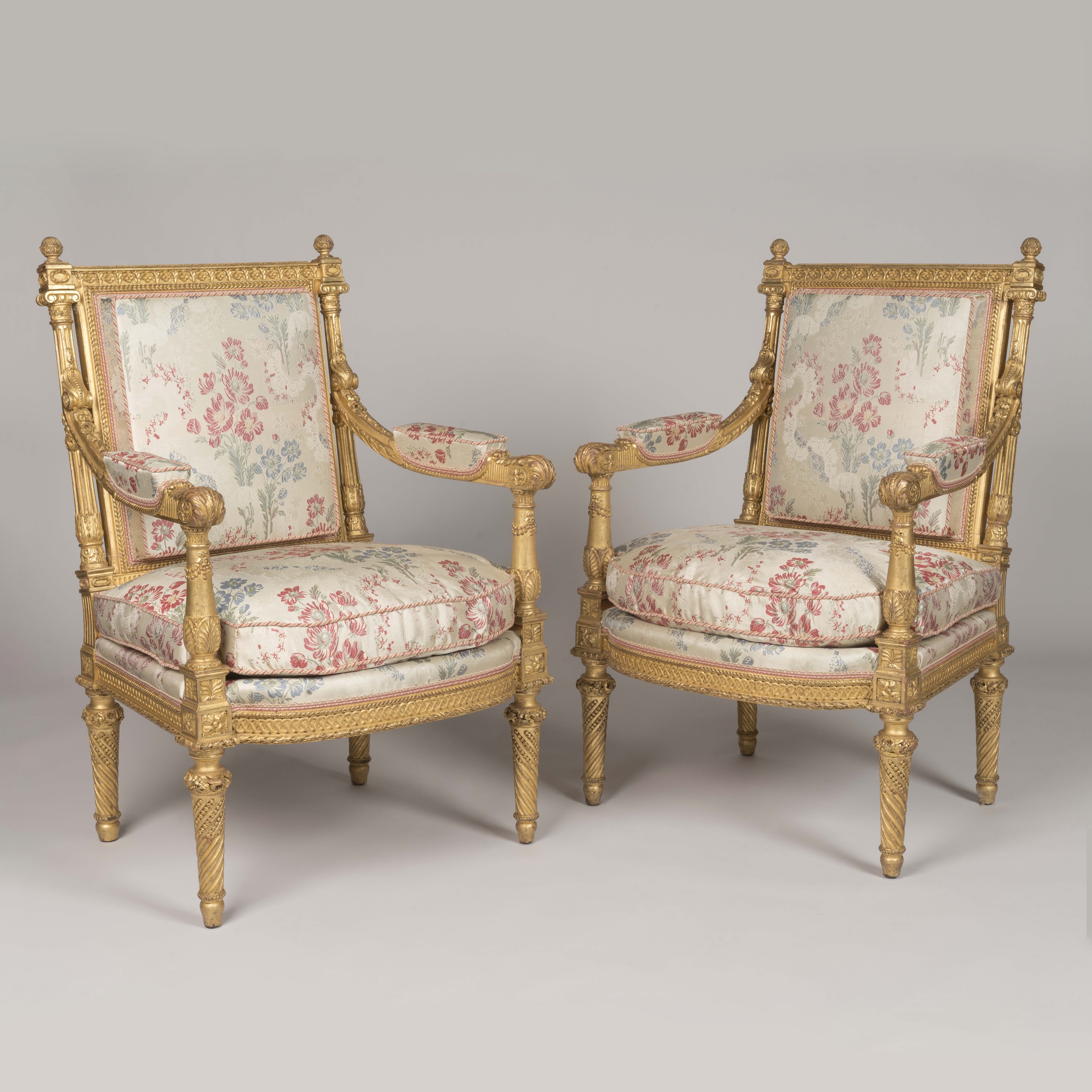
A Pair of Louis XVI Style Fauteuils à la Reine




A Pair of Louis XVI Style Fauteuils à la Reine
Dimensions: H: 39 in / 99 cm | W: 25.5 in / 65 cm | D: 23 in / 58 cm
PRICE: $41,900

A Pair of Louis XVI Style Fauteuils à la Reine After the design by Jean-Baptiste Claude Sené For Marie Antoinette's Grand Cabinet Today at the Louvre The original design dates to 1787. The carved chairs are of elegant neoclassical proportions, with predominantly straight lines with the exception of the seat rail and armrests. They are watergilded throughout and supported on tapering legs with stop-fluted torsade headed by floral capitals. The seat rail has interlaced decoration. The padded armrests have baluster supports bearing carved ribbon-tied pearl garlands. The backrest is flanked by fluted columns with ionic capitals below the toprail, which is carved with quatrefoils, palmettes and has pinecone finials. They are upholstered in a fine floral silk. French, late 19th century
The prototype for this pair is the suite of Royal seating delivered in 1787 to Château de Saint-Cloud, for Queen Marie Antoinette's Grand Cabinet. Three armchairs of this design were supplied alongside three side chairs, all today at the Louvre in Paris. The armchair bears all the hallmarks of neoclassical style, popular in France after 1775, with its straight, tapering legs and decorative elements which include classical columns with Ionic capitals and laurel and acanthus leaf motifs. Related Royal armchairs, also by Sené, are on view at the Victoria & Albert Museum in London as well as the Metropolitan Museum of Art in New York.
Jean-Baptiste Claude Sené, maître in 1769.
The quality and originality of Sené's work placed him among the pre-eminent menuisiers of the late 18th century. Around 1770 he established his workshop in the rue de Cléry, quickly building his reputation and ultimately supplying seat-furniture to the Garde-Meuble for Versailles, Montreuil, Saint-Cloud, Compiègne and Fontainebleau. His position ensured he remained in the vanguard of design characterised by strict form, delicate frames and well-adjusted carving.
Comparative Literature:
Kjellberg, Pierre. Le mobilier français du XVIIIe siècle : dictionnaire des ébénistes et des menuisiers. Paris: Editions de l'Amateur, 1989, p. 853, illustrates the Royal fauteuil.
You may also like


An Imposing Pair of French Louis Philippe Fauteuils
A Rare Fauteuil de Bureau In the Louis XV Style By François Linke
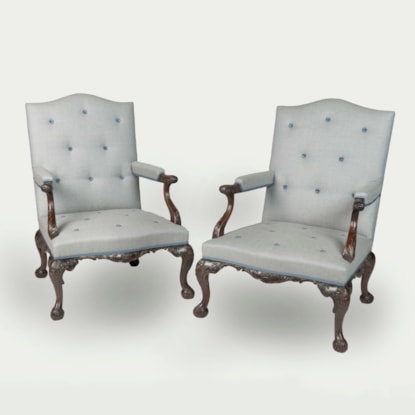
A Pair of Gainsborough Library Armchairs In the George II Style

A Pair of Mahogany Chippendale Style Armchairs

A Pair of George III Period Mahogany Armchairs

A Striking Pair of Walnut Chairs by Gillows
Recently viewed