Vip access

 Favourites


















Latest Stories
September 2026
Louis XVI: The Return to Classical Order

September 2026
Louis XVI: The Return to Classical OrderLouis XVI furniture from 1774 to 1792: Riesener's marquetry, Marie Antoinette's Trianon style and the nineteenth-century revival of the Neoclassical reign.
On 10 May 1774, Louis XV died at Versailles and his nineteen-year-old grandson succeeded him as Louis XVI. The new king inherited a court whose taste was already shifting away from the Rococo of his grandfather’s reign, and the cabinetmaker who would supply Marie Antoinette’s most important commissions had already been at work in Paris for two decades. Jean-Henri Riesener had arrived in the city from his native Westphalia in 1754 and entered the workshop of Jean-François Oeben at the Manufacture des Gobelins. Within twenty years he would be ébéniste du roi to the new king, the principal cabinetmaker to the queen, and the maker of furniture so technically refined that pieces from his workshop are still considered the highest achievement of French eighteenth-century cabinetmaking. The career of Riesener, more than that of any other figure, defines the Louis XVI style: its origins in late Rococo training, its rapid embrace of the new classical taste after 1770, its peak in the queen’s commissions of the 1780s, and its sudden eclipse with the fall of the monarchy in 1792.
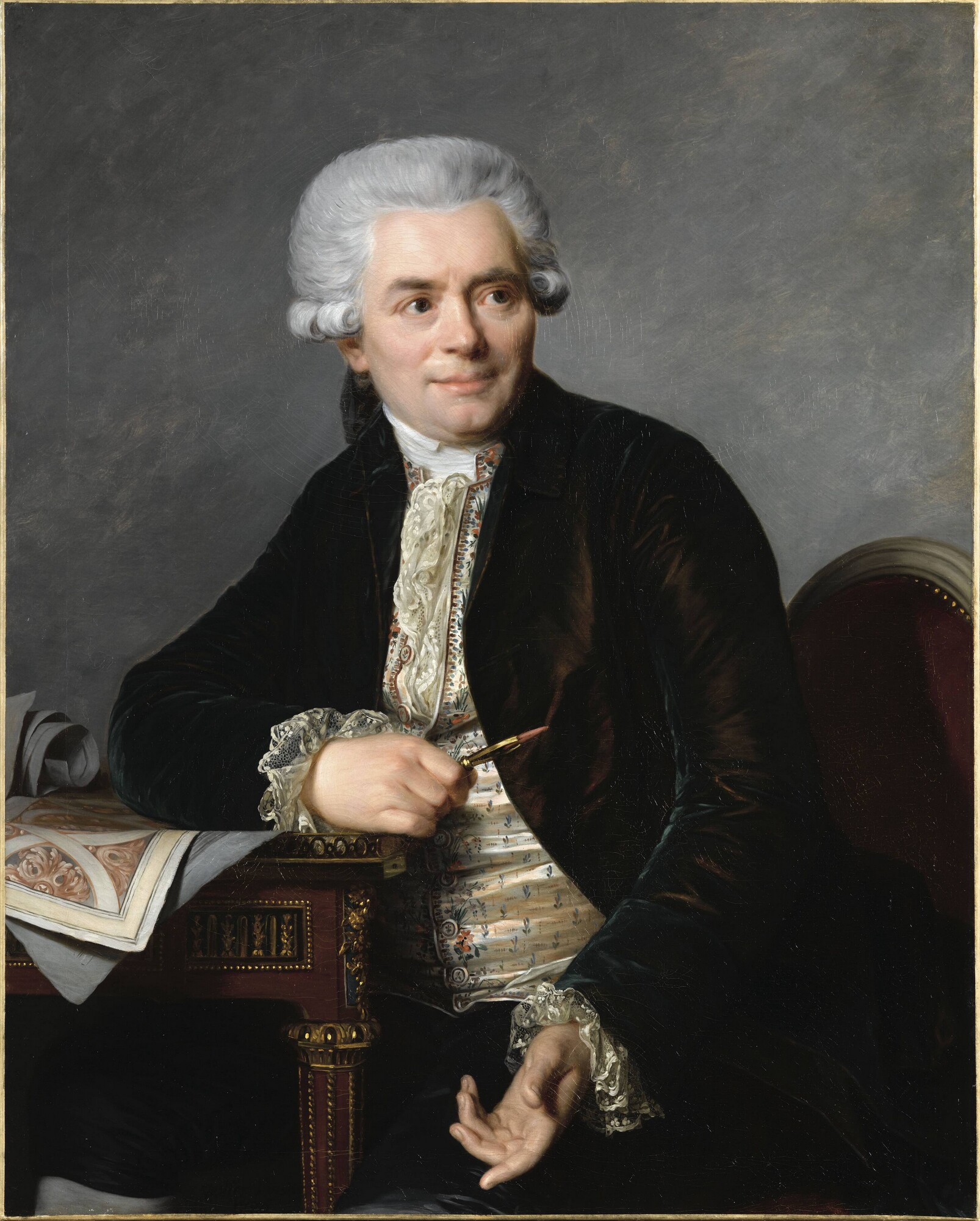
Portrait of Jean-Henri Riesener by Antoine Vestier, 1786. © RMN-GP (Château de Versailles) / © Gérard Blot
Louis XVI furniture takes its name from the king who reigned from 1774 to 1792, but the style itself was already established by the time he came to the throne. The shift from Rococo to Neoclassicism had been underway for roughly a decade, prompted by the archaeological discoveries at Pompeii and Herculaneum and by a wider French intellectual mood that had grown impatient with the asymmetry, whimsy and curve of the previous reign. Curves straightened, ornament was disciplined, and the visual vocabulary of antiquity, columns, friezes, urns and acanthus, replaced the rocaille shellwork of Madame de Pompadour’s generation. By 1780 the new style had become the standard vocabulary of Parisian luxury.
Pompeii and the Antique Imagination
The shift in French taste was set in motion not by a designer but by an archaeologist. Excavations at Herculaneum began in 1738 under the patronage of Charles VII of Naples, followed a decade later by the systematic clearing of Pompeii from 1748 onwards. The objects coming up from the ash were domestic in scale. Three-legged braziers, painted wall fragments and small bronze lamps suggested a Roman world far more finely detailed than the grand monuments familiar from above ground, and engraved records of the finds began circulating among the educated classes from the 1750s. The Comte de Caylus’s seven-volume "Recueil d’antiquités", published between 1752 and 1767, gave Parisian designers a working library of classical motifs, and Johann Joachim Winckelmann’s writings on Greek art, translated into French during the 1760s, supplied the intellectual case that ancient art represented a moral and aesthetic standard for the present.
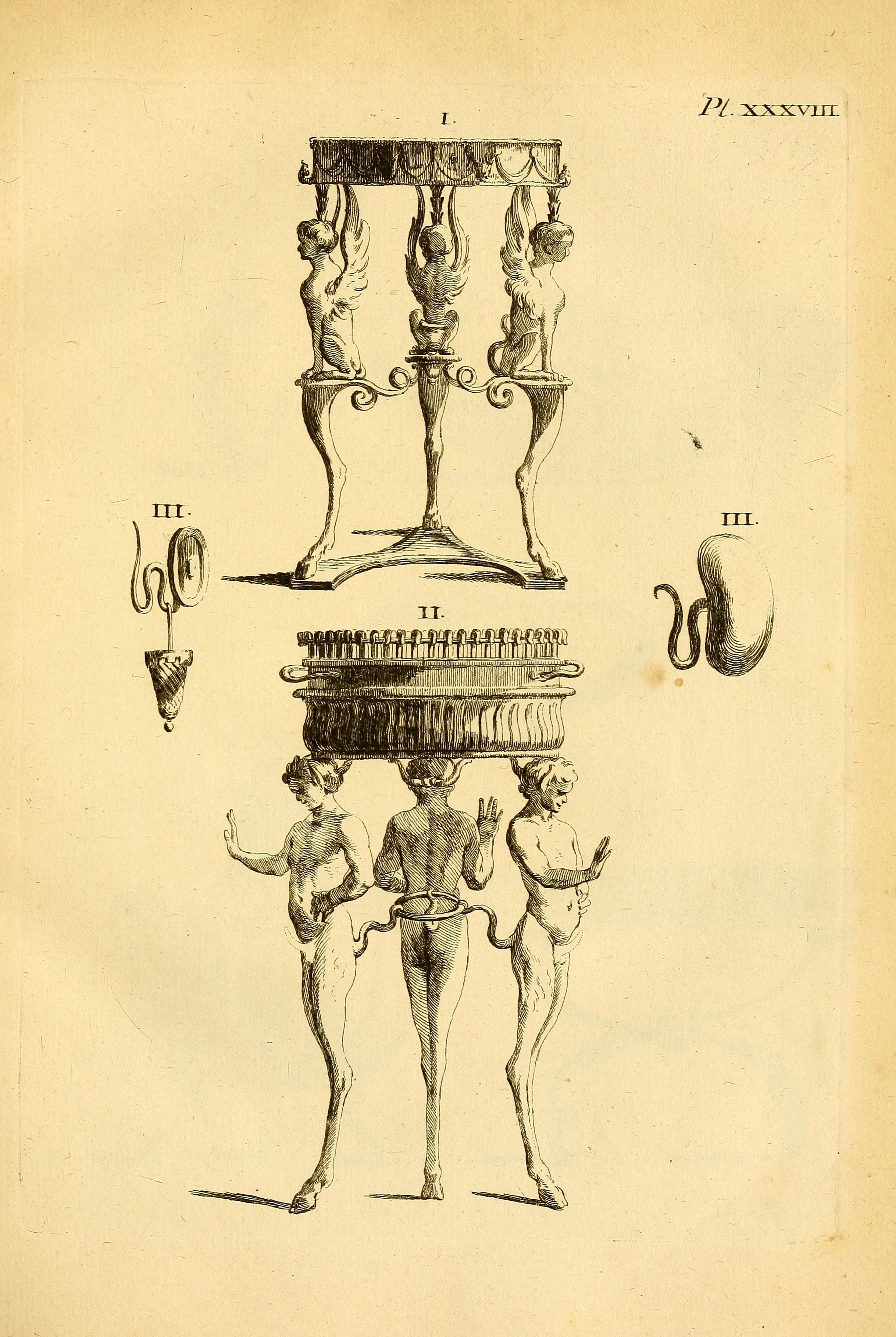
A plate from the Comte de Caylus' famous Recueil d'Antiquités which would inspire contemporary French furniture makers to produce similar tripod stands.
The intellectual case was made before the visual one. By the mid-1760s a recognisable "Goût grec" had emerged in the salons of Madame Geoffrin and her circle, applied to silver, ceramics and the decoration of small chambers more readily than to furniture itself. Curiously, the early Neoclassical taste was almost as often called "Etruscan" as "Greek", a confusion that arose because the painted walls of Pompeii and Herculaneum had been mistaken by some antiquaries for Etruscan work. Pompeian red, the terracotta-coloured ground used for painted walls, and the tripod-legged athénienne, a pedestal stand inspired by Roman incense burners, both entered the French decorative vocabulary in this period and remained in use throughout the reign of Louis XVI.
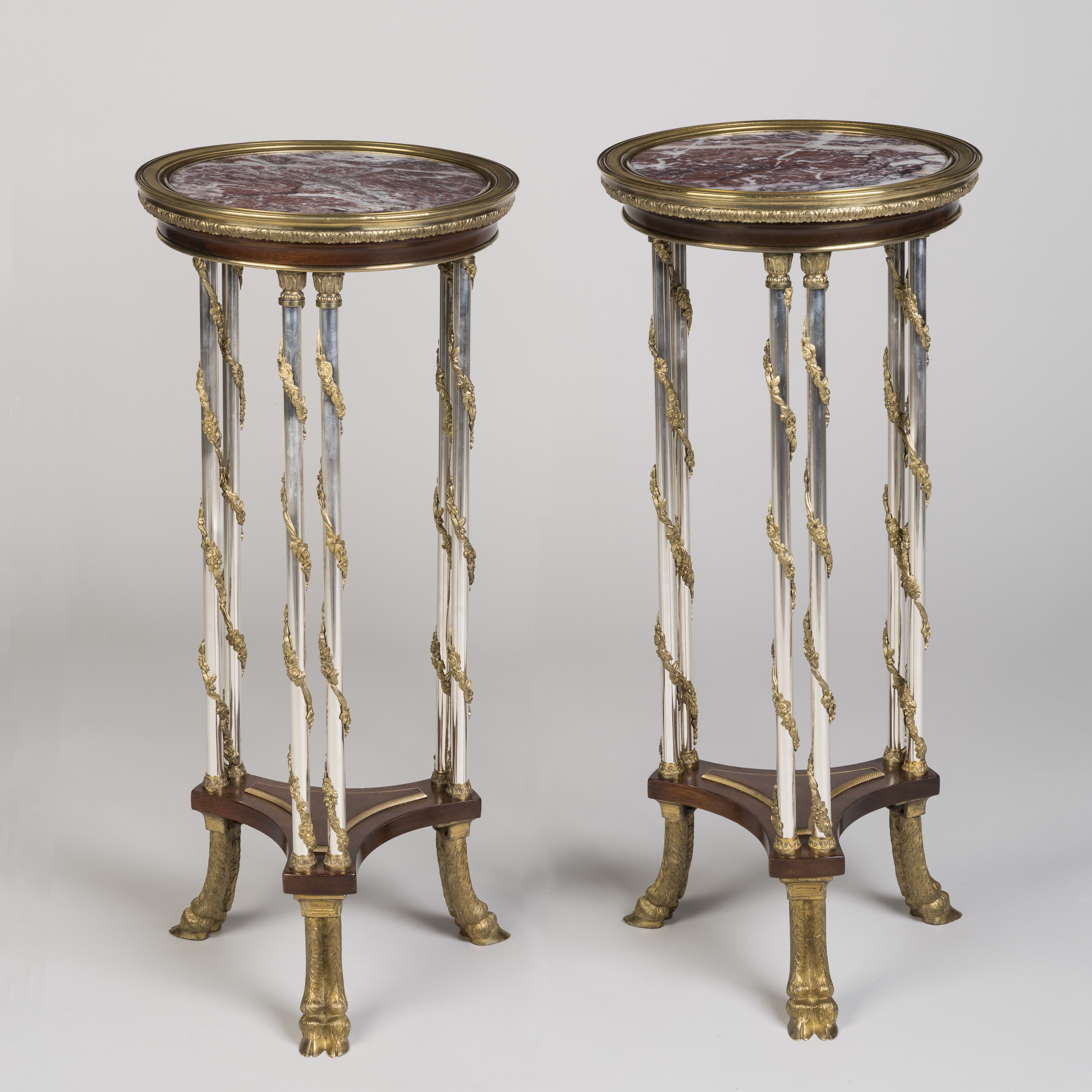
Inspired by Classical Antiquity, these ormolu and silvered guéridon tables in the Louis XVI style have straight columnar legs and hoof feet. Previously with Butchoff Antiques, London.
Translated into furniture, the new vocabulary was specifically architectural. The leg of a chair or commode became a column, fluted on its outer face and tapered to a foot rather than splaying as the cabriole had done. The lower edge of a commode acquired a frieze, the upper a cornice. Carved decoration was disciplined into Greek-key borders, anthemion friezes, ovolo and bead mouldings, and stylised acanthus leaves wrapping the bases of table legs and the corners of chests. Caryatids and term figures, female busts whose lower bodies tapered into a square pedestal, supplied a more theatrical option for the angles of side tables and console pieces. By the mid-1770s the principle was visible across every Parisian workshop of consequence.
The New Anatomy of French Furniture
The chair was the form in which the new style declared itself most plainly. The Louis XVI chair has an oval or circular back called a dossier en médaillon, framed with a simple moulding, the so-called perles (a string of small carved pearls) or a twisted-ribbon pattern. The arm meets the back at a right angle and is supported by a vertical post that aligns precisely with the front leg, giving the side elevation the look of a small architectural order. Where the leg meets the seat rail, a small square block called a dé de raccordement is left visible and decorated with a single carved rosette. The leg tapers to a small foot and is fluted on its outer face, sometimes wrapped at the base with a stylised acanthus leaf. Stretchers between the legs were generally abandoned, since the geometric joints of the new construction were strong enough without them.
The case furniture acquired a comparable severity. The Louis XV commode, with its bombé front and concave sides, was replaced by a rectangular block whose centre panel was often brought slightly forward in a feature called a risalto, breaking the flat front into three vertical sections and giving the cabinetmaker a frame for three distinct marquetry compositions. Doors took the place of drawers in the commode à vantaux, while the secrétaire à abattant, a tall upright cabinet with a drop-front writing surface, presented an even larger plane for marquetry display. Smaller forms multiplied with the social demands of private apartments: the bouillotte table, a circular pedestal with a marble top and a brass gallery, made for the card game of the same name; and the console, semi-circular or rectangular, set against the wall beneath a pier glass with its laurel swags and acanthus carved on a single delicate frieze.
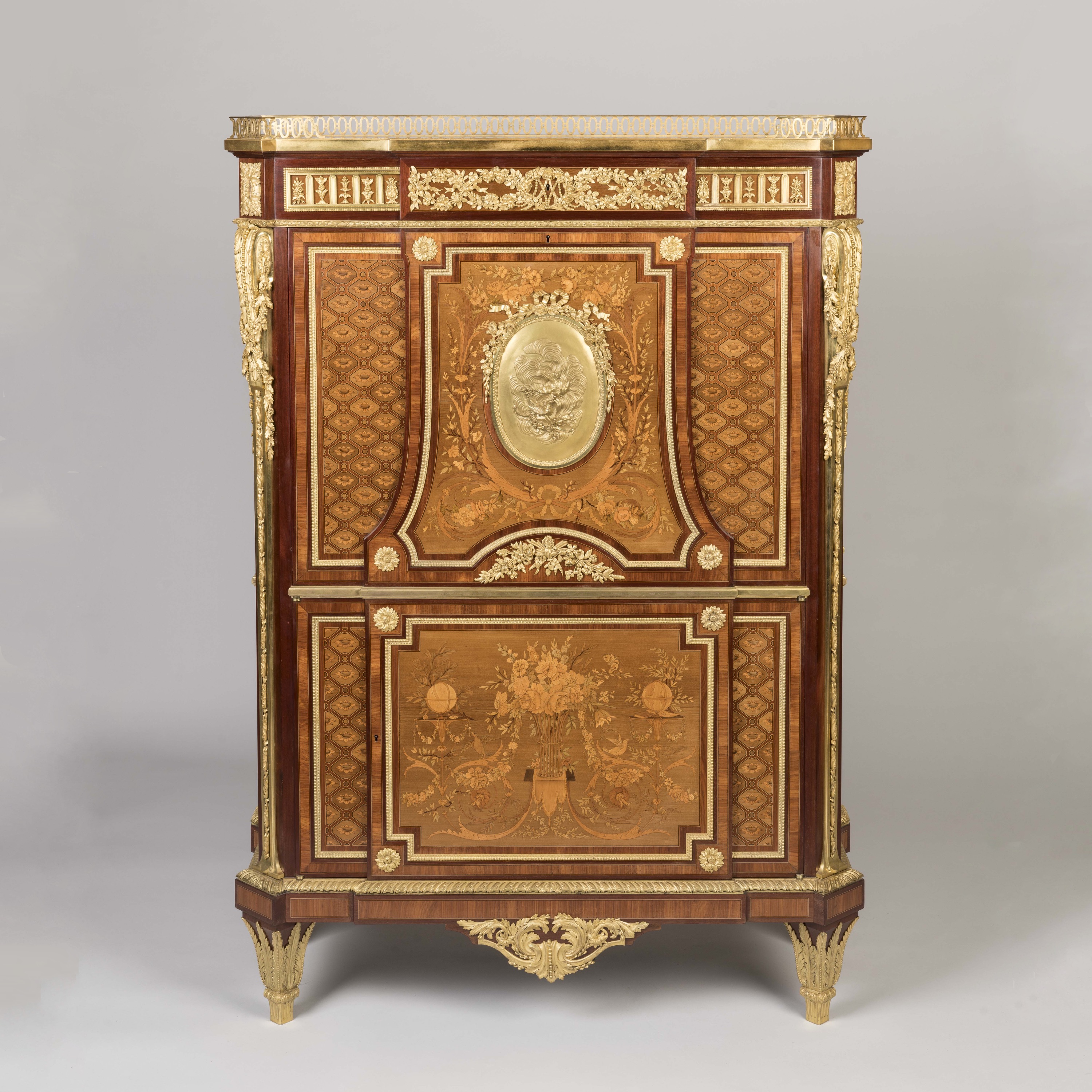
The ultimate Louis XVI style cabinet, inspired by original designs by Riesener for Marie Antoinette. This 19th century secrétaire à abattant by Paul Sormani has all the classic hallmarks of the Louis XVI period, including the breakfront risalto (or à ressaut) configuration which allow multiple large panels of marquetry to dominate alongside refined ormolu of stylised acanthus leaves. Butchoff Antiques, London.
The materials of the period favoured restraint over display. Mahogany, imported through the trans-Atlantic colonial trade, became the dominant timber for the finest pieces, prized for its straight grain and its capacity to take a fine carved profile without splitting. Less prestigious furniture was painted in soft pastels, the so-called Trianon gray and white, sometimes accented with gilding on the most prominent carvings. White Carrara marble was set into commode and table tops, providing the cool architectural surface the new geometry demanded. Gilt-bronze mounts were used with a precision the Rococo had not required, often confined to the corners and edges of a piece rather than spread across its surface. The cabinetmaker Martin Carlin began collaborating with the royal porcelain manufactory at Sèvres to set hand-painted porcelain plaques, depicting flowers, birds and pastoral scenes, directly into the wood of small writing desks and ladies’ cabinets. Surviving examples of Carlin’s work are now among the most prized objects in the Louvre, the Wallace Collection and the major American museums.
The King’s Ébénistes
The Parisian luxury trade was strictly divided by the Corporation des Menuisiers-Ébénistes. The menuisier, working in solid beech, walnut or mahogany, made chairs and bedsteads to be carved or painted; the ébéniste, working in veneers and marquetry over an oak carcase, made the case pieces, the commodes, secrétaires and bureaux that carried the most prestige. Both were required on admission as maîtres to brand their work with their own stamp, and a second mark, JME, applied by the jurés inspecting the finished piece, indicated that it had passed the guild’s quality control. The obligation had been universal since 1743, and these two marks remain the foundation on which serious attribution to the period still rests. The ébénistes du roi at the Louvre and the Gobelins were exempt from guild jurisdiction, but any stamped piece can usually be placed within a known career.
Jean-Henri Riesener, who had taken over Oeben’s workshop in the 1760s and married Oeben’s widow, was named ébéniste du roi early in the new reign and supplied the bulk of the royal furniture from 1774 until 1784. His marquetry was the finest of the century: panels of tulipwood, satinwood, sycamore and harewood, cut and shaded by acid-staining and hot-sand burning, set within geometric trellis grounds and bordered with bands of contrasting timbers. The bureau du roi, the great rolltop desk begun by Oeben for Louis XV in 1760 and completed by Riesener in 1769, was the supreme example of the late Rococo style, but his work for Marie Antoinette in the 1780s was wholly Neoclassical, with severe rectangular cases finished in solid mahogany and ornamented with finely cast and chased gilt-bronze mounts. Riesener fell from favour after 1784, when his prices were judged too high and the queen turned increasingly to Guillaume Beneman and to Adam Weisweiler.
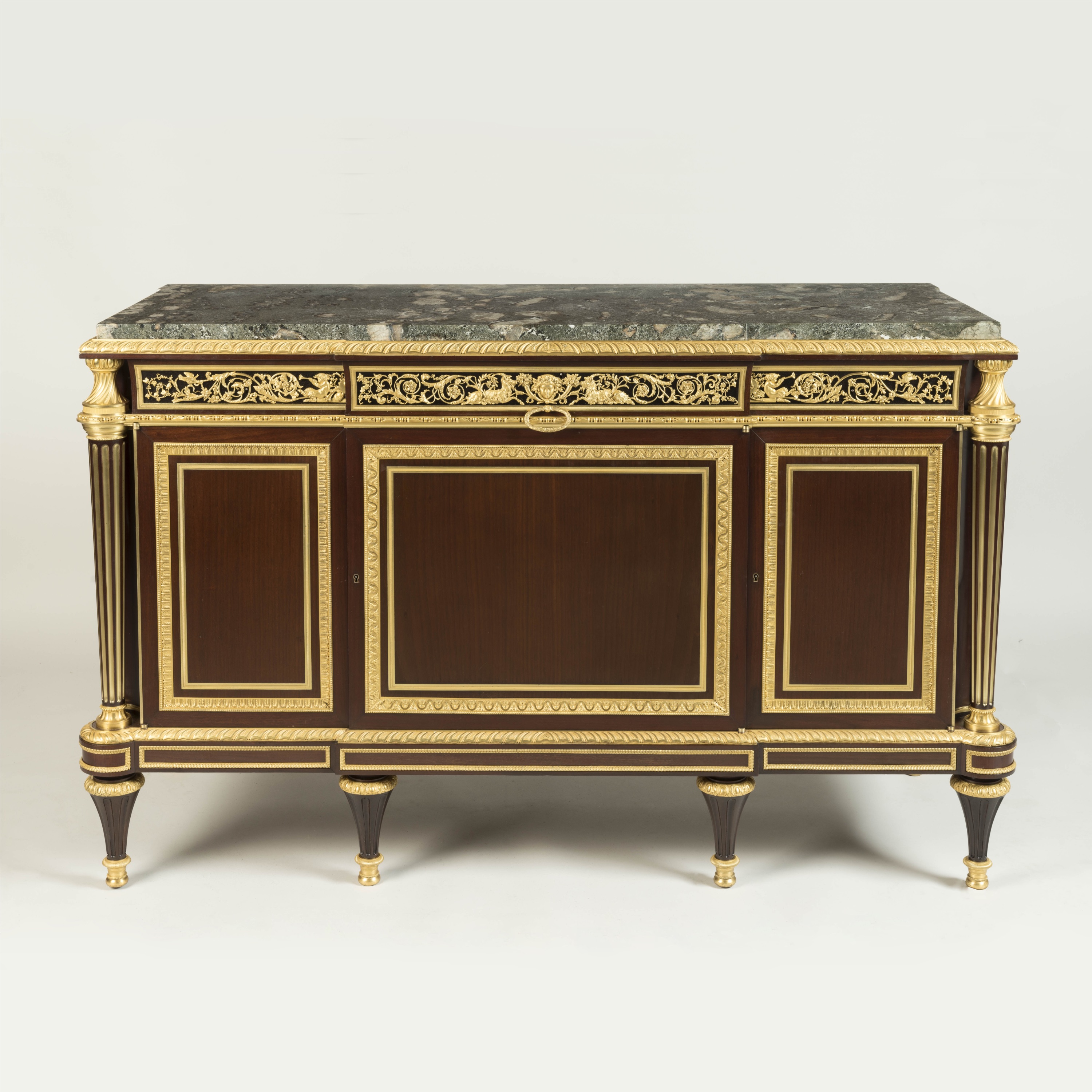
Commodes in the style of Adam Wesiweiler such as this one exemplify the more austere and architectural style that Marie Antoinette favoured in her final years at the Petit Trianon. Previously with Butchoff Antiques, London.
Georges Jacob was the dominant menuisier of the reign and the figure who fixed the Louis XVI chair as we now know it. He was the first significant Parisian craftsman to use mahogany for seating, where its density allowed the fluted column of the leg to be cut without snapping, and his workshop developed the open-work backrest carved with the lyres, sheaves of wheat or interlaced rings that became standard motifs of the queen’s apartments. David Roentgen, working principally from his workshops at Neuwied in the Rhineland and from a Parisian shop on the rue de Grenelle, supplied the king with elaborate mechanical desks whose hidden springs released drawers, raised mirrors and produced writing slopes at the touch of a concealed button. The king’s well-known interest in locks and mechanisms made Roentgen’s furniture a natural court taste. Martin Carlin specialised in the smallest and most precious pieces of the reign, the Sèvres-mounted ladies’ tables and bonheurs-du-jour already mentioned, and Adam Weisweiler, working into the 1790s, supplied the more austere and architectural late style that the queen preferred in her final years at the Petit Trianon.
Marie Antoinette’s Private Court
Louis XVI gave Marie Antoinette the Petit Trianon on his accession in 1774. The small neoclassical pavilion in the gardens of Versailles had been built in the 1760s for Madame de Pompadour, who died before its completion. It became, over the following decade, the queen’s private retreat from the formal court. The state apartments at the main palace were furnished for ceremony; the queen’s rooms at the Trianon were furnished for private use, with smaller and lighter pieces intended for reading, intimate suppers, music and conversation. The furniture made for the Trianon is the most personal product of the reign: pieces small enough for a private hand, finished in solid mahogany or cool gray paint, often with the queen’s monogram set into a roundel of marquetry or chased gilt-bronze.
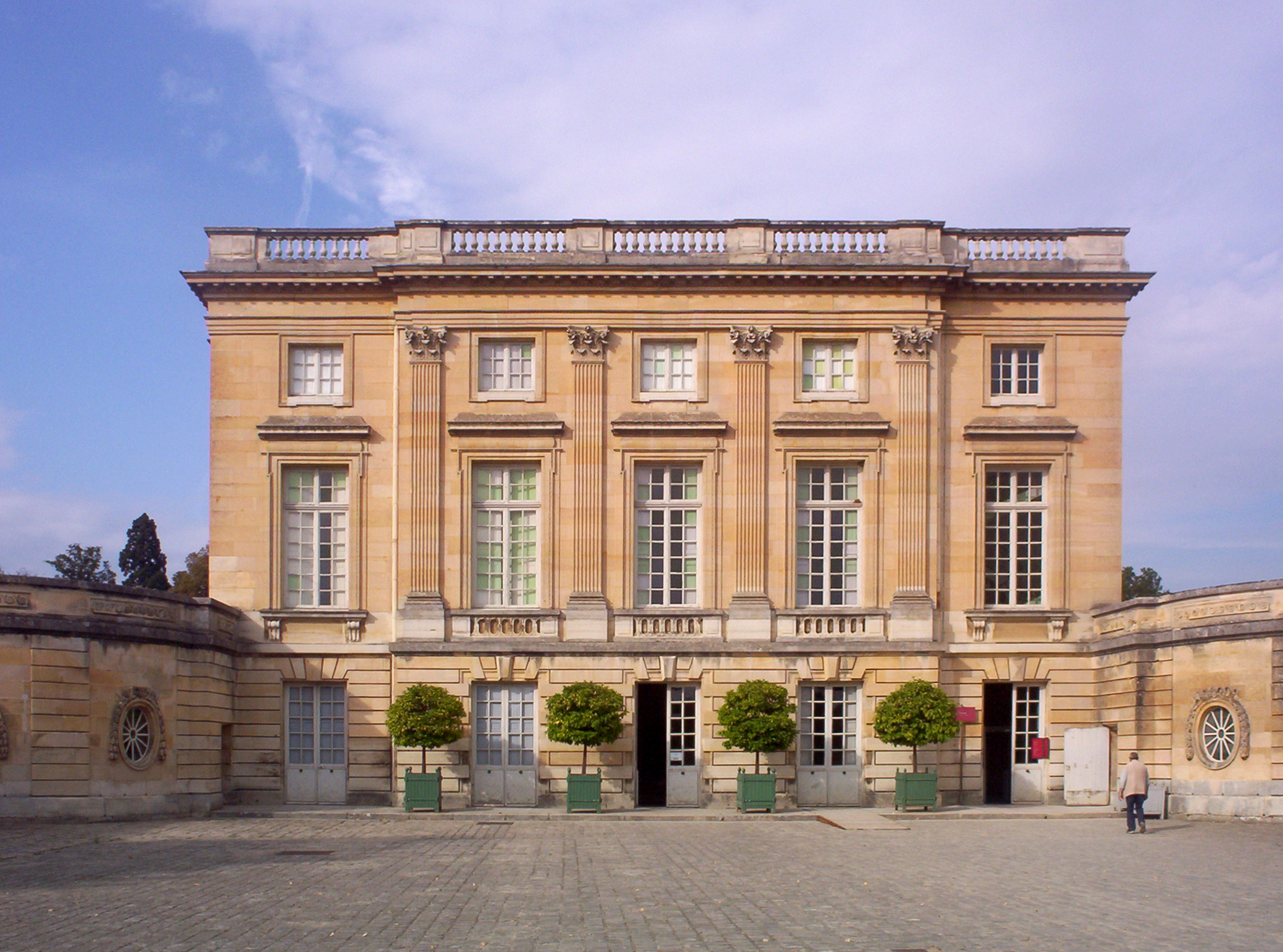
The façade of the Petit Trianon. Although built by Louis XV's architect for Madame de Pompadour, it would subsequently become a symbol of the Neoclassical Louis XVI style when Marie Antoinette furnished it in the final two decades of the 18th century.
The pastoral aesthetic developed further at the Hameau de la Reine, the picturesque hamlet of thatched cottages, dairy and mock farm built on the Trianon grounds between 1783 and 1786. Furniture made for these private spaces drew its motifs from a romanticised version of country life: sheaves of wheat tied with ribbon, garden rakes, watering cans and wicker baskets of flowers. Carved ribbon bows, the so-called Nœud de Ruban, sat at the cresting of mirrors and chair backs, twisted as if the carpenter had caught the moment a real ribbon was tied. Heavy floral festoons of roses, lilies and laurel hung from carved pegs across the friezes of console tables. The quiver of arrows, an emblem of Cupid often paired with a flaming torch, became a frequent motif on the chairs and small writing tables of the queen’s apartments. Many of the queen’s chairs themselves were supplied by Georges Jacob, whose openwork backrests, carved with lyres or oak garlands, set the standard for the private register of the reign.
The taste at the Trianon was lighter than the official Neoclassicism of the early reign, and noticeably influenced by English furniture-making, an enthusiasm the French called Anglomania. The queen and her circle preferred polished mahogany to gilded oak and structural visibility to applied ornament. The colour palette they favoured, a soft range of pale gray, white and dove, came to be called Trianon gray. Gilding, when it appeared, was confined to the most prominent carved details rather than coating an entire surface. By the late 1780s the Trianon style had become the recognised alternative to the heavier court Neoclassicism of the early reign.
From Revolution to Revival
The Louis XVI furniture trade did not survive the Revolution intact. The royal collections at Versailles, the Tuileries and the Petit Trianon were inventoried, dispersed and sold by the new Republic in a series of revolutionary sales beginning in 1793, organised to convert royal property into ready cash for the war effort. The marquetry commodes, gilt-bronze candelabra and Sèvres-mounted writing tables passed in their thousands from royal apartments into private hands across Europe. British and American buyers were prominent among the purchasers, and much of the finest Louis XVI furniture now in the great public collections of London, New York and Washington passed out of France in those years. The pieces that did not sell at price were sometimes burned for the gold in their ormolu, an act of iconoclasm that destroyed an unknown but substantial number of the period’s smaller objects.
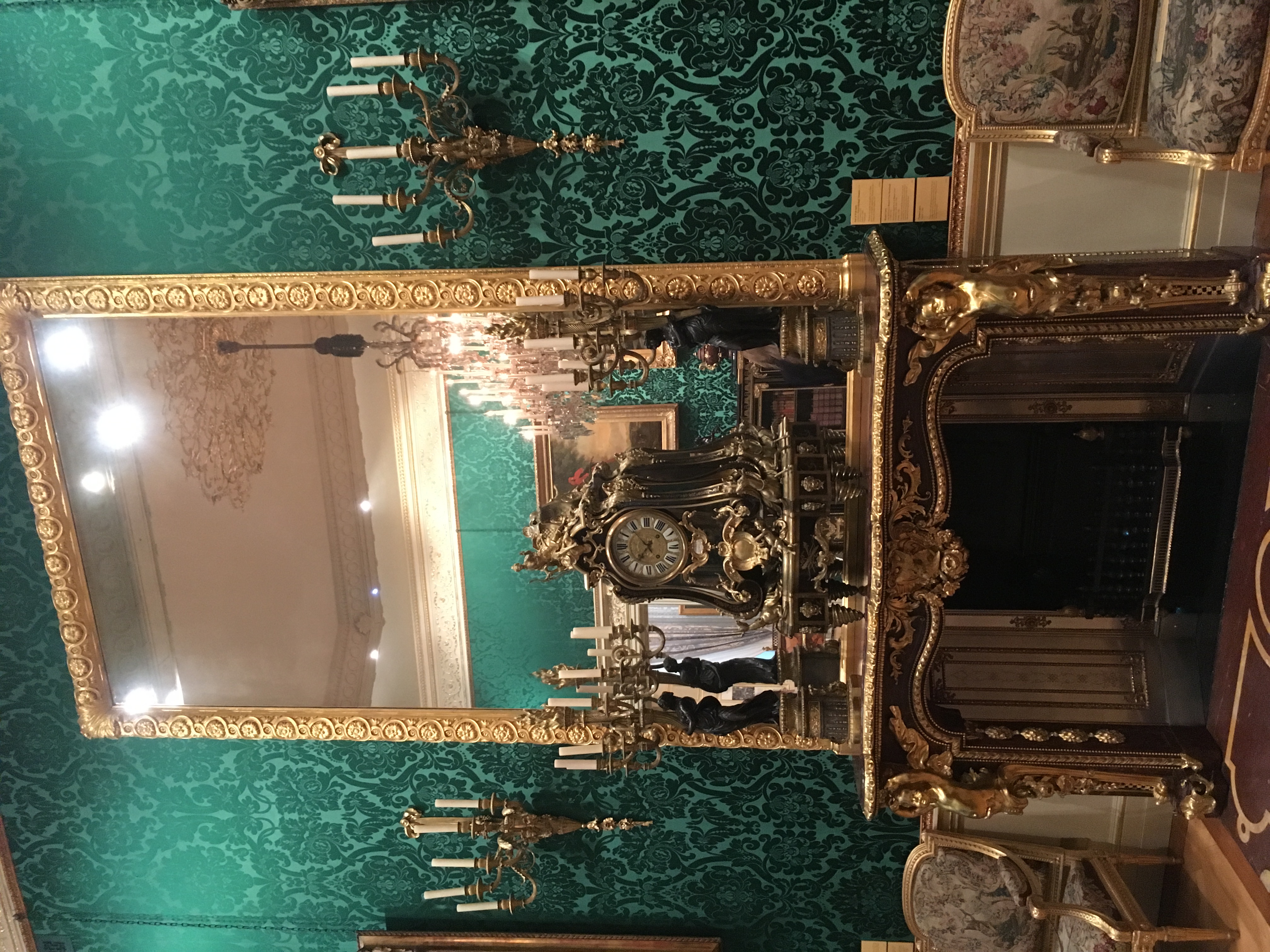
The Wallace Collection in London houses some of the greatest Ancien Régime furniture and decorative arts of the 18th century, much of it with direct ties to the French monarchy and eventually sold following the Revolution. Image is author's own.
The Allarde Law of 17 March 1791 abolished the corporate guilds and ended the requirement to be a maître ébéniste in order to make furniture commercially. Quality control collapsed almost immediately, and by the mid-1790s the Parisian trade was producing furniture of markedly lower technical standard than the work of the previous decade. One workshop survived this transition with its reputation enhanced. Georges Jacob retired in 1796 and passed the business to his sons, who renamed it Jacob Frères and later Jacob-Desmalter; the firm became the principal supplier to Napoleon and the imperial court, and the chairs and tables they produced after 1800 carried forward the discipline of the Louis XVI form into the heavier, more openly classical Empire style.
The strongest commercial revival of Louis XVI taste came not in France but later in the nineteenth century, on both sides of the Channel. From the 1850s onwards a generation of Parisian and London cabinetmakers, led by Henry Dasson, Paul Sormani, the Beurdeley dynasty, François Linke, Maison Krieger and Holland & Sons, produced furniture in the Louis XVI manner of a quality often equalling and occasionally surpassing the eighteenth-century originals. Most pieces in the Louis XVI taste circulating in the British and American markets today belong to this nineteenth-century revival rather than to the original reign, and the distinction matters greatly to value and provenance.
Originals and Revivals
The collector’s distinction between an original Louis XVI piece and a nineteenth-century revival turns on a small number of specific tests. The JME stamp, present on furniture passed by the guild between 1743 and the abolition of the corporations in 1791, is the principal documentary mark. Period construction methods, the use of hand-cut veneers, oak carcases joined by wedge-cut dovetails, mercury-gilded mounts in solid bronze, and shrinkage cracks consistent with two centuries of seasonal movement, are the principal physical ones. Notably, furniture experts including Christopher Payne and Jurgen Huber (senior conservator at the Wallace Collection) have pointed out the superior construction of 19th century revival pieces which achieve a level of perfection rarely seen in the 18th century
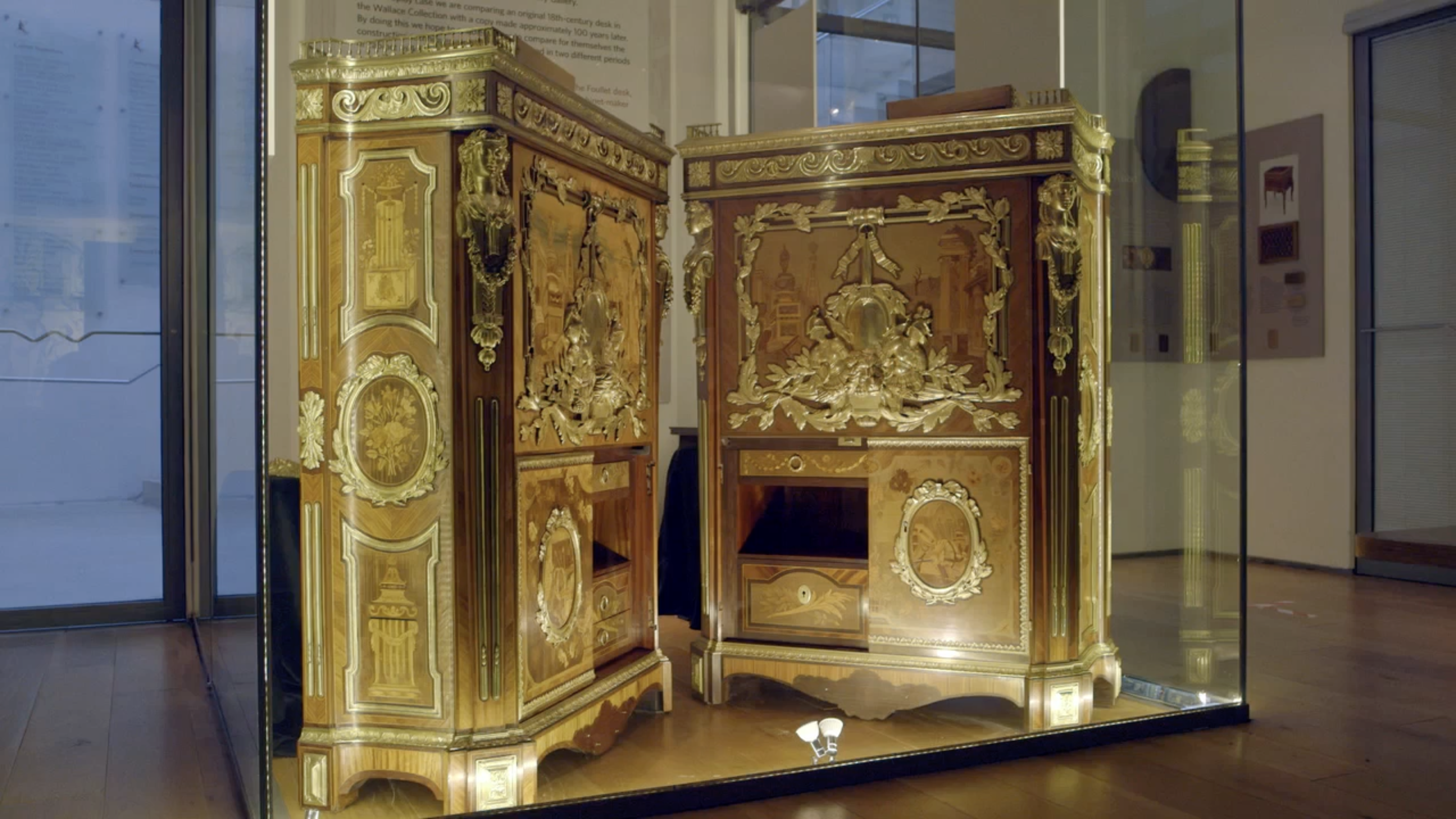
A close comparison at the Wallace Collection showing an 18th century fall-front secretaire by Pierre-Antoine Foullet (left) next to the only known 19th version (right), its construction surpassing the prototype. Available for sale at Butchoff Antiques, London.
Provenance carries the same weight here as in any other field of the decorative arts. Pieces with documented descent from a known eighteenth-century French collection, particularly those traceable to the royal sales of 1793 onwards, command a premium that no later piece, however finely executed, can match. The most accomplished revival makers, Dasson, Linke, Sormani, the Beurdeley firm, signed and dated their work with care, and a stamped revival cabinet from a named maker is a serious object in its own right, even where the underlying design copies a Riesener original. Both categories now circulate at the higher end of the British and American auction market: eighteenth-century originals as museum-grade objects, and named revival pieces by Dasson, Linke or Sormani as collector’s furniture in their own right.
Written by Rainier Schraepen
 Read More
Victorian Furniture: The Style That Defined an Era
When Joseph Paxton’s Crystal Palace opened in Hyde Park on 1 May 1851, it housed more than thirteen thousand exhibits beneath its glass and iron canopy. Furniture occupied a substantial share of the floor space, and what visitors saw there was unlike anything that had come before. Carved sideboards rose to the height of a tall man, their panels cut with whole narrative scenes. Coil-sprung chairs offered a depth of comfort no eighteenth-century upholsterer could have produced, and machine-cut ornament covered surface after surface in quantities no hand carver could equal. The Great Exhibition gathered the contradictions of Victorian furniture into a single building, where revival designs pulled from half a dozen historical periods sat alongside technical bravura made possible by industrial machinery. The public debate that followed asked whether the result was art, novelty, or vulgarity dressed in the clothes of art.
The style’s design vocabulary was already forming in the late Regency, well before Victoria’s accession in 1837, and continued to influence Edwardian production for years after her death in 1901. It was the first style produced for a mass middle-class market and the first to introduce the matching parlour suite as a standard purchase. It was also the most stylistically restless period in the history of British furniture. Designers and cabinetmakers borrowed openly from Gothic, Rococo, Renaissance, Elizabethan and Tudor sources, sometimes blending them within a single object. The era earned its reputation through ambition and through the sheer volume of furniture produced for the homes of industrial Britain.
A Reign Defined by Revival
The defining habit of Victorian design was its tendency to look backwards. No major Victorian style is original to the period. Every important strand of Victorian furniture re-imagines an earlier one, and several re-imagine multiple periods at once. Critics at the time called this contest of styles the "Battle of the Styles", and it ran without resolution from the 1830s until the closing decades of the century.
The Gothic Revival came first and gave the era much of its early character. Its leading voice was A.W.N. Pugin, who established his furniture workshop at 12 Hart Street in Covent Garden in 1829 in his late teens, and whose sense of design was inseparable from his religious convictions. For Pugin, Gothic was not a fashion but a Christian and moral architecture. His furniture for Windsor Castle, his collaboration with Charles Barry on the new Palace of Westminster, and his published volume "The True Principles of Pointed or Christian Architecture" of 1841 gave Gothic Revival a coherence the other revivals never quite matched. The visual grammar drew from medieval cathedrals: pointed arches, quatrefoils, trefoils, and heraldic motifs, often executed in oak and fitted with the highly individual brass handles Pugin designed himself. After his death at forty in 1852, his son Edward Welby Pugin carried the style on with a more flamboyant and French-inflected hand.
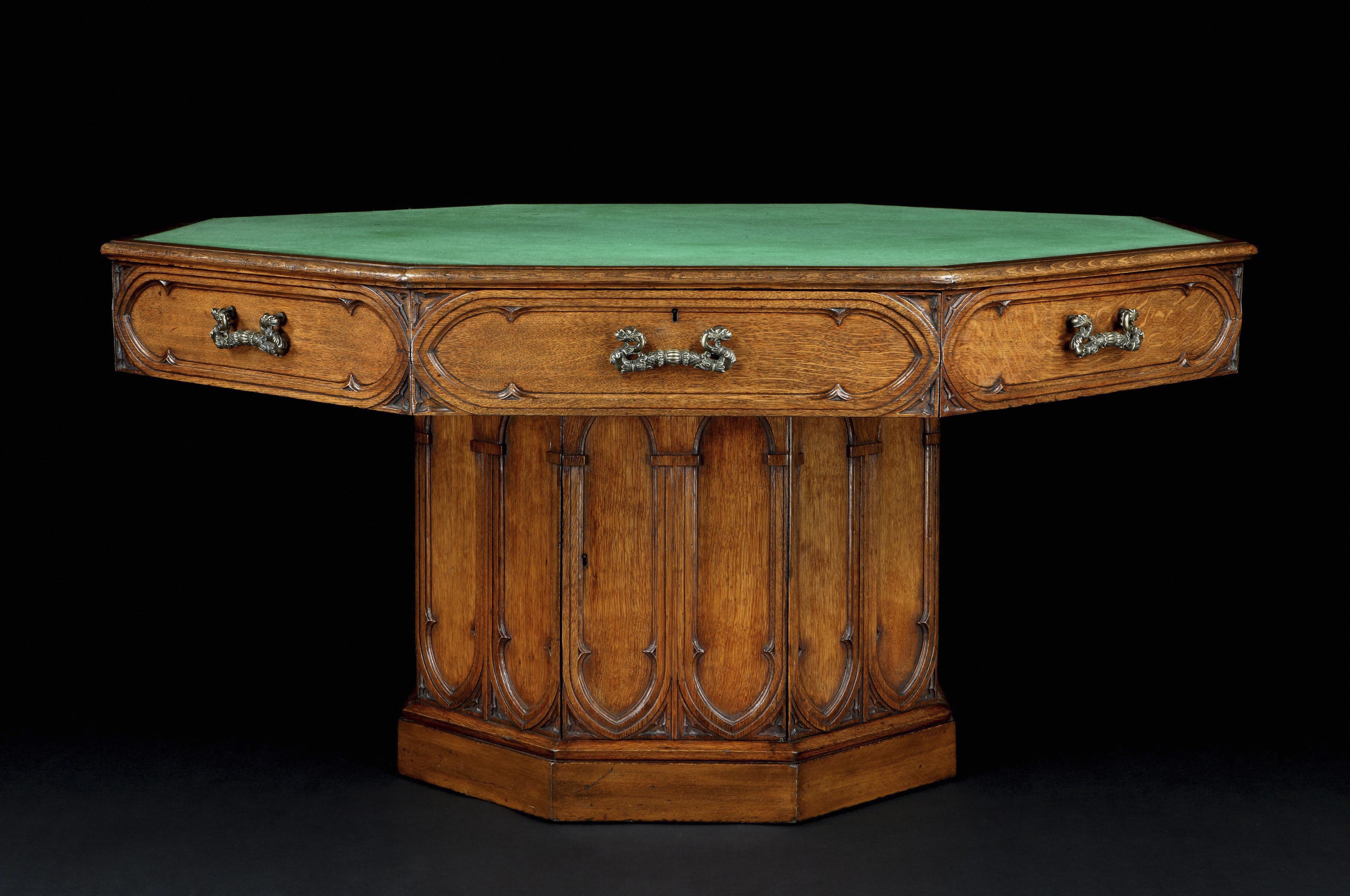
This royal table, sold by Butchoff Antiques, has all the hallmarks of Pugin's gothic revival. The table came from Windsor Castle, and has an inventory stamp from Queen Victoria's reign, dated 1873.
Rococo Revival emerged alongside the Gothic and reached its peak in the 1840s and 1850s. It revisited the cabriole leg of mid-eighteenth-century France, the deeply incised "finger-mouldings" that follow the curves of the wood, and naturalistic carvings of grapes, roses and acanthus. The distinction between an original Louis XV piece and a Victorian Rococo Revival cabinet matters both commercially and to the connoisseur. Revival pieces are heavier, more emphatic in their carving, and produced with the assistance of the band saw and steam-powered lathe rather than entirely by hand. Renaissance Revival followed in the 1860s and 1870s as a deliberate reaction against Rococo’s softness, favouring pediments, columns and heavy cresting, often with marquetry panels and gilt-bronze mounts; Italian craftsmen such as Giovanni Battista Gatti supplied elaborately inlaid cabinets to British and Continental collectors throughout the period. Tudor and Elizabethan revivals found their place in halls and dining rooms, where heavy oak with twist-turned columns evoked the perceived solidity of an older England. Each revival made its own argument about what English furniture ought to be, and the period accommodated all of them simultaneously.
Britain’s Great Cabinetmakers
Gillows of Lancaster supplied luxury furniture to the British market across the entire span of the Victorian era and well beyond. Founded by Robert Gillow in the 1730s, the firm was still producing pieces of the first rank into the 1890s. Its Lancaster workshops sat close to the docks and had first call on imported timbers, and a Gillows mahogany dining suite was understood throughout the period as a benchmark of quality. The firm’s stamp, with the company name divided by a small dot, came into use around 1795 and remains an important indicator of authentic Gillows pieces today; some examples carry an additional stamp identifying the journeyman, with names such as James Lawson recurring through the records. Thousands of design drawings and "Estimate Sketch Books" survive in the Lancaster archives, which is part of what makes secure attribution possible. Gillows also kept a London showroom on Oxford Street and supplied principal English country houses; after merger the firm became Waring & Gillows and continued in business into the twentieth century.
Holland & Sons of London was the comparable name in the south, descended from the cabinetmaker Thomas Dowbiggin whose name was retained on the firm’s letterhead until around 1902. Holland & Sons produced furniture for Buckingham Palace, the Houses of Parliament and the Royal Collection, and was the supplier of choice for nineteenth-century state commissions where quality and discretion were equally required.
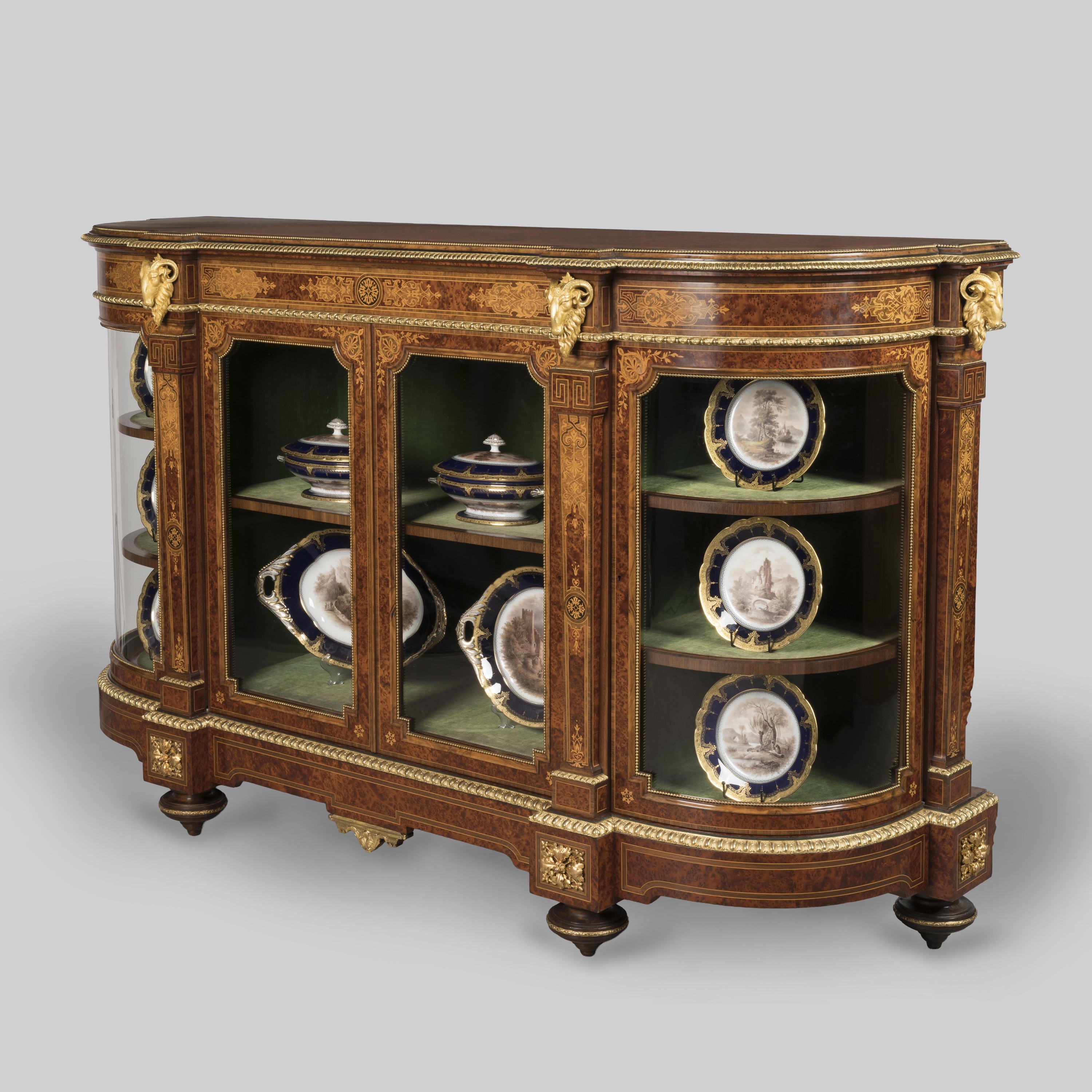
An Important Marquetry Side Cabinet, attributed to Holland & Sons, made for Whitbourne Hall in 1866. The cabinet bears many similarities to the royal furniture made for Marlborough House around the same time. Butchoff Antiques, London.
Jackson & Graham of Oxford Street was particularly associated with Louis XVI Classicism in revival form. The firm’s exhibition pieces were technically ambitious, and their work appeared at the Crystal Palace in 1851 and at later international exhibitions. Morel & Seddon, working in the 1820s and 1830s, supplied much of the furniture for Windsor Castle, often executing designs by A.W.N. Pugin, and produced the carved Liver Bird armchairs for Liverpool Town Hall in 1829 at a recorded cost of just over £501 for a set of forty. To these names should be added the Blake family of marquetry cutters, whose work from the 1820s onwards turns up in pieces by E.H. Baldock and others. The British Victorian trade was a network of interlocking workshops, and the best surviving pieces frequently passed through several hands before reaching the customer.
The Great Exhibition of 1851
The Crystal Palace did not invent the contradictions of Victorian furniture but it gathered them in one building. The most ambitious exhibits were the so-called "Virtuoso" pieces, made not for domestic use but to demonstrate a firm’s technical reach. Thomas Sopwith’s "Monocleid" cabinet, designed in the mid-1830s and exhibited at the Crystal Palace over twenty years later, took its name from the single key that operated its many locks at once; the design remained on the trade circuit and was copied into the 1840s and beyond. Gerrard Robinson exhibited carved sideboards whose panels held entire narrative scenes, the kind of object designed to be looked at for half an hour rather than glanced at over breakfast. Robinson kept making such pieces in the 1890s, long after taste had moved on. Jackson & Graham showed cabinets that combined Louis XVI Classicism with English execution, and several Indian and Chinese exhibits introduced to a mass British audience the lacquerwork, ivory inlay and bamboo forms that would feed the late-century vogue for the Anglo-Indian and the Aesthetic.
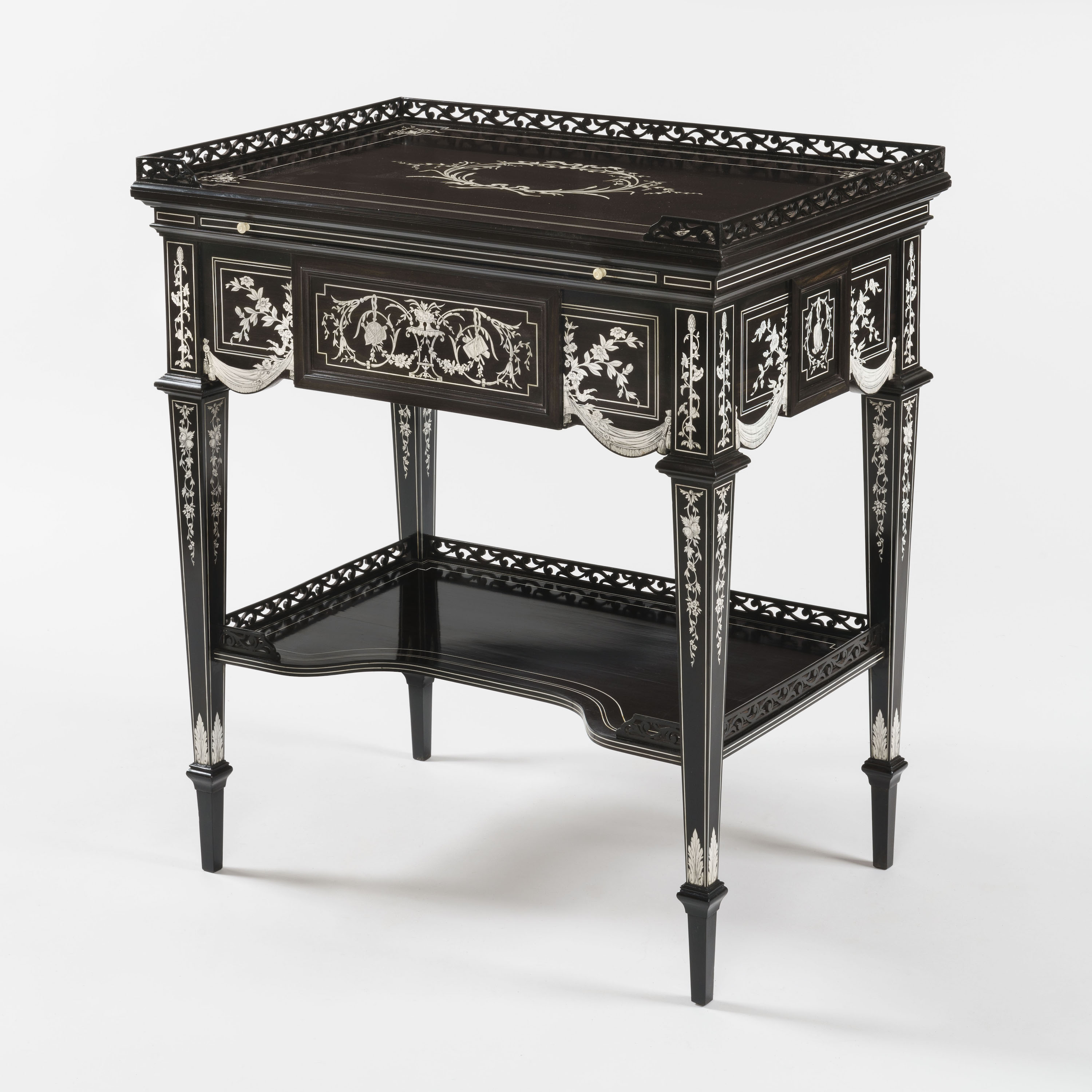
Absolutely faultess in execution, this ebony and ivory-inlaid Louis XVI style table attributed to Jackson & Graham represents the epitome of Victorian "virtuoso" furniture. The cabinetmaker, against all odds, has set himself the challenge of translating an 18th century ormolu-mounted table (today at Waddesdon Manor) in two dimensions simply using veneers and marquetry. Butchoff Antiques, London.
The reaction to all this was not entirely admiring. Henry Cole, who had organised much of the Exhibition, was among those who saw machine-replicated ornament as evidence of a coarsening of taste. So was the designer Owen Jones, whose response was more constructive. In 1856 Jones published "The Grammar of Ornament", a survey of decorative pattern drawn from Egyptian, Greek, Moorish, Indian, Chinese and medieval European sources, proposing a basis for design that was both historical and disciplined rather than the riot of mismatched ornament that had filled so many of the Crystal Palace exhibits. The institutional consequence was the founding of the South Kensington Museum in 1857, now the Victoria and Albert Museum, with the explicit aim of educating manufacturers and the public alike in what its founders considered correct principles. The Crystal Palace closed in October 1851, but its arguments about machine, ornament and taste remained in circulation for the rest of the century.
Material, Industry, and the Question of Taste
Mahogany held its position as the dominant Victorian timber, prized for its hardness, fine grain and the deep reddish patina it acquired with age. Rosewood, distinguished by its dark figured streaks and the floral scent released when freshly cut, was reserved for show pieces in the parlour and the smaller cabinet trade. Walnut found its way into bedroom suites, and oak became the timber of choice for Gothic Revival commissions and, later in the century, for the Arts and Crafts movement. The visible surface of all but the cheapest furniture was finished in French polish, a labour-intensive technique in which many thin layers of shellac dissolved in alcohol were rubbed onto the wood with a cloth-wrapped pad called a "rubber", building a glassy depth without burning the timber beneath. White or grey Carrara marble was set into washstand and dresser tops, and cast brass handles in teardrop or batwing form completed the standard hardware vocabulary.
The single most consequential interior innovation of the era was the coil spring, patented for furniture use in 1828. Set into a webbed seat frame and tied down beneath horsehair stuffing, the spring allowed for the deep tufted upholstery of the Victorian sofa and the gentleman’s library chair. Buttons pulled the upper cover down through the stuffing and anchored it to the frame, creating the puffed and indented surface that distinguishes Victorian seating from the harder forms of the previous century, with London upholstery firms such as Howard and Sons of Berners Street building reputations on the depth and longevity of their sprung seating. By the 1860s a deeply tufted parlour suite was within reach of any prosperous middle-class household.
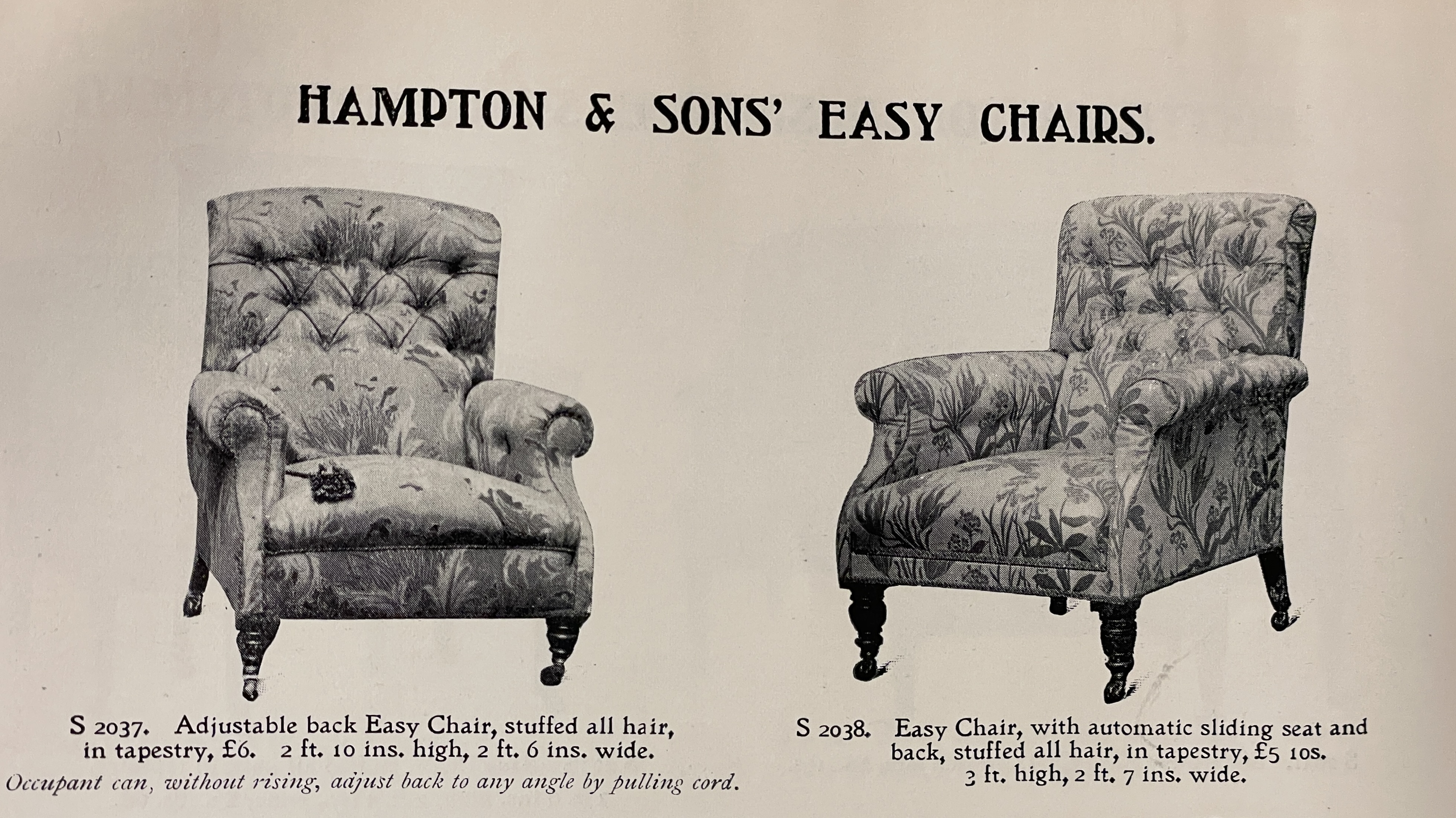
A catalogue from Hampton & Sons, showing the modern new coil sprung seating which was also famoulsy produced by competitors such as Howard & Sons. Catalogue scan from the Butchoff Antiques archive, London.
The industrial workshop transformed the production economy of furniture without entirely displacing the hand. The circular saw could cut veneers at a fraction of the cost and to a fraction of the thickness possible by hand. Steam-powered lathes produced turned legs and bobbin spindle work at volumes the workshop of 1830 could not have matched. The band saw, in widespread use from the 1850s, opened a more difficult possibility: mechanising the curved S-shaped components that had defined Rococo Revival cabinet making, work previously done with a hand-held bow saw. The cost of these gains was the slow displacement of the master cabinetmaker by the factory foreman. By the 1870s a single workman in a large London or Lancashire factory might do nothing but turning, or nothing but polishing, all day. The same machinery that produced a finely cut Gillows veneer also produced shallow paper-thin facings on cheap pine, painted to mimic flame-figured mahogany or, more brazenly, grained to imitate marble. The "honesty of materials" debate, audible in the criticism of the Crystal Palace and given its full intellectual form by John Ruskin, asked whether furniture should declare what it was, and would shape the next generation’s design reform.
The Reform Movement and the Aesthetic Turn
The first widely read response to the over-decoration of mid-Victorian taste came from Charles Eastlake, whose "Hints on Household Taste in Furniture, Upholstery and Other Details", published in 1868, sold steadily on both sides of the Atlantic for the better part of two decades. Eastlake argued for solid construction, simple geometry and a rejection of the factory-made imitations that had multiplied since the Crystal Palace. Furniture in what came to be called the Eastlake style favoured oak over rosewood and exposed joinery over French-polished surfaces. Chamfered edges replaced moulded ones, and decoration tended towards low-relief incised lines rather than the deep carving of the previous decades. It was a reform aimed squarely at the middle-class household.
The deeper intellectual argument came from William Morris, whose firm Morris, Marshall, Faulkner & Co. was founded in 1861 and reorganised as Morris & Co. in 1875. Morris’s hostility to factory production was not merely aesthetic but ethical, descending in a direct line from John Ruskin’s writings on the dignity of labour. He insisted on visible craftsmanship and on the medieval workshop model, in which the maker’s hand was present in every part of the object. The "Sussex" chair, a lightweight rush-seated armchair adapted from a country pattern and produced by Morris & Co. from the 1860s onwards, became the symbolic object of the Arts and Crafts movement: cheap to produce, easy to live with, and unmistakably the work of a hand rather than a machine.
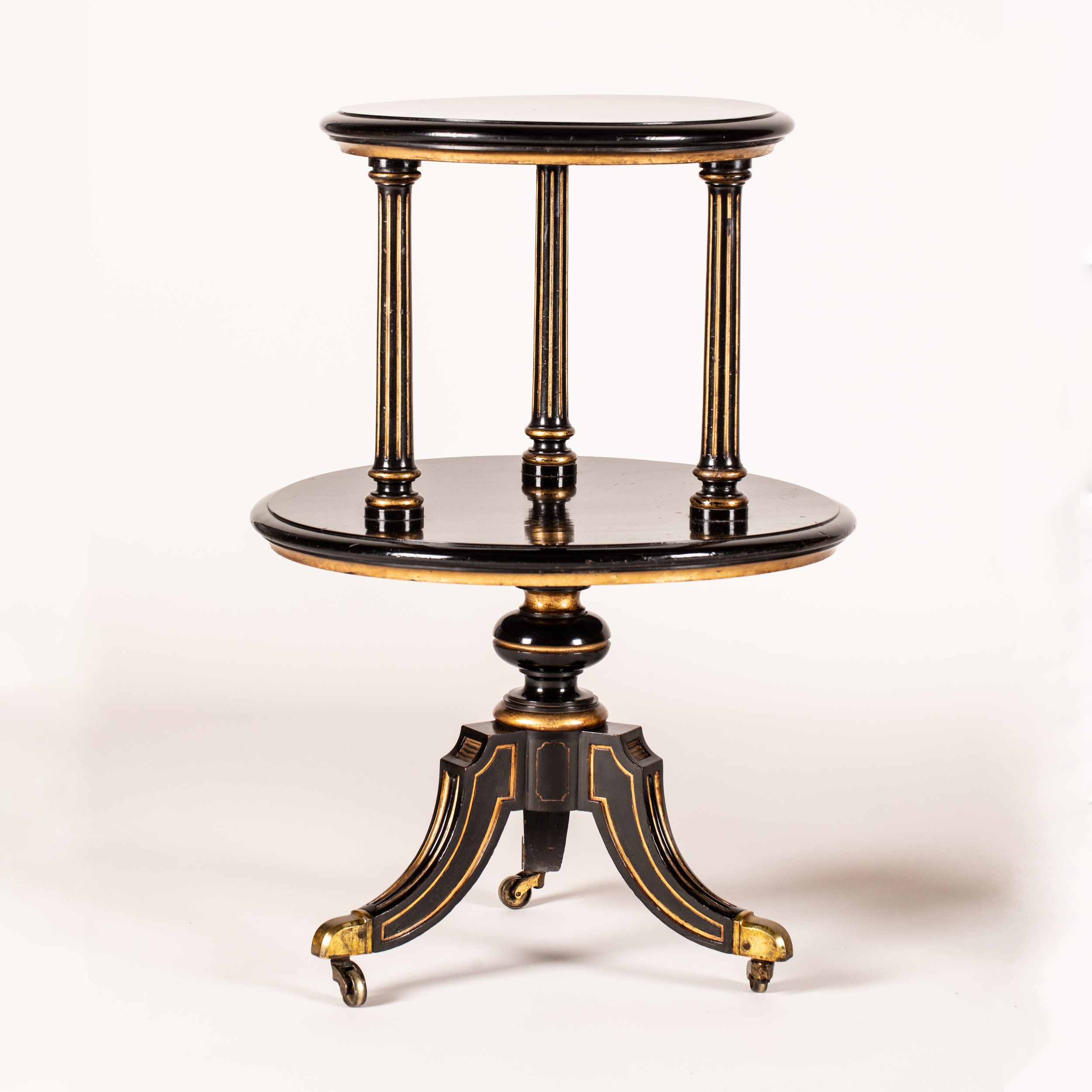
This black ebonised and lacquered table, one of a pair, with its incised ornament, replaced the dark and heavily carved furniture which was popular in the early Victorian period. Butchoff Antiques, London.
The Aesthetic Movement followed a different but related thread, drawing on the Japanese woodblocks and lacquerwork that began arriving in Britain in the 1860s and 1870s after the opening of Japanese trade. Designers such as E.W. Godwin worked in ebonised wood with sparse incised line and asymmetric form, in deliberate rejection of revival vocabulary; the Anglo-Japanese cabinet became a fixture of the more advanced drawing room. By the closing decades of the century the dense, dark, heavily carved furniture of the 1850s had ceased to be the unquestioned standard. Edwardian production, a pronounced lightening of touch already visible in the 1890s, would carry forward the discipline of the reform movement without its moralism. By 1900, ebonised forms, oak frames and pale upholstery had displaced the dense walnut and dark velvet of forty years earlier in the more advanced commissions.
Collecting Victorian Furniture Today
The Victorian market today is large and uneven. Anonymous mid-19th century trade furniture, plentiful in country auctions and provincial dealers’ rooms, sells at prices that often disappoint the consigning family; named workshop pieces, by contrast, have held their value and in many categories continued to appreciate. The difference is rarely visible at a casual glance. Both kinds of furniture may share the same dark mahogany, the same buttoned upholstery and the same revival vocabulary, but a Gillows dining suite stamped with the firm’s name and supported by a Lancaster archive entry occupies a different category entirely from an unattributed cabinet of similar form.
For collectors and interior designers approaching the period, a few points of close attention repay the effort. Maker stamps, brand burns and labels are the starting place: Gillows of Lancaster, Holland & Sons, Jackson & Graham and Edwards and Roberts sometimes marked their work, and the presence of a stamp can affect value. Nevertheless, quality remains of absolute importance whether a piece is stamped or not. The condition of the original finish matters almost as much. Old polish that has been stripped and replaced loses much of the lustrous depth that distinguished the surface in the first place, and overcleaned brass mounts read as later interventions. Provenance, where it can be documented through house sale records, commission ledgers and family inventories, makes the difference between an attribution offered with confidence and one offered with hope.
The strongest Victorian furniture, particularly the named cabinetwork of the principal London and Lancaster firms and the early Gothic Revival pieces of the Pugin circle, continues to occupy serious auction sales. Pieces of comparable quality from the eighteenth century are often unobtainable to all but the largest collectors; the best Victorian equivalents remain available through specialist dealers such as Butchoff Antiques.
Written by Rainier Schraepen

Louis XV: The Triumph of Rococo Elegance
When Louis XIV died in 1715, the court fled Versailles. The great palace was too cold, too vast, and too freighted with the dead king’s memory to suit the new regime of Philippe d’Orleans, regent for the child Louis XV. Courtiers returned to Paris and commissioned a new kind of townhouse. The hôtel particulier was conceived for a different sort of life: intimate rooms for private conversation, small salons for card parties and cultivated company, boudoirs for reflection, and dining rooms set apart from the kitchens by hidden service passages. The furniture required to equip these rooms had yet to be invented, and when it emerged it would define Louis XV furniture as we now know it: lighter, smaller, curved, and devoted above all to the pursuit of comfort.
Within twenty years, Parisian ébénistes and menuisiers had produced what would be recognised as the highest expression of French taste. The style is defined by the cabriole leg, the bombé front, the asymmetrical shell, and a concern with ease and privacy no previous century had thought to build into its furniture. It is also defined by the relationships that produced it: the cabinetmaker and the bronze-chaser, the guild craftsman and the merchant, the king’s mistress and the porcelain factory. The rocaille aesthetic reached every court in Europe, passed from fashion at the end of the eighteenth century, then returned in triumph in the nineteenth. Much of what the market today describes as Louis XV belongs to that second age rather than the first.
From Regence to Rocaille
The style did not arrive fully formed. It grew out of the Regence, the transitional period between 1715 and roughly 1730, when the heavy vocabulary of the Grand Siècle was gradually loosened. Charles Cressent, trained as a sculptor before becoming cabinetmaker to the Regent, gave these years their most inventive furniture: commodes with bombé fronts and sinuous cabriole legs, still broadly symmetrical but softened by a new fondness for curve and foliage. The cabriole leg, its profile drawn from the silhouette of a goat’s limb, replaced the turned baluster and the pegged stretcher. A chair could now stand on four curved legs without the heavy framing the previous age had required, and this single change did more to transform the silhouette of French furniture than any other.
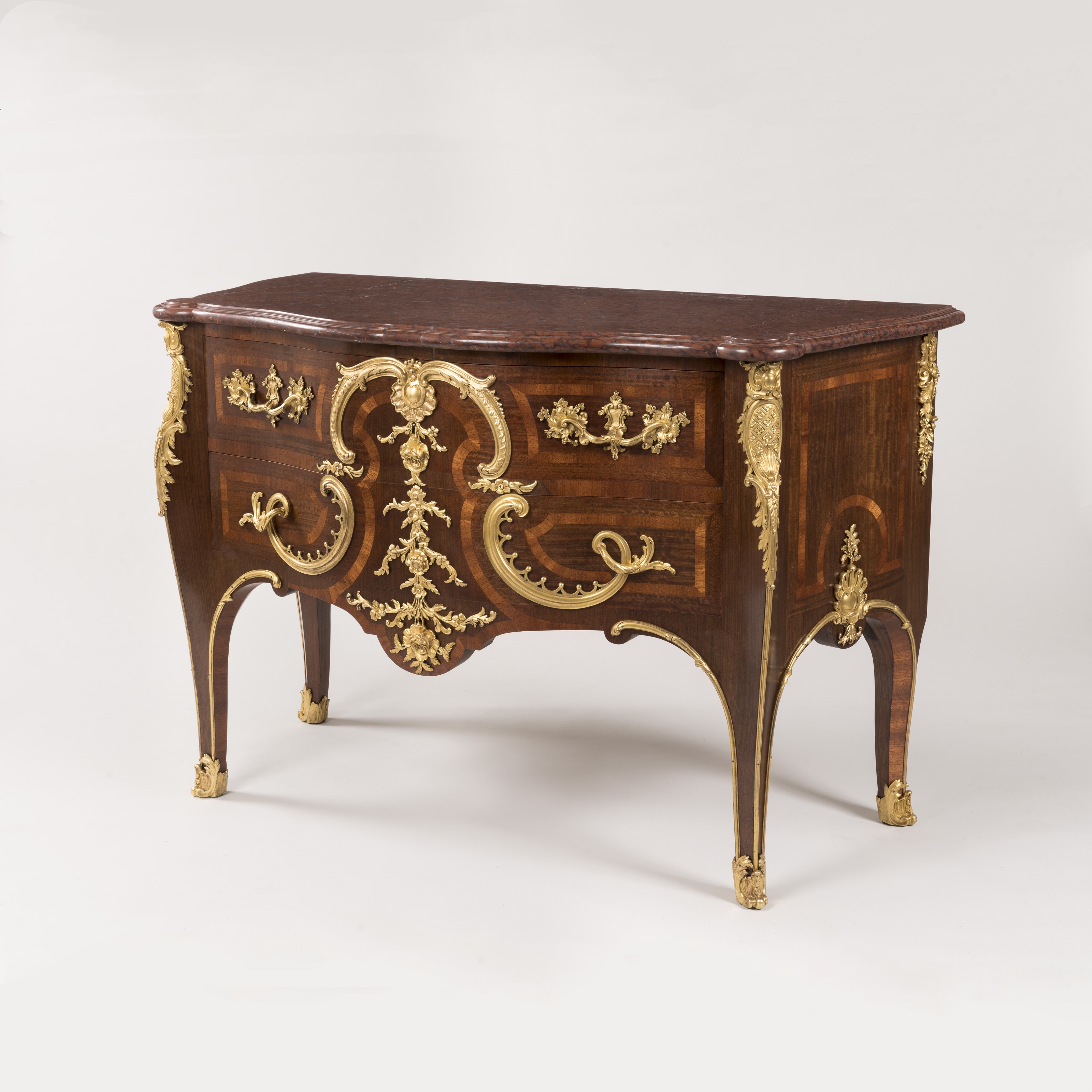
This commode has all the hallmarks of an original Charles Cressent design, who softened the rigid lines of the Louis XIV period by introducing curved bombé fronts, cabriole legs, and serpentine C-scrolls in the ornament. One of a pair, made by Durand, circa 1880, with Butchoff Antiques, London.
By the early 1730s the Regence had given way to the full Rococo. The shift is most often associated with Juste-Aurele Meissonnier, a Savoyard silversmith whose published engravings abandoned bilateral symmetry altogether. His chimneypieces and table settings proposed a balanced asymmetry he called contraste, and the taste spread rapidly from the luxury trades to cabinetmaking. Shells and rocaille ornament, named for the pebbled shellwork of earlier French garden grottoes, became the signature motifs of the new manner, joined by C-scrolls, S-scrolls, and the long acanthus leaves that flowed across the gilt-bronze mounts of the finest commodes. Chinoiserie and singerie, depicting idealised Chinese scenes and monkeys dressed as courtiers, added a note of exotic wit. By 1740, the style rocaille was the established language of the Parisian interior.
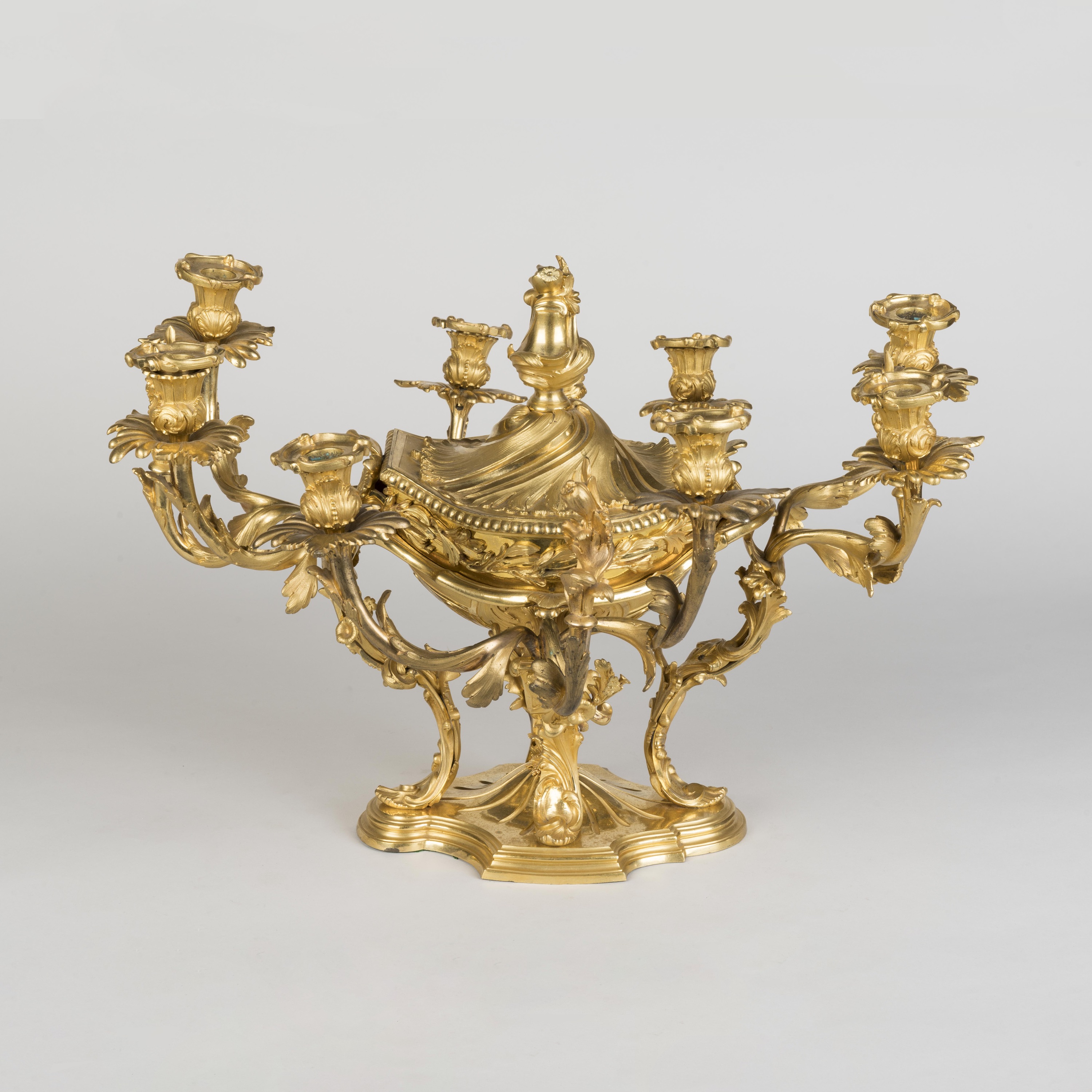
This ormolu Rococo centrepiece, with its curved arms, acanthus leaf decoration and balanced asymmetry is derived from Meissonier's published designs. Previously with Butchoff Antiques, London.
The Rococo did not last. By the early 1760s a reaction was underway. The discoveries at Herculaneum and Pompeii, widely published from 1757, introduced a vogue for antique precedent the rocaille could not accommodate. Curves began to straighten and commodes gained pilastered corners and fluted legs. By the close of the reign in 1774 the furniture being delivered to the royal residences was, in essentials, already the Louis XVI style. The transition is easy to read in the work of Jean-François Oeben, whose early pieces belong to the full Rococo and whose last works, completed by Riesener after his death, anticipate the classical restraint of the next reign.
The New Grammar of Comfort
If the old furniture of Versailles had been designed for ceremony, the new furniture of Paris was designed for conversation. Two words governed the thinking of the age, commodité and bienséance, and between them they produced an explosion of specialised forms.
The fauteuil, the open-armed upholstered armchair, was the workhorse of the salon. A fauteuil à la reine had a flat back, intended for placement against a wall; a fauteuil en cabriolet had a concave back that followed the spine and was drawn into the centre of the room. The bergère, deeper and wider, with closed upholstered sides and a loose seat cushion, offered an enveloping comfort unknown in the previous century. The marquise, broader still, was effectively a one-and-a-half-person seat designed to accommodate the hooped panier skirts worn at court. The duchesse brisée, made in sections that joined as a chaise longue, allowed a woman to recline during the morning toilette.
The case furniture was equally specific. The commode, invented under Louis XIV, reached its mature form under Louis XV. The bombé commode, with doubly curved front and sides, stood on high cabriole legs and was finished on every surface because it often stood in the centre of a room. It was the most prestigious piece an ébéniste could produce. The bureau plat, freed from stretchers and standing on cabriole legs, replaced the older writing cabinets and allowed a minister or scholar to work in the open, usually with a cartonnier alongside for papers and correspondence.
Smaller tables multiplied with the interior’s social demands. The chiffonnière held needlework; the table à jeu had a reversible top with a playing surface on one side and a marquetry panel on the other; the rafraîchissoir held wine and glasses at intimate suppers. The bonheur-du-jour, introduced at the end of the reign, was a light lady’s writing desk with a tiered superstructure of drawers, designed to be carried between bedroom and boudoir.
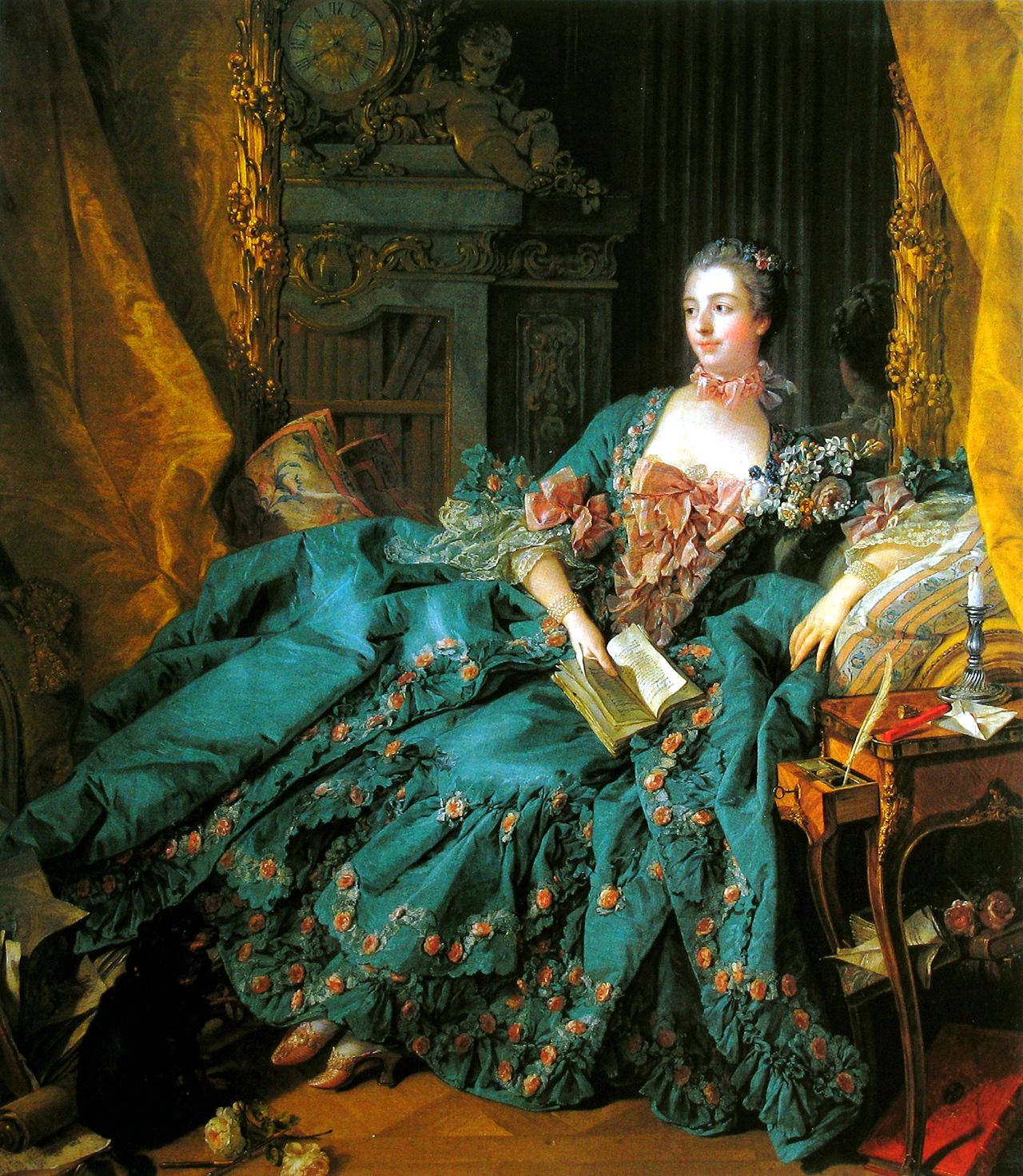
Madame de Pompadour, sitting next to a fashionable table à chiffonière, portrayed in 1756 by François Boucher (Alte Pinakothek, Munich).
The reign also made room for virtuoso mechanical furniture, the meubles à combinaisons. Jean-François Oeben, named ébéniste du roi in 1754 and granted a workshop in the Manufacture des Gobelins, built his practice around it. His desks contained hidden compartments released by concealed springs and writing surfaces that slid forward under a tambour shutter. The bureau à cylindre, the roll-top desk, was his most important invention. The form culminated in the bureau du roi, begun by Oeben in 1760 and completed by Riesener in 1769, a piece on which marquetry, mechanism, and gilt-bronze reached a pitch no later maker has surpassed.
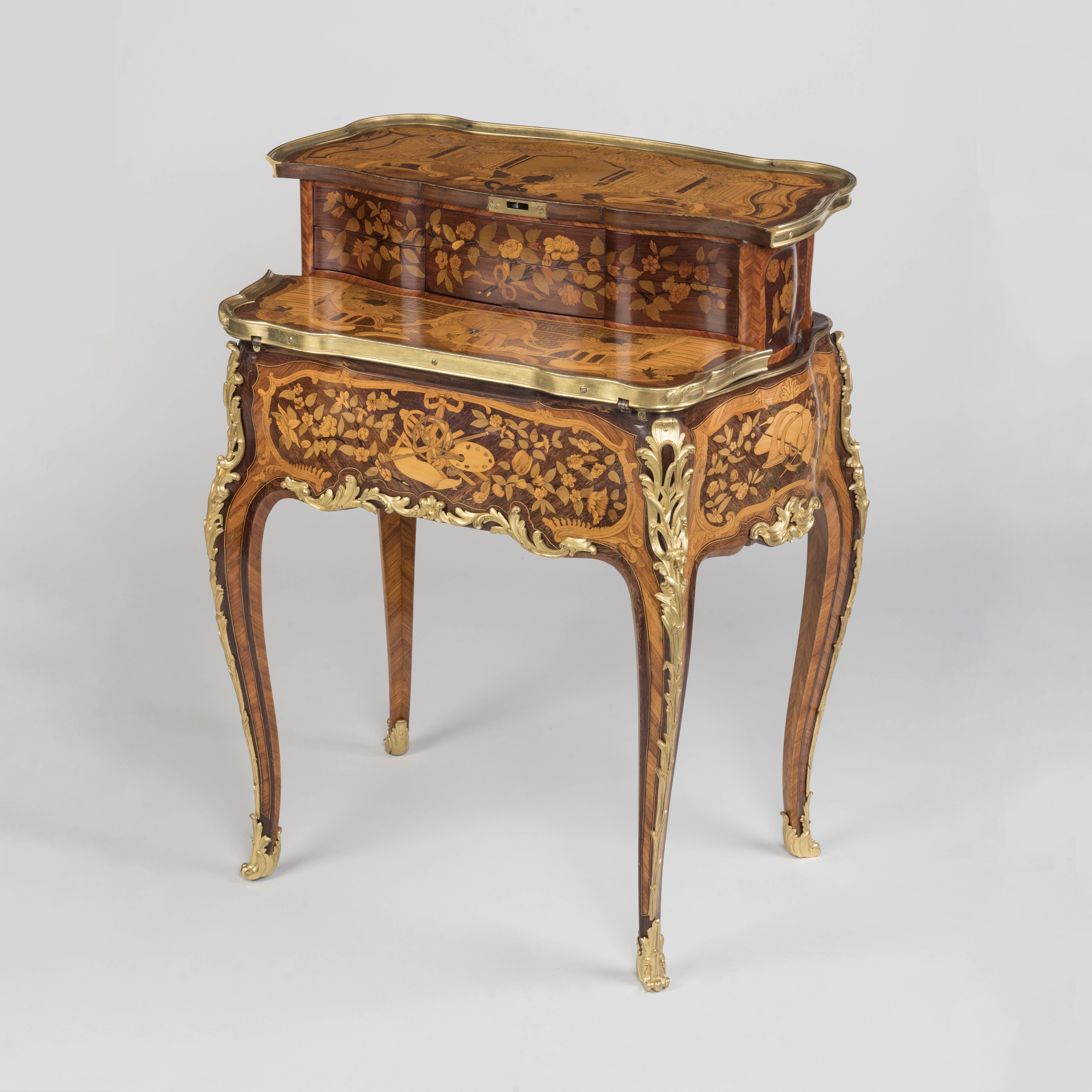
Louis XV furniture, especially that designe by Oeben, often incorporated mechanical marvels which allowed for a plethora of hidden compartments and special features, often using spring-loaded actions or clever lever systems. This 19th century table pays hommage to Oeben's example made for Madame de Pompadour'd bedroom at Versailles.
Ébénistes, Menuisiers, and the Guild Stamp
The production of Louis XV furniture was governed by one of the most rigorous craft guilds in Europe. The Corporation des Menuisiers-Ébénistes divided its masters into two strictly separated branches. The menuisier worked in solid wood, producing seat furniture, beds, consoles, and carved architectural elements whose surfaces were painted, gilded, or left in the natural grain. The ébéniste worked in veneer, laying thin sheets of exotic hardwoods over a stable oak carcase to produce commodes, secrétaires, and cabinets at the highest end of the market. A master of one branch could not legally practise in the other.
Candidates spent years as apprentices and journeymen before being admitted as masters on presentation of a chef-d’œuvre. Once admitted, they struck their name into the underside of every piece they produced. A second mark, JME, stood for jurande des menuisiers-ébénistes and was applied by the six jurés who inspected furniture before it left the workshop. The obligation to stamp became universal from 1743, and these two marks are the foundation on which serious attribution still rests. A piece without any stamp is not necessarily suspect, since the ébénistes du roi operating under direct royal patent were exempt from guild jurisdiction, but any piece bearing a stamp can usually be placed with some precision in the career of a known maker.
The named cabinetmakers of the period form the core of every French furniture reference library. Bernard II van Risen Burgh, stamped BVRB in capitals to preserve the commercial secrecy of his name, specialised in lacquer-mounted commodes and small tables supplied through the marchands-merciers to the court. His combination of Japanese or Chinese lacquer panels, chased gilt-bronze, and end-grain floral marquetry drew the leading merchants of luxury goods directly to his workshop. Pierre Migeon, patronised by Madame de Pompadour, was responsible for a large share of the small writing furniture of the mid-century. Jacques Dubois, admitted master in 1742, produced vividly coloured marquetry commodes and bureaux in the full Rococo manner. Martin Carlin, a German-born maker who married into the Oeben family, specialised in the jewel-like case pieces mounted with Sèvres porcelain plaques that defined the last fashionable years of the reign.
Among the menuisiers, Jean-Baptiste Tilliard, his son, and Nicolas-Quinibert Foliot supplied the crown with the seat furniture that formed the structural backbone of the Rococo salon, carved in beech and walnut and painted or gilded.
The Marchands-Merciers
The makers had one further master. The marchands-merciers were the luxury merchants of Paris, a trade corporation distinct from the craft guilds, and they occupied the commercial territory between the cabinetmaker and the client. Forbidden from making anything themselves, they combined objects from different sources, adding new mounts, panels, and finishes as fashion required. In practice they were the interior designers of the age, and during the reign of Louis XV they directed the Rococo style as effectively as any maker.
Lazare Duvaux, whose Paris shop supplied Madame de Pompadour and much of the court through the late 1740s and 1750s, is the best-documented figure of the trade. His surviving livre-journal, covering 1748 to 1758, records sales to the duc d’Orleans, the Prince de Conti, and dozens of other clients, and it is an essential primary source for the period. Duvaux would order an unmounted commode from BVRB, send it to a fondeur for gilt-bronze mounts, supply panels of lacquer or porcelain, and deliver the finished piece to the client’s hôtel with an itemised bill. His competitors, Thomas-Joachim Hébert earlier in the reign and Simon-Philippe Poirier at the end, operated on the same principle.
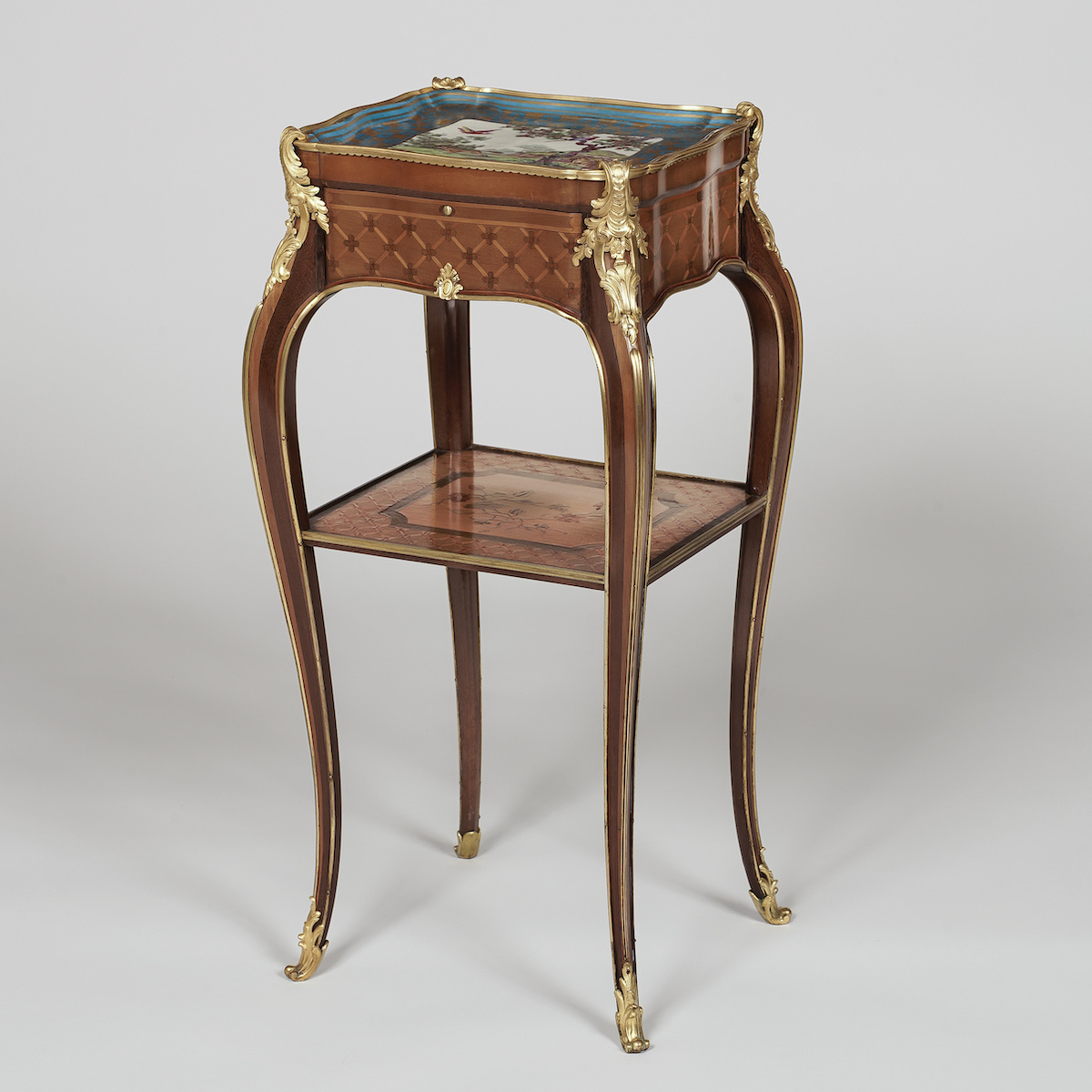
This porcelain-mounted table is a Louis XV design by Roger Vandercruse, who's furniture often incorporated custom-made porcelain plaques made by Sèvres on the request of Poirier. This version, made around a century later using all the same material and techniques, even incorporares an identical porcelain plaque to the prototype from the 18th century which can be seen at the Wallace Collection in London. Butchoff Antiques, London.
The marchands-merciers also made the international sourcing of materials possible, linking Parisian craftsmen to the trade routes that brought Japanese and Chinese lacquer screens to Europe through the Dutch East India Company. A screen might be purchased at Amsterdam, dismantled at the shop, and its panels cut down and fitted to French carcases made specifically to receive them.
Poirier’s contribution was the development of Sèvres-mounted furniture. From the late 1750s he commissioned porcelain plaques from the factory and had them set into tables, writing desks, and jewel cabinets by BVRB, Carlin, and later Roger Vandercruse Lacroix. The result had no precedent in European production, and it became the defining fashionable object of the last Louis XV years.
Materials, Mounts, and the Coloured Palette
The furniture has reached us in browns and soft gilt, a ghost of the original. Two and a half centuries of sunlight and oxidised varnish have muted the Louis XV palette almost beyond recognition. A commode by BVRB or Jacques Dubois, freshly delivered from the workshop, glowed. Its tulipwood and kingwood marquetry was still pink and violet, set against the clear yellow of stained holly and the sea-green of dyed sycamore. The bronze mounts caught the candlelight on fresh shellac. In a Rococo interior whose panelling was pale blue or rose, the furniture was part of the colour scheme, not a foil to it.
The preferred veneers came from the exotic hardwoods of Central and South America and the East Indies, supplied through Cadiz, Bordeaux, and Lorient. Bois de rose (tulipwood) and bois de violette (kingwood) were the staples, often laid together in geometric parquetry of diamonds, cubes, or sunbursts. The great innovation of the period was bois de bout, end-grain marquetry, in which wood was cut across the grain for a softer, more painterly effect. Oeben and his circle used it to compose the floral bouquets and trophies of musical instruments that define the marquetry of the reign.
Gilt-bronze, or ormolu, gave Louis XV furniture its characteristic shimmer. The mounts were cast by fondeurs using the lost-wax process, chased by ciseleurs, and gilded by doreurs-sur-métaux using an amalgam of gold and mercury driven off the bronze by heat. The process was toxic and the lives of the gilders were short, but it produced a finish of extraordinary richness. A master mount from the mid-century carries three or four distinct textures within a single casting: matte, burnished, punched, and stippled. The gold lies on the surface with a soft, moonlight quality that later electroplated mounts have never reproduced. On the finest pieces the mounts were modelled from the same drawing that governed the marquetry.
Imported lacquer was the most expensive veneer. Japanese and Chinese screens, supplied by the marchands-merciers, were cut down and applied to commode fronts, their black or red grounds counterpointing the gilded bronze. Where imported lacquer was unavailable, the Parisian vernis Martin took its place. Developed by the four Martin brothers under a royal patent of 1730, it was compounded of resin, oil, and pigment, built up in thin layers, and polished to a glassy surface in vivid greens, reds, and blues.
Madame de Pompadour and the Politics of Taste
Louis XV installed Jeanne-Antoinette Poisson at Versailles as maîtresse-en-titre in 1745. For the next twenty years she ran what amounted to a cultural ministry, choosing architects, directing painters and sculptors, and taking charge of the decorative arts. Her residences at Bellevue, Crécy, and the Hermitage (at Versailles) became laboratories of taste that the aspirant class imitated.
Her most consequential intervention was the rescue of the Vincennes porcelain factory in 1756 and its removal to Sèvres, where it came under royal protection. She selected the rose pink, the celestial blue, and the deep apple green that became its signature grounds. The Sèvres-mounted furniture developed by Poirier and Carlin owed its existence to her patronage.
She was also the patron of the most radical Rococo. What Meissonnier had launched as a designer’s provocation became, under Pompadour, the official aesthetic of the French court and, through the ordinary operation of fashion, of every court in Europe. When she died in 1764 a reaction against the rocaille was already underway, but the style she had sponsored would shape the collective idea of eighteenth-century France for the next two centuries.
The Nineteenth-Century Revival
The Rococo was out of fashion for barely half a century. The Revolution and the Empire preferred the antique, but by the 1830s taste was turning, and the Paris Exposition Universelle of 1855 confirmed that the Louis XV style had returned in earnest. The demand that followed sustained an entire generation of workshops in the Faubourg Saint-Antoine.
The revival was not a mass-market imitation; the finest examples matched, and occasionally exceeded, the eighteenth-century originals. Henry Dasson (1825 to 1896), originally a bronzier, produced Louis XV pieces in which the ormolu was modelled, chased, and gilded with a precision the Rococo itself had not always achieved. François Linke (1855 to 1946) carried the tradition into the twentieth century, winning the gold medal at the Paris Exposition Universelle of 1900 for furniture that combined Louis XV form with the inventive sculptural mounts of his collaborator Léon Messagé. Paul Sormani supplied clients across Europe from a workshop on the rue Charlot. Alfred-Emmanuel Beurdeley built his firm’s reputation on close copies of the Louis XV pieces held in the French royal collections. Zwiener, Krieger, and Millet rounded out the field.
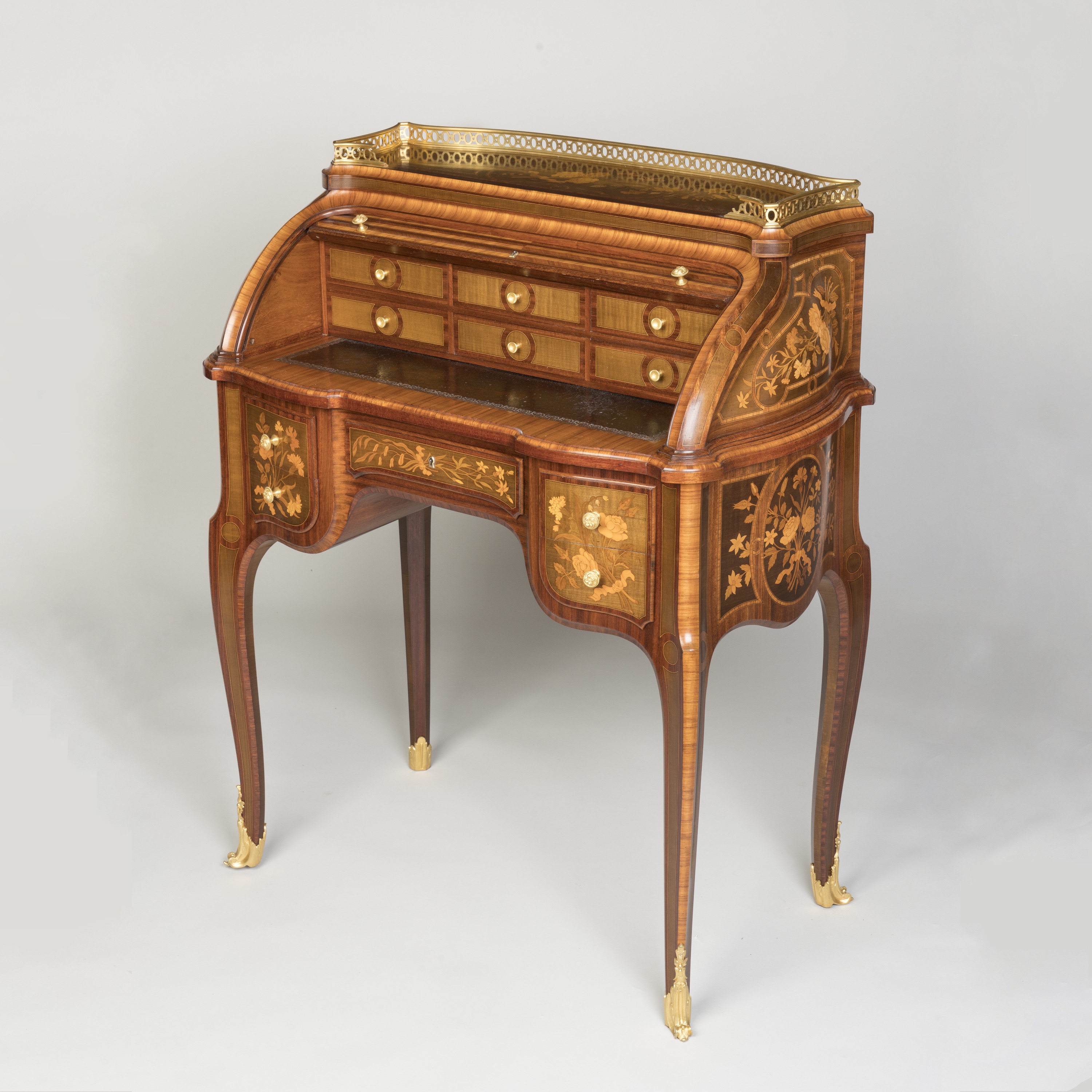
This exceptional bureau à cylindre by François Linke dates to the late 19th century, and is a version of the roll-top desk by Jean-François Oeben made around 1760 which can be seen at the Musée Nissim de Camondo. Made to the same standards using traditional techniques, the Parisian revival furniture of the Belle Époque was often valued more highly than their original 18th century counterparts.
A piece from one of these workshops is not a reproduction in the modern sense. The cabinetmakers worked from the same first principles as their eighteenth-century predecessors, used oak carcases and solid secondary timbers, and finished their bronzes by hand. A Linke commode of 1895 is a piece of Louis XV furniture made in 1895, not a fake of a piece made in 1755, and its value rests on its own qualities.
The distinction between the two periods still matters to collectors. An eighteenth-century commode stamped by BVRB or Dubois is a museum object, priced in the tens or hundreds of thousands of pounds. A revival piece by Linke, Dasson, or Sormani occupies a different but equally serious category. Eighteenth-century cabinet-work carries hand-sawn tool marks on rough undersides, hand-cut dovetails, and oak oxidised to a colour no staining reproduces.
The Furniture of Private Life
The Louis XV style has survived the collapse of the monarchy that produced it because it was the first style in the history of European furniture designed for the individual rather than the state. The Boulle of Louis XIV had served the glory of the Sun King. The Riesener of Louis XVI would serve the dignity of a philosophical age. The rocaille of Louis XV served the pleasures of a private room: the letter written at a bonheur-du-jour, the afternoon passed in a bergère. That shift of scale has kept the style in demand across two centuries, because the life it equipped, a life of comfort, conversation, and cultivated company, has never gone out of fashion.
written by Rainier Schraepen

Louis XIV: The Sun King’s Furniture Revolution
No French monarch understood the political power of beautiful objects as clearly as Louis XIV. From the moment he assumed personal rule in 1661, the Sun King set about transforming the decorative arts into instruments of royal authority, recruiting the finest craftsmen in Europe to furnish palaces of unprecedented splendour and establishing a system of state-controlled workshops that would make Paris the undisputed centre of luxury production for the next two centuries. The furniture created under his patronage was political: designed to project the majesty of the throne, to regulate the rituals of court life, and to demonstrate to every visiting ambassador and nobleman that France had surpassed Italy as the arbiter of European taste.
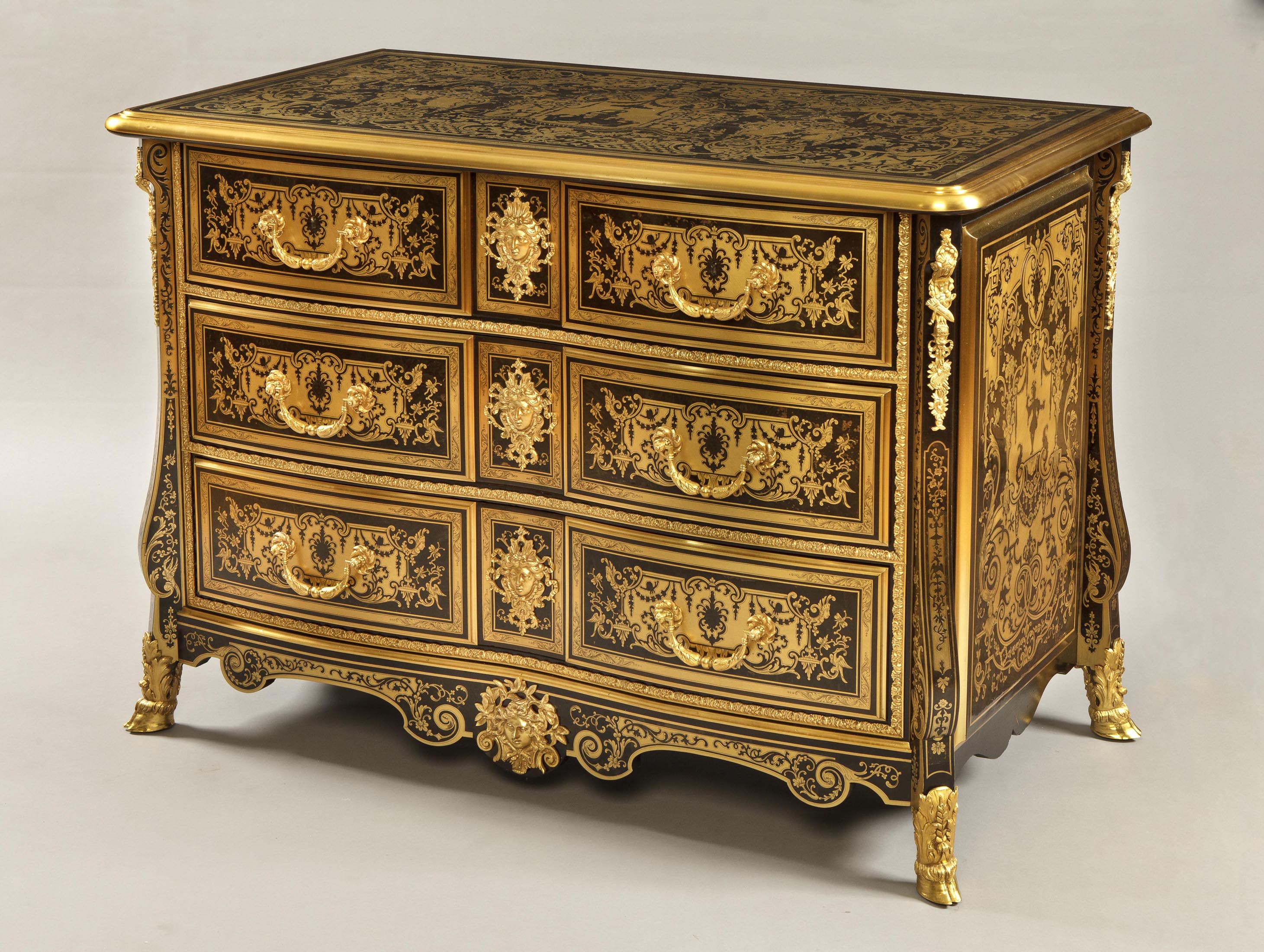
A superlative example of a Louis XIV Style commode. Even though made during the 19th century, the form and design is a pure Louis XIV era invention, and relates to commodes at the Wallace Collection in London and those supplied to the Grand Trianon by André-Charles Boule between 1708-1709. Previously with Butchoff Antiques.
The reign gave the history of cabinetmaking one towering figure, Andre-Charles Boulle, whose mastery of brass, tortoiseshell, and gilt bronze created a vocabulary of forms and techniques that has never been surpassed. It gave European interiors three furniture types that would dominate for the next three hundred years: the commode, the bureau plat, and the side cabinet. And in the Gobelins manufactory it established an institutional model for the collaboration of artists, craftsmen, and designers that no subsequent regime has equalled, along with the principle of the unified interior that would become the organising idea of every great house from Stockholm to St Petersburg.
The Manufacture Royale
The centralisation of the arts under Louis XIV had an unlikely precursor. Nicolas Fouquet, the Surintendant des Finances, had established workshops at Maincy to furnish his chateau at Vaux-le-Vicomte, and it was there that he discovered the exceptional qualities of the painter Charles Le Brun. The costly excellence of Vaux-le-Vicomte brought about Fouquet’s arrest in 1661 on charges of peculation, but it had the merit of bringing Le Brun to the attention of the young King. Louis resolved that such talent should serve the Crown, not a subject.
In 1664, Louis appointed Jean-Baptiste Colbert as Surintendant des Batiments, effectively a minister for the arts. Colbert purchased the premises of the Gobelins brothers on the outskirts of Paris, until then a tapestry workshop, and expanded them into the Manufacture des meubles de la Couronne, charged with furnishing the royal residences and developing a national style. Le Brun was placed in overall control, with a duty not only to administer the workshops but to provide all the designs used in the manufactory. His authority extended to every detail: architecture, painting, sculpture, tapestry, metalwork, and furniture were to be conceived as a single unified scheme, consecrated to the glory of the monarch.
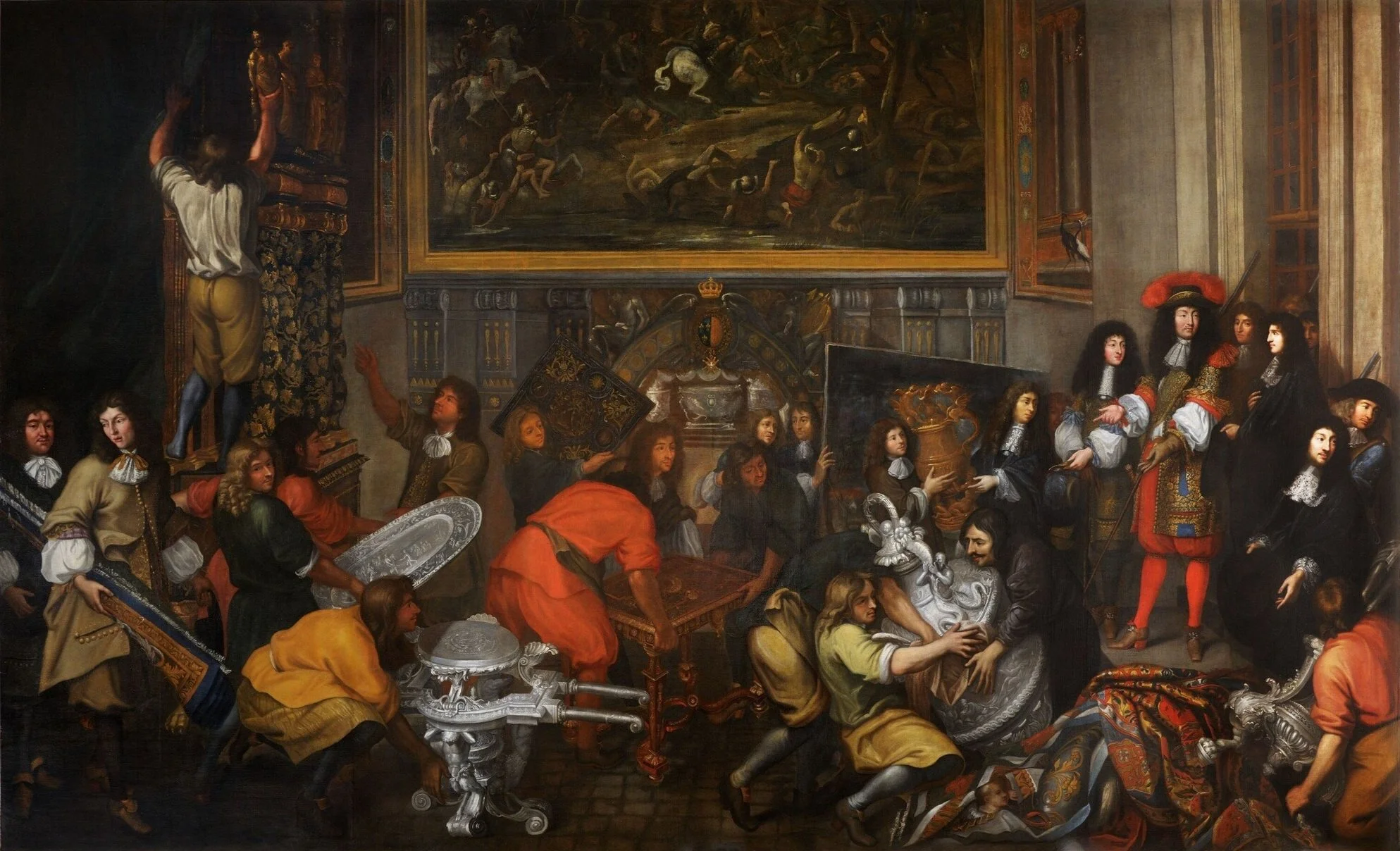
A Royal visit to the Gobelins workshops, as painted by Simon Renard de Saint-André, circa 1667-1669. A tapestry of identical design was woven at Gobelins, promoting all the riches which were produced their for the glory of the Crown.
Le Brun’s genius lay in recognising that the Gobelins could not succeed as a purely French enterprise. He retained the Flemish, Italian, and Dutch craftsmen who had been drawn to Paris, understanding that it was through collaboration with these immigrants that French workshops would acquire their unrivalled mastery. The arrangement worked. By the end of Louis XIV’s reign, Paris was internationally renowned as the premier centre for luxury goods in Europe, and French fashions in furniture and interior design spread far and wide across the Continent. A tapestry woven at the Gobelins between 1667 and 1672, still displayed at Versailles, records the moment of triumph: it shows Louis, conspicuous in shoes with red heels, accompanied by Colbert on an official visit to the workshops. Craftsmen present him with objects in silver and bronze, while the Dutch-born cabinetmaker Pierre Gole carries the top of a marquetry table and the Italian Domenico Cucci stands beside the spectacular hardstone cabinets he had made for the King at enormous expense.
Andre-Charles Boulle
The closure of the Gobelins between 1694 and 1697, brought about by the financial strains of Louis XIV’s wars, saw the rise of the man who would become the most celebrated cabinetmaker in French history. Andre-Charles Boulle had been working in the Louvre workshops since before 1666, when he became a master cabinetmaker in his early twenties. The son of a cabinetmaker and an avid collector of paintings, prints, and drawings, he had received a royal warrant exempting him from the restrictive guild regulations and was granted a patent as sculpteur en mosaique, a title that acknowledged the artistic ambition of his work.
Boulle’s name has become synonymous with the technique of decorating furniture with a marquetry of brass and tortoiseshell, a method that was employed almost continuously throughout the eighteenth and nineteenth centuries. The technique involved cutting sheets of brass and shell together, producing two versions of the same design: premiere partie, with brass on a shell ground, and contre partie, with shell on a brass ground. But this was not his only, nor even his first, skill. Boulle began as a master of wood marquetry, the “paintings in wood” inspired by Dutch and French artists such as Jean-Baptiste Monnoyer, and his metal marquetry designs were almost exclusively based on his own drawings, a reflection of his training as a draughtsman and collector.
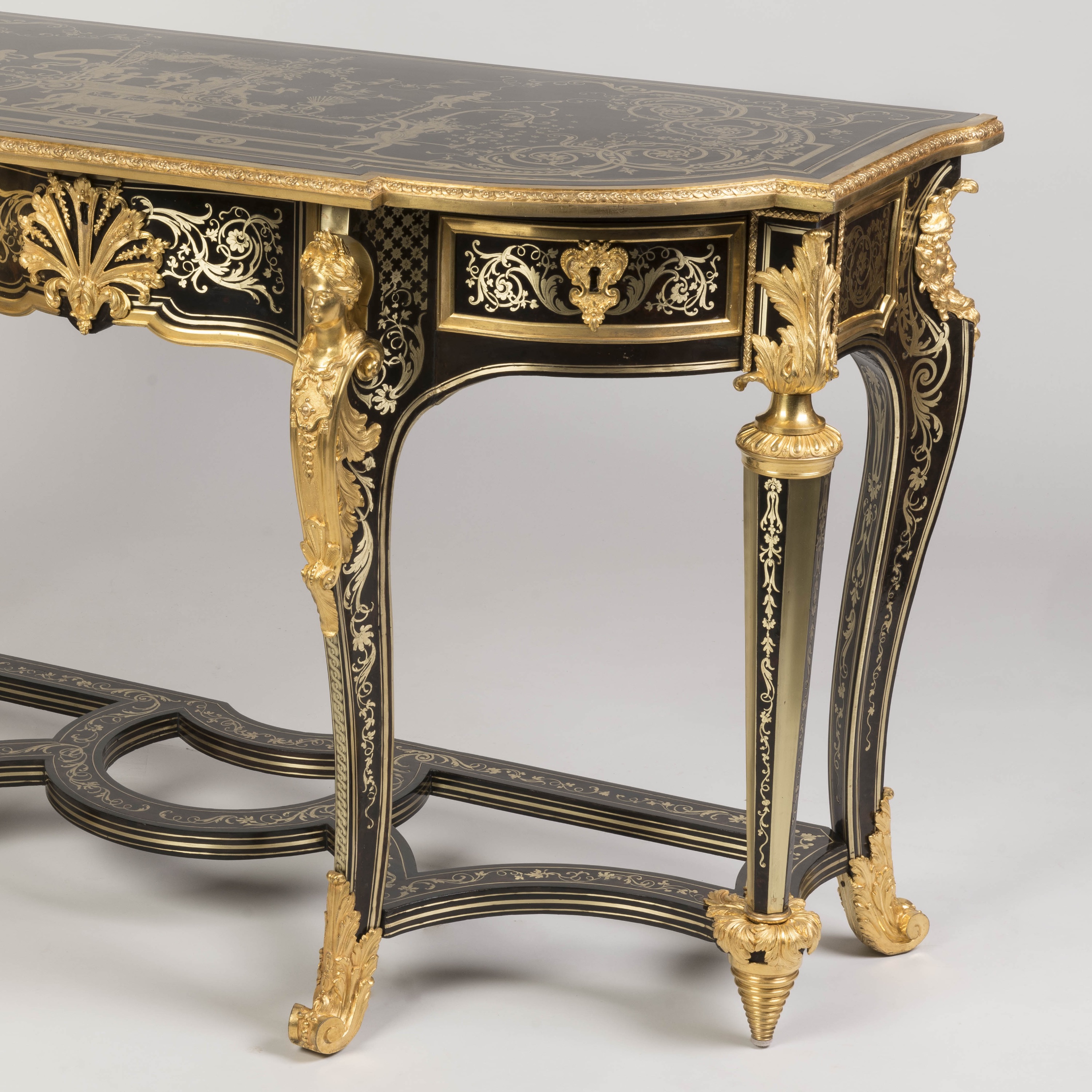
No longer merely serving a protective function, André-Charles Boulle turned metal mounts into gilded decorative masterpieces, fusing flawlessly with the shapes and forms of the furniture he designed. Butchoff Antiques, London.
What set Boulle apart from every contemporary was his complete mastery of the relationship between cabinetwork and gilt-bronze mounts. The mounts on earlier furniture had served a largely protective function, guarding vulnerable edges and corners. Boulle took them to a different, sculptural level, modelling the mounts himself and personally supervising their casting. The quality and coherence of these mounts distinguished his furniture from that of every other maker of the period, and the fusion of carcase and bronze that he perfected has been described as perhaps the most characteristic and influential innovation in furniture of the Grand Siecle. His great cupboards were the showpieces of the age. His bureau plat, with its tall sinuous legs freed from stretchers, foreshadowed a form that would dominate writing furniture for the next century. His sons perpetuated and adapted the house style of mixed-media veneers until the fall of the French monarchy in 1792, a continuity of workshop practice spanning more than a century.
The Furniture of Versailles
When the Court was installed at Versailles in 1682, the furniture in the Grande Galerie, the Salon de la Guerre, and the Chambre du Roi was almost exclusively of silver. The throne was silver. The orange-tree tubs, the ewers, the braziers, the fire-dogs, the chandeliers, and the candelabra were all of silver, hung with cut-glass pendants. It was a luxury that only Louis XIV could afford, and it announced to every visitor that France possessed wealth and craftsmanship beyond the reach of any rival. But the financial strains of frequent war brought this magnificent display to an abrupt end. The sumptuary edict of 1689 consigned the greater part of these grandiose pieces to the melting-pot, and the silver furniture of Versailles passed from reality into legend.
The loss gave an unexpected impetus to the development of gilt bronze. Cheaper than silver but no less opulent in appearance, gilt bronze lent itself as a substitute whose gold reflections added to the glittering ambience of a room lit by sunlight or candlelight. In Boulle’s hands, the material achieved an expressive power that silver had never possessed: his mounts were not merely protective or decorative but sculptural, integral to the design of the piece rather than applied to its surface. The edict of 1689, intended as an act of wartime austerity, thus launched the material that would define French furniture for the next two centuries.
The reign also saw the invention of three furniture forms that would prove equally lasting. The commode, first delivered for Louis XIV’s bedroom at the Grand Trianon in 1708, was an entirely new article of furniture, its early form resembling a sarcophagus resting on heavy feet. By 1715, Boulle had developed a lighter version with only two tiers of drawers on slender legs, and the commode would go on to become the most popular form of French case furniture for the next three hundred years. The bureau plat replaced the cumbersome writing desk with eight legs, offering a broad flat surface supported on four elegant cabriole legs. The meuble d’appui, or side cabinet, was designed to sit lower than the older cabinet on stand, allowing connoisseurs to display paintings above it, a form that would be revived with particular enthusiasm in the nineteenth century under the name credenza.
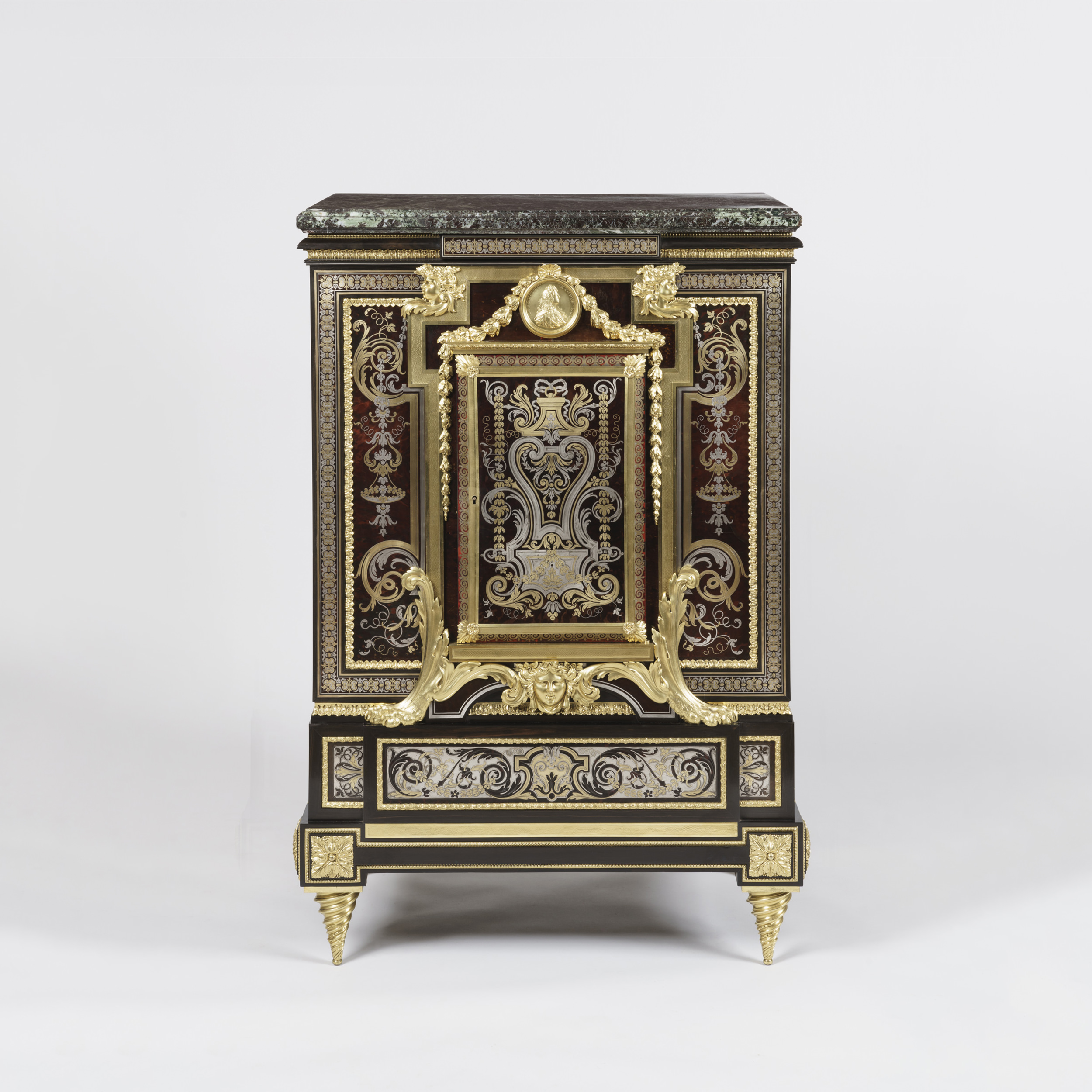
The Louis XIV ushered in a new type of cabinet, called a 'meuble d'appui' which was lower the previous Renaissance cabinets. Previously with Butchoff Antiques.
The Craftsmen of the Grand Siecle
Boulle did not work alone. The Gobelins and the Louvre workshops housed a constellation of talent, much of it foreign-born, whose collective achievement was to establish French supremacy in every branch of the decorative arts. Pierre Gole, a Dutchman, delivered his first commission for the Louvre in 1661 and continued to supply royal furniture until his death. His speciality was floral marquetry of extraordinary delicacy, and a cabinet he made for Monsieur, the King’s brother, survives in the Victoria and Albert Museum. Domenico Cucci, an Italian sculptor and metalworker, made a series of spectacular cabinets at huge expense for the King, with stunning hardstone inlays of flowers and birds produced at the Gobelins in deliberate emulation of the Grand Ducal workshops in Tuscany. These cabinets, with doors that opened to reveal series of drawers hiding collections of precious stones, were forerunners of the glazed vitrine that would develop in the following century. Alexandre-Jean Oppenordt, also Dutch-born, was given lodgings at the Louvre in 1684 and delivered twelve marquetry cabinets for Versailles before making a pair of commodes after designs by Jean Berain that anticipated an entirely new direction in furniture design.
Berain himself, appointed dessinateur de la Chambre du roi, was perhaps the most influential decorator of the later part of the reign. Where Le Brun’s vocabulary had been monumental and architectural, Berain developed a style of linear arabesques that combined the grotesques of antiquity with exotic figures in Chinese costumes, anthropomorphic monkeys, and fabulous mythological beasts. His lighter, more playful decorative language eased the transition from the heavy Baroque of Louis XIV toward the elegance of the Regence, and his influence on Boulle was so close that it is often difficult to distinguish the part played by each in the design of furniture. The decorative vocabulary of the period as a whole drew on classical antiquity with a grandeur that matched the monarch’s ambitions: acanthus, laurel, and lotus; lions’ heads, rams’ heads, griffins, and dolphins; and the royal insignia of the interlaced Ls, the fleur-de-lis, and the sunburst emblem of the Roi-Soleil, stamped on every surface as a reminder of who commanded this extraordinary enterprise.
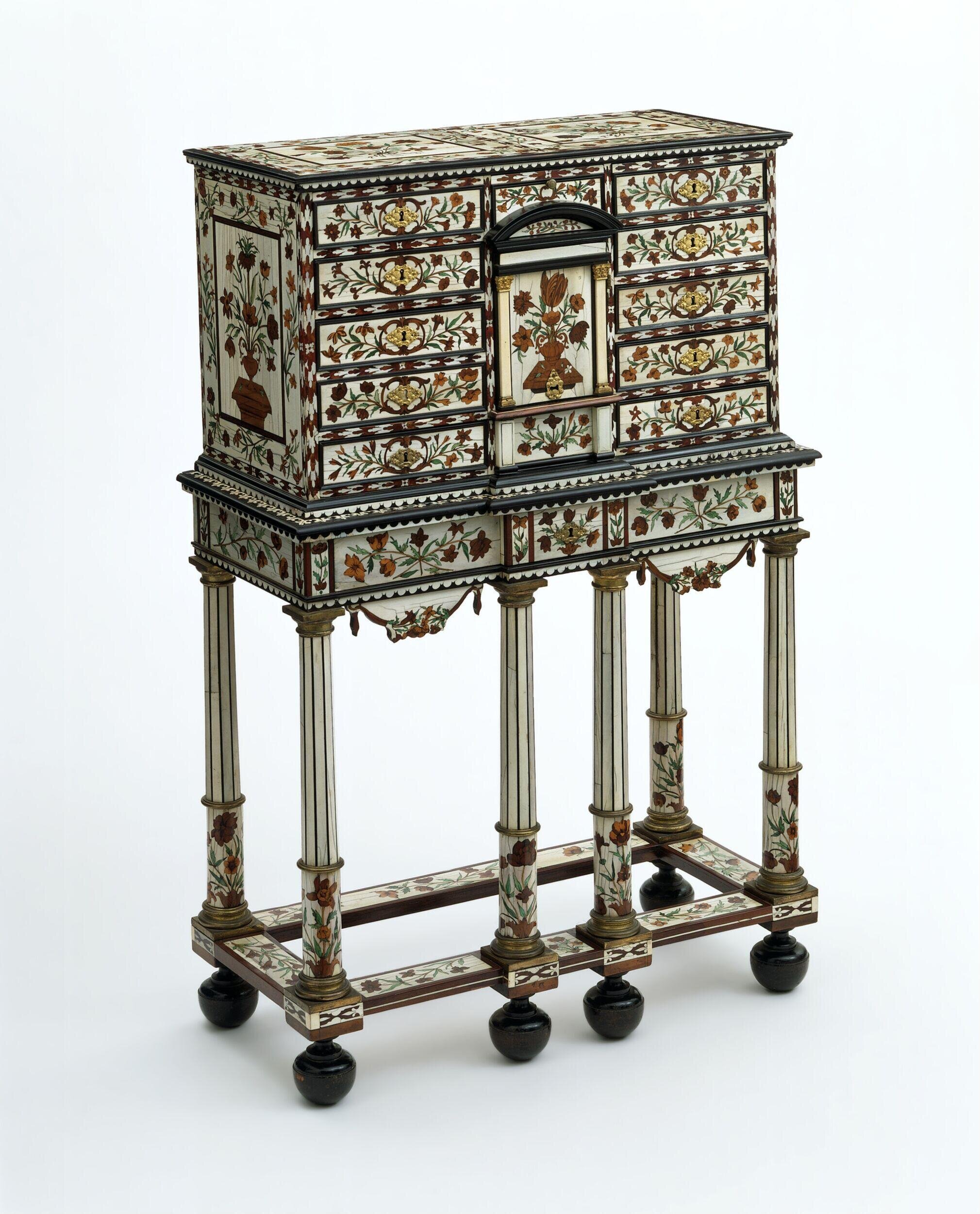
Specialising in floral marquetry, Pierre Gole was a furniture maker based at the Louvre workshops. This cabinet-on-stand (1661-1665), almost certainly made for the King's brother, is on display at the Victoria & Albert Museum in London.
The Boulle Revival
The fashion for Boulle furniture never entirely disappeared after the Revolution, but in the nineteenth century it enjoyed a revival of remarkable breadth, achieving a more widespread popularity even than it had known in the previous century. The highly skilled and sophisticated nature of Boulle’s work meant that only the very best makers attempted copies or reinterpretations: Beurdeley, Sormani, Fourdinois, Dasson, and Linke among them. The challenge was not merely technical but artistic, for Boulle’s designs depended on a unity of cabinetwork and bronze that demanded mastery of both disciplines.
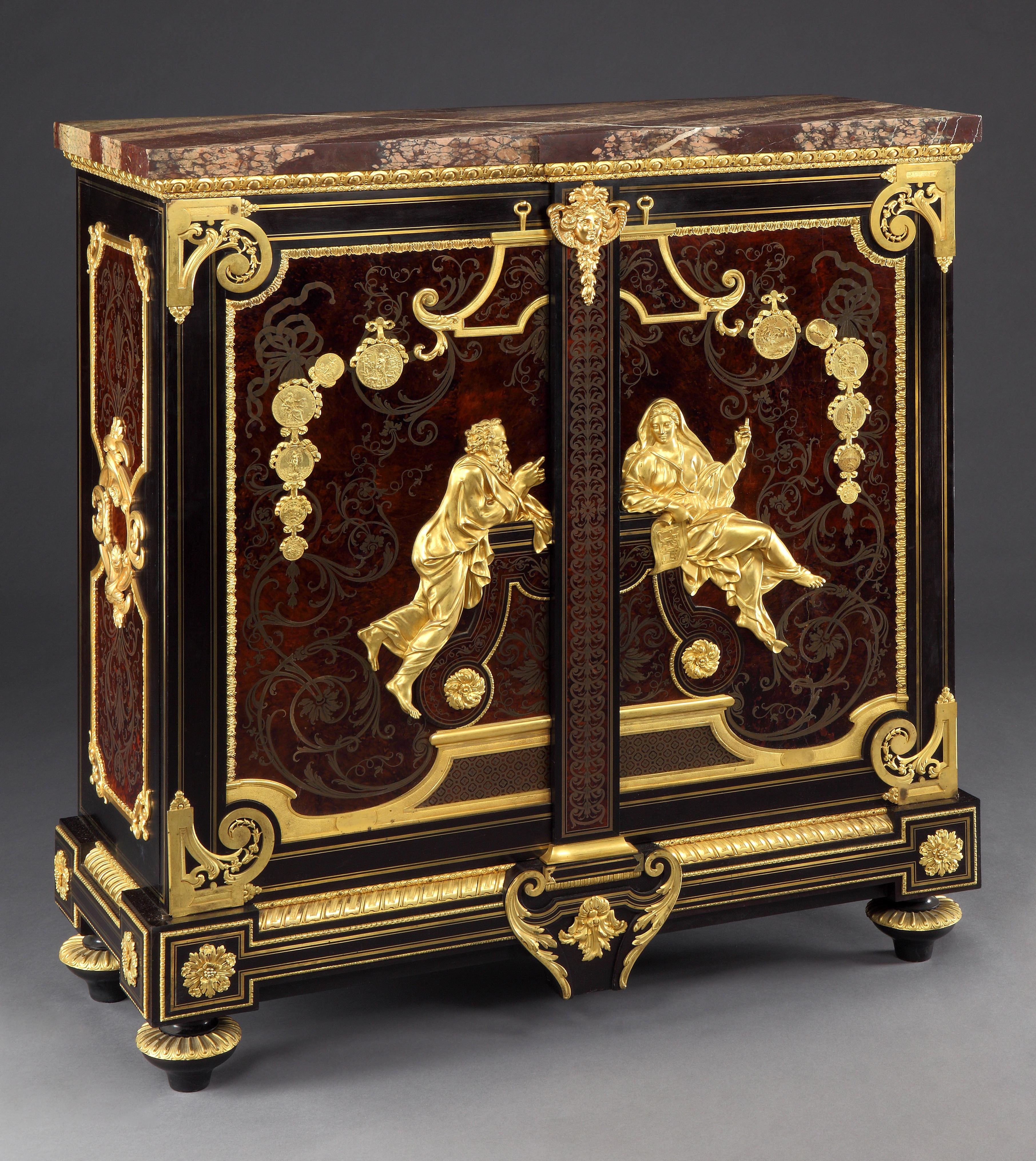
This meuble d'appui by Henry Dasson has exquisite ormolu mounts and première partie marquetry. It is based on earlier designs completed under Boulle himself between 1705-1715, working for the French Crown. Previously with Butchoff Antiques, London.
Henry Dasson, whose skills as a bronzier were unmatched in the later nineteenth century, produced Boulle-revival pieces of extraordinary quality, working in the styles of Louis XIV, XV, and XVI with equal authority. When his workshop effects were auctioned in 1894, the master patterns for his bronze mounts were purchased by Francois Linke, who used them to make his own faithful copy of the celebrated “Sun King” cabinet in 1913, a pair of cabinets on stands bearing the distinctive gilt-bronze figure of Louis XIV dressed as a Roman emperor on a turtle-shell ground. The original pair by Boulle survives in the Louvre, and no other eighteenth-century examples are known. In London, Charles Blake made copies of the Trianon commodes that Boulle had delivered for Louis XIV’s bedroom in 1708, while the Italian-born firm Nosotti offered a copy of a small Boulle cabinet with a plaque of Louis XIV for 250 guineas after the Hamilton Palace sale of 1882, where the original had realised £2,310. Befort Jeune specialised in furniture that adapted the Louis XIV style to the smaller proportions of mid-nineteenth-century rooms, demonstrating that Boulle’s designs, conceived for the grandest palace in Europe, could be successfully domesticated without losing their essential character.
A Style That Conquered Europe
Louis XIV’s greatest legacy to the decorative arts was not any single technique or furniture form but a principle: that the interior of a room should be conceived as a unified work of art, with furniture, panelling, hangings, and objets d’art designed together under a single directing intelligence. Under Le Brun, this idea was realised at Versailles with a completeness that no previous court had attempted, and the engraved designs published from the late seventeenth century onwards spread the model across Europe with extraordinary speed. Danish and Swedish monarchs set out to emulate the Grand Monarch as best they could. The Elector of Bavaria furnished his palaces in conscious imitation of Versailles. In Russia, Peter the Great looked to French models for the decoration of his new capital at St Petersburg.

The Louis XIV period pioneered decorative schemes whereby furniture, textiles, lighting and objects were all designed to adhere together as a 'unified work of art.' This room at the Metropolitan Museum of Art in New York gives us a glimpse into a period-specific Louis XIV bedchamber.
The influence spread through individual craftsmen as well as through published designs. Daniel Marot, who had trained under Le Pautre and worked in Boulle’s own workshop, was compelled to leave France by the Revocation of the Edict of Nantes in 1685 and carried the French Baroque style to the Netherlands and thence to England in the service of William III. In London, the cabinetmaker Gerrit Jensen employed a marquetry of tortoiseshell, brass, and pewter similar to the technique being perfected by Boulle in Paris, producing some of the earliest English furniture in the French taste. The thread of influence runs directly through to the greatest makers of the following century: Jean-Francois Oeben, who would create the celebrated bureau du roi, was himself a pupil of the sons of Boulle, and Riesener, Oeben’s successor and the foremost cabinetmaker of the Louis XVI period, made a console table in Boulle marquetry after the master’s own designs, an act of homage that acknowledged the debt the entire French furniture tradition owed to the craftsmen of the Grand Siecle.
For collectors and designers today, Louis XIV furniture represents the moment at which French cabinetmaking achieved its identity. The forms invented under the Sun King’s patronage, the commode, the bureau plat, the side cabinet, remain staples of the European interior. The gilt-bronze mounts that Boulle elevated to an art form continue to define the highest level of craftsmanship in French furniture. And the principle of the unified interior, first realised in the state apartments of Versailles, remains the foundation on which every serious scheme of decoration is built.
written by Rainier Schraepen

Discover how the Grand Tour shaped British taste, from Florentine pietre dure and Roman micromosaics to the revolution in furniture design led by Robert Adam.
The Grand Tour was the most consequential shopping trip in the history of European taste. From the late seventeenth century onwards, young men of wealth and standing crossed the Alps to immerse themselves in the classical world, returning with crates of marble, mosaic, bronze, and hardstone that would reshape the interiors of their country houses and, in time, the entire direction of British design. Italy was the destination that mattered. Florence offered the pietre dure workshops of the Medici; Rome offered antiquities, micromosaics, and the friendship of artists who would paint your portrait among the ruins; Naples, after the excavations at Herculaneum began in 1738, offered a direct encounter with the ancient world preserved beneath volcanic ash.
The objects these travellers brought home served as proofs of cultivation and symbols of taste, and in the hands of architects like Robert Adam they became the raw material for a revolution in furniture and interior design that would sweep through every level of the English trade. The Grand Tour created a market for classical taste that would shape European decorative arts for the next two centuries.
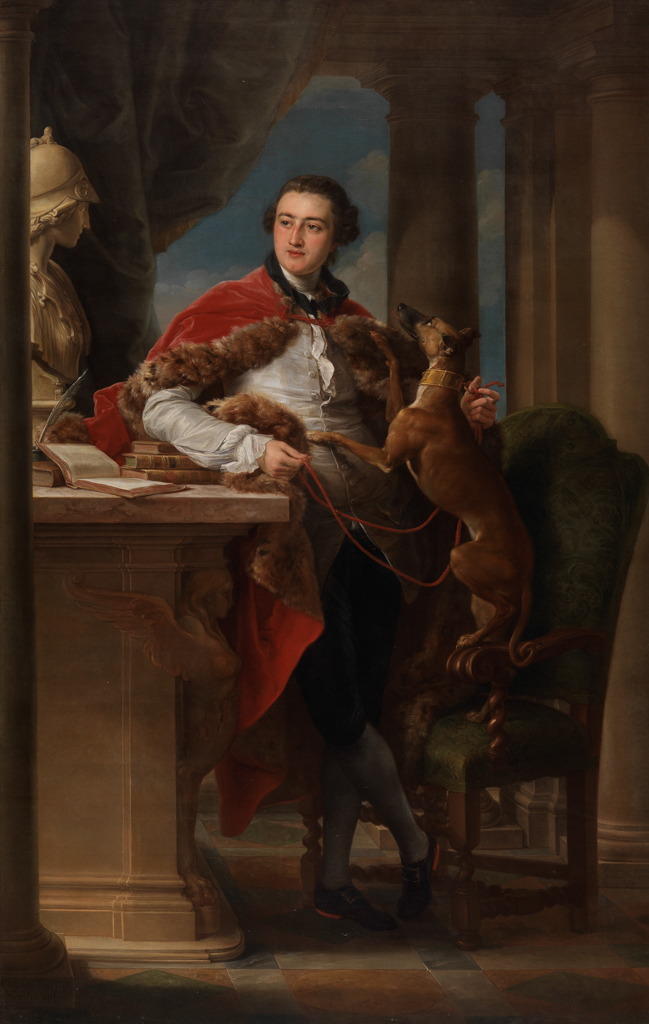
Pompeo Batoni, The Seventh Earl of Northampton, 1758 (Fitzwilliam Museum, Cambridge). One of dozens such portraits that served as both souvenir and social credential.
The Treasures of Florence
The workshops that produced the Grand Tour's most coveted objects had their origins in the ambitions of the Medici. The Opificio delle Pietre Dure, or Grand Ducal workshops, were established in Florence in 1580 by Francesco I de'Medici, initially to furnish a dynastic mausoleum of extraordinary splendour. When that project stalled, the Medici turned their craftsmen's skills to commerce. They arranged in the Uffizi gallery a display of the exquisite figures and inlaid panels made for the mausoleum's altar, in order to tempt the grandest of grand tourists to commission similar works to take home with them. Many succumbed, including the diarist John Evelyn, who bought nineteen panels of pietre dure mosaic and had them made up into a cabinet, now at Christ Church, Oxford. Others acquired panels for caskets and cabinets, or bought whole table tops of these rich and glowing materials, inlaid with tiny laminae of agates, jasper, lapis lazuli, and chalcedony.
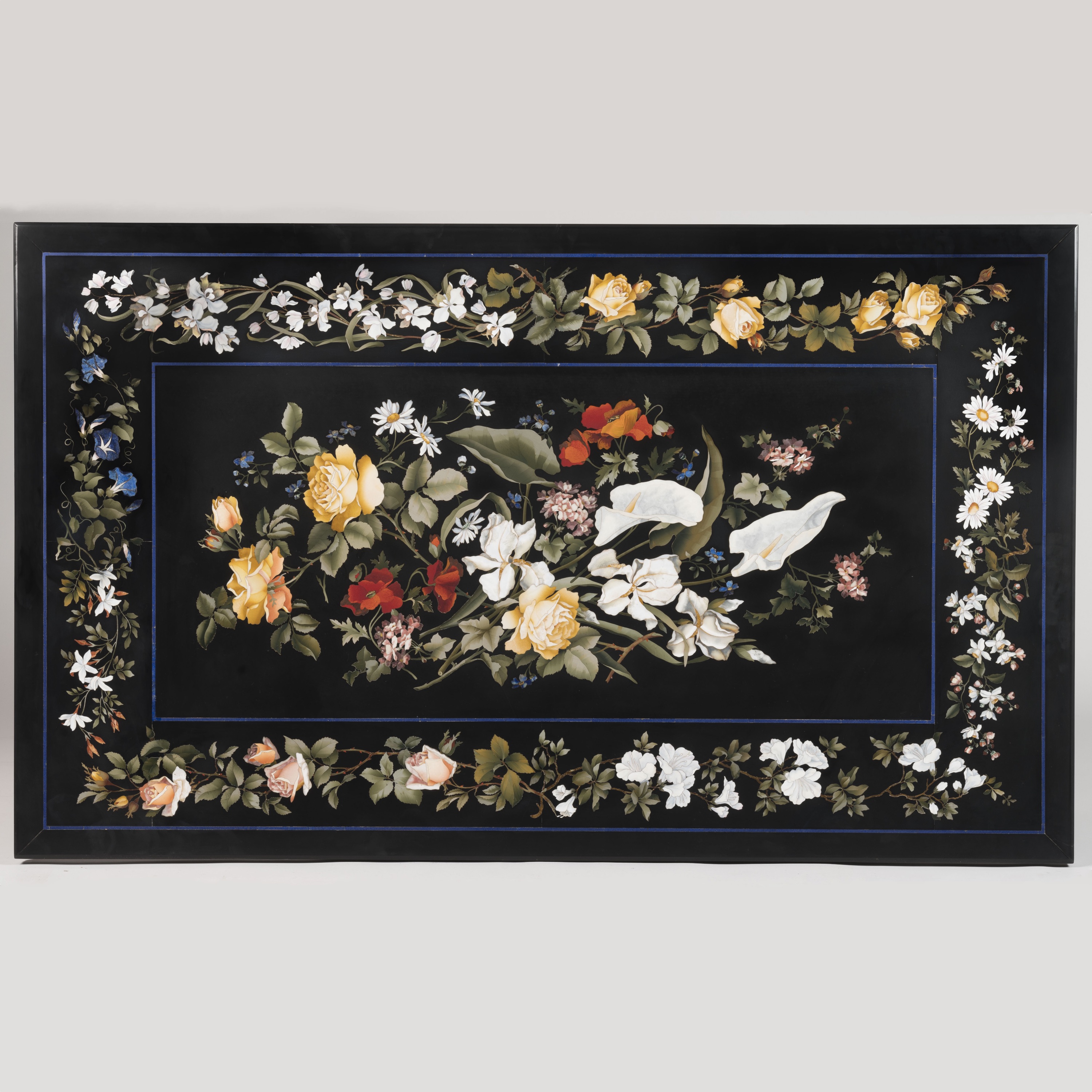
This table top is attributed to Gaetano Bianchini, who trained at the Opficio delle Pietre Dure and set up his own private workshop in Florence around 1825. Image: Butchoff Antiques, London.
Pietre dure, however, was expensive beyond the reach of most travellers. Imitations made in scagliola paste became increasingly popular as an alternative. Enrico Hugford, the Abbot of Vallombrosa, developed a technique that enabled him to use scagliola pastes as paints capable of great delicacy of tone. He and his pupils, Lamberto Cristiano Gori and Pietro Belloni, produced numerous pictures and table tops in this substance, especially for export to England. A surviving example, a scagliola table top made for an English grand tourist named Mr. East, demonstrates how effectively the technique could imitate the colour and lustre of true hardstone at a fraction of the cost. The scagliola tops made in the second half of the eighteenth century follow the gradual change in style from the late Baroque to Neo-Classicism, their wayward cartouches and carelessly strewn flowers giving way to correct architectural motifs, still-lifes of Etruscan vases, and upright figures of Grecians and Romans.
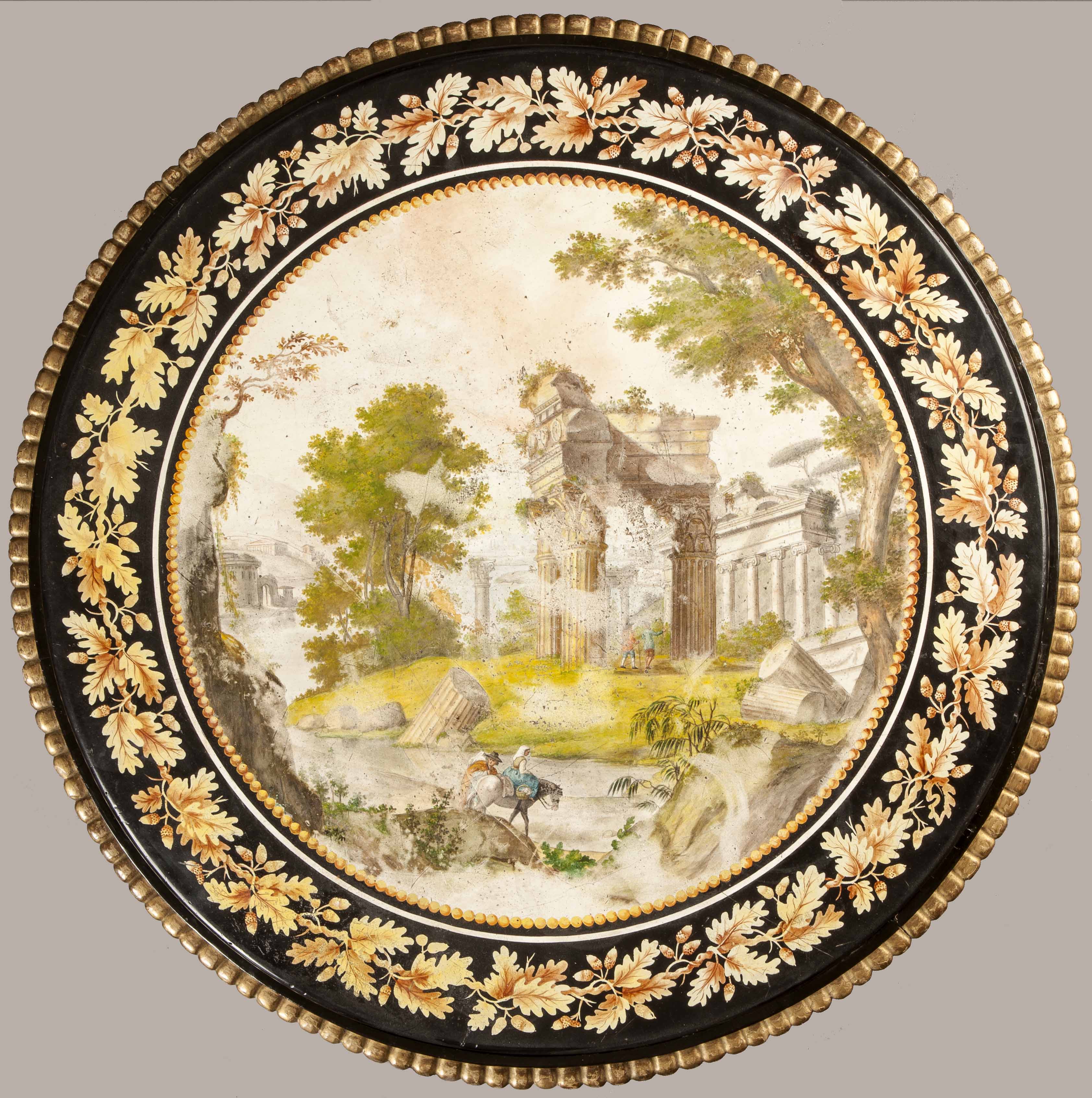
Almost certainly by Pietro Della Valle, this scagliola table top (circa 1825) shows the incredible range of the technique, which involved creating a paste which could be applied as paint to mimic brushwork and could equally imitate hardstone inlay (as seen on the pearl border and the oak garland). Previously with Butchoff Antiques.
Rome and the Art of the Souvenir
If Florence was the Grand Tour's workshop, Rome was its theatre. The city offered not only the ruins of antiquity but a thriving industry of artists and craftsmen who catered to the tastes and vanities of wealthy visitors. Pompeo Batoni painted portrait after portrait of young Englishmen posed against classical backgrounds, their confidence and their new acquisitions equally on display. The 7th Earl of Northampton sat for Batoni in 1758, surrounded by furnishings that reflected the archaeological taste of the moment, one of dozens of such portraits that served as both souvenir and social credential.
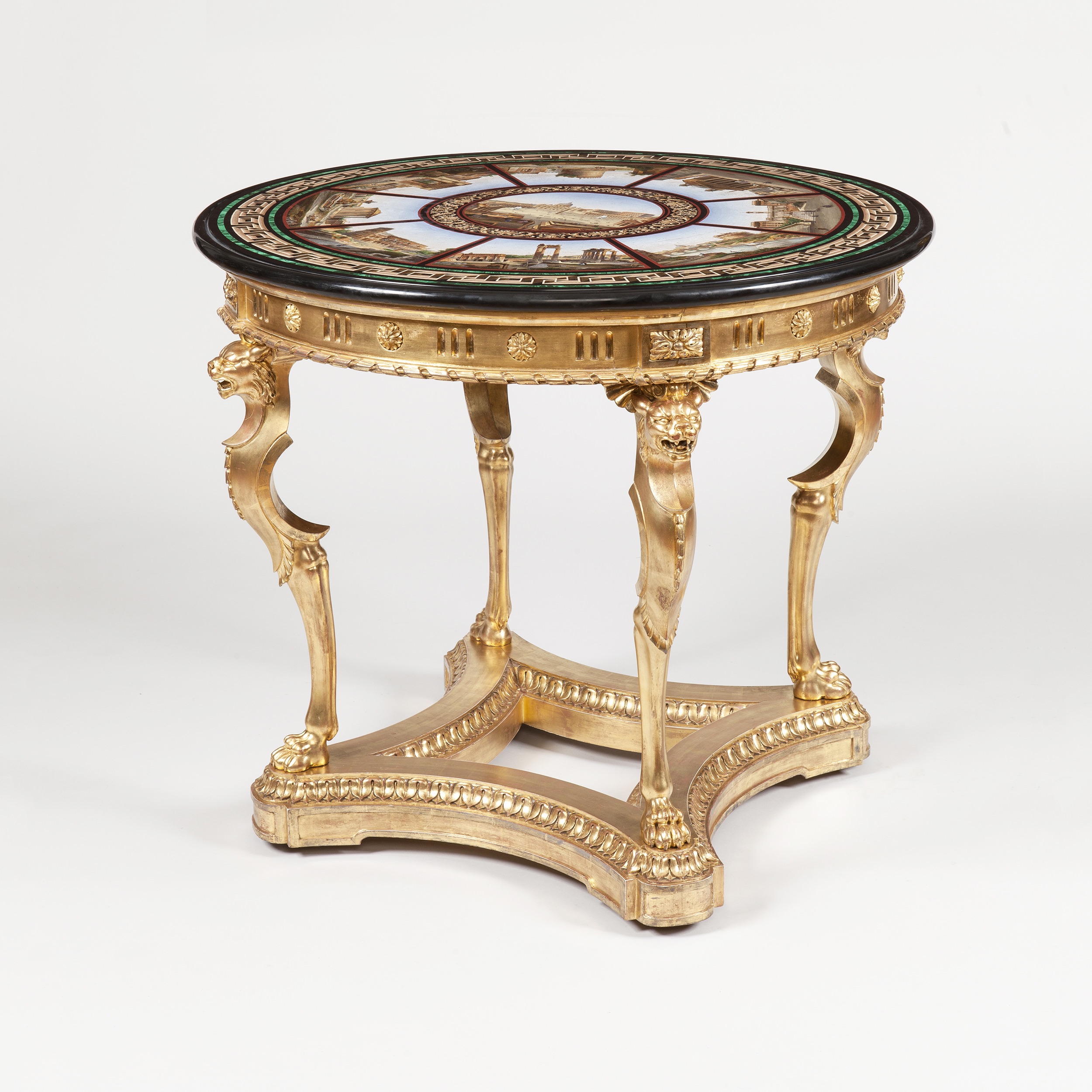
The ultimate Grand Tour souvenir: a large micromosaic table with views of Rome. This table was acquired by the 6th Earl of Macclesfield on his Grand Tour. Butchoff Antiques.
The most distinctive Roman contribution to Grand Tour collecting was the micromosaic. The Vatican Mosaic Workshop had been established in the sixteenth century, and from the 1770s its craftsmen developed a technique of assembling minute tesserae into panels of astonishing intricacy, depicting views of the Forum, St Peter's, and classical subjects drawn from the collections of the great Roman museums. These panels were set into table tops, snuff boxes, and jewellery, their quality and detail far surpassing anything that could be produced outside Italy. The designs drew on celebrated antique originals: one surviving table top combines a roundel based on the Doves of Pliny in the Capitoline Museums with a floral bouquet copied from a Roman mosaic floor in the Pio-Clementino Museum.
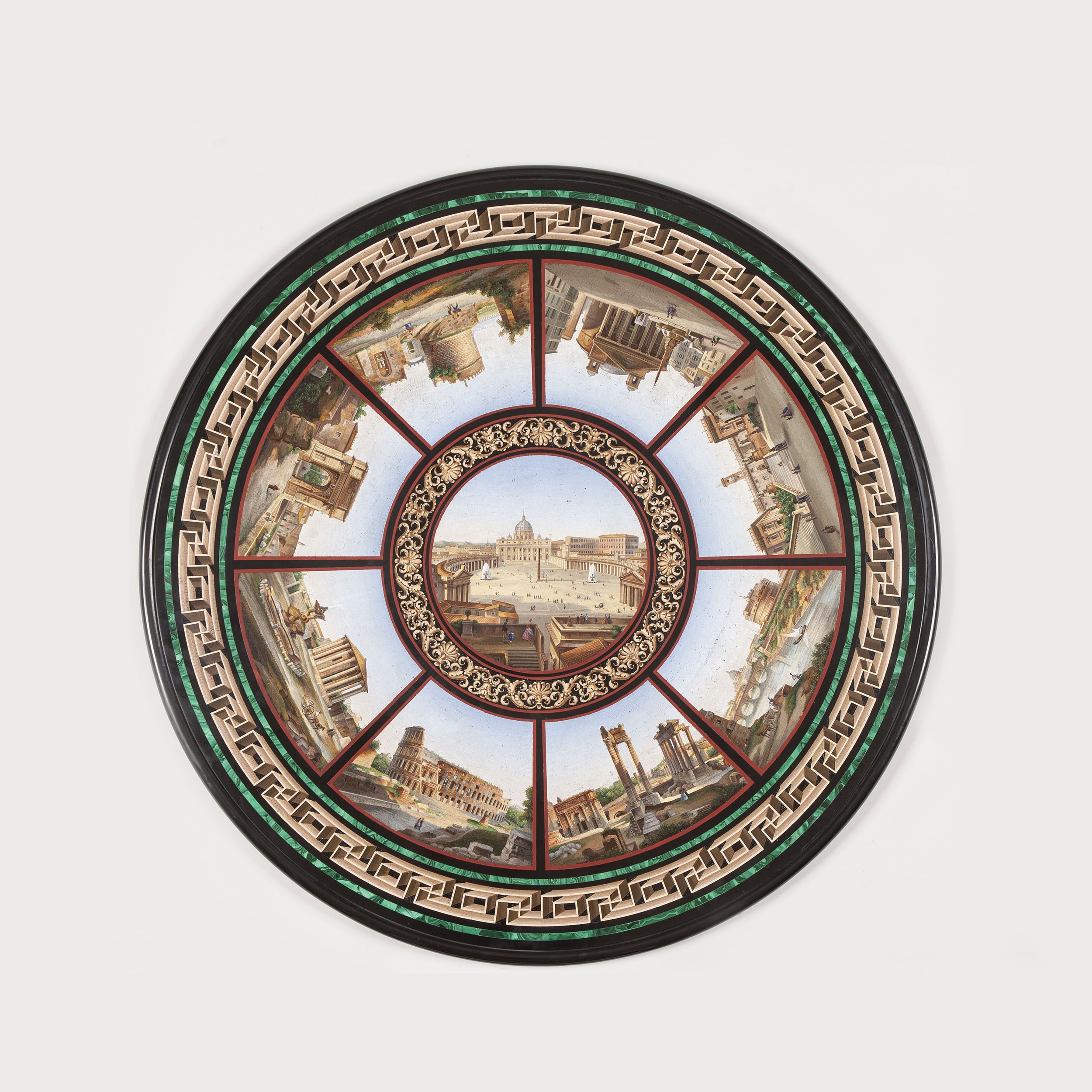
The top of the Grand Tour table is one of the greatest micromosaic tabletops in private hands, attributed to Cesare Roccheggiani, with a diameter of 90cm and using tens of thousands of small coloured tesserae depicting views of Rome. Butchoff Antiques.
Bronze reductions of classical sculpture offered another category of portable antiquity. In Rome, the founders Zoffoli and Righetti produced small-scale bronzes of celebrated antique works, including the Medici Vase from the Uffizi and the Borghese Vase now in the Louvre. In Paris, Ferdinand Barbedienne and his partner Achille Collas later industrialised this tradition, using a mechanical reduction machine to produce bronze copies of Greek and Roman originals that made the Apollo Belvedere and the Venus de Milo available to collectors across Europe.
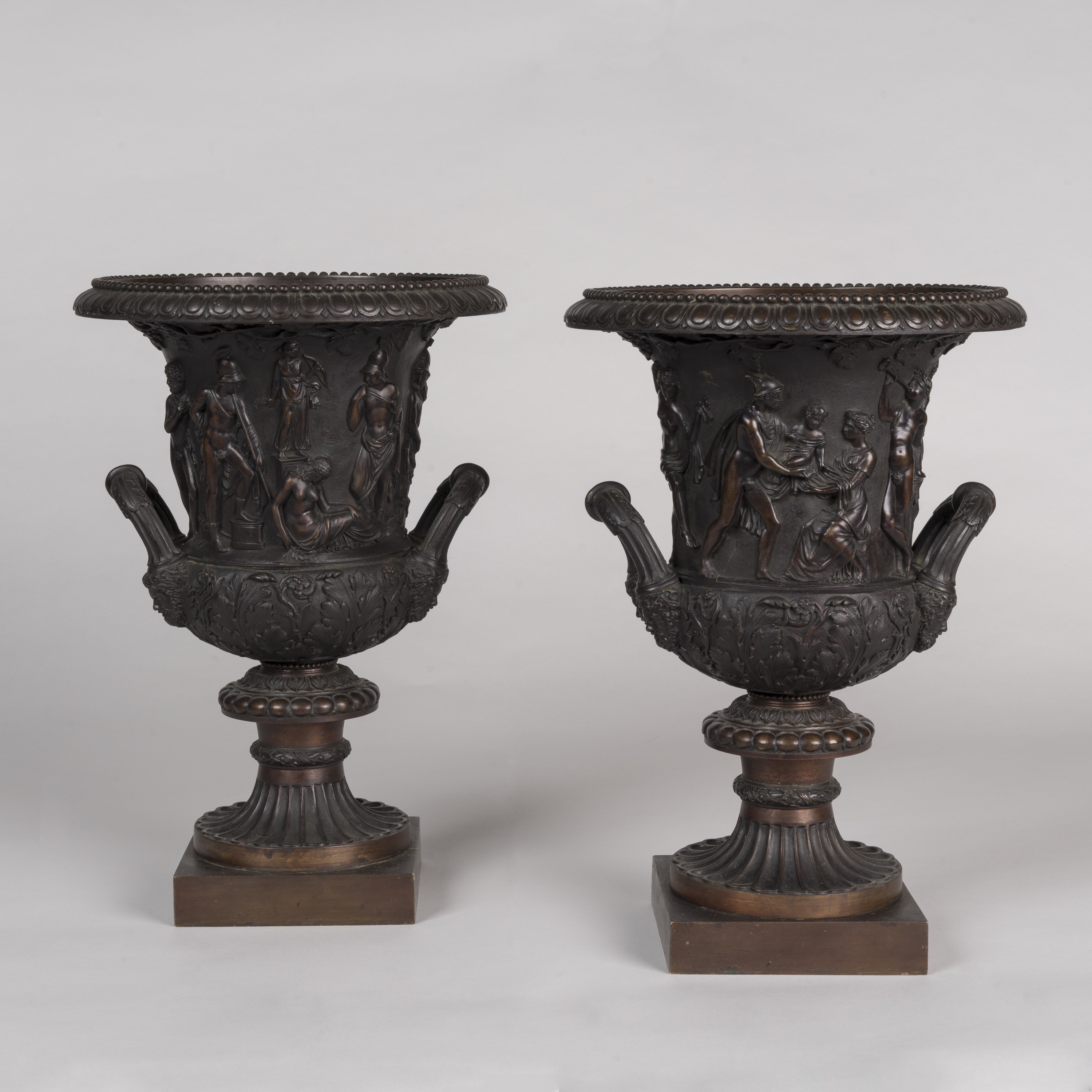
Reductions of the famous Medici & Borghese vases were made in Italy, as well as in France (such as the illustrated pair) throughout the 19th century. Butchoff Antiques.
Piranesi, Adam and the Revolution in British Taste
The Grand Tour's most far-reaching legacy was not an object but an idea: that the decorative arts of ancient Rome could be revived, in modern materials and for modern uses, with a fidelity that earlier generations had never attempted. The man who made this idea irresistible was Giovanni Battista Piranesi, the Roman engraver and archaeologist whose dramatic views of ancient ruins were published and distributed widely throughout Europe. Piranesi revitalised images of ancient Rome by adding details of his own invention, and subsequent publications such as Robert Wood's Ruins of Palmyra and Ruins of Balbec further fuelled the thirst for antiquity across the Continent.
In the 1750s, Piranesi's vision of romantic archaeology inspired a brief vogue for ruin rooms furnished with stools in the form of broken columns and sofas resembling antique sarcophagi. More lastingly, Piranesi became a close friend of the young Scottish architect Robert Adam during Adam's four years of architectural study in Rome. Soon after his return in 1758, Adam was making a sensation in the fashionable world with interiors created in a novel decorative style. Where the Palladian architects of the first half of the century had favoured solemn and ponderous classical forms, the decorations of Robert Adam were in the manner of the delicate stucco reliefs in the baths, tombs, and villas of ancient Rome. He was also extremely fond of the brightly painted motifs known as grotesques, with which Raphael and his pupils had decorated the loggias of the Vatican and the walls of the Villa Madama.
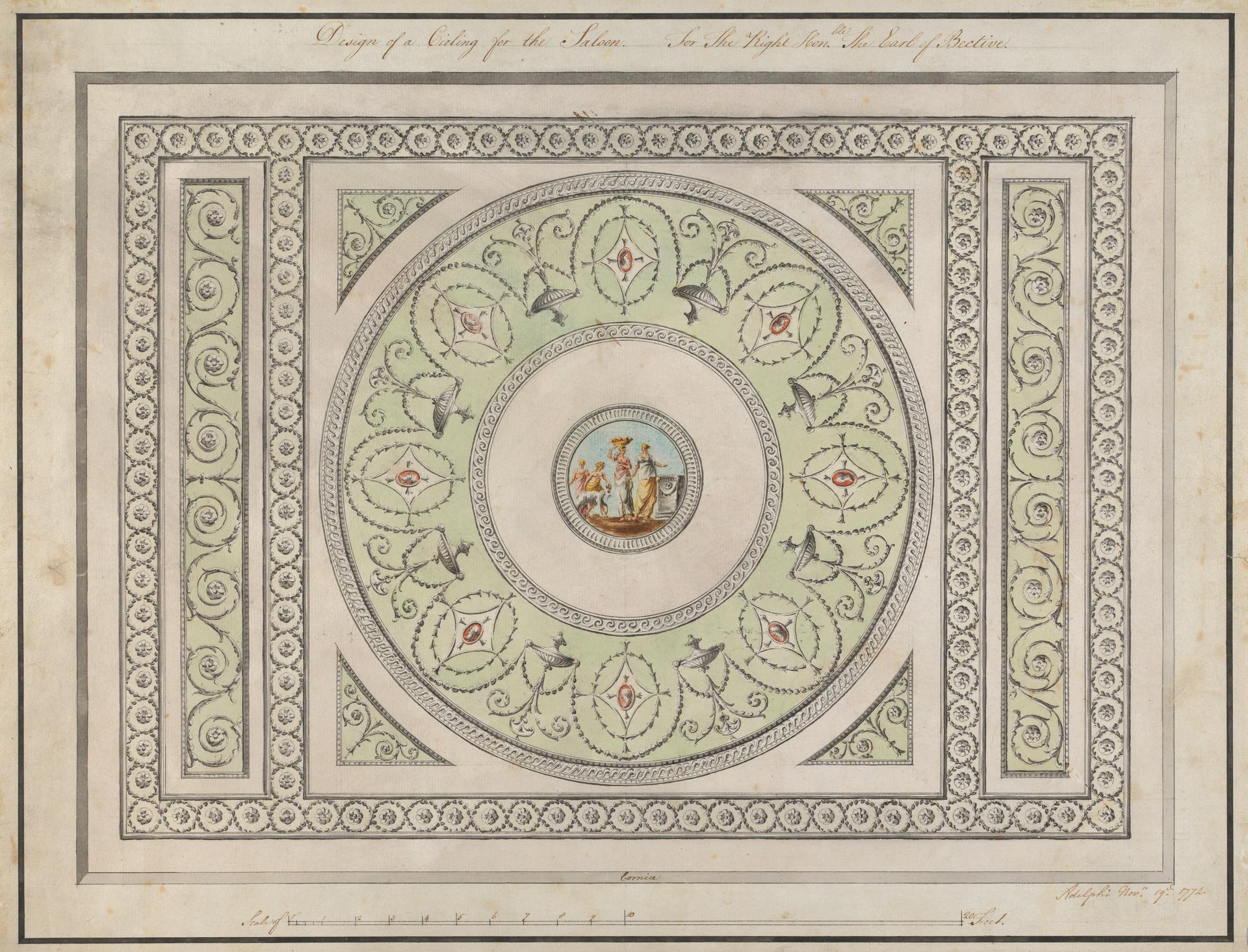
Robert Adam, design for a ceiling for Headfort House, Ireland (1772). Yale Center for British Art.
The year 1762 was crucial. It was then that Adam turned his attention to furniture design, and his influence was to hasten a revolution in fashionable taste. That revolution spread rapidly from the great houses through every class of the furniture trade, carried by the principal craftsmen who had worked for Adam and his clients: Samuel Norman, William France, John Linnell, Ince and Mayhew, and Thomas Chippendale among them. An earlier generation had blazed the trail. William Kent spent approximately ten years in Italy from 1709, and in the furniture he later designed for English houses one may often see the reflection of the great carved and gilt tables and the magnificently hung beds he had seen in Italian palaces.
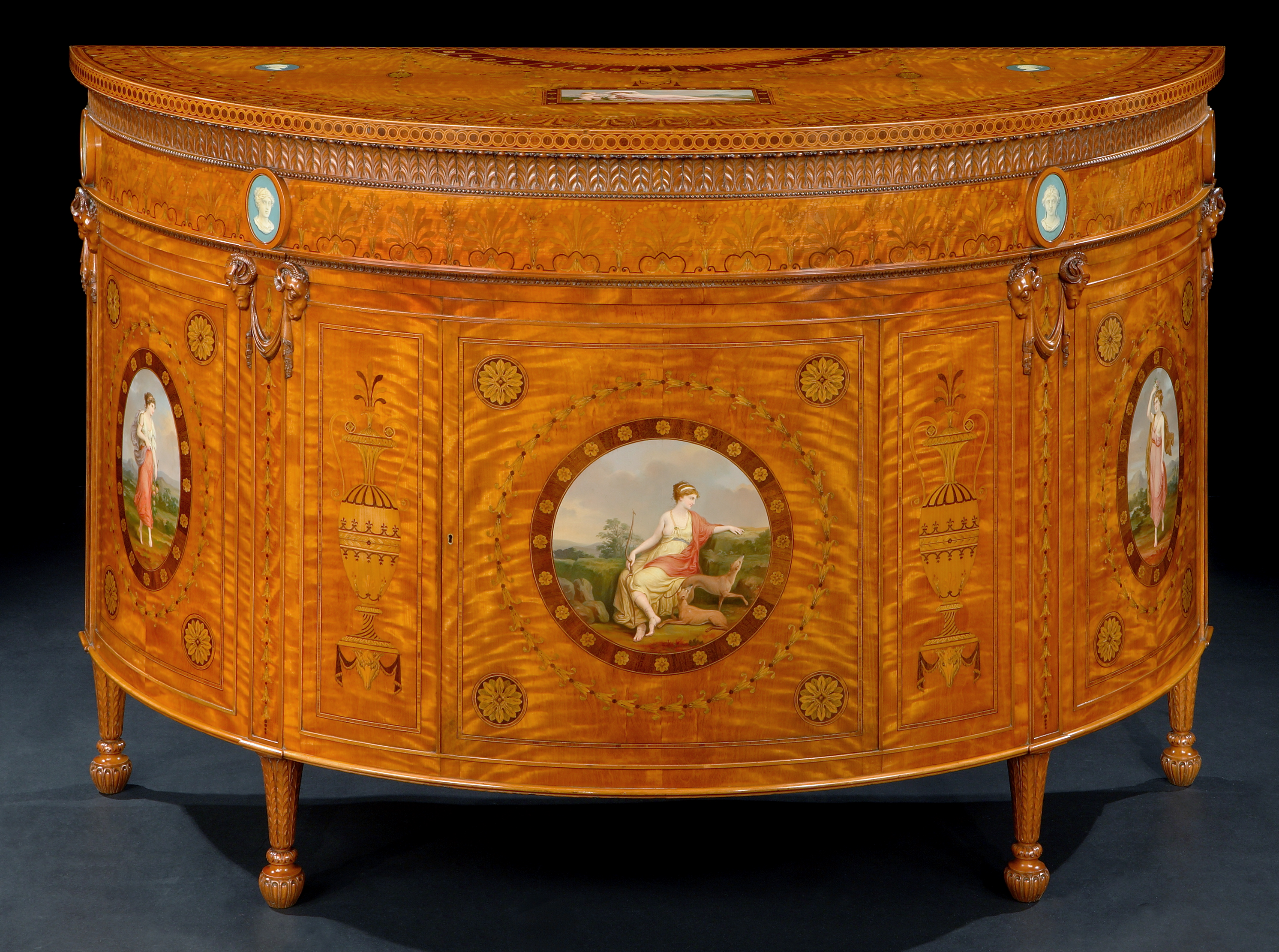
This commode was made in the 19th century, after the original design of Robert Adam for the Countess of Derby in 1774. Previously with Butchoff Antiques.
The Grand Tour Table
The furniture form most intimately associated with the Grand Tour is the centre table with an Italian marble or hardstone top. These exquisitely inlaid marble tops were expensive souvenirs, often bought directly by the traveller from the maker or retailer in Florence or Rome and shipped back to England, where a suitable base was made to receive them. The tops contained a colourful variation of specimen stones, including lapis lazuli, malachite, porphyry, breccia marble, agates, and verde antico, and they remain among the most sought-after of all Grand Tour acquisitions.
The English trade in fitting imported tops to locally made bases became a thriving industry. From the 1820s, Gillows were making expensive rosewood supports for Italian specimen marble tops brought back by wealthy travellers. George Morant of New Bond Street produced designs for bases with winged griffin supports on lion paw feet, specifically intended for pietre dure tops. Taprell, Holland and Son supplied a parcel-gilt burr walnut base for an unusually large imported marble top attributed to Alfonso Cavamelli of Rome, measuring over four feet in diameter (sold by Butchoff Antiques). The extravagance of some commissions was remarkable: the carved rosewood tripod base made by Robert Strahan of Dublin was designed specifically for a pietre dure marble top by Joseph Darmanin of Malta, bearing the arms of General Robert King, 1st Viscount Lorton of Boyle.
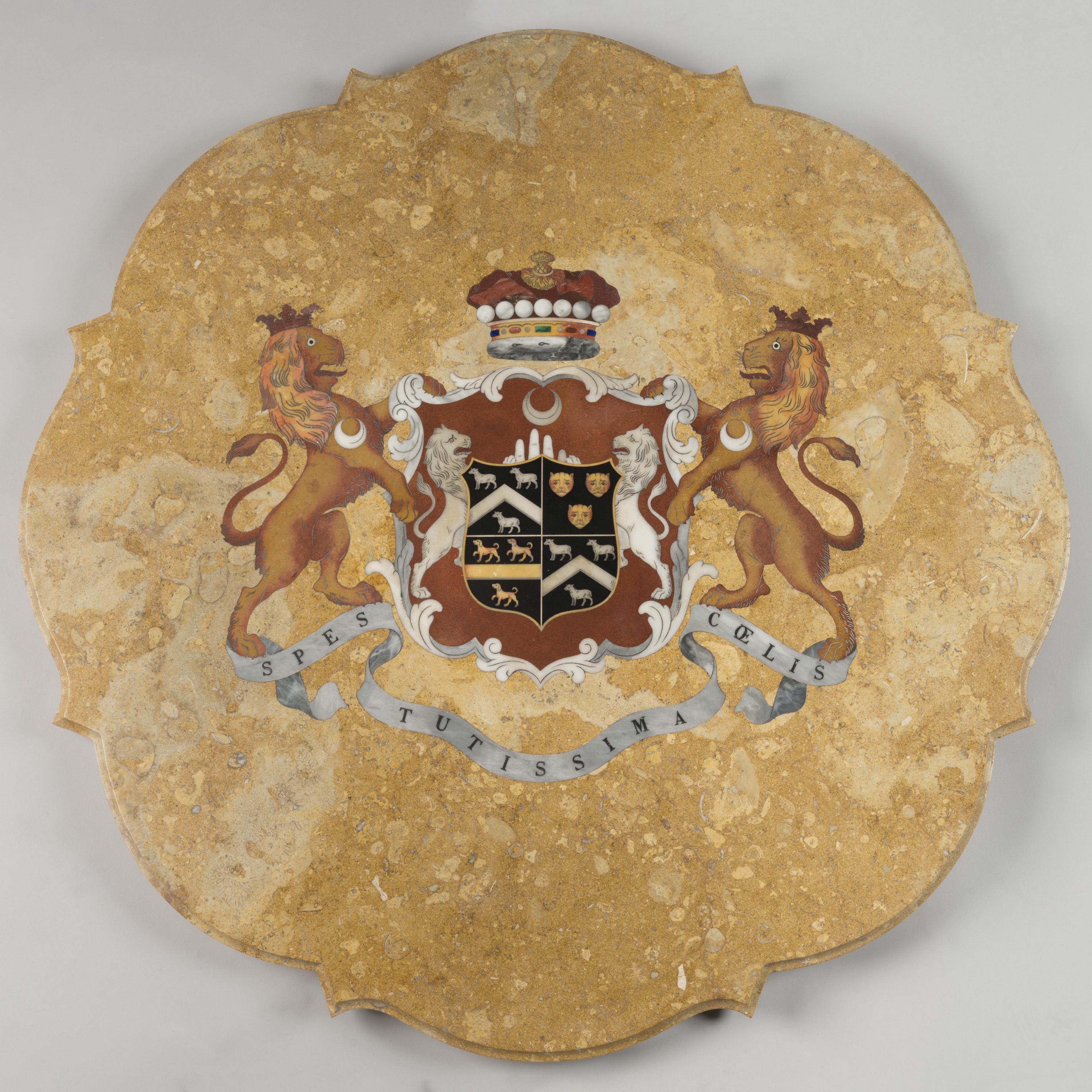
This tabletop, made by Darmanin of Malta for an Irish nobleman, circa 1830, sits on its own custom-made mahogany base made to Strahan, Dublin's top furniture maker at the time. Butchoff Antiques.
The trade could involve spectacular historical pieces. The 3rd Earl of Warwick purchased a pietre dure tabletop bearing the arms and attributes of the patrician Grimani family, a pinnacle in the history of hardstone decoration, and ordered a new frame in the Elizabethan Revival style to support it at Warwick Castle in 1829, the Grimani family having retained the original giltwood base. The transmission from ancient original to English furniture could also be remarkably direct: the architect Henry Holland sent Charles Heathcote Tatham to Rome in the 1790s to collect classical fragments and execute drawings to be used as design sources, and the furniture made for Holland's projects was the work of Marsh and Tatham, whose co-founder Thomas Tatham was C.H. Tatham's brother.
Stone, Bronze, and Mosaic
The Grand Tour ended as a social institution in the early nineteenth century, overtaken by the railways and the democratisation of European travel. But the objects it produced have never lost their appeal, and for reasons that go beyond historical curiosity. A pietre dure table top, with its geometric arrangement of lapis lazuli, malachite, porphyry, and agate, reads as both deeply historical and strikingly modern in its palette. These pieces sit comfortably in contemporary schemes precisely because their appeal is rooted in material beauty and craftsmanship rather than in a single period aesthetic.
For interior designers, Grand Tour objects offer a particular versatility. A micromosaic panel or specimen marble top introduces colour, texture, and a sense of permanence that few other categories of antique can match. Where a piece of period furniture anchors a room in a specific era, a Grand Tour table or bronze transcends period boundaries, serving as a bridge between old and new. The robust materials, stone, bronze, and mosaic, are inherently forgiving of daily use, and the scale of many Grand Tour tables makes them practical as well as decorative.
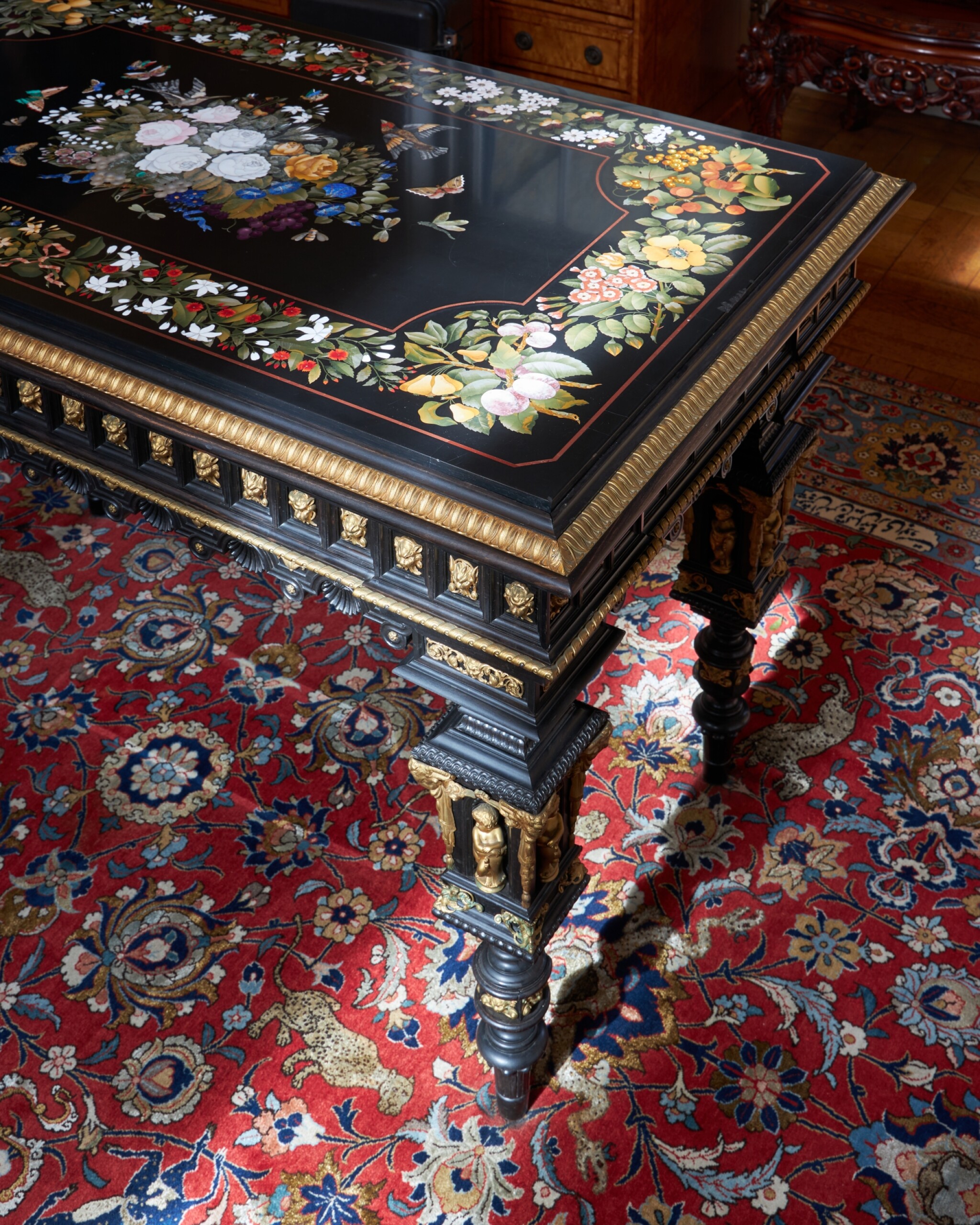
A florentine hardstone table, seen in the home of Freddie Mercury, stands beautifully in the room surrounded by satinwood furniture and antique carpets. Image courtesy of Sotheby's.
The craftsmanship involved in the finest Grand Tour pieces cannot be replicated today at comparable quality or cost. Micromosaic panels from the Vatican Workshop, scagliola tops by the Hugford school, and pietre dure table tops from the Opificio represent techniques perfected over generations and now largely extinct. For discerning collectors, this combination of irreplaceable craftsmanship, material richness, and cross-period versatility makes Grand Tour objects one of the most rewarding areas of the antiques market.
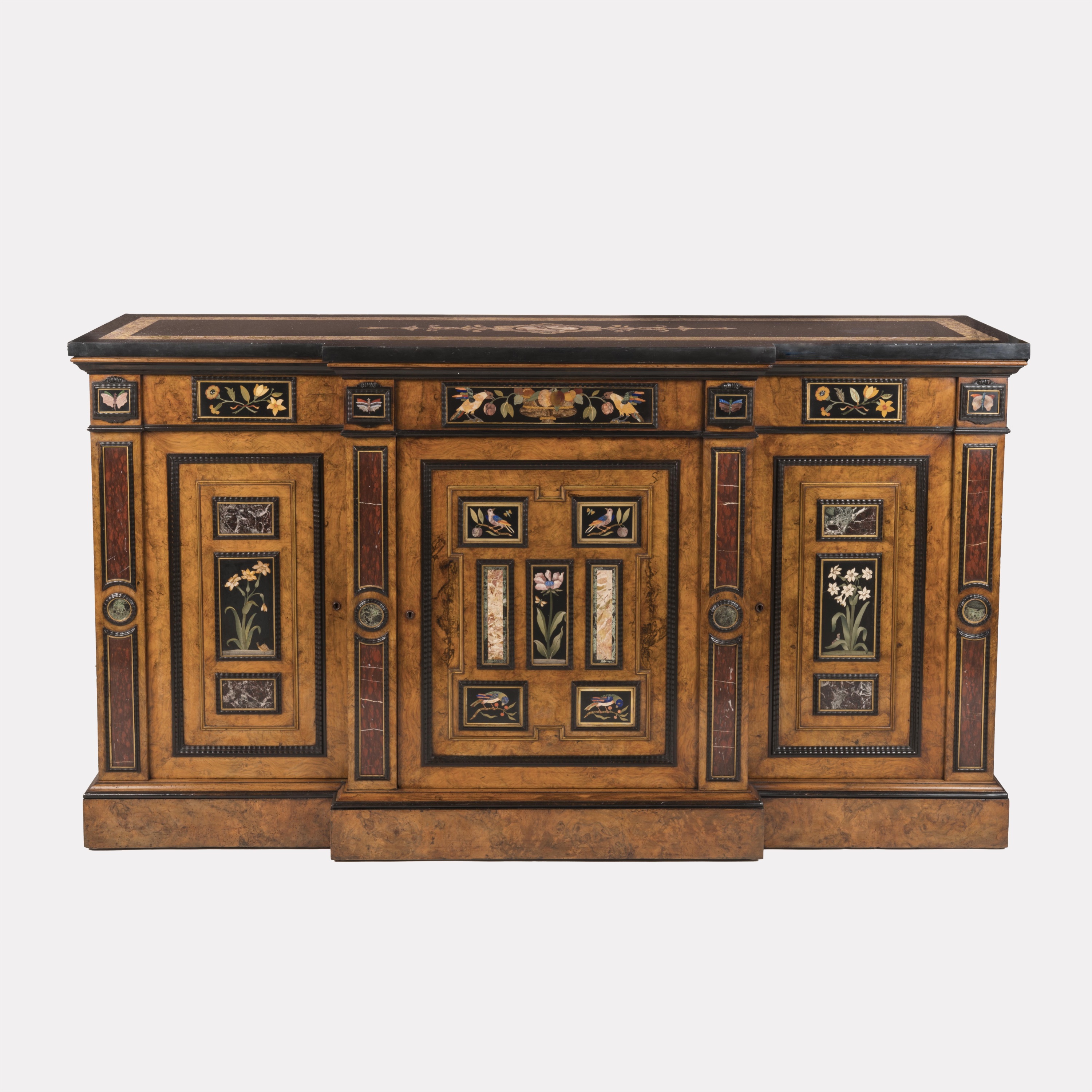
An 1840s cabinet, custom-made to incorporate a collection of 18th century Florentine pietre dura panels. Undoubtedly the centrepiece of a collector's home. Butchoff Antiques.
Written by Rainier Schraepen

The most powerful man in Europe understood that furniture could serve as propaganda. When Napoleon Bonaparte crowned himself Emperor in 1804, the former royal palaces of France stood empty, stripped of their contents during the Revolution. Napoleon set about refurnishing them on a scale that rivalled the Bourbons themselves, spending between thirteen and seventeen million francs on furniture for the imperial residences in barely a decade. The result was not simply a new fashion but an instrument of state: empire style furniture, designed by architects rather than craftsmen, drew its forms directly from ancient Rome and Egypt and proclaimed through every gilt bronze mount and mahogany surface the legitimacy of a self-made dynasty.
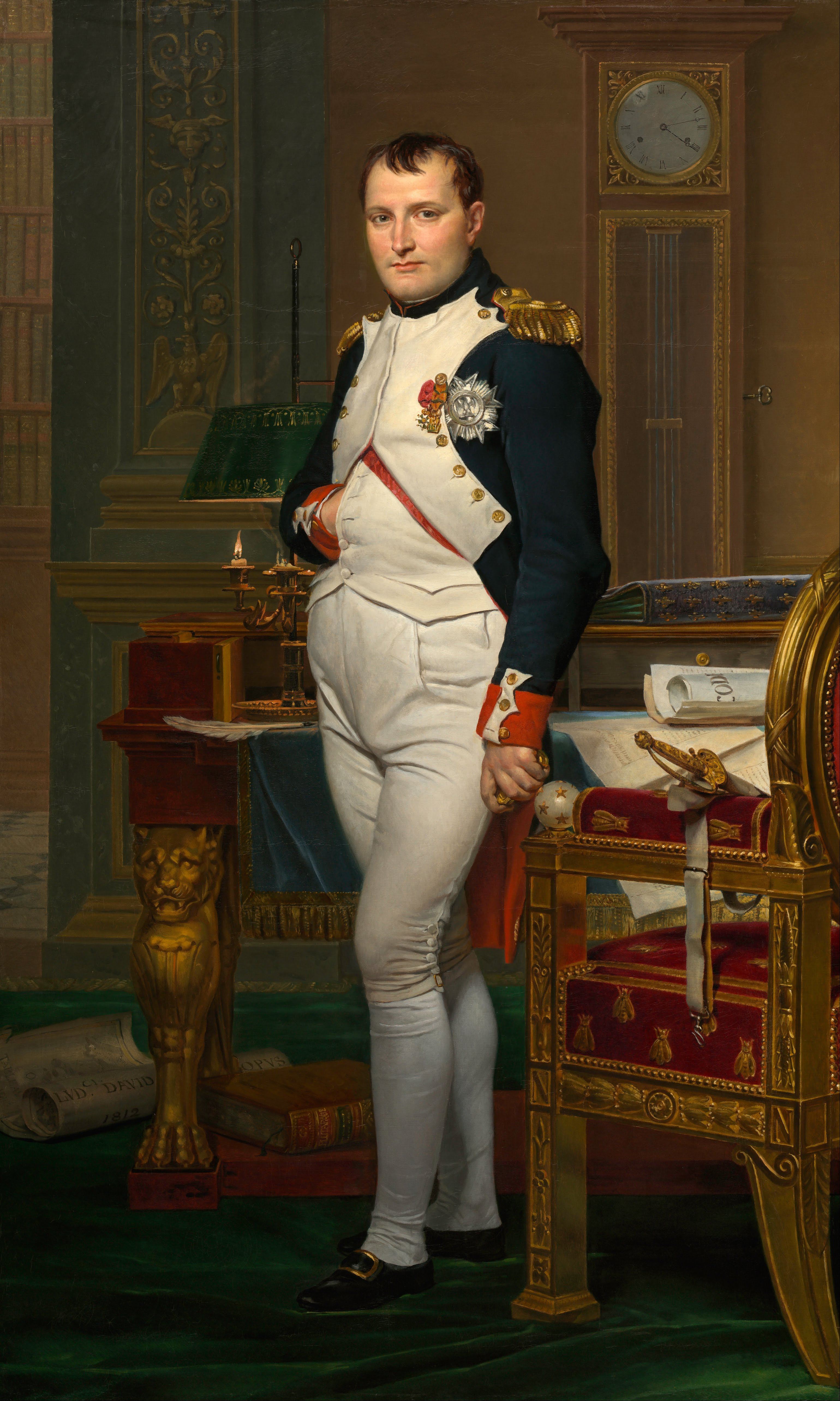
Jacques-Louis David, The Emperor Napoleon in his Study at the Tuileries, 1812 (National Gallery of Art, Washington D.C.)
The style had been gathering since the 1790s, when the upheaval of revolution paradoxically accelerated a taste for classical severity that had been developing for a decade before the Bastille fell. Percier and Fontaine, the two architects who would define the Empire vocabulary, had studied ancient originals in Italy and brought back an uncompromising vision of antiquity revived in its original purity. Their designs, executed by the greatest cabinet-making dynasty in Parisian history, would spread from the Tuileries to the courts of Europe and as far as the drawing rooms of New York.
From Revolution to Empire
The French Revolution ended the absolute rule of the Bourbon kings, but it affected the evolution of furniture less profoundly than has frequently been claimed. The new patrons, the wealthy bourgeoisie, were content with Louis XVI furniture from former days, and the spirit of the Ancien Regime survived until the end of the eighteenth century. As Helena Hayward wrote, “the Revolution was rather a period of arrested development. It was not until the Empire that craftsmanship in furniture-making took on a new lease of life, but by then the social atmosphere had changed.”
The intervening style, known as Directoire after the only stable government of the period, was in fact the expression of a taste for classical forms that had developed several years before the Revolution. The painter Jacques-Louis David had designed austerely classical furniture for his studio as early as 1788, reflecting an academic approach to antiquity that would triumph under the Empire. Winged sphinxes, eagles, and antique-style tripods anticipated the forms to come, while the rear legs of chairs adopted the “sabre” type, not a reference to military swords but a modernisation of the legs of ancient Greek klismoi, seen painted on vases from as early as the fifth century BC.
Linus teaches the letters to Musaeus on the tondo of a kylix, Eretria Painter, circa 330/35 BC. (Paris, Louvre). Showing an ancient Greek klismos chair.
A critical institutional change accompanied this aesthetic shift. The abolition of the guilds in 1791 eliminated the rigid separation between menuisier and ebeniste that had governed Parisian furniture-making for generations. Georges Jacob, the most inventive chair-maker of the later eighteenth century, seized the opportunity to begin making case furniture as well, a practice previously outlawed. His sons would continue the workshop into the Empire period, and the Jacob dynasty they founded would become the most important supplier of furniture to Napoleon’s court.
Percier, Fontaine and the Architecture of Furniture
The Empire style was shaped less by cabinet-makers than by two architects: Charles Percier and Pierre-Francois-Leonard Fontaine. Having studied classical originals in Italy, they approached furniture not as craft but as architecture in miniature, reviving antiquity in what Hayward called “all its original purity” rather than adapting it freely as earlier designers had done. Their first major commission was the Chateau de Malmaison, acquired by Josephine Bonaparte and made ready in record time under their supervision. They designed the furniture, executed by the Jacob brothers, as well as the interior decoration for the music room and the library, rooms with columns and panelling of mahogany that are still intact today. The interiors at Malmaison, immediately acclaimed for their elegance, decisively influenced the cabinet-maker’s art during the years surrounding the opening of the Empire period.
Their pattern book, the Recueil de Decorations Interieures, published in Paris in 1801 and re-issued in 1812, codified the new vocabulary. In this work, which had a considerable influence across France and most of Europe, furniture was given pride of place. The Recueil established what Hayward described as “an official art, to which heavy forms lend a slightly theatrical air,” evoking “a sense of majestic grandeur, reflecting Napoleon’s genius for building and his nostalgia for the proud splendour of ancient Rome.”
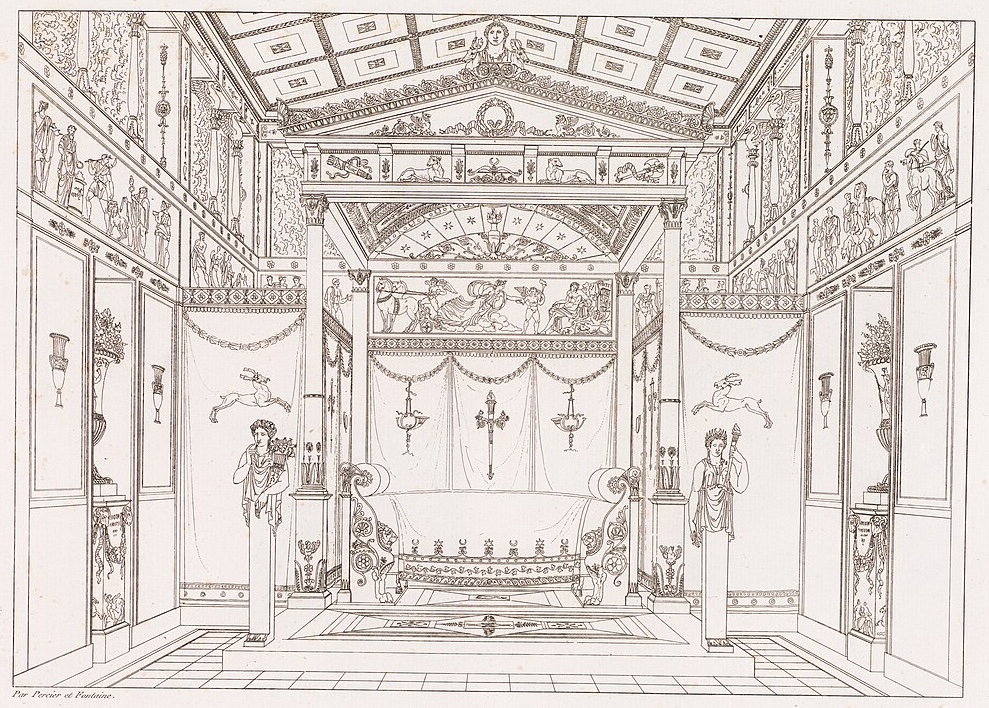
Charles Percier and Pierre François Léonard Fontaine, Bedchamber Design from Recueil de Décorations Intérieures, 1812, Etching.
Percier and Fontaine were not alone in shaping the Empire vocabulary. Vivant Denon, the archaeologist and engraver who became director of the Musee Napoleon in the Louvre, published his Voyage dans la Basse et Haute-Egypte in 1802, inspiring the Egyptian motifs that became an essential feature of fashionable taste. For middle-class patrons, Pierre de La Mesangere published his Collection de Meubles et Objets de gout between 1802 and 1835, with approximately four hundred plates that made the features of Napoleonic furniture familiar well beyond the imperial palaces. Hayward characterised the contrast well: “The delicious simplicity of La Mesangere makes a pleasing contrast with the splendid architectural severity of Percier and Fontaine.”
Napoleon’s Imperial Workshops
French furniture achieved exceptional brilliance in the Napoleonic era. Paris became once again the most important centre for fine cabinet-making and set the tone for the rest of Europe, a supremacy made possible by Napoleon’s generous patronage and by the military conquests that carried the style to every corner of the Continent. Between 1800 and 1813, over ten thousand workmen earned their living in the Paris furniture industry, employed by no fewer than eighty-eight workshops.
The dominant firm was Jacob-Desmalter, founded when Francois-Honore-Georges Jacob-Desmalter took over his father’s business with his older brother in 1796. By the height of the Empire, he employed three hundred and fifty workmen in his workshops in the Rue Meslee, near the Porte Saint-Denis. His annual output reached the value of seven hundred thousand francs, a third of which was destined for export, and the stock in his warehouses was worth a further five hundred thousand francs. He was, quite simply, the most fashionable cabinet-maker in Paris.
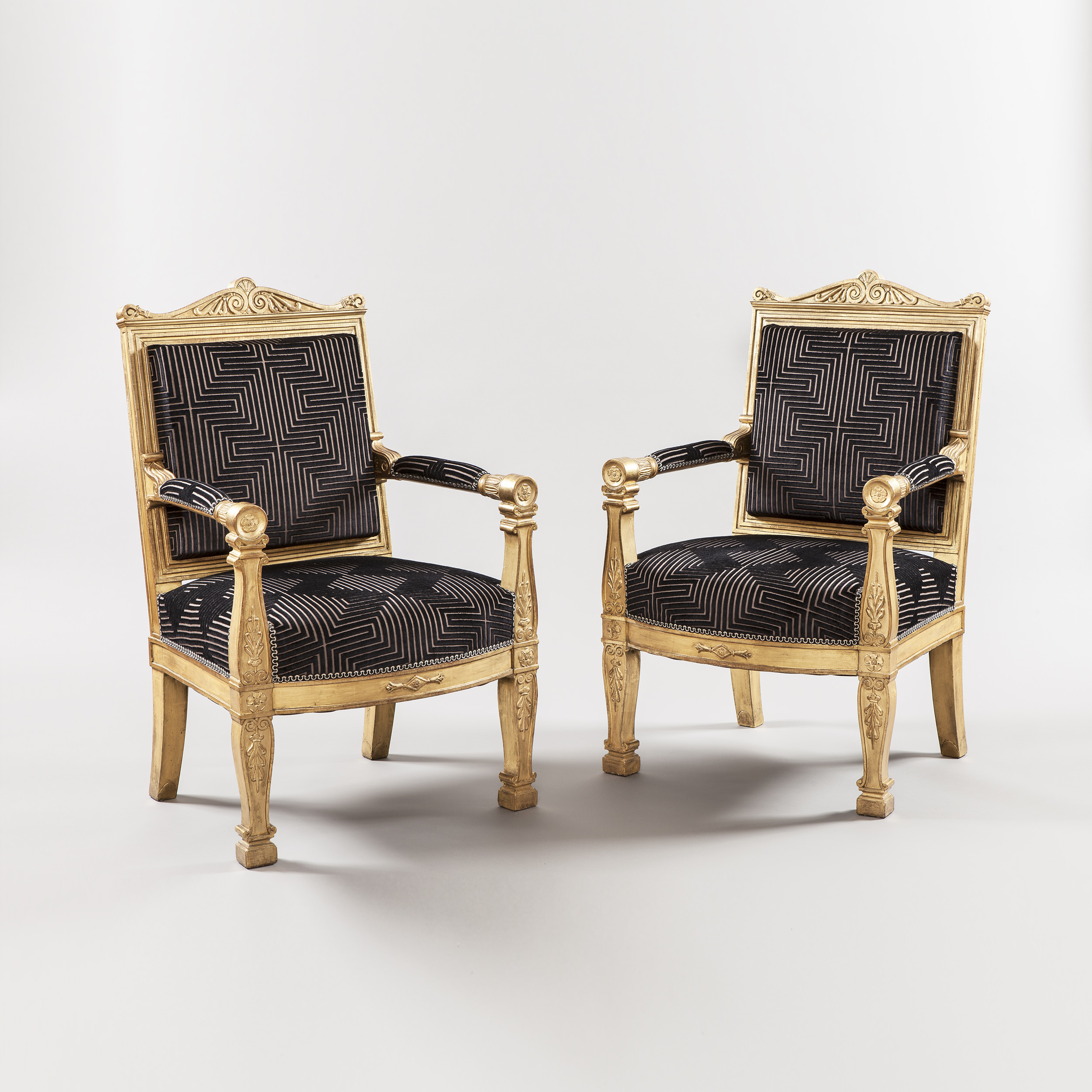
A Pair of Empire Period French Fauteuils, firmly attributed to François-Honoré-Georges Jacob-Desmalter, circa 1810. Butchoff Antiques.
Napoleon’s programme of refurnishing the former royal residences was both a political act and an economic stimulus. In reviving the grand policy so successfully pursued by the Bourbons in favour of the furniture industry, he emptied the treasury at a remarkable rate: the general inventory of the Mobilier de la Couronne between 1810 and 1811 records expenditure of between thirteen and seventeen million francs on furniture for the imperial palaces. Over half a million francs were paid to Jacob-Desmalter for the Palais des Tuileries alone. The Garde-Meuble Imperial supervised every commission, and the residences that survive, Fontainebleau, Compiegne, Trianon, and the Elysee among them, still bear witness to the tremendous scale of the enterprise.
The Defining Forms of Empire Furniture
In form and proportion, Empire furniture did not differ radically from that made under the Consulate, although it tended progressively to become heavier and more majestic. Novelty was expressed in the ornamental features of the veneering and marquetry and, above all, in the design of the gilt bronze mounts, whose delicacy and elegance gradually coarsened towards 1815. Mahogany was the favoured wood, its plain, lustrous surfaces providing a foil for the sculptural bronzes that defined the style. The continental blockade from 1806 prevented the importation of mahogany from the English colonies, exaggerating its value and intensifying the use of indigenous woods including walnut, oak, elm, ash, maple, and beech, the last of which was admirably suited for gilding.
The console table became a specifically Napoleonic piece of furniture, retaining its rectangular shape but replacing columns and pilasters with supports in the form of classical fauna: griffins, sphinxes, caryatids, and Egyptian busts. Commodes, by contrast, lost their distinctive personality to become integrated with the surrounding furnishings, borrowing ornamental motifs from the fireplace and becoming utilitarian rather than decorative. In comfortably furnished rooms, the commode was faithfully accompanied by the indispensable fall-front secretaire.
Bedroom furniture was particularly inventive. The lit en bateau earned tremendous popularity, its boat-shaped end-pieces curved and flaring outwards in the form of swans’ necks. A famous example belonged to the beautiful Juliette Recamier, its simple mahogany surfaces and elegant lines enhancing the effect of the gilt bronze mounts. The psyche, or cheval-glass, with its mirror mounted on pivots, became a standard piece of the well-furnished bedchamber.
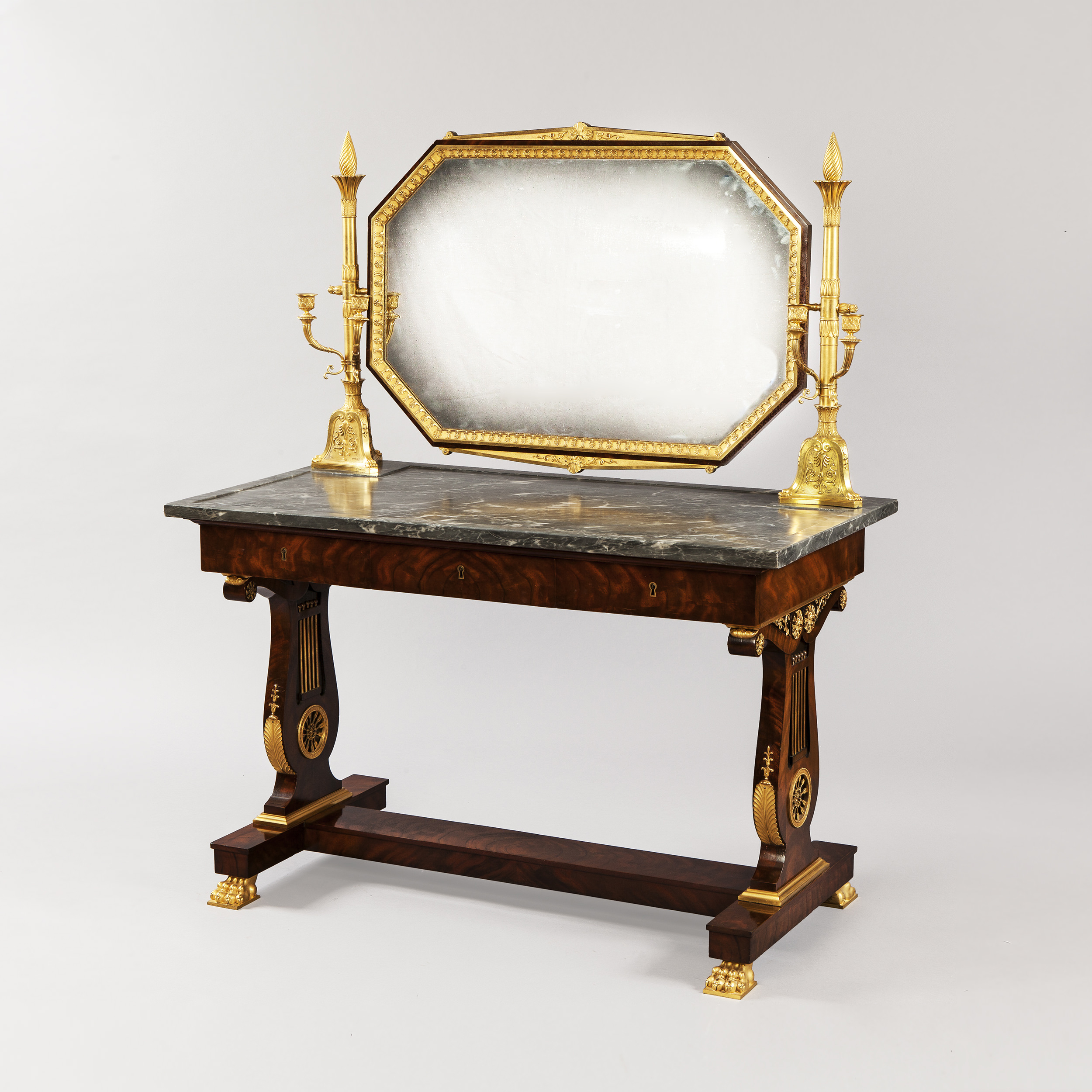
A superb example showing the inventive nature of French Empire bedroom furniture. Dressing Table firmly attributed to François-Honoré-Georges Jacob-Desmalter, circa 1810. Butchoff Antiques.
Seat furniture evolved steadily. Chairs initially conserved their scroll backs from the Consulat period, but the rectangular back, either plain or upholstered, gradually became the standard form. The curved-back chair en gondole proved especially appealing, and fine examples survive in Josephine’s dressing room at Fontainebleau and in Marie-Louise’s boudoir at Compiegne. Small, round gueridons were welcomed for their practical advantage in rooms where people gathered, and they remained in favour throughout the Napoleonic period and beyond.
Empire Across Europe
The Empire style spread rapidly beyond the frontiers of France. Developing from the classicism of Louis XVI, the new style achieved an air of academic formality, shedding any sense of feminine elegance and concentrating upon severe lines and often somewhat heavy forms. Napoleon’s military conquests played a considerable part in carrying the style to every corner of Europe and as far afield as Russia.
In England, the parallel development became known as the Regency. Thomas Hope, a wealthy banker and talented connoisseur, published his Household Furniture and Interior Decoration in 1807 as a record of his house in Duchess Street, London. Hope is believed to have designed the furniture himself, and his book established what came to be known as the “English Empire” style: articles severely rectilinear in shape, with plain surfaces of mahogany veneer relieved with small ormolu ornaments of classical motifs such as honeysuckle, palmette, lotus and acanthus leaves, wreaths, and figures of chimerae or sphinxes.
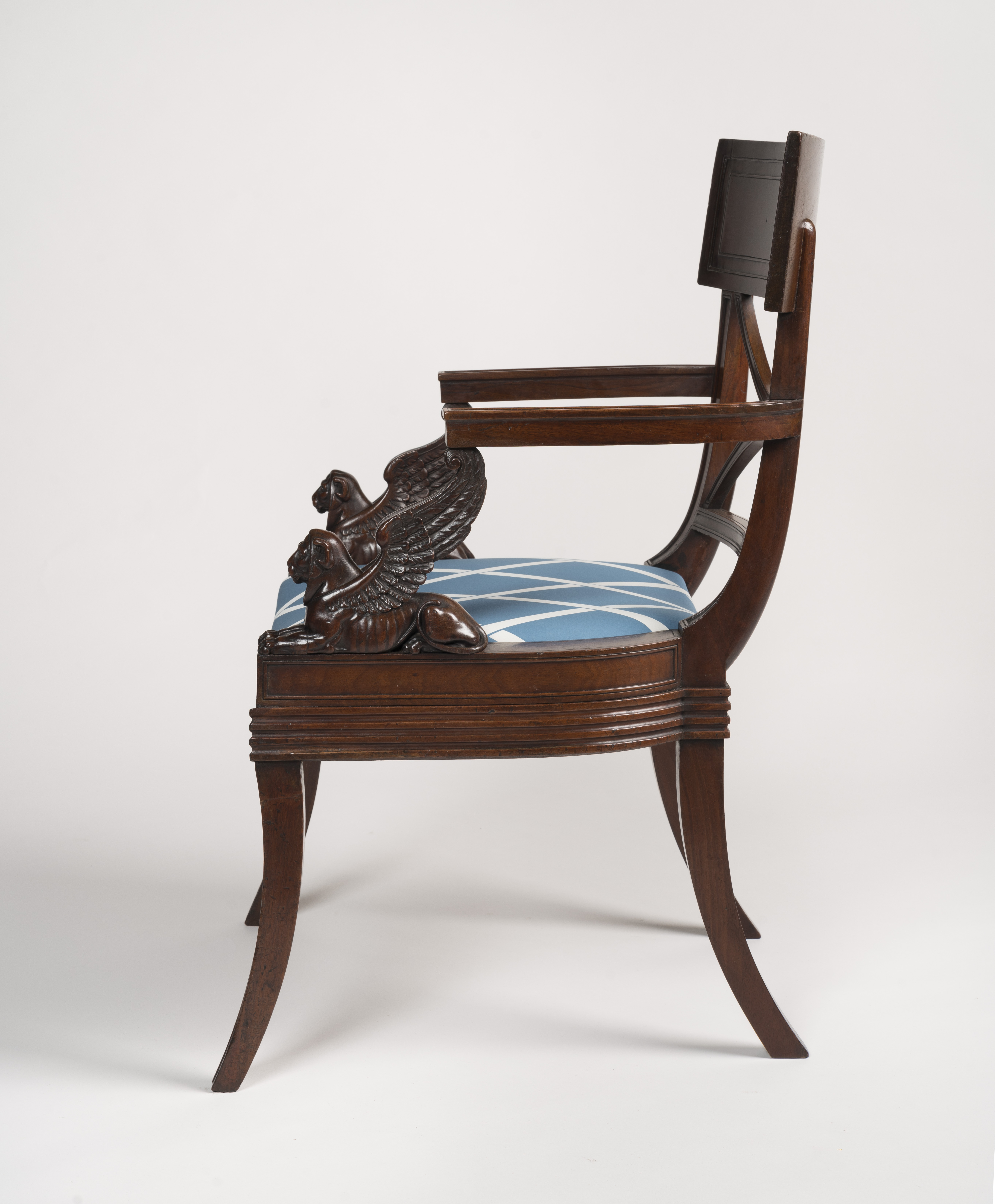
One of pair of Regency Armchairs after the design of Thomas Hope showing the direct influences of French empire designers such as Percier & Fontaine as well as Classical Antiquity. Butchoff Antiques.
In the German territories, the style was adapted to local traditions. For the Wurzburg Residenz, Johann Valentin Raab provided furniture less severe than its Parisian counterparts, giving more prominence to carved and gilt decorative features. In Vienna, cabinet-makers favoured finely cast and chased gilt bronze mounts. Yet the Empire style barely survived the end of imperial power. The wars had impoverished the middle classes, and from the severe contours of Empire furniture a more relaxed and intimate bourgeois style was evolved, known as Biedermeier.
In Russia, craftsmen in St Petersburg produced chairs showing an interesting compromise between the designs of Jacob-Desmalter and those of Sheraton. In America, the Scottish-born Duncan Phyfe became the most important name in establishing the Empire style in New York, his interpretations of English Regency forms so individual that he can be credited with having evolved a highly personal style.
The Undervalued Style
The Empire was not revived in the nineteenth century with anything like the intensity of the styles of the Ancien Regime. Makers and their patrons looked back instead to the furniture of the three Louis, and the severe masculinity of Napoleonic design fell from fashion almost as swiftly as the Emperor himself. Yet it never disappeared entirely. In the last two decades of the nineteenth century, firms such as Krieger produced mahogany furniture with gilt bronze mounts inspired directly by the designs of Percier and Fontaine, supplying clients from Florida to Argentina with Empire-style pieces that demonstrated the international appeal of the Napoleonic vocabulary.
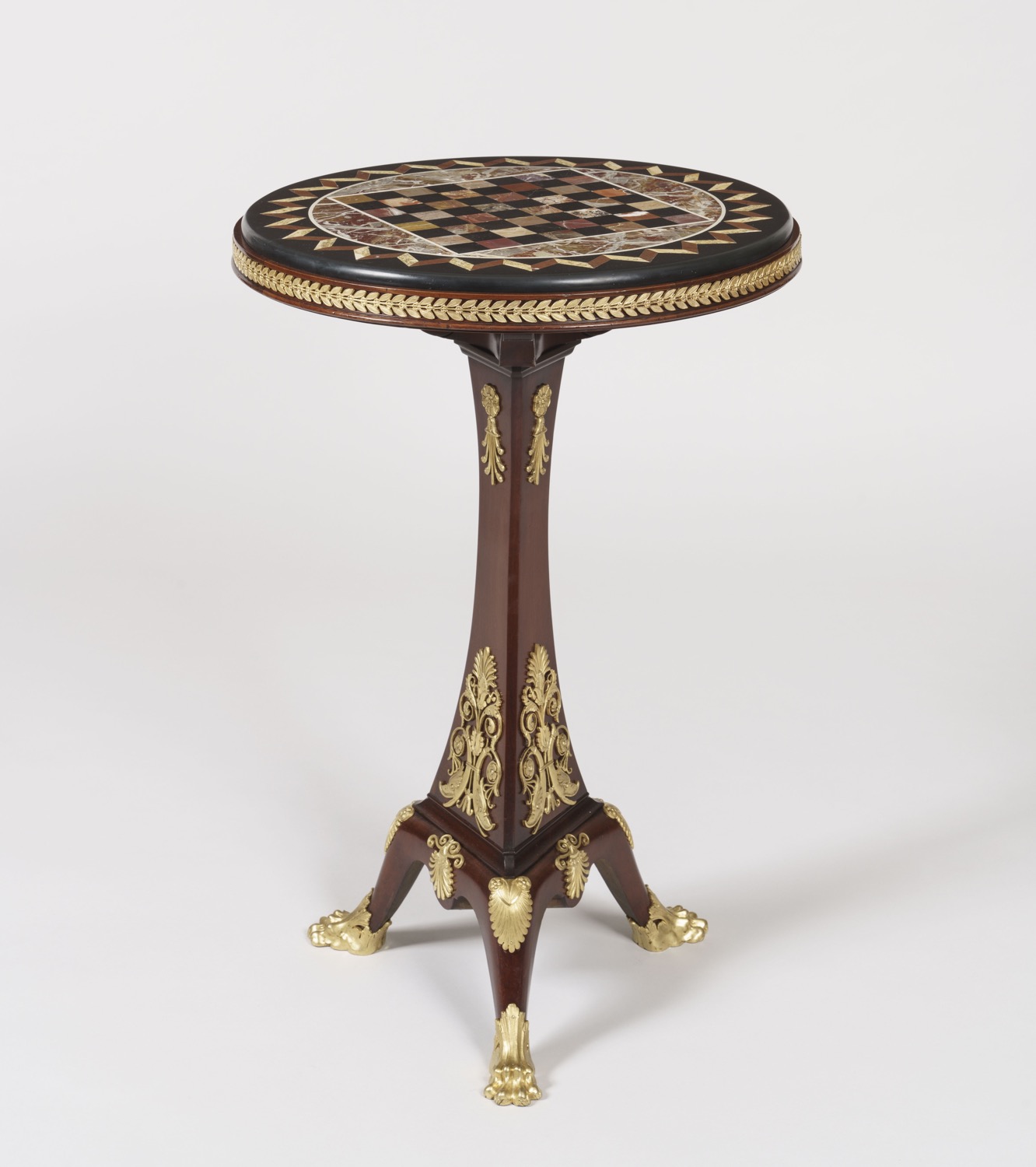
An Empire Revival chess table, attributed to Maison Kriéger, circa 1870. Previously with Butchoff Antiques.
That appeal persists today, and for good reason. Empire furniture offers an architectural gravitas that few other styles can match. The strong geometric forms, dark woods, and sculptural ormolu mounts read as serious and grounding in a scheme, qualities that interior designers deploy to particular effect in studies, libraries, and formal dining rooms. The clean lines prove surprisingly compatible with modern and contemporary art, and the robust construction that characterised furniture built for imperial palaces makes Empire pieces forgiving of daily use in working rooms, practical furniture rather than objects for display.
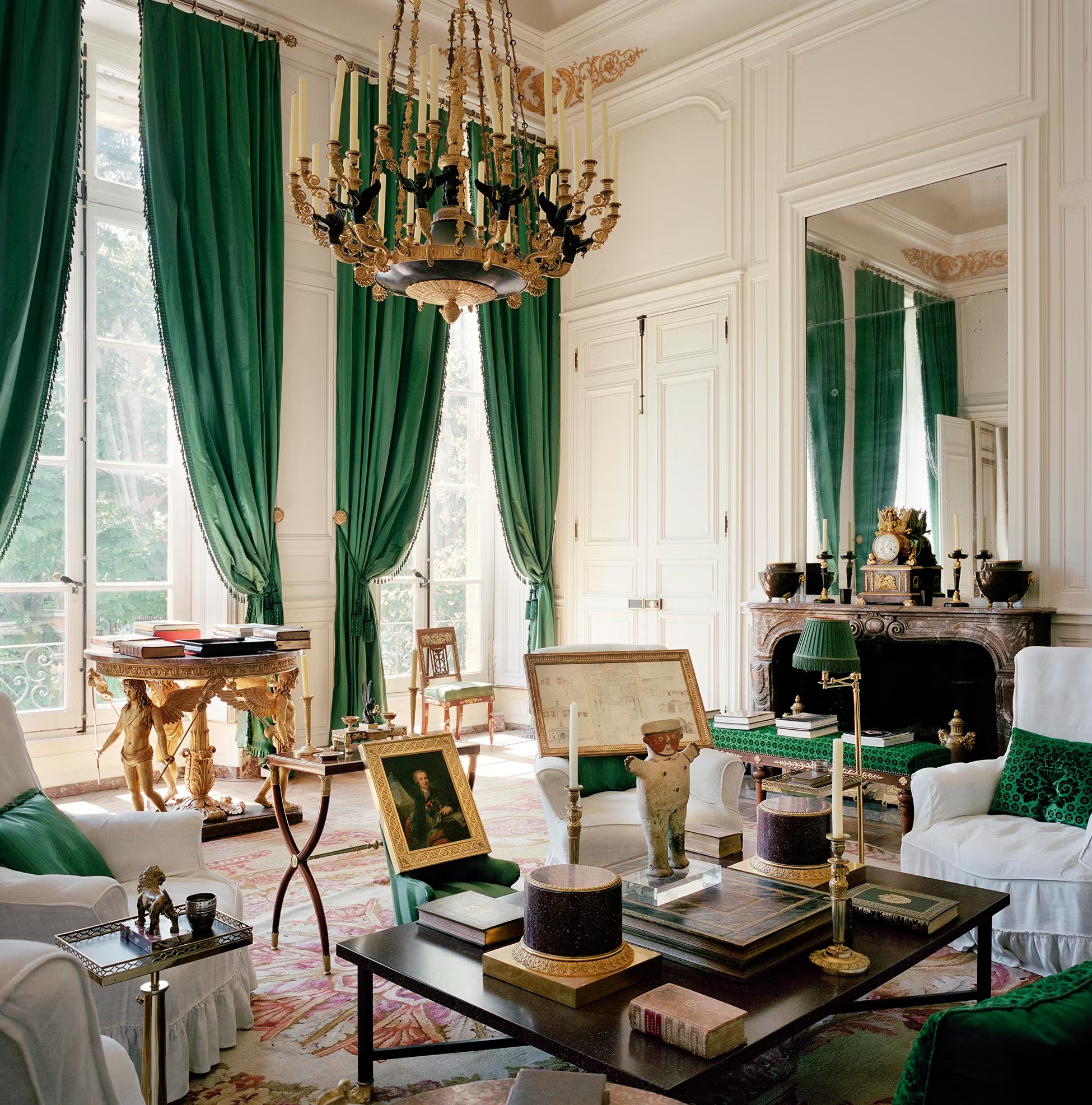
The Empire salon at the Paris home of the legendary Hubert de Givenchy.
Where Rococo furniture succeeds through movement and asymmetry, Empire furniture anchors a room through stillness and geometry. A single console table or pair of gueridons, placed against a well-chosen wall colour, can define an entrance hall with an authority that few other periods achieve. The style’s relative undervaluation compared to Louis XV and Louis XVI furniture makes it, for discerning collectors and designers alike, one of the more compelling opportunities in the current market.
written by Rainier Schraepen

The Rococo: Curves, Grandeur and the Art of Excess
The word "rococo" was never used by the people who created it. In the salons and ateliers of 1730s Paris, the style was known simply as the "gout moderne", the modern taste, a name that captures something essential about its spirit. It was new, it was fashionable, and it was deliberately opposed to everything that had come before. The term "rococo" arrived later, coined by neoclassical critics as a derisive conflation of "rocaille", the shell-encrusted rockwork of aristocratic grottoes, and "barocco", the Italian word for Baroque. What began as an insult became the name of one of the most seductive decorative movements in European history.
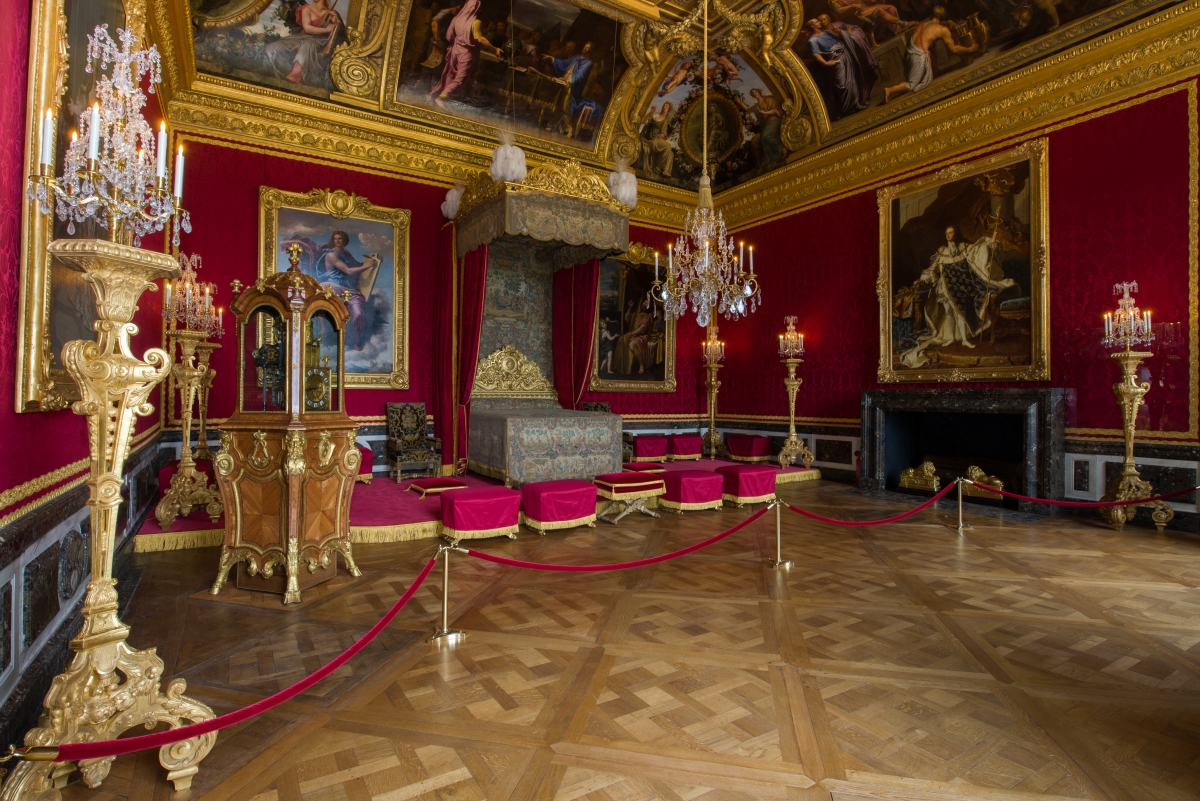
The grand interiors at Versailles epitomised the Louis XIV style, favored by the great Sun King. The rococo was a deliberate reaction to these established styles.
Rococo furniture emerged not at the royal court but in the private townhouses of Paris. When Philippe, duc d'Orleans, moved the seat of power from Versailles to the Palais Royal during his regency (1715-1723), the aristocracy followed. The rigid ceremony of Louis XIV's court gave way to a more intimate social life, and the new Parisian residences demanded furniture to match: lighter, more personal, and suited to the smaller salons and boudoirs where daily life was actually lived. From this migration grew the first decorative style shaped by private taste rather than royal decree, and its influence would sweep across the whole of Europe within a generation.
The French Court and the Influence of Madame de Pompadour
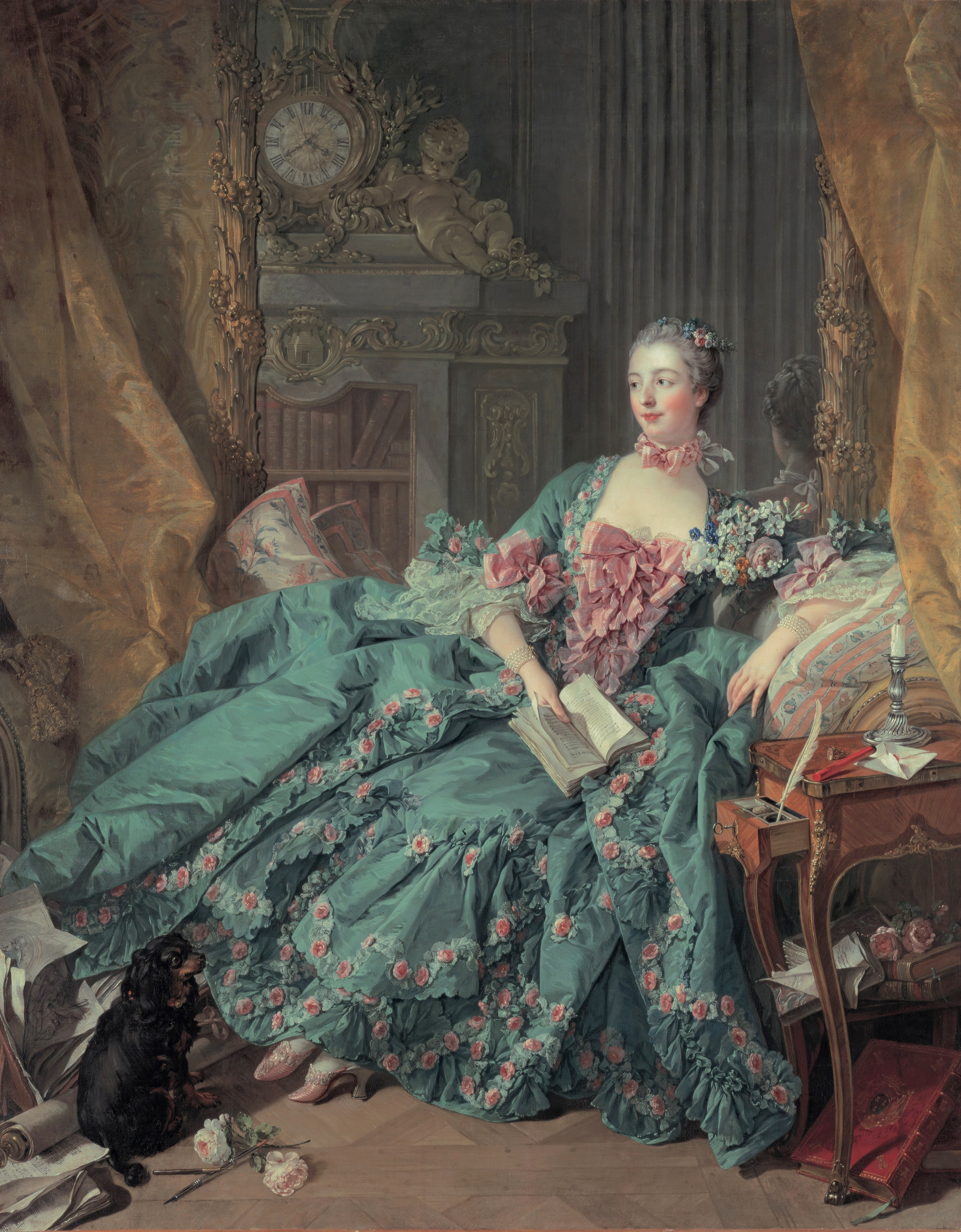
The new face of Rococo: Madame de Pompadour, painted here by François Boucher in 1756.
The popularity of the Rococo owed an enormous amount to two figures: Louis XV himself, and his celebrated mistress, Madame de Pompadour. She was a knowledgeable patron of the arts and an important client of the marchands merciers, the luxury furniture dealers who served as arbiters of fashionable taste. Her ability to create an atmosphere of intimacy in which the king could relax shaped the fashion for interiors that were at once luxurious and genuinely comfortable, a combination that had rarely been achieved before.
The transformation was physical as well as social. At Versailles, Fontainebleau, and Compiegne, small intimate rooms were planned, decorated, and furnished to satisfy the contemporary taste for informality. Around these royal palaces, smaller chateaux proliferated: Choisy, Louveciennes, and Bellevue, which Pompadour furnished alongside the Chateau de Champs and residences at La Celle and Aunay. Fashion demanded different suites of upholstered furniture to suit the seasons of the year, and entirely new types of furniture, reduced in scale, were needed for the salons, boudoirs, and bedrooms where daily life was actually spent. Chairs were still arranged around the walls of a room in formal array, but lighter, more mobile chairs known as chaises courantes could now be drawn into the room to encourage conversation.
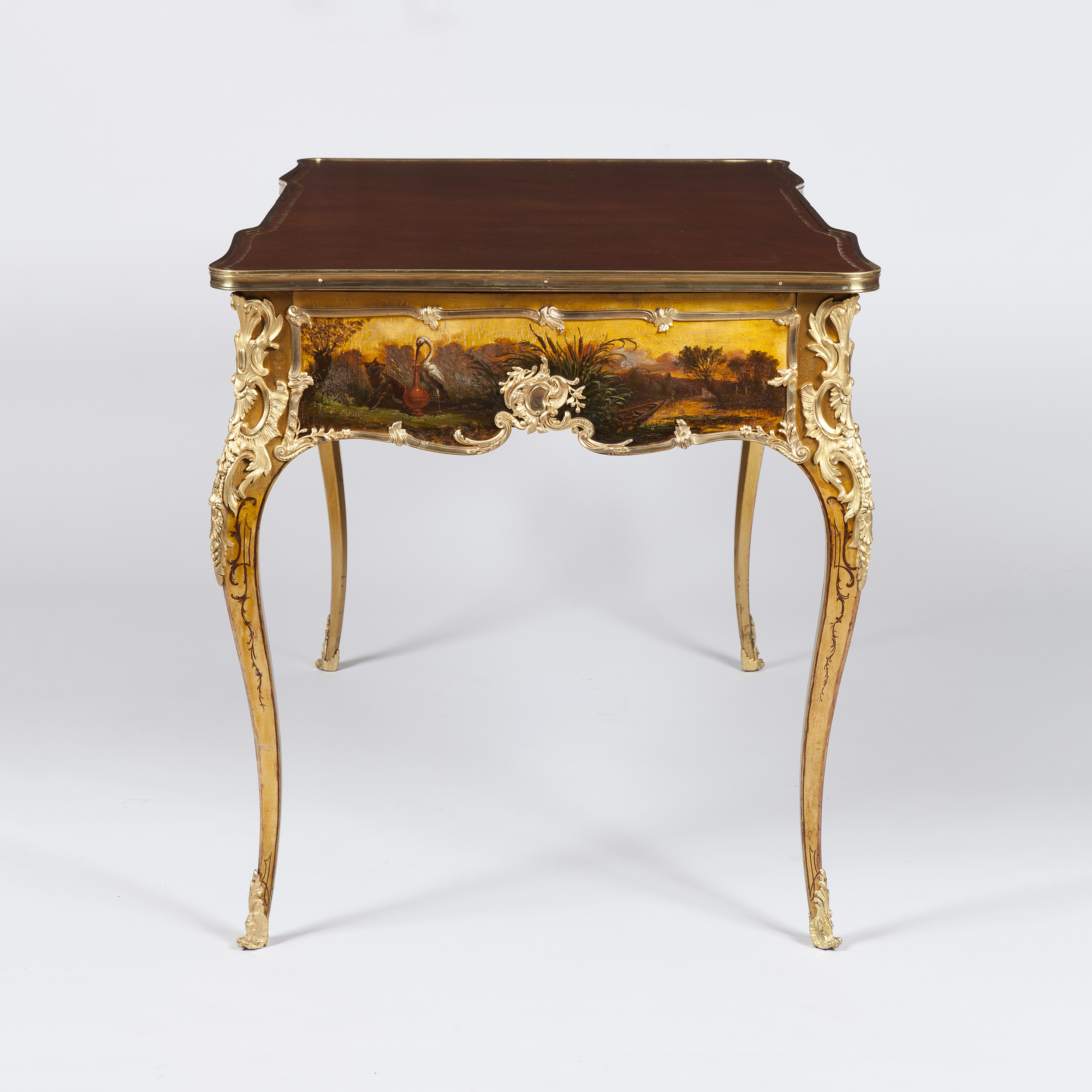
This Louis XV style bureau plat, made in the 19th century by Henri Picard, is decorated with Vernis Martin, made fashionable during the Rococo period. From Butchoff Antiques.
Pompadour's patronage extended to decorative techniques such as vernis Martin, the celebrated French lacquer named after the Martin brothers who held a royal patent. She was portrayed by the Swedish painter Alexandre Roslin seated before a "coquillier," a small cabinet designed to house a collection of shells, reflecting the fashionable taste for natural curiosities that permeated the period.
The marchands merciers were central to this world. They were men of stature, in close touch with purchasers whose taste they understood and whose appetite for novelty they fostered. They influenced the ebenistes through the orders they placed and coordinated the work of craftsmen belonging to different guilds. Leading figures such as Lazare Duvaux, Simon-Philippe Poirier, and Dominique Daguerre wielded considerable power in matters of taste, acting as intermediaries between patron and maker.
The Defining Characteristics of Rococo Furniture
The Rococo, for all its complexity, is easy to read. It can be characterised, as Christopher Payne has observed, as having "no straight lines." At its height, the style's proponents advocated asymmetry, though in France the later manifestations were more ordered, with subtle rather than full-blown asymmetry retaining harmonious proportions. Naturalistic motifs were adapted into abstract forms: C-scrolls, S-scrolls, stylised acanthus leaves, scallop shells, and carved ornament evoking, in its restless energy, the continuous movement of waves.
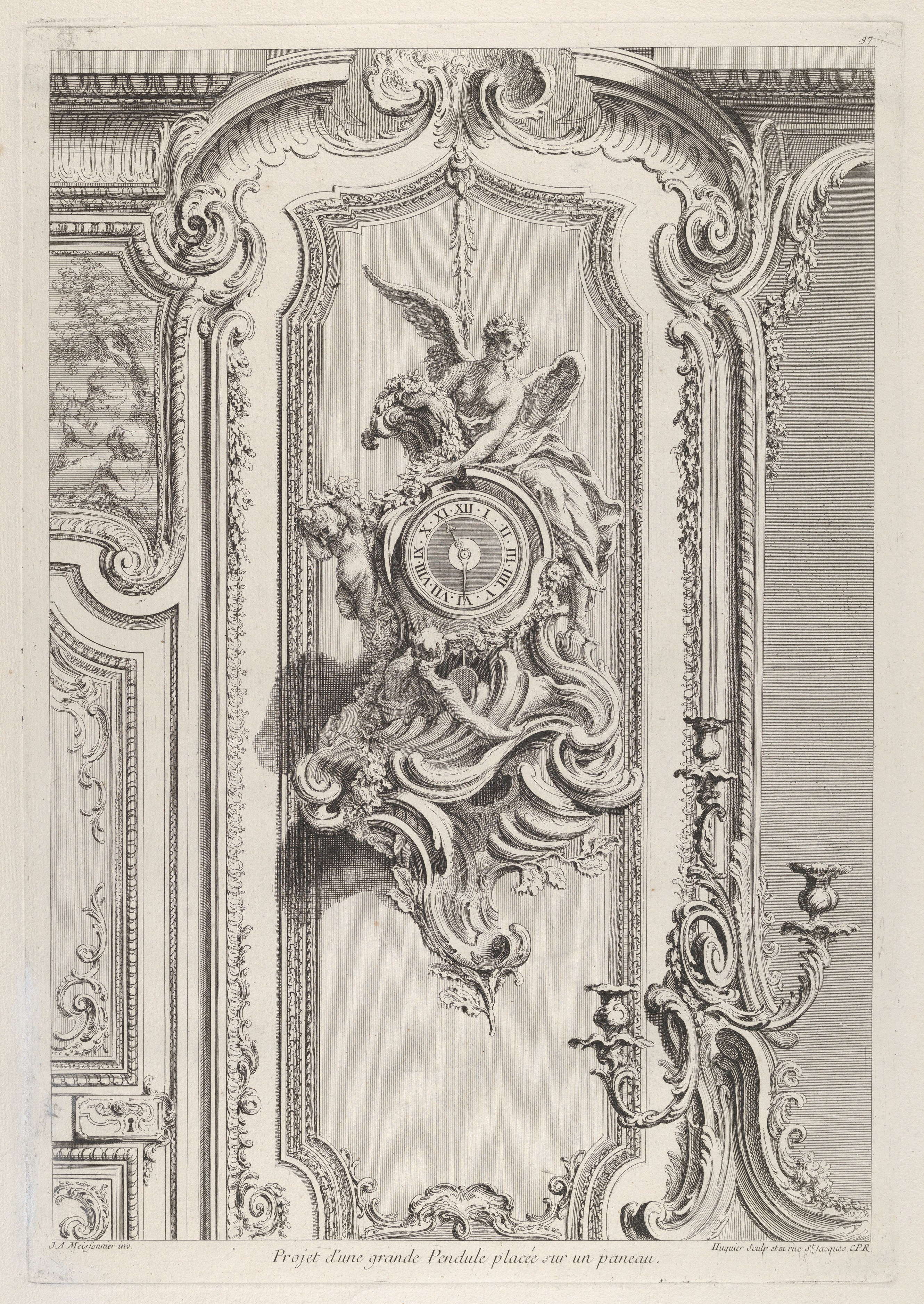
Exuberant asymmetrical Rococo was typical of Meissonnier's inventive designs, disseminated by his published engravings during the first half of the eighteenth century.
Two designers defined the poles of Rococo ornament. Juste-Aurele Meissonnier (1695-1750), of Piedmontese origin, introduced swirling, asymmetrical forms that depended upon the subtle play of curves to achieve their provocative charm. Nicolas Pineau (1684-1754), by contrast, reflected the true character of French rocaille: supple and graceful lines, with ornament of shells, flowers, and palms clearly defined on curving surfaces. Pineau's designs were engraved by Mariette and widely used in mid-eighteenth century workshops, shaping the visual language of a generation of furniture makers.
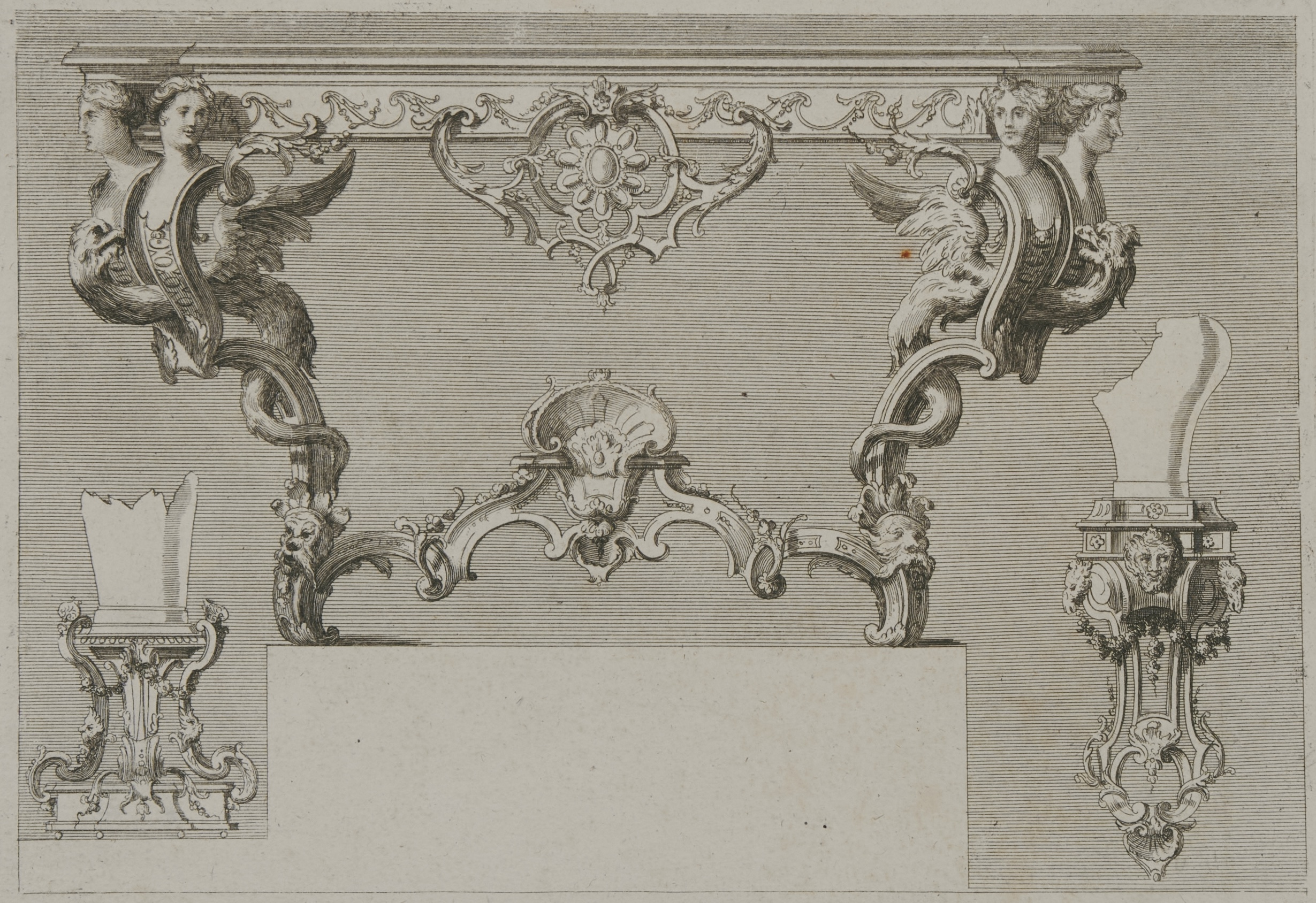
Pineau's graceful designs, while less inventive than Meissonnier's, were more readily translated into real-world objects and interiors.
Cabinet pieces relied on elongated, supple curves with legs of cabriole type, a form whose name derives from the French for a leap in dance. The cabriole leg was extraordinarily labour-intensive to produce: a single veneered example might take two days to shape and another two to veneer. Marquetry and exotic wood veneers in kingwood, rosewood, and tulipwood threw into relief the sparkling gilt-bronze mounts, with handles composed of curling foliage, cartouches, and volutes.
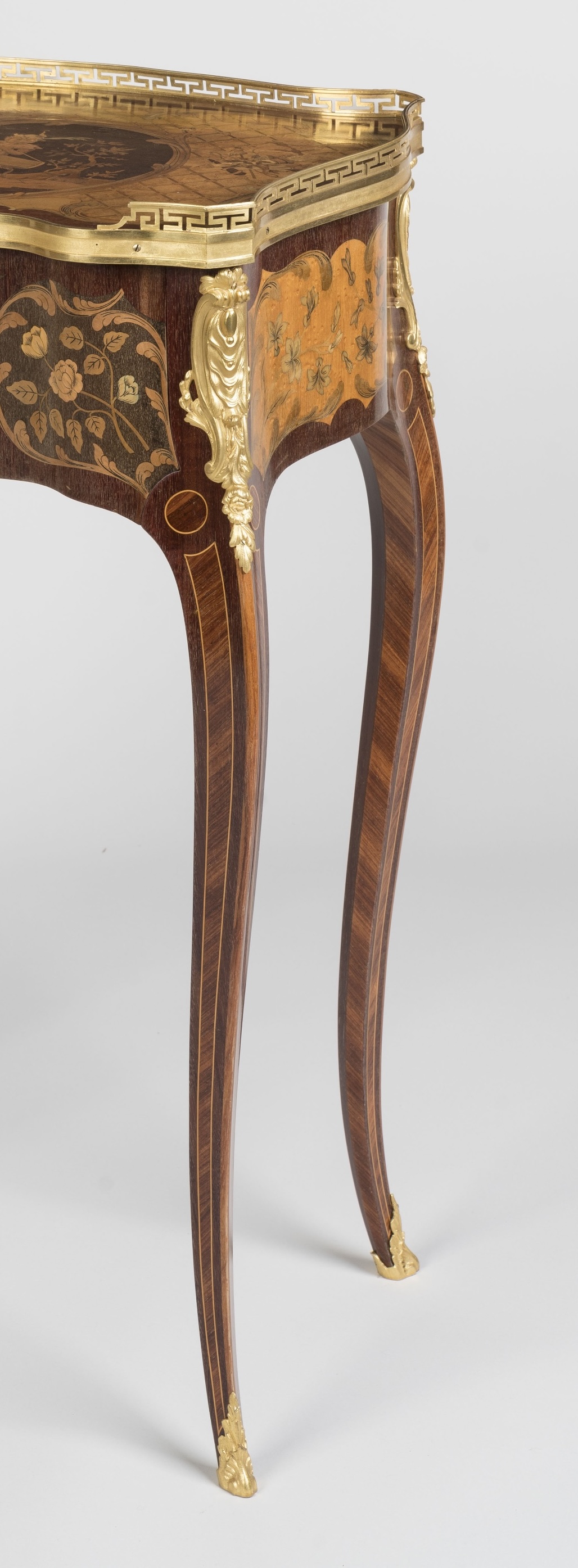
Cabriole legs, ormolu mounts, exotic woods and marquetry all come together in this Rococo style table, made by Beurdeley of Paris during the nineteenth century. From Butchoff Antiques.
The bombe commode, with its swelling convex form, became one of the most fashionable furniture types between roughly 1730 and 1760, enriched with elaborate ormolu and often serving as the centrepiece of a room. Seat furniture evolved in parallel. The bergere, with its closed upholstered sides and thick cushion, the duchesse brisee (a day-bed in two or three parts), and deep armchairs known as veilleuses were all developed to serve the new informality. Even the colours of Versailles softened during this period, with rooms painted in couleur d'eau, petit vert, jonquille, and gris de perle rather than the heavy gilding of the previous reign.
The Parisian Workshops and Guild System
Every piece of Rococo furniture was a collective work. The guild system rigidly separated the crafts involved in its production. The menuisier, or joiner, worked the solid wood: cutting, shaping, carving, and joining. The carver contributed decoration in relief, the painter and gilder added colour, and the upholsterer furnished seats and beds. Rivalries between these guilds were intense; according to Andre Roubo, a practising menuisier whose treatise L'Art du Menuisier appeared between 1769 and 1775, joiners frequently carved small decorative motifs themselves rather than cede the work to a specialist.
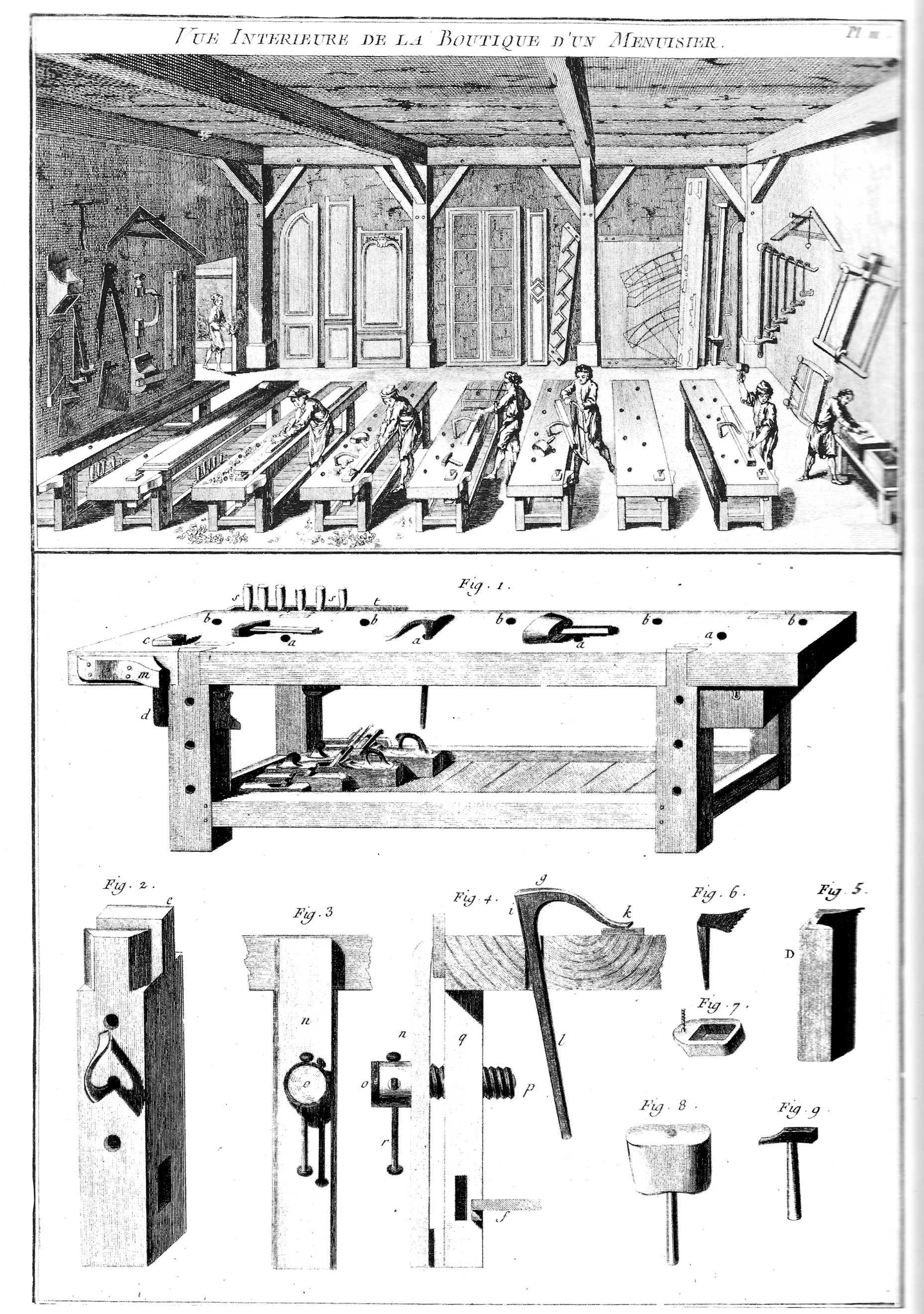
Plate 11 from Roubo's treatise on cabinetmaking.
The art of veneering added another specialisation. The craftsmen who practised it were known as ebenistes, a term derived from "menuisiers en ebene," and in 1743 the guild formally recognised their status, becoming the Corporation des Menuisiers-Ebenistes. From that year, every piece was required to bear the maker's stamp. Workshops were inspected four times a year, and substandard furniture was confiscated. The stamps were usually hidden, which suited the marchands merciers, who preferred their clients not to approach the makers directly. Royal furniture alone was exempt, as those craftsmen served the king outside the guild's control.
Gilt-bronze mounts added yet another specialist: the fondeur-ciseleur, or bronze caster and chaser. The cost of modelling sculptural mounts was extraordinary, often three to five times greater than the cabinet work and veneering combined. Master models were jealously guarded and handed down through generations.
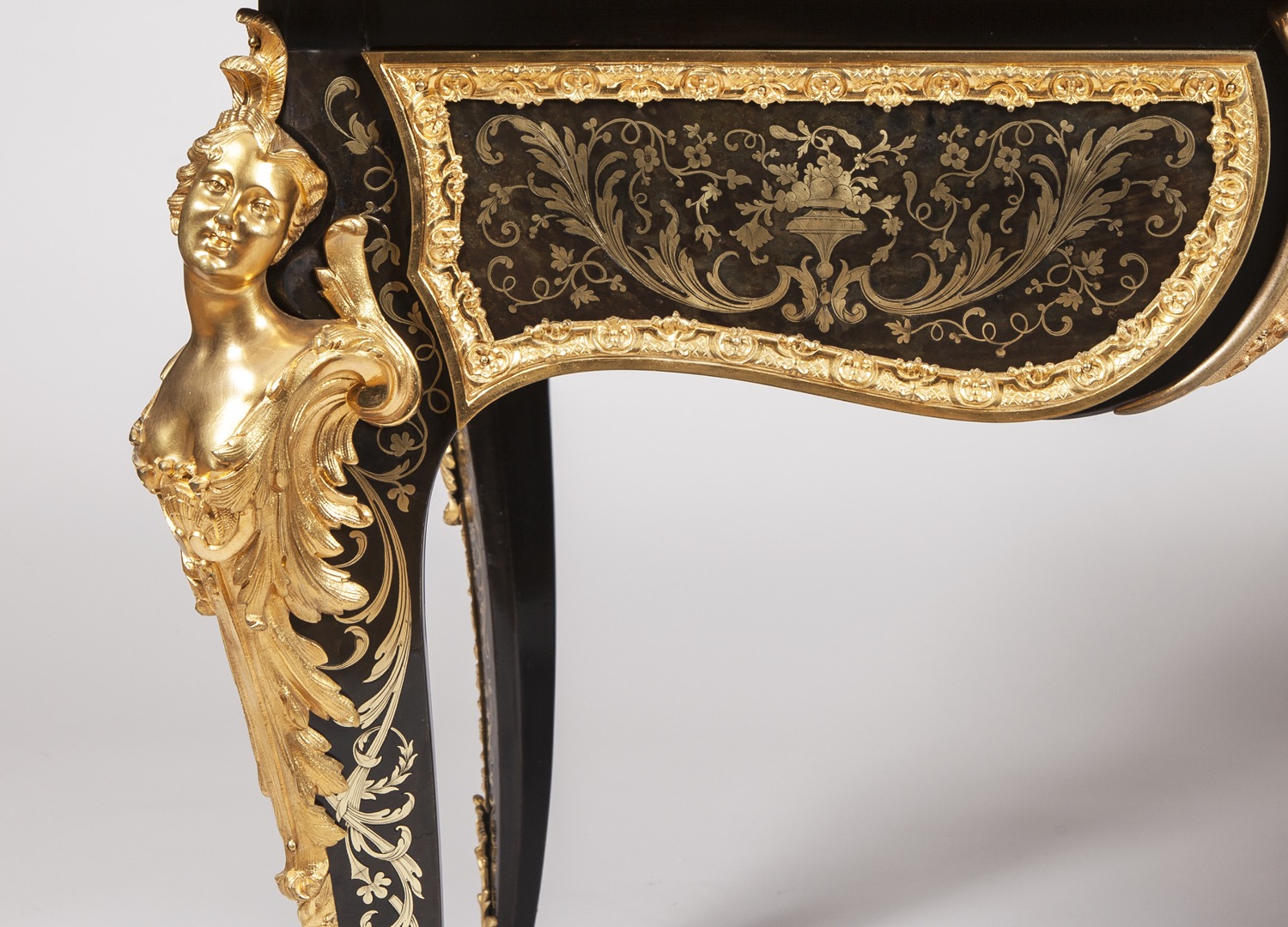
Figural espagnolettes, such as those seen on the bureau plat, were cast by makers such as Charles Cressent and mounted on his own furniture, breaking earlier conventions. Image: Butchoff Antiques.
The makers themselves were remarkable. Charles Cressent, who worked for the Regent and wealthy financiers from 1719 to 1757, broke convention by casting his own bronze mounts, producing the characteristic espagnolettes and faun masks that defined early Rococo furniture. Bernard II Vanrisamburgh, known by his guild stamp BVRB, was among the finest ebenistes of his generation, particularly skilled in working oriental lacquer to fit the complex curves of bombe commodes. Jean-Francois Oeben, named ebeniste du roi in 1754, combined mechanical ingenuity with superb craftsmanship, devising furniture with concealed drawers released by hidden mechanisms. Many of these masters were immigrants, drawn to Paris by the exceptional demand for furniture: Flemings such as Vanrisamburgh and Roger Vandercruse, and Germans including Oeben and his successor Jean-Henri Riesener, a tradition of Parisian craftsmanship that later masters such as François Linke would sustain into the twentieth century.
Rococo Across Europe
The Rococo was born in Paris, but its influence radiated across the Continent, adapted everywhere to local traditions and temperaments. In England, the development was gradual. The earliest Rococo carved mahogany chairs, inspired by engravings published in London in 1736 by the Italian Gaetano Brunetti, are curiously heavy, as though the carver were more accustomed to weighty Baroque forms than the curvaceous elegance of French example.
It was Matthias Lock who first interpreted French rocaille with genuine freedom. His sets of designs for mirrors and tables, published in 1744 and 1746, included C-scrolls, flowers, and masks, with birds, winged dragons, and leaping hounds entwined in frothy, wave-like ornaments. Lock's workshop was in Tottenham Court Road, and his designs provided a challenge and a model for English carvers. Thomas Chippendale, who was probably in close touch with Lock, published his celebrated Gentleman and Cabinet-Maker's Director, the first book solely devoted to furniture in England. The Director was enormously influential, offering patrons a choice and craftsmen a model that could be varied at will. Its designs for chairs with pierced and carved splats, cabriole legs, and serpentine commodes drew freely on the Rococo repertoire.
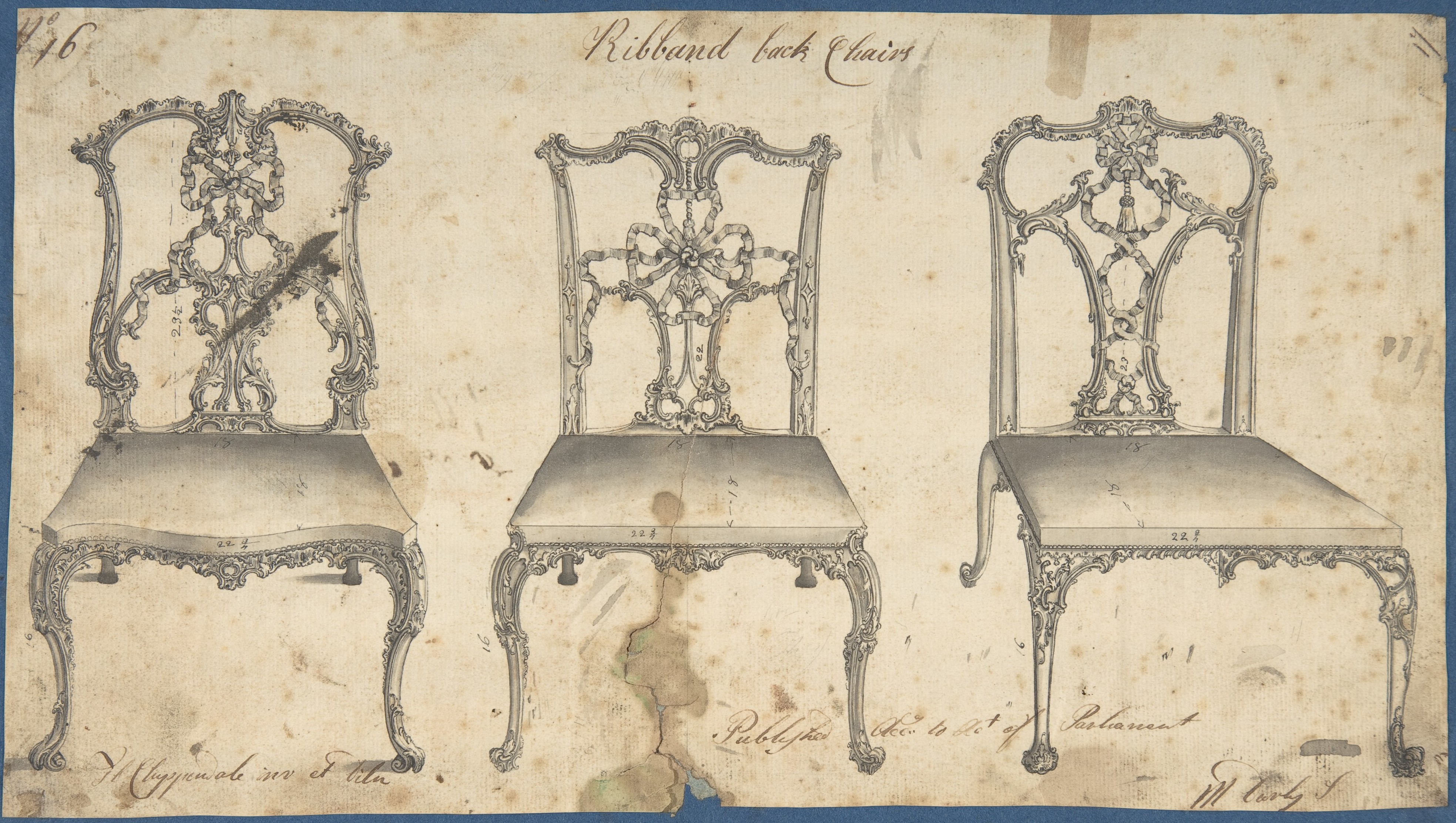
Chippendale's so-called Ribband-back chairs exemplify the taste for French rococo styles in English furniture design.
In Germany, the style achieved a different character entirely. Rococo interiors in scintillating white and gold, or blue and silver, adorned palatial residences well before mid-century. At Bayreuth, court sculptors produced carved console tables of remarkable exuberance, with bold, fluid carving and flame-like motifs. Frederick the Great's palaces at Potsdam featured stucco decorations that rivalled even Bavaria and, as Helena Hayward observed, quite overshadowed their French prototypes. It was in one such room that Bach played for the king on a theme Frederick himself had composed.
Elsewhere, the Rococo took on still other forms. In Italy, it merged with existing Baroque traditions. In Spain, japanned chairs were decorated with rocaille ornaments and parcel-gilded, bridging the gap between solid tradition and French fashion. In Scandinavia, French motifs were carved in a characteristically naive manner, often rather large, picked out with gilding in a distinctively Danish style.
The Decline and the Turn to Neoclassicism
The Rococo was already under attack before mid-century. In 1754, the engraver Nicolas Cochin published a plea in the Mercure for a return to "the way of good taste of the preceding century." It was Cochin, this arch-enemy of the Rococo, who had been chosen to accompany Madame de Pompadour's brother, the future Marquis de Marigny, on his formative travels to Italy between 1749 and 1751, a journey that would help plant the seeds of the style's displacement.
The catalyst for change came from archaeology. Systematic excavation began at Herculaneum in 1738 and at Pompeii in 1748. Piranesi's engravings of Ancient Rome, published from 1748, were distributed widely, and subsequent works such as Robert Wood's Ruins of Palmyra (1753) and Ruins of Balbec (1757) fuelled a growing thirst for classical antiquity. The Comte de Caylus, a noted antiquarian whose circle included Louis XV's foreign minister the Duc de Choiseul, published six volumes of ancient artefacts between 1752 and 1755. By 1759, d'Alembert could write that "a most remarkable change in our ideas has taken place."
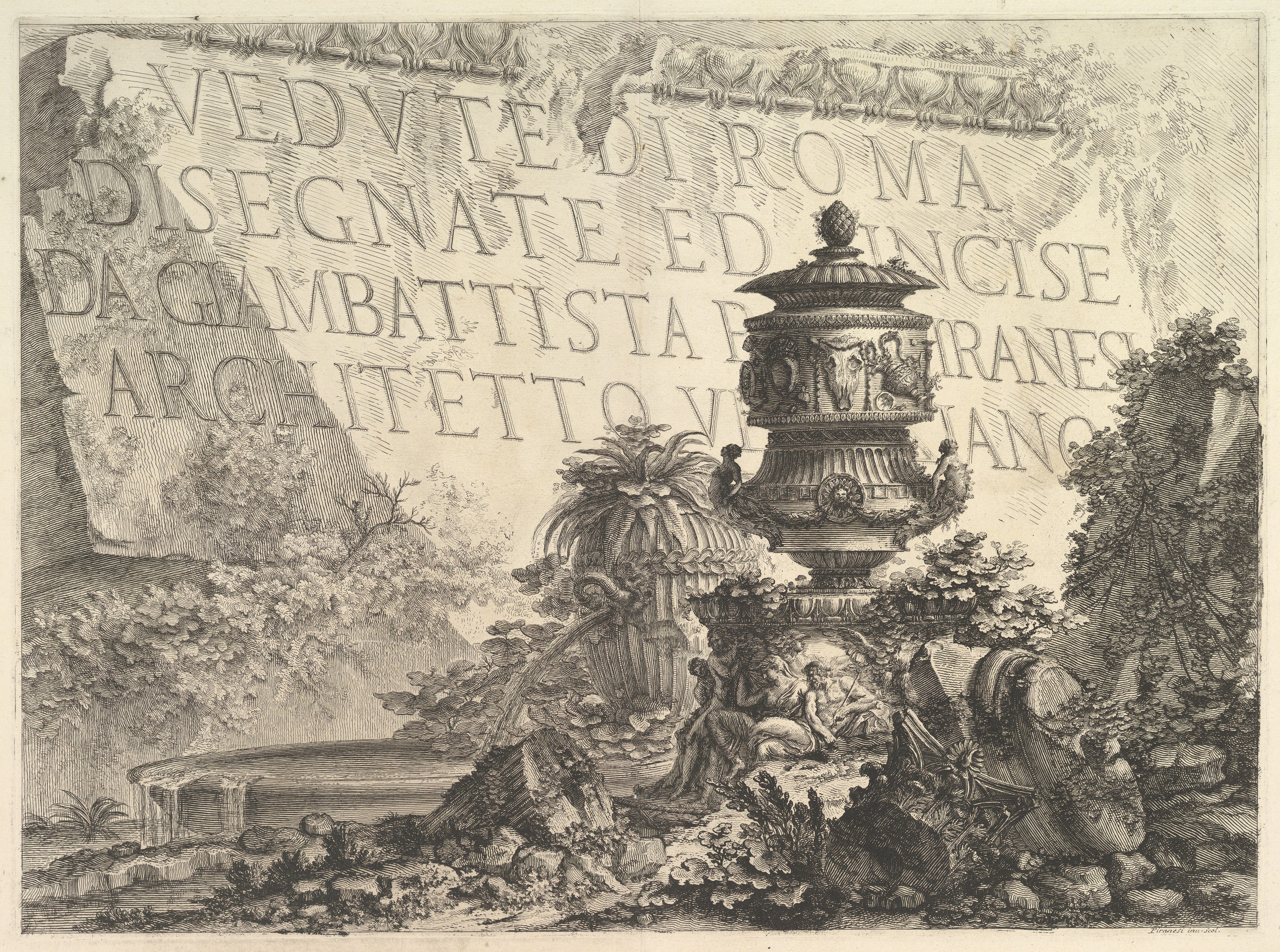
The frontispiece of Piranesi's book 'Views of Ancient Rome' clearly signals a turn toward neoclassicism and a return to Greco-Roman ideals.
The Transitional style (c.1760-1775) marked the Rococo's gradual displacement. The bombe form fell from fashion and greater rectangularity was introduced, often with a central breakfront panel. Straight tapering legs replaced the cabriole, and fluted columns replaced sinuous curves. The commode "a la grecque," a model favoured by Pompadour herself, signalled the new direction. Jean-Francois Oeben, the very ebeniste du roi who had mastered Rococo mechanics, was among the first and most important makers to produce furniture in this emerging taste.
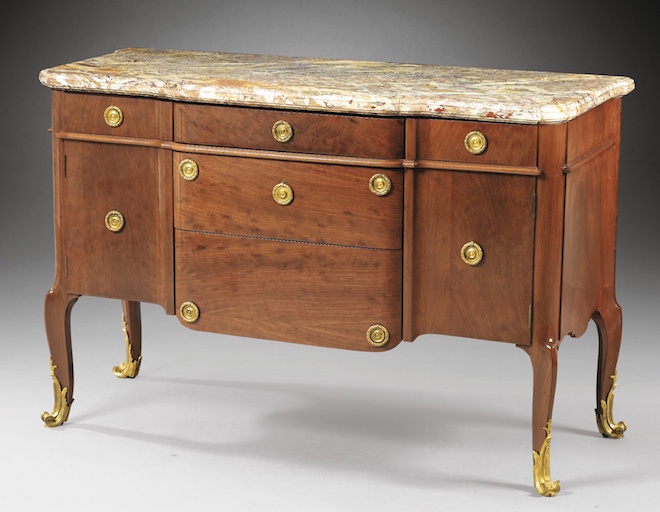
This commode à la grecque, ordered by Madame de Pompadour, made by Oeben, shows the cabinetmakers' conscious move away from curved forms toward rectilinear designs. Sold at Sotheby's.
The king himself never wavered. Louis XV always preferred the Rococo, and when he died in 1774, Neoclassicism had already dispossessed it. The style he loved had run its course in barely forty years, consumed by the very restlessness and appetite for novelty that had brought it into being.
A Decorators' Style
The Rococo has never entirely gone away. Since its original decline in the 1770s, the style has experienced repeated cycles of revival, each generation finding in its curves and gilding something that the prevailing fashion lacked. The first major revival occurred in England from the 1820s, when gilt chairs and settees appeared at Tatton Park and Rococo interiors were created at Belvoir Castle and Apsley House. As Hayward observed, the Rococo offered "a curvilinear luxuriance" that provided relief from rectilinear fashions, and it carried none of the lofty associations of the classical or the nationalistic overtones of the Gothic. It was, she noted, "a decorators' style," and decorators have returned to it ever since.
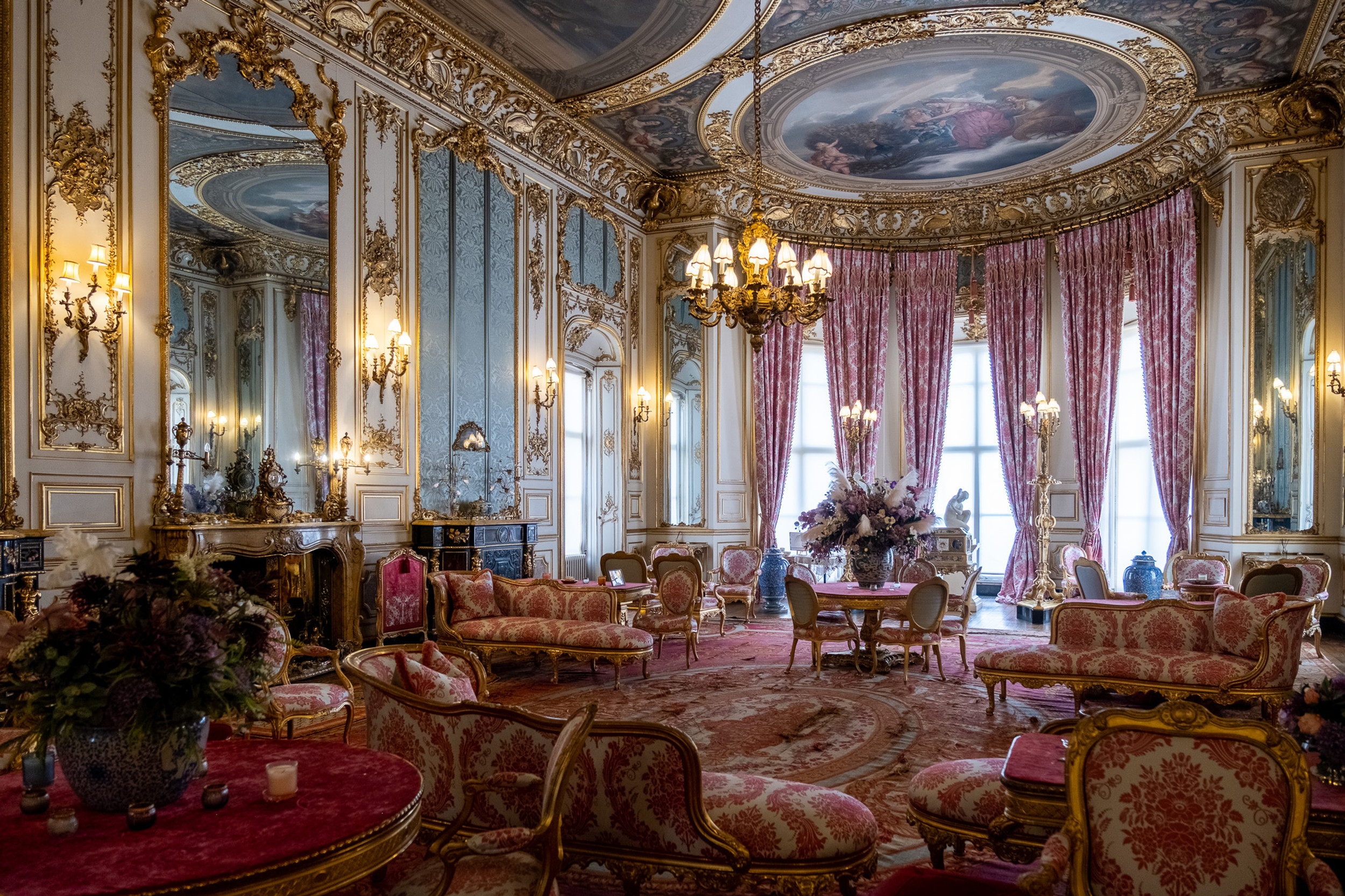
The interiors at Belvoir Castle, seat of the Duke and Duchess of Rutland, was decorated in the nineteenth century Rococo style.
In nineteenth-century Paris, the leading ebenistes sustained the tradition through their own revivals. Alfred-Emmanuel Beurdeley produced exquisite tables in the Louis XV manner around 1880, working in kingwood, amaranth, and tulipwood with gilded bronze mounts, directly inspired by celebrated eighteenth-century models. The Napoleon III period (1852-1870) saw a particularly vigorous return to Rococo motifs, combining earlier artistic influences with the technical capabilities of a new industrial age.
That same impulse continues today. Rococo furniture is experiencing a resurgence in high-end residential interiors, particularly in London townhouses and country estates where generous ceiling heights and well-proportioned rooms can accommodate its scale. The organic curves and asymmetry of a Rococo commode or console table provide a natural counterpoint to the clean lines of modern architecture, a tension that designers use deliberately to bring warmth and visual interest to contemporary spaces. Drawing rooms, principal bedrooms, and entrance halls remain the rooms best suited to Rococo statement pieces, just as A.J. Downing recommended boudoirs and parlours for the style in the 1850s.
The key, as it has always been, is confidence rather than pastiche. Throughout the eighteenth century itself, Rococo furniture sat alongside earlier Baroque pieces and, by the 1760s, beside the first Neoclassical experiments. A single gilded commode or pair of fauteuils, placed with conviction in an otherwise restrained scheme, can anchor a room in a way that no contemporary reproduction achieves. The Rococo has lasted precisely because it was the first style to put comfort and private pleasure at the centre of furniture design, and that instinct remains as compelling now as it was in the salons of 1730s Paris.
Written by Rainier Schraepen

Distinguishing 17th-Century Masterpieces from 19th-Century Revivalism
When it comes to the world of antique furniture, few names carry the same level of prestige and craftsmanship as that of André-Charles Boulle, the renowned 17th-century Parisian ébéniste (cabinetmaker) whose virtuosic marquetry techniques elevated the art of furniture-making to new heights. Boulle's masterful creations, characterized by their intricate brass and tortoiseshell inlays, have long been the holy grail for discerning collectors and curators alike.
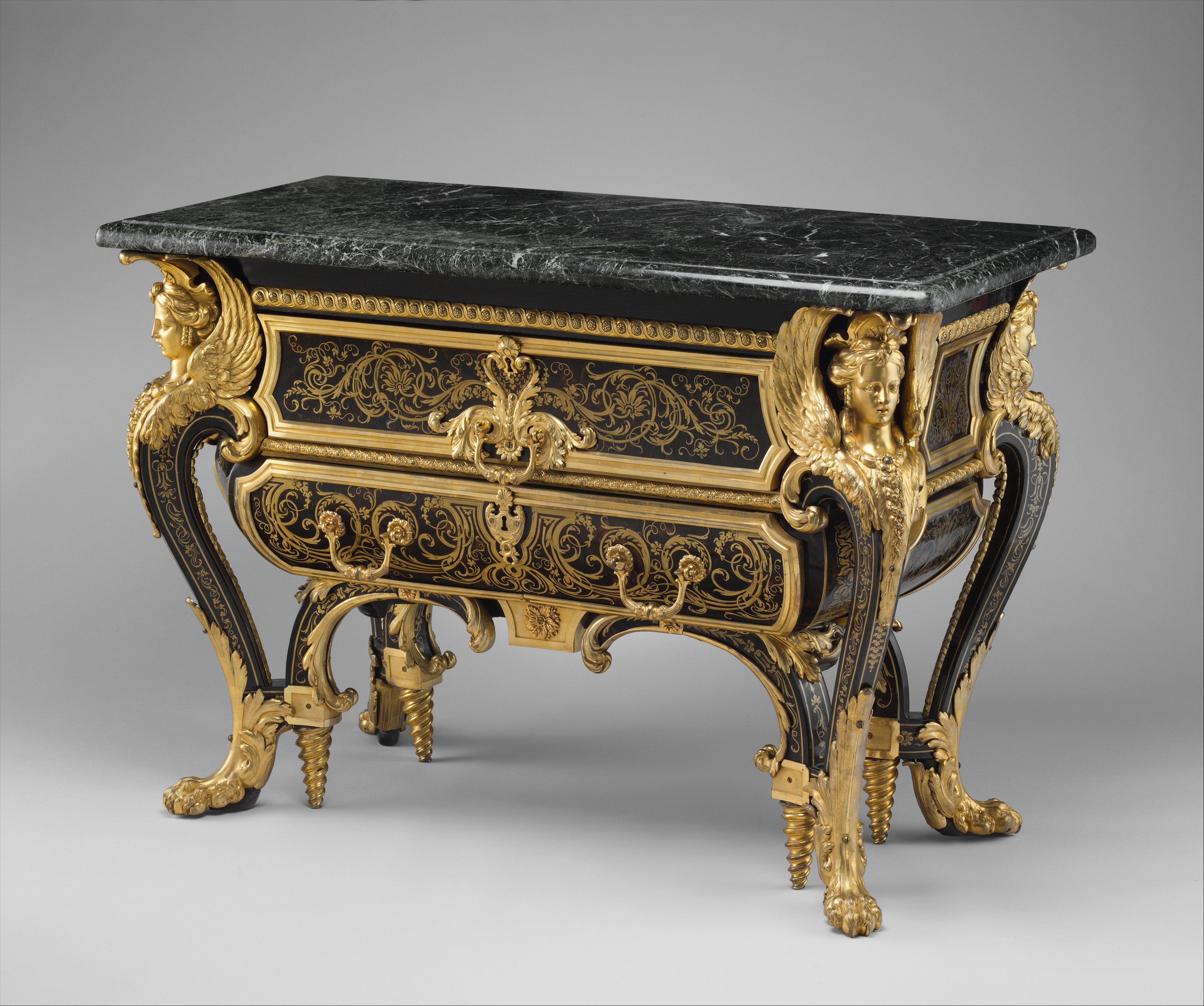 Commode by André-Charles Boulle, french, circa 1710–20. Accession no. 1982.60.82. The Metropolitan Museum of Art, New York.
Perhaps unsurprisingly, the enduring popularity of Boulle's designs has also given rise to a proliferation of 19th-century revival pieces, many of which were produced with impressive technical precision despite not claiming the novelty or provenance of the originals. For the seasoned antique enthusiast or the novice collector, distinguishing these 17th-century masterpieces from their 19th-century renditions can be a daunting task, requiring a keen eye for detail and an in-depth understanding of the evolving techniques and materials employed in Boulle's workshop and beyond.
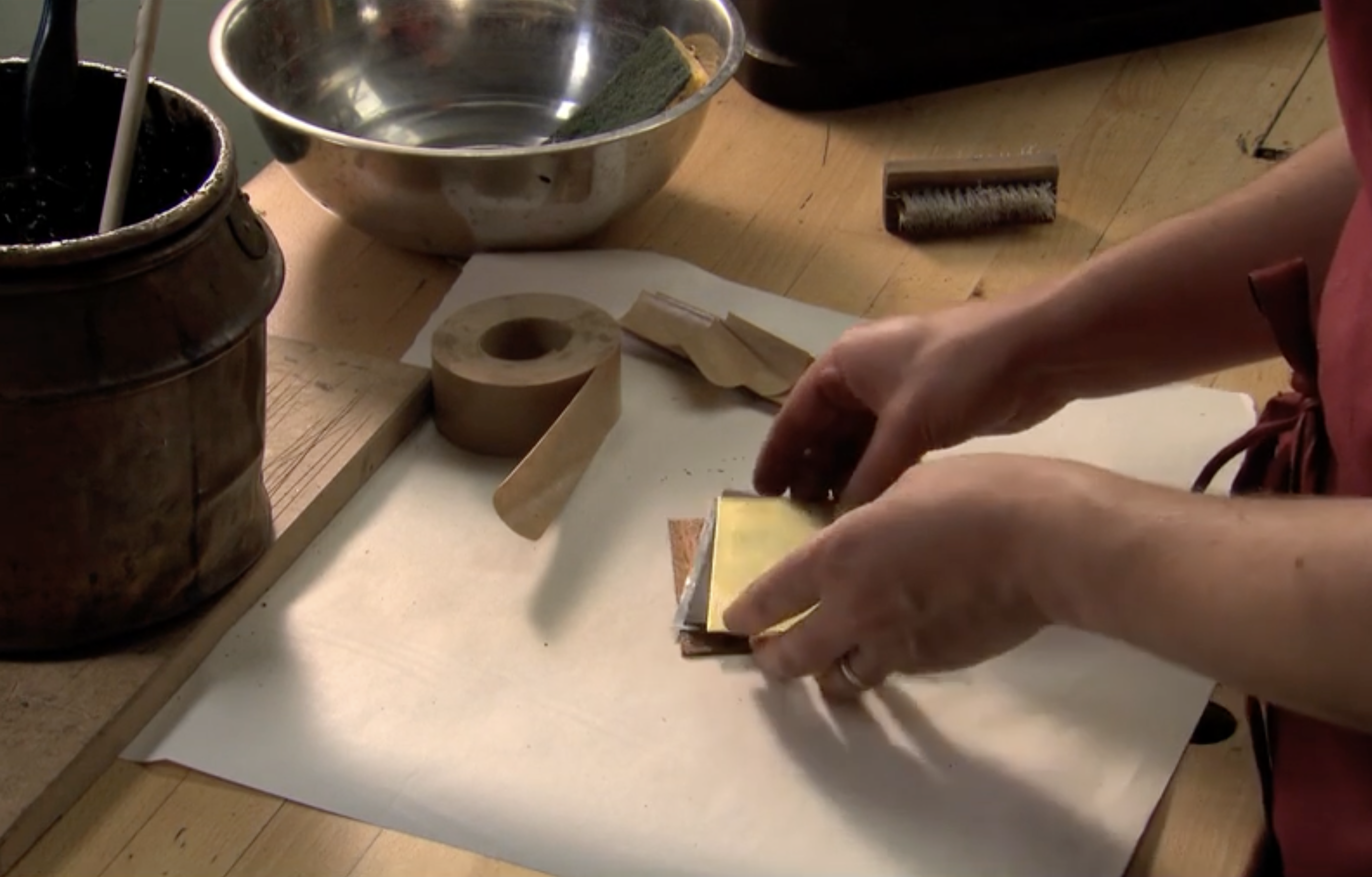
A “packet” consisting of wood, pewter, horn and brass, being prepared for marquetry cutting.
The Fundamental Technique: Tarsia a Incastro
The genius of Boulle marquetry lies in the "packet" or "stack" cutting method, known as tarsia a incastro. This ingenious process allowed for the simultaneous creation of two distinct decorative panels from a single cutting session. The ébéniste would begin by gluing together two sheets of material of equal thickness—traditionally tortoiseshell and brass—often with a piece of paper in between to facilitate separation later. A design was then pasted onto the top surface, and using a fretsaw (a fine bow saw), the artisan would cut through both layers simultaneously, following the intricate design lines.
Once cut, the stack was separated, resulting in two sets of identical components: a brass background with a tortoiseshell cutout, and a tortoiseshell background with a brass cutout. This process, known as the première partie and contre-partie, respectively, is a critical distinction for evaluating 17th-century Boulle masterpieces versus their 19th-century revivals. Historically, the première partie, with its luminous tortoiseshell background, was considered the more desirable and valuable of the two, often used for the primary face of a cabinet, while the contre-partie was relegated to the sides or companion pieces. Pairs exhibiting both types of Boulle marquetry are especially rare and sought after.
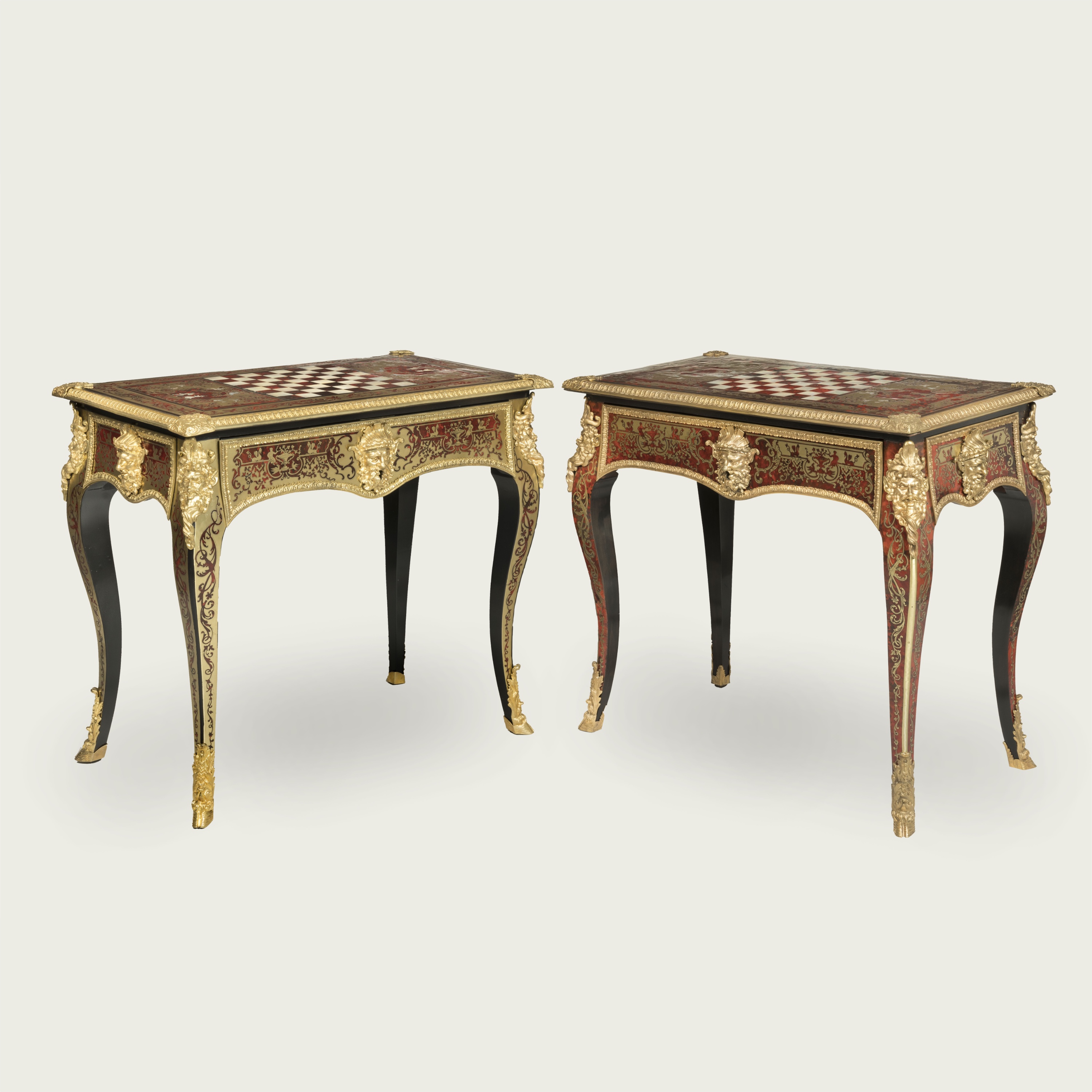
A Fine Pair of Games Tables of the George IV Period in the Manner of André-Charles Boulle, Attributed to Thomas Parker (active 1805-1830), with Butchoff Antiques.
Evolution of the Cut: 17th vs. 19th Century
One of the most reliable ways to date Boulle work lies in the physical evidence of the saw's passage. In the 17th-century masterpieces produced during the reign of Louis XIV, the hand-forged saw blades used were significantly thicker, resulting in a wider "kerf" (the gap between the metal and the shell). Artisans would then fill this wide gap with a mixture of hot hide glue and lampblack or charcoal, creating a distinct black outline that added contrast and "pop" to the design. This mastic filling was not merely functional but became an integral part of the aesthetic, creating the distinctive dark borders that frame each brass element.
The blade angle also provides crucial evidence. Early 17th-century cutting was predominantly vertical or showed variable angles that were largely accidental, necessitating heavy mastic filling to achieve a smooth surface. The tendrils of vines in Boulle's original workshop pieces exhibit a fluidity of line and an artistic "nervousness" in the scrolling foliage that mechanical reproduction simply cannot replicate.
Ian Butchoff practicing the art of traditional marquetry cutting under the guidance of Yannick Chastang, at the LAPADA fair in Berkeley Square, London.
In contrast, the 19th-century revival pieces, produced during the Louis-Philippe and Napoleon III eras, utilized industrially manufactured steel blades that were much finer and more uniform, resulting in an incredibly tight, sometimes seamless fit between the metal and shell. The revivalist marqueteurs often employed conical cutting techniques, where the blade was angled slightly as it passed through the materials, creating a bevelled edge that allowed the pieces to push together almost seamlessly, much like a conical plug fitting into a hole. With little to no filler needed, these 19th-century works often exhibit a more mechanically perfect appearance. These ingenious craftsmen and innovators pushed the technique to entirely new limits.
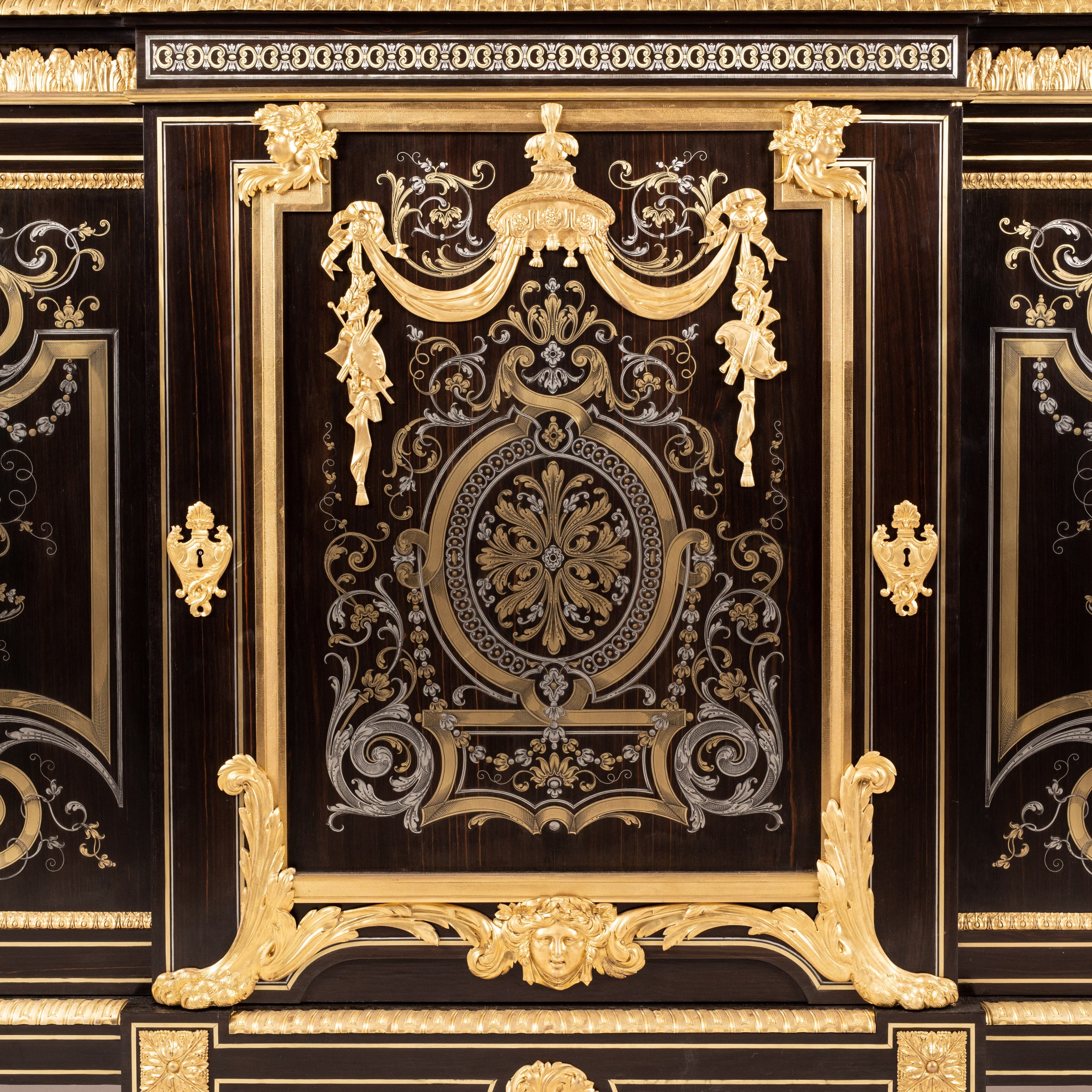
Near perfect. The brass and pewter designs have been cut with extreme precision on this 19th century cabinet. As a true show of skill, the marquetry has been set in ebony, an extremely dense and hard wood, as opposed to soft and pliable turtleshell. With Butchoff Antiques.
Carcass Construction and Secondary Woods
Beneath the opulent surface of Boulle furniture, the structural "bones" of the piece can provide invaluable clues to its origins. One of the most immediate tactile tests is the overall weight of the furniture, which can differentiate the heavy, solid oak substrates of the 17th century from the lighter, often machine-cut veneers and softwood carcasses used in 19th-century reproductions. A genuine 17th-century piece will possess a substantial heft that speaks to its architectural construction.
In the workshops of André-Charles Boulle and his contemporaries, the carcass was built with architectural solidity, using quarter-sawn French oak to maximize stability and minimize warping—a crucial consideration when applying the rigid brass and tortoiseshell veneers. Quarter-sawing produces a grain pattern that is vertically aligned, creating the most stable possible foundation. To create a smooth surface for the marquetry, the coarse grain was often filled, or the wood was "toothed" using a toothing plane to increase glue adhesion.
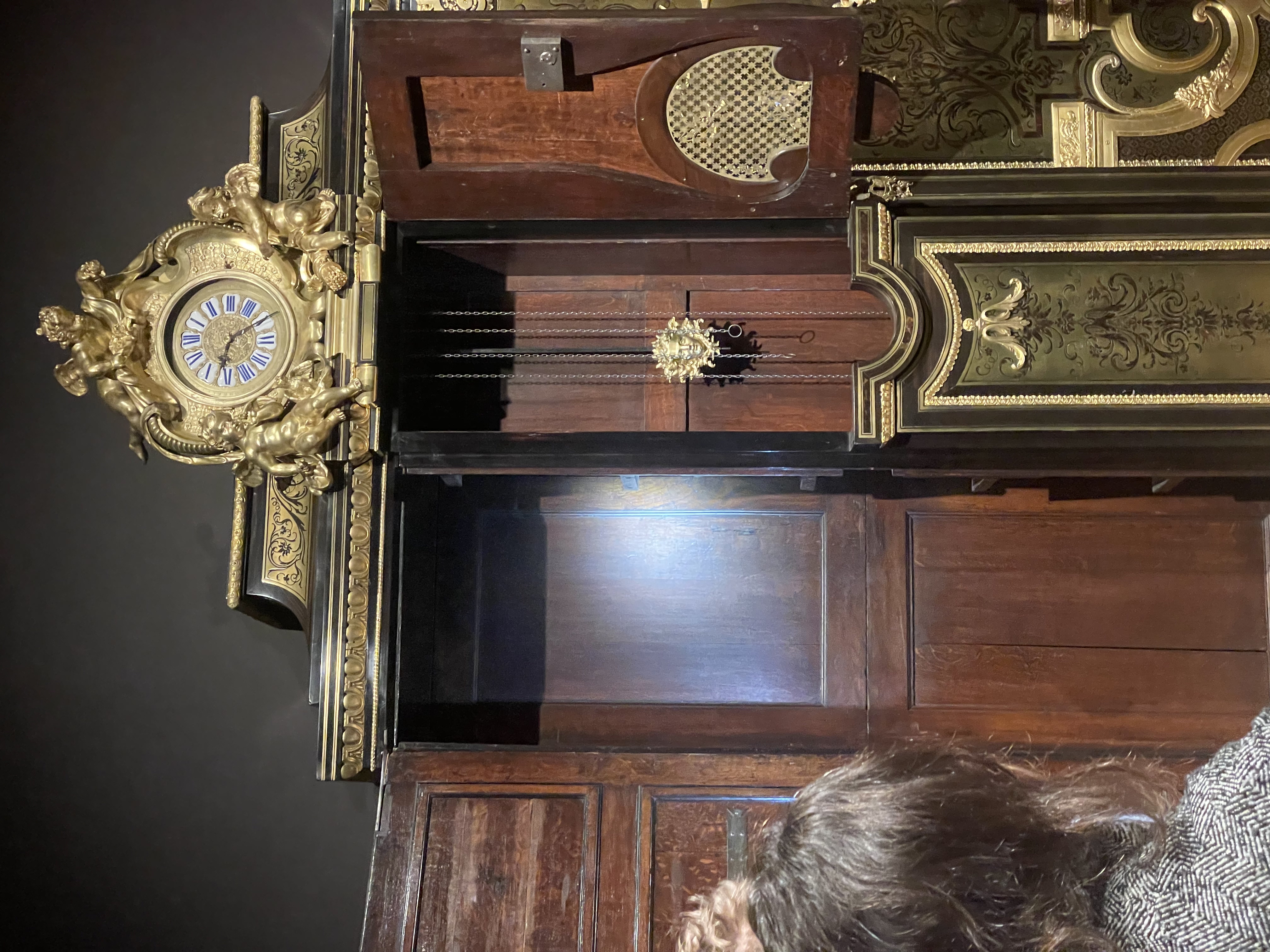
A rare glimpse inside an original Boulle armoire, circa 1715, showing the solid oak paneled construction, today at the Wallace Collection (F429). Photograph by Rainier Schraepen.
The exposed areas, such as the backboards, drawer bottoms, and undersides, will often exhibit the deep, warm brown or grey-black hues of aged oak that has oxidized over three centuries. Backboards were frequently split (riven) rather than sawn, showing an uneven, natural texture. Where saw marks are visible on hidden surfaces, they appear as straight, irregular lines from manual pitsaws or handsaws.
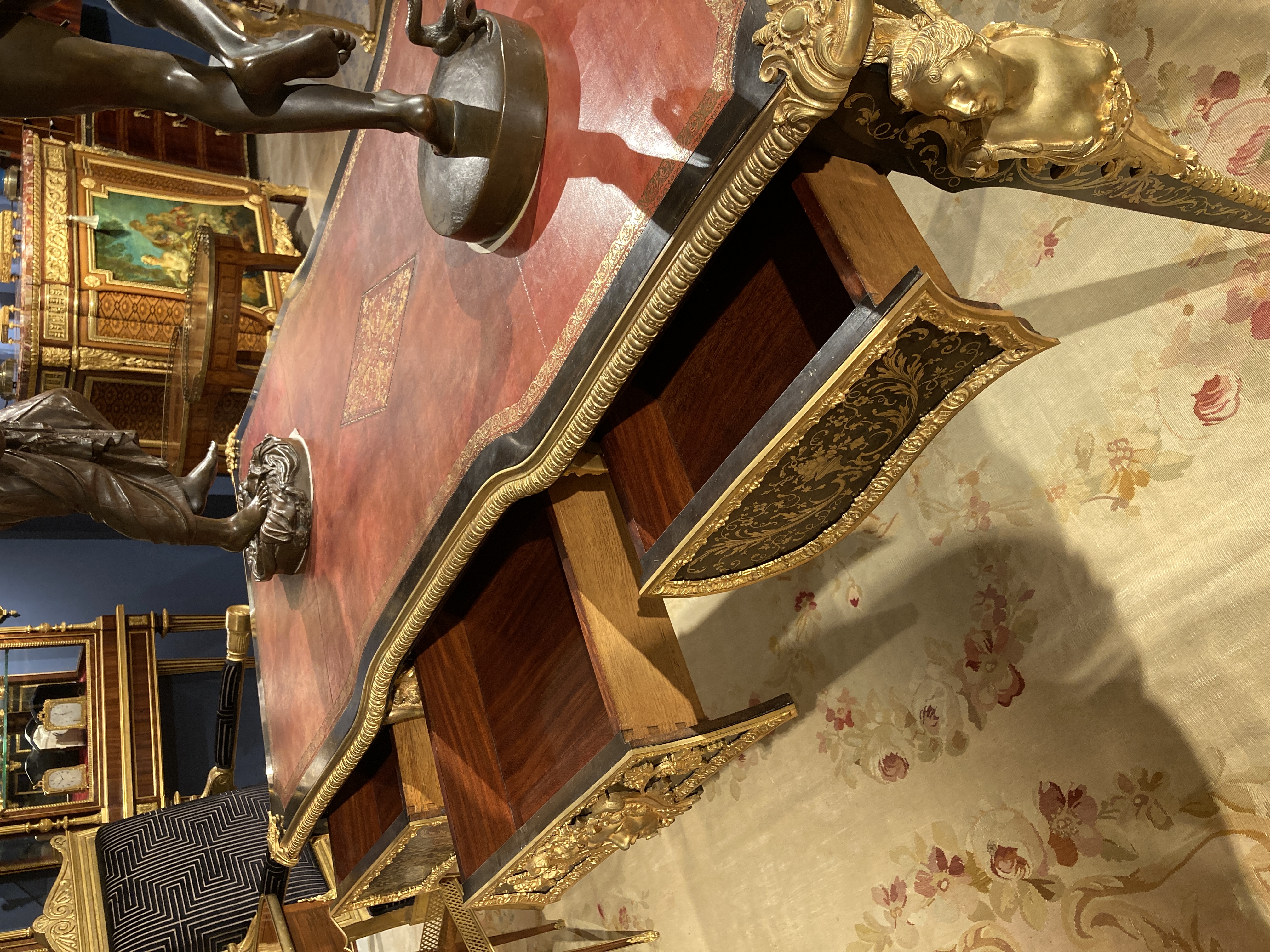
A very refined and successful Boulle revival bureau plat (writing table) by Benjamin Gros, circa 1870, showing the mahogany-lined drawers. Gros was among the top cabinetmakers active in Paris around the mid-19th century, working with other great makers such as Charles Guillaume Winckelsen. With Butchoff Antiques.
Conversely, 19th-century revivalist ébénistes had access to industrial timber yards and different imported woods, including solid mahogany for drawer linings (a relative luxury in the 17th century) and softwoods like pine or poplar for the carcase. A particularly deceptive practice involved constructing the carcase from inexpensive pine, then veneering the visible interior parts with thin sheets of oak to mimic 17th-century solid construction, though this is rarely seen on Parisian furniture. These later pieces may also feature tell-tale signs of machine processing, such as uniform board thickness and the distinctive arc-shaped scratches of circular saw marks—technology that did not exist in Boulle's time.
Metallurgy and Mounts: Mercury Gilding vs. Electroplating
The bronze mounts, or ormolu, that adorn Boulle furniture serve not only as decorative elements but also as protective "jewelry" framing the marquetry. Distinguishing the metallurgical techniques used in the 17th and 19th centuries is often the single most reliable way to authenticate a piece, as the chemical signature of the gold application is difficult to replicate or fake.
During the reign of Louis XIV, the exclusive method employed was mercury gilding, also known as "fire gilding." This process involved mixing ground gold with liquid mercury to create a paste (amalgam), which was then applied to the cast bronze mounts. The mounts were subsequently heated in a fire, causing the mercury to evaporate—a highly toxic process that was eventually banned—leaving a fused layer of gold with a rich, warm yellow tone and a substantial, "buttery" luster. The gold layer is notably thick, filling the microscopic pores of the bronze and creating a depth that cannot be achieved through modern methods. Under magnification, mercury gilding sometimes exhibits tiny pinholes or a slightly pitted texture caused by escaping mercury vapour bubbles.
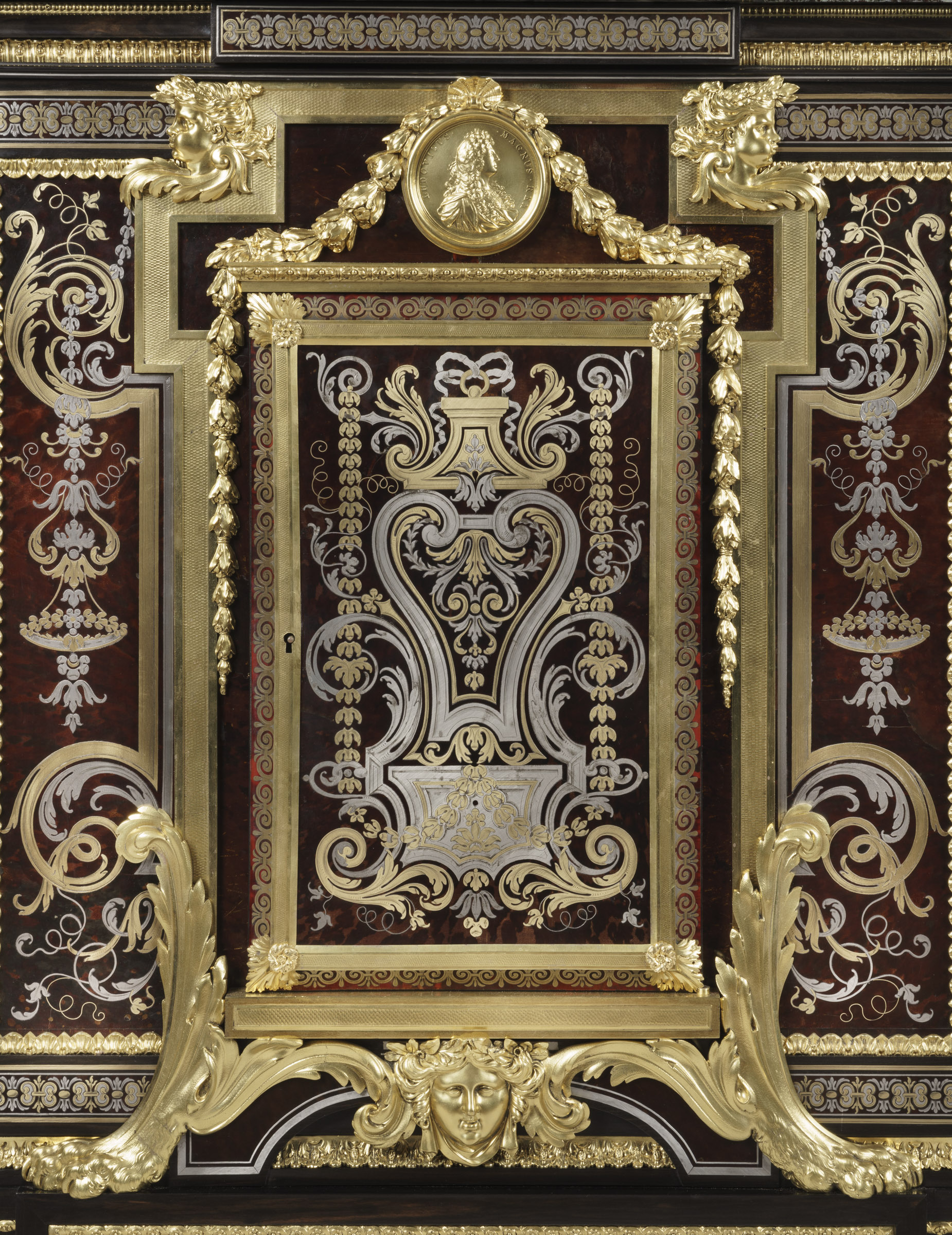
A pioneer of revival French furniture, Charles Guillaume Winckelsen is widely considered one of the most accomplished cabinetmakers of the 19th century. His extremely limited output is justified by the perfection evident in each of his pieces, as seen on this cabinet, sold by Butchoff Antiques. The mounts are mercury gilded using traditional techniques, and retain their original colour and lustre.
The durability of mercury gilding is extraordinary. Even after 300 years, genuine 17th-century mounts often retain their brilliance without tarnishing. On authentic antiques, one will observe characteristic "high-point wear," where the gold has worn away on the noses of masks or the tips of acanthus leaves, revealing the darker oxidized bronze underneath, whilst the crevices retain bright gold.
In contrast, the 19th-century revival pieces often utilized electroplating, invented in the late 1830s and popularized by Christofle by the mid-19th century. This method involves suspending the bronze mount in an electrolyte solution containing dissolved gold, then passing an electric current through it to deposit a thin, uniform layer of gold. While visually similar, the gold layer is typically thinner and less integrated with the underlying bronze, resulting in a colder, more uniform appearance that can seem flat or glassy. The coating lacks the soft, satiny depth of fire gilding and is more prone to being rubbed off or pitted by environmental corrosion. The top makers in Paris continued the process of mercury gilding well into the 20th century, despite posing a serious risk to the health & safety of the craftsmen. According to an article in Connaissance des Arts from 1956, the firm of Samson was still proudly producing mercury gilded ormolu mounts using traditional techniques for their porcelain vases and creations.
Material Sourcing: Tortoiseshell, Brass, and Pewter
The raw materials used in Boulle's workshop were not only of the highest quality but also carefully sourced and prepared. True Boulle work utilizes the scutes (scales) of the Hawksbill sea turtle, a thermoplastic material that can be moulded when heated. The iconic deep red background associated with Boulle furniture was achieved through a specific technique: the ébéniste painted the reverse side of the naturally translucent yellow-brown shell with a mixture of animal glue and vermilion (cinnabar) pigment before adhering it to the wood.
Over three centuries, the organic glues degrade and the vermilion oxidizes, causing the colour to mature into a deep, dark "clotted blood" red or rich aubergine—rarely remaining bright. In contrast, 19th-century revivalist makers employed chemically synthesized pigments, including early aniline dyes or refined vermilion, with more stable binders. Consequently, revival pieces often display a jarringly bright, vibrant "fire engine" red that lacks the mellow richness of earlier pieces. Ironically, the revival pieces best represent what colours the original Boulle furniture may have had.
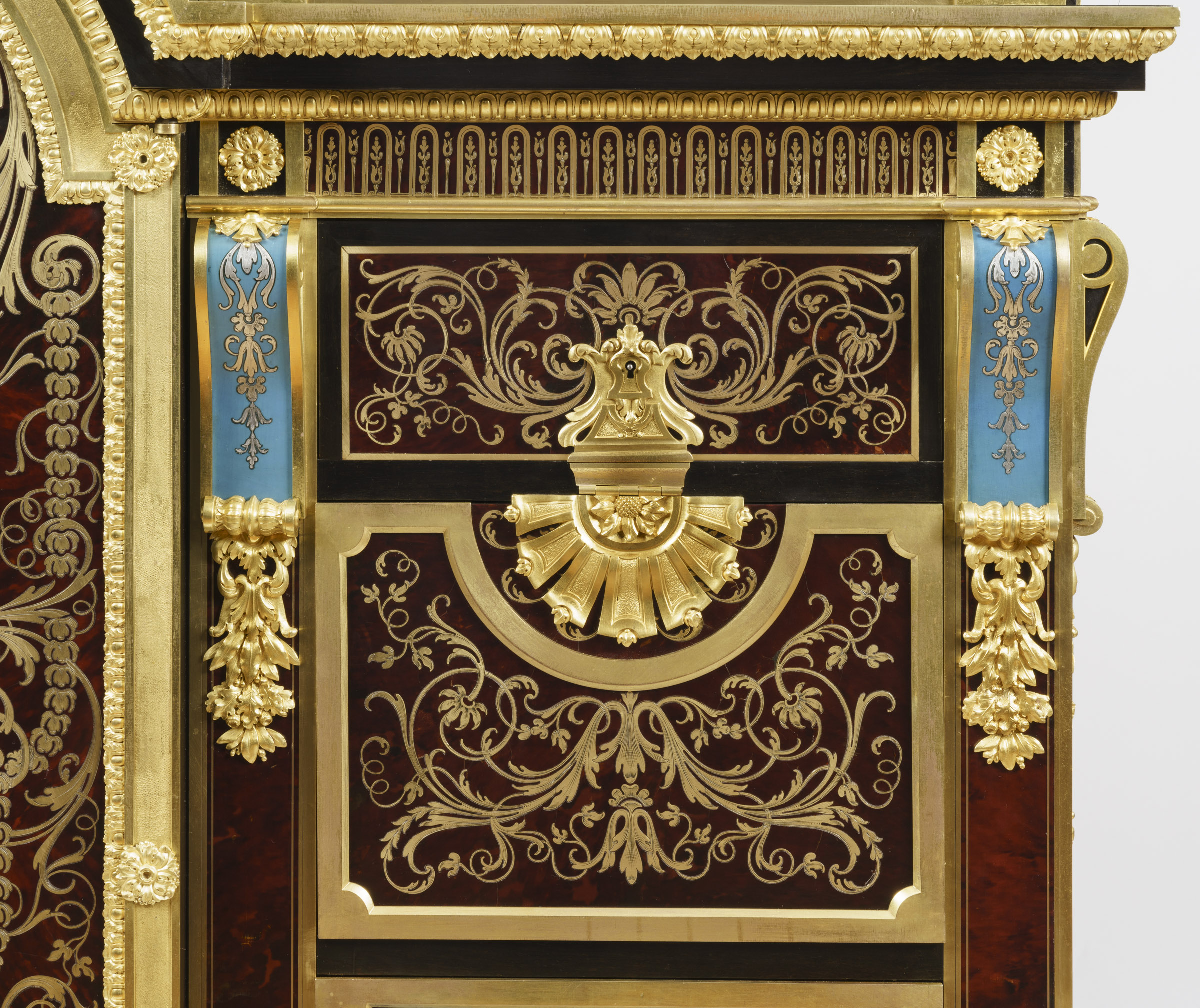
Another masterpiece by Charles Guillaume Winckelsen, dated 1869, showing areas of blue-stained horn as well as red-dyed turtleshell. Revival cabinets such as this allow a glimpse into a more distant past, when Boulle himself was desiging furniture with the same colour palette and motifs in mind for the French Royal Court. Previously with Butchoff Antiques.
The brass provides further evidence of authenticity. In the 17th century, brass was often produced by the "battery" method (hammering) or through early, imperfect rolling mills. It contains trace impurities of zinc and lead that give it a specific colour—often a paler, lemon-yellow gold. The gauge was notably thicker and the metal stiffer. When the glue fails on 17th-century pieces, this thick brass tends to lift in strong, rigid curves.
Industrial 19th-century brass was produced by high-precision rolling mills, resulting in perfectly uniform thickness and chemically purer composition. The colour is often a harsher, more coppery or orange-yellow. Being thinner and softer, when 19th-century brass lifts, it often stays flatter or curls more gently than its baroque predecessor.
Stylistic Integrity vs. Pastiche
While the technical mastery of 19th-century Boulle revival pieces is often impressive, the true connoisseur can discern subtle differences in the overall design and proportions that distinguish them from the architectural symmetry and strict adherence to the Louis XIV aesthetic found in the 17th-century masterpieces. André-Charles Boulle did not simply make furniture; he created architecture in miniature, defined by Baroque principles of symmetry, weight, and hierarchy.
Genuine 17th-century pieces are rigorously symmetrical, constructed with distinct architectural components: a plinth (base), pilasters (columns), capitals, and an entablature (cornice). The aesthetic is heavy, imposing, and severe, designed for the vast, high-ceilinged galleries of Versailles. The legs are typically straight, tapering square pillars (gaine-shaped) or massive scrolls, conveying immense weight-bearing capacity. Masters of the era understood negative space, often leaving areas of plain black ebony to allow the eye to rest and to frame the marquetry panels.
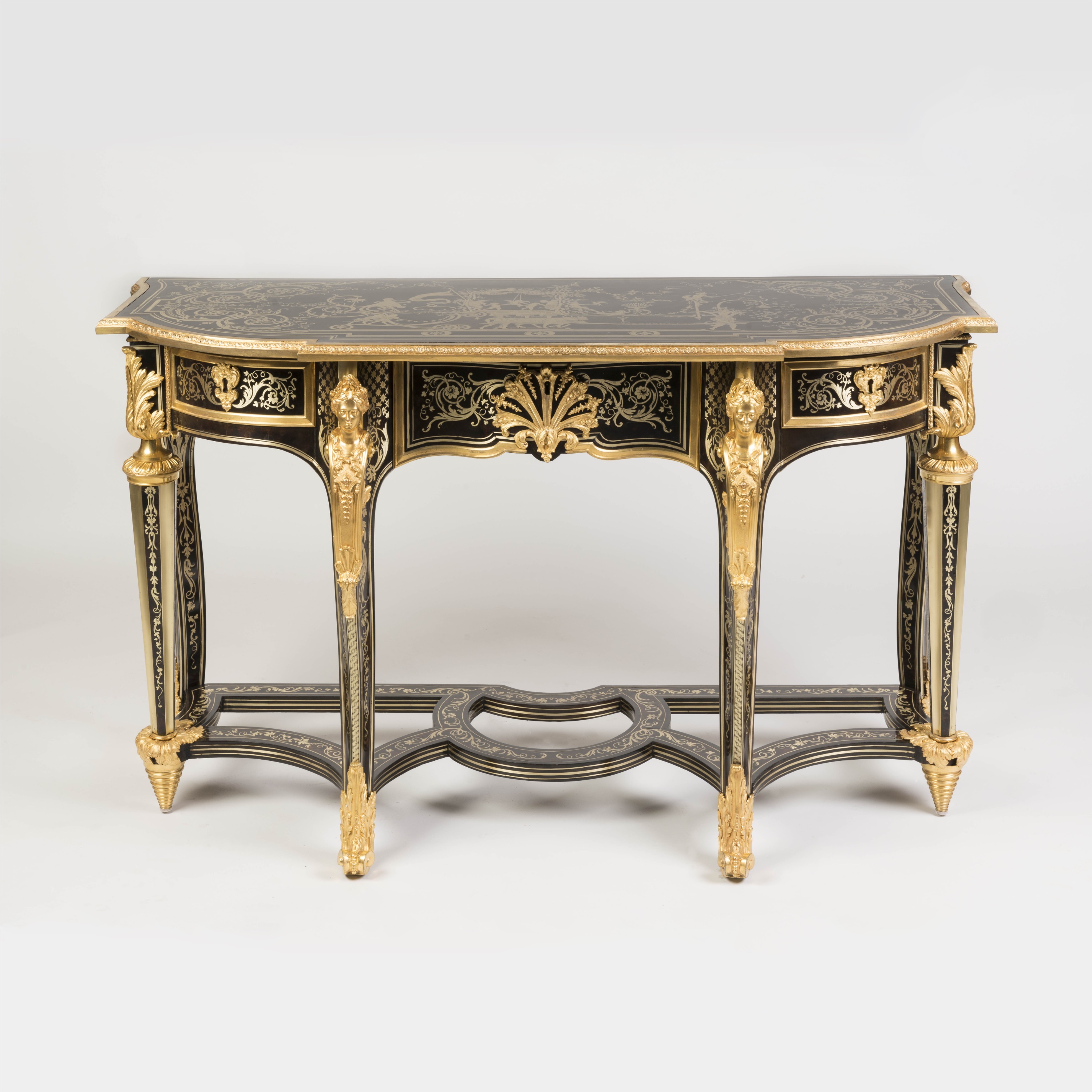
This table, with Butchoff Antiques, is inspired by a group of well-documented consoles made by André-Charles Boulle around 1705. There are three groups, many of which have preserved their marquetry tops of the same design as that on the present nineteenth century piece.
The ébénistes of the 19th century, driven by a desire to appeal to evolving market tastes and the eclectic sensibilities of the Second Empire, sometimes "improved" or hybridized the original designs. A definitive sign of revival work is the blending of Louis XIV materials with Louis XV Rococo curves. If one encounters a piece with characteristic Boulle brass and tortoiseshell marquetry but mounted on curvy cabriole legs—the S-shaped leg typical of the mid-18th century—it is almost certainly a 19th-century creation. André-Charles Boulle largely predated the full Rococo style and did not employ such forms on his grand case pieces.
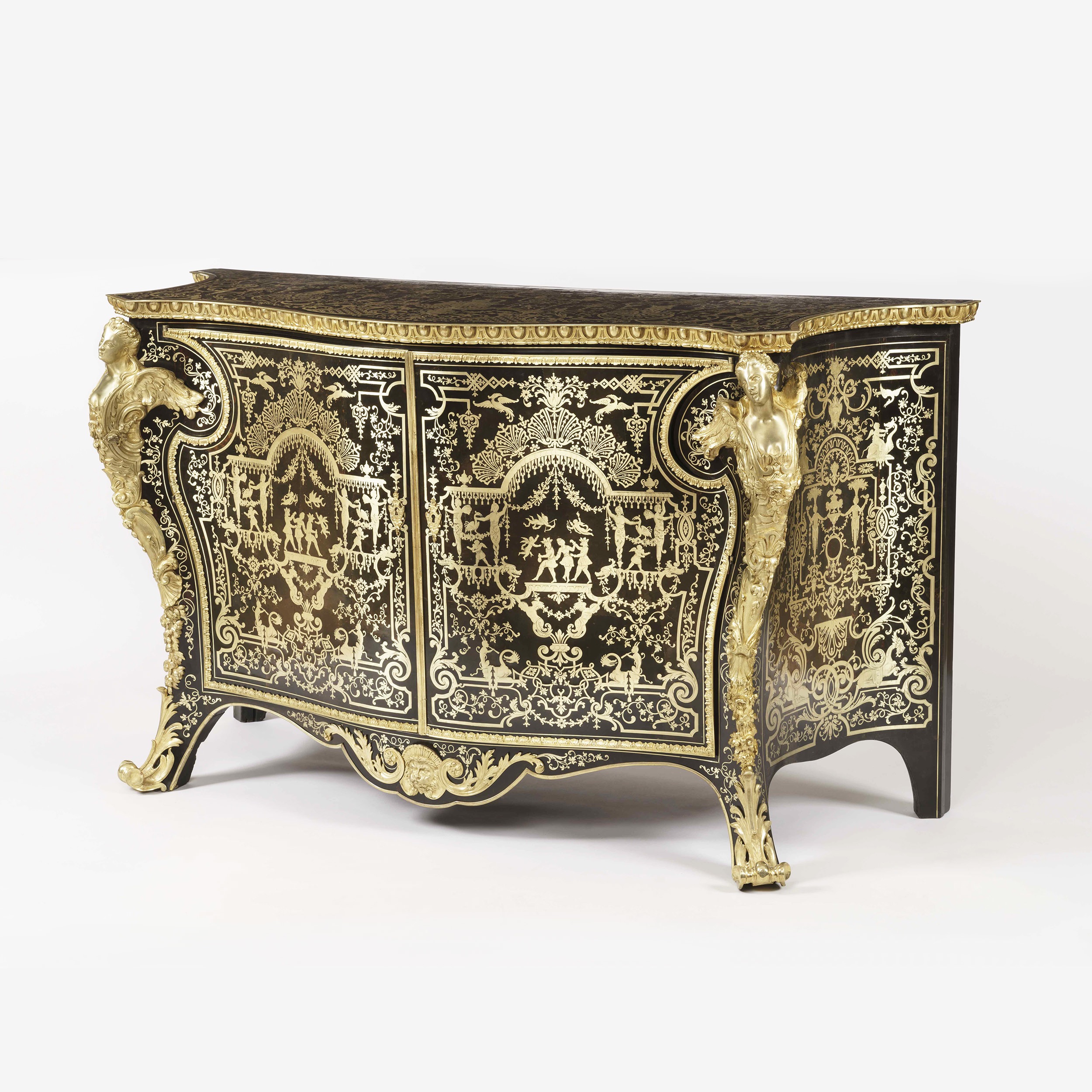
An incredibly rare commode by Charles Mellier. French born, Mellier moved to England, worked for, and eventually took over the illustrious Anglo-French cabinet makers Monbro and Company, circa 1870. The form of the commode is Louis XV inspired by Pierre Langlois, while the surface ornament is taken from earlier Boulle designs. Previously with Butchoff Antiques.
Furthermore, 19th-century makers often exhibited "horror vacui" (fear of empty space), feeling compelled to cover every square inch with decoration. If the marquetry pattern crawls relentlessly over every moulding, leg, and side panel without respite, it suggests the industrial exuberance of Victorian taste rather than the disciplined grandeur of the Sun King's court.
Attribution and Marks: The Stamps of the Revivalists
One of the most definitive ways to identify the origin of a piece of Boulle furniture is through the presence (or absence) of maker's marks and stamps. Interestingly, a signature or stamp often serves as evidence that a piece is not from the 17th century—a paradox that confuses many collectors. If one searches for the stamp "BOULLE" expecting confirmation of André-Charles Boulle's authorship, disappointment awaits.
Boulle held the title of Premier ébéniste du Roi and was granted lodging in the Louvre Palace. This royal privilege exempted him from the strict controls of the Paris Guild of Joiners and Cabinetmakers. The regulation requiring furniture makers to stamp their work with their name and the JME mark (Jurande des Menuisiers-Ébénistes) was not rigorously enforced until 1743–1751, well after Boulle's death in 1732. Therefore, a genuine Louis XIV piece from the Boulle workshop is almost never stamped. Attribution must be made through archival documentation, provenance, and quality of execution.
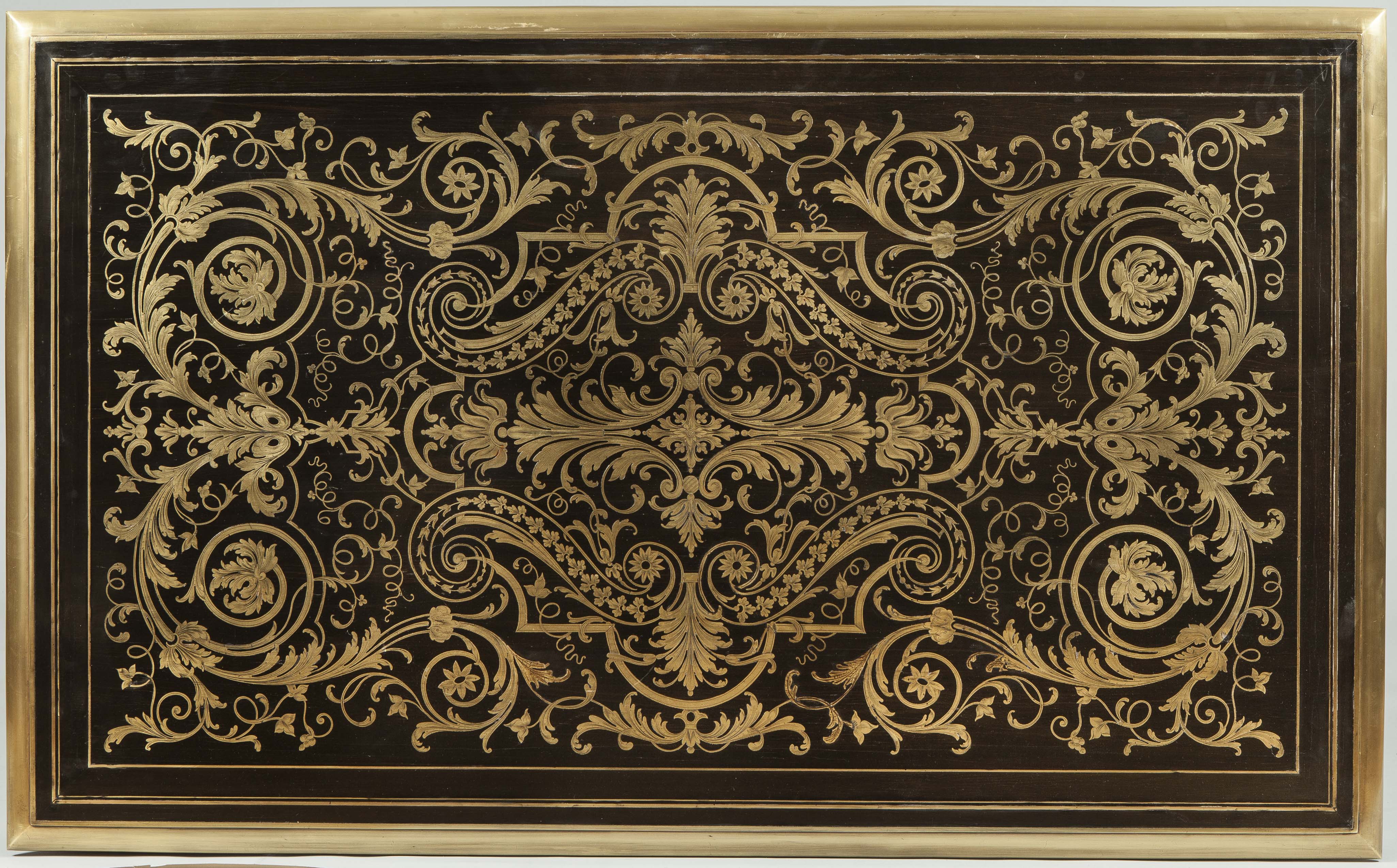
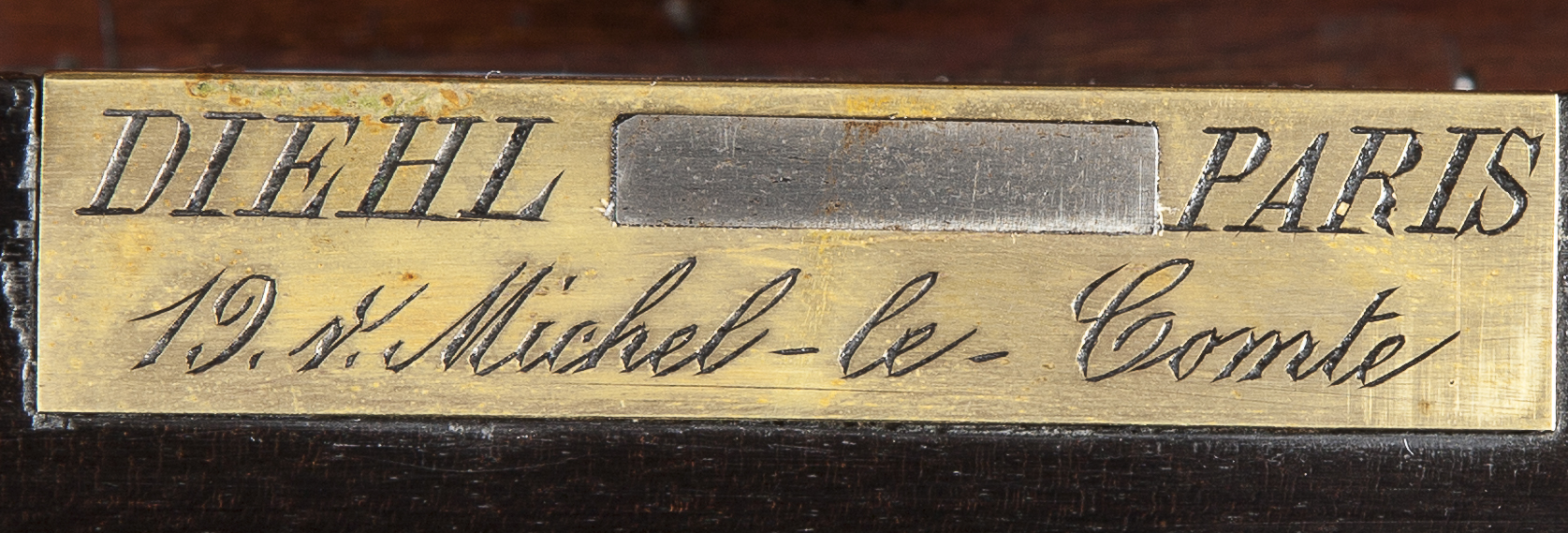
The top of a centre table, circa 1860, with brass marquetry inlaid in wood. Detail of the cabinetmaker's stamp, Charles-Guillaume Diehl. With Butchoff Antiques.
In contrast, the 19th-century revivalist ébénistes often proudly displayed their marks, with pieces bearing the stamps of renowned makers such as Befort Jeune (the most prolific Boulle specialist), Mathieu Befort, Henry Dasson (who often dated his works, solving the mystery immediately), or Wassmus. These stamps, typically found on the top of the carcase beneath marble tops, on lock faces, or on backboards, can serve as clear indicators that a work is a product of 19th-century revival. Much Boulle furniture was also imported to or made in England, where retailers like Edwards & Roberts or Town & Emanuel stamped their names on pieces they restored or sold, effectively branding them as 19th-century.
Conclusion
As the demand for Boulle's exquisite creations continues to captivate collectors worldwide, the ability to distinguish 17th-century masterpieces from their 19th-century counterparts has become an essential skill for anyone serious about acquiring these magnificent works. The differences extend far beyond mere aesthetics, encompassing materials science, manufacturing technology, artistic philosophy, and historical context. By examining the physical evidence of saw kerfs, the weight and composition of carcases, the metallurgy of gilt bronze mounts, and the chemical ageing of tortoiseshell and vermilion, one can build a compelling case for authenticity. Recent scientific research in the field of metallurgy, particularly by Yannick Chastang who uses XRF (x-ray fluorescence) to analyze the composition of metal mounts, is increasingly taking on an important role in authenticating 17th & 18th century pieces.
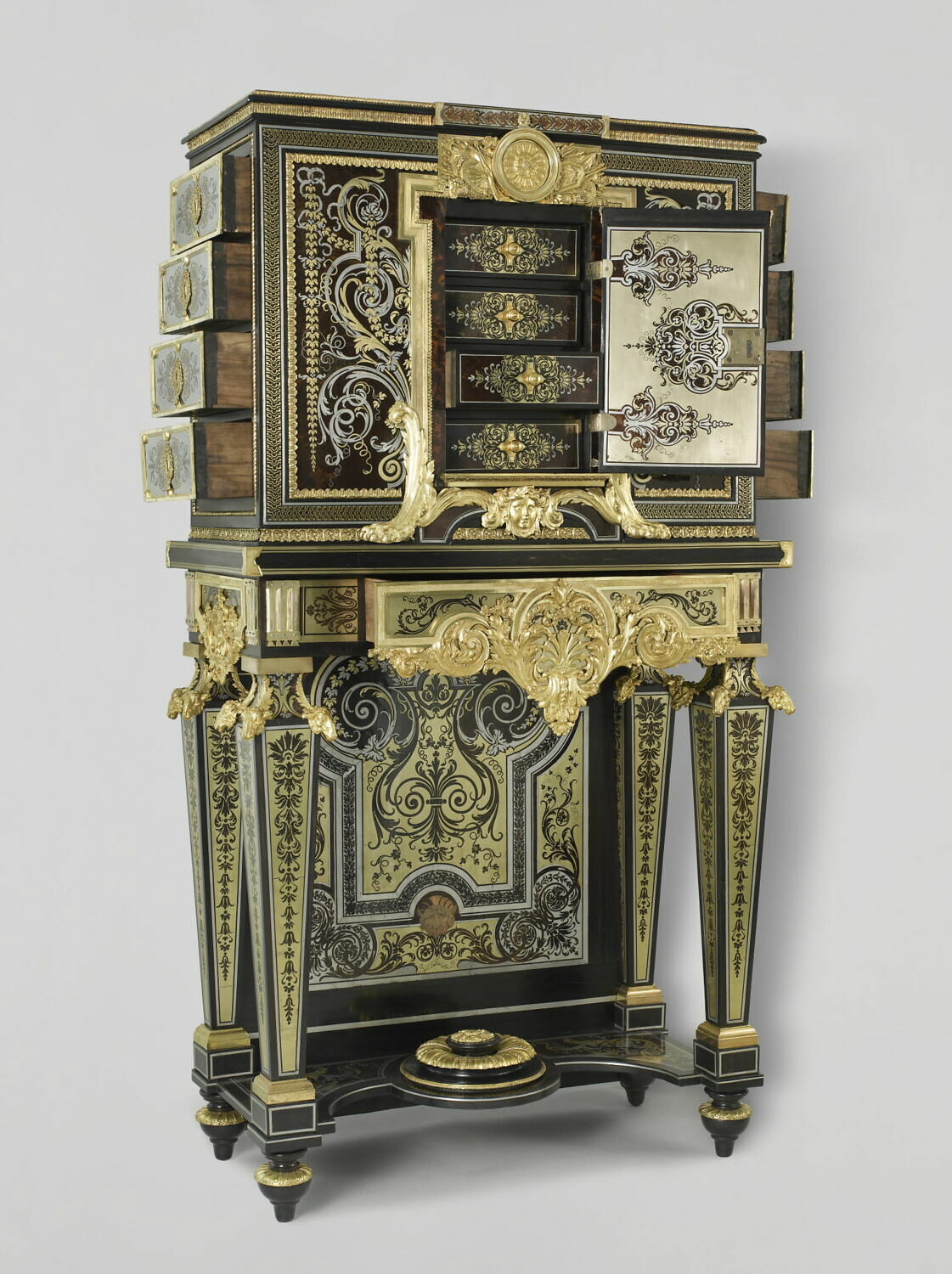
A Cabinet-on-Stand (one of a pair), circa 1685-1715, today at the Louvre, accession number OA5468.
Understanding that a 17th-century piece will almost inevitably show signs of lifting brass, restoration patches, and the warm patina of genuine mercury gilding helps dispel the dangerous myth that pristine condition equals authenticity. Indeed, a piece claimed to be from 1700 that displays absolutely flat marquetry, perfect bright colour, and no visible repairs is almost certainly a 19th-century reproduction. The survival of such fragile materials in perfect condition is mechanically impossible over three centuries.
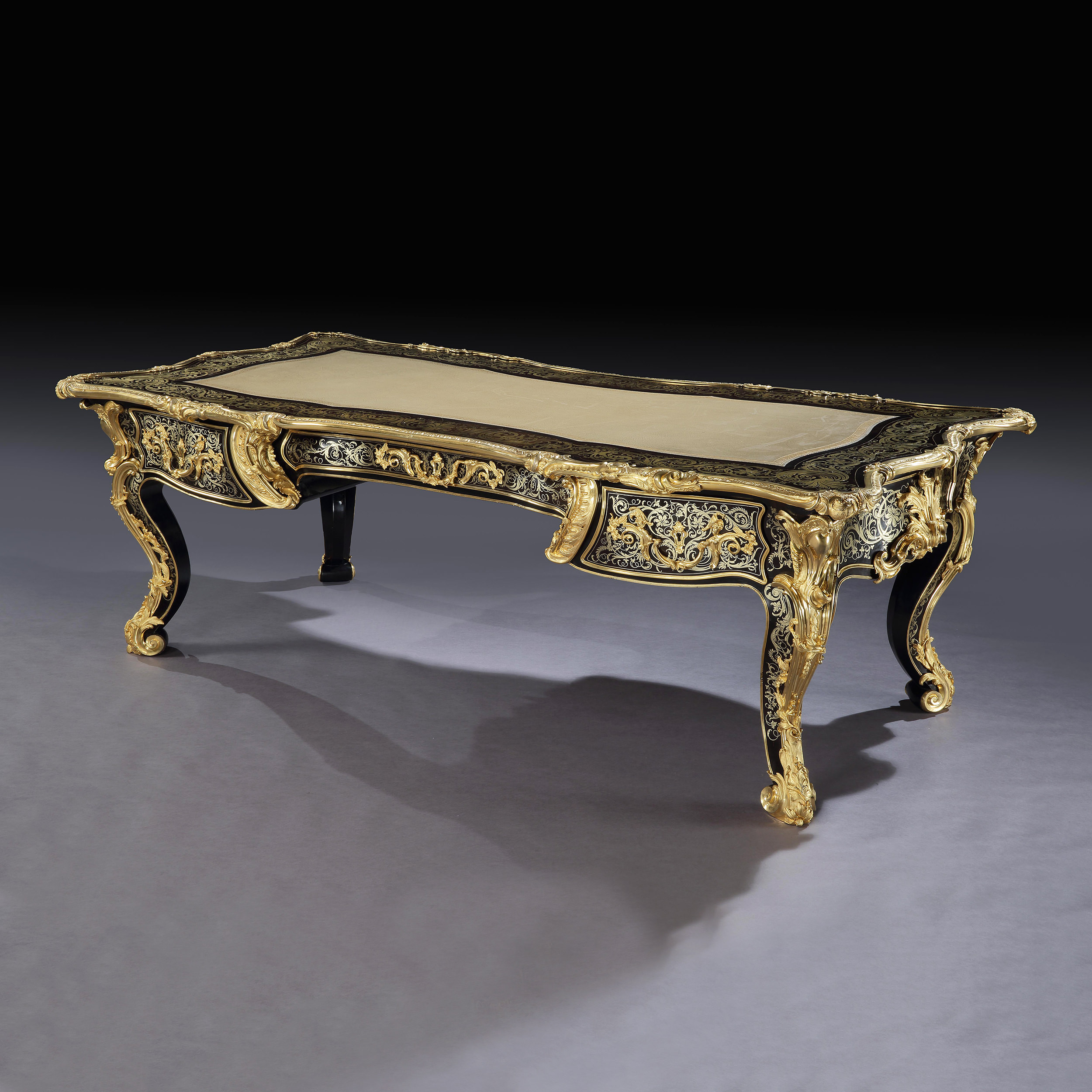
A 19th century marvel, this magnificent bureau plat (writing table) of palatial proportions was made by Toms & Luscombe of London and exhibited at the 1862 London universal exhibition. It later made an appearance in the 1962 Bond film, Dr. No, starring the legendary Sean Connery. With Butchoff Antiques.
For collectors, curators, and enthusiasts, this knowledge transforms the act of examination from subjective appreciation into rigorous connoisseurship. By delving into the intricate technical details, material sourcing, and stylistic nuances that define Boulle's work, one can uncover the true artistic and historical significance of these pieces, ensuring that the legacy of this legendary ébéniste is not only preserved but properly understood and celebrated for generations to come. The market for Boulle furniture remains robust, often exceeding 6-figure sums for single pieces, making authentication not merely an academic exercise but a practical necessity for anyone investing in these extraordinary examples of French decorative arts.
Citations
[1] Kisluk-Grosheide, Danielle O. "Boulle Work and the Art of Marquetry." The Metropolitan Museum of Art Bulletin, vol. 54, no. 2, 1996, pp. 1–56.
[2] Coutts, Howard. The Art of Ceramics: European Ceramic Design, 1500-1830. Yale University Press, 2001.
[3] Verlet, Pierre. Le Mobilier Royal Français. Picard, 1990.
[4] Bowett, Adam. Woods in British Furniture-Making 1400-1900: An Illustrated Historical Dictionary. Oblong, 2012.
[5] Thornton, Peter. Seventeenth-Century Interior Decoration in England, France and Holland. Yale University Press, 1978.
written by Rainier Schraepen

The Investor’s Guide to British Cabinetmaking: A Lineage of Integrity
For the discerning collector, the true measure of an investment-grade antique is not found merely in its aesthetic appeal, but in its capacity for endurance. While beauty is subjective, value requires a verifiable foundation. The celebrated investment integrity of British cabinetmaking, particularly within the 18th-century sphere, is not a matter of chance. It is the direct result of a unique historical lineage that established a tangible framework for authenticity and quality, transforming fine furniture into a stable verifiable asset class.
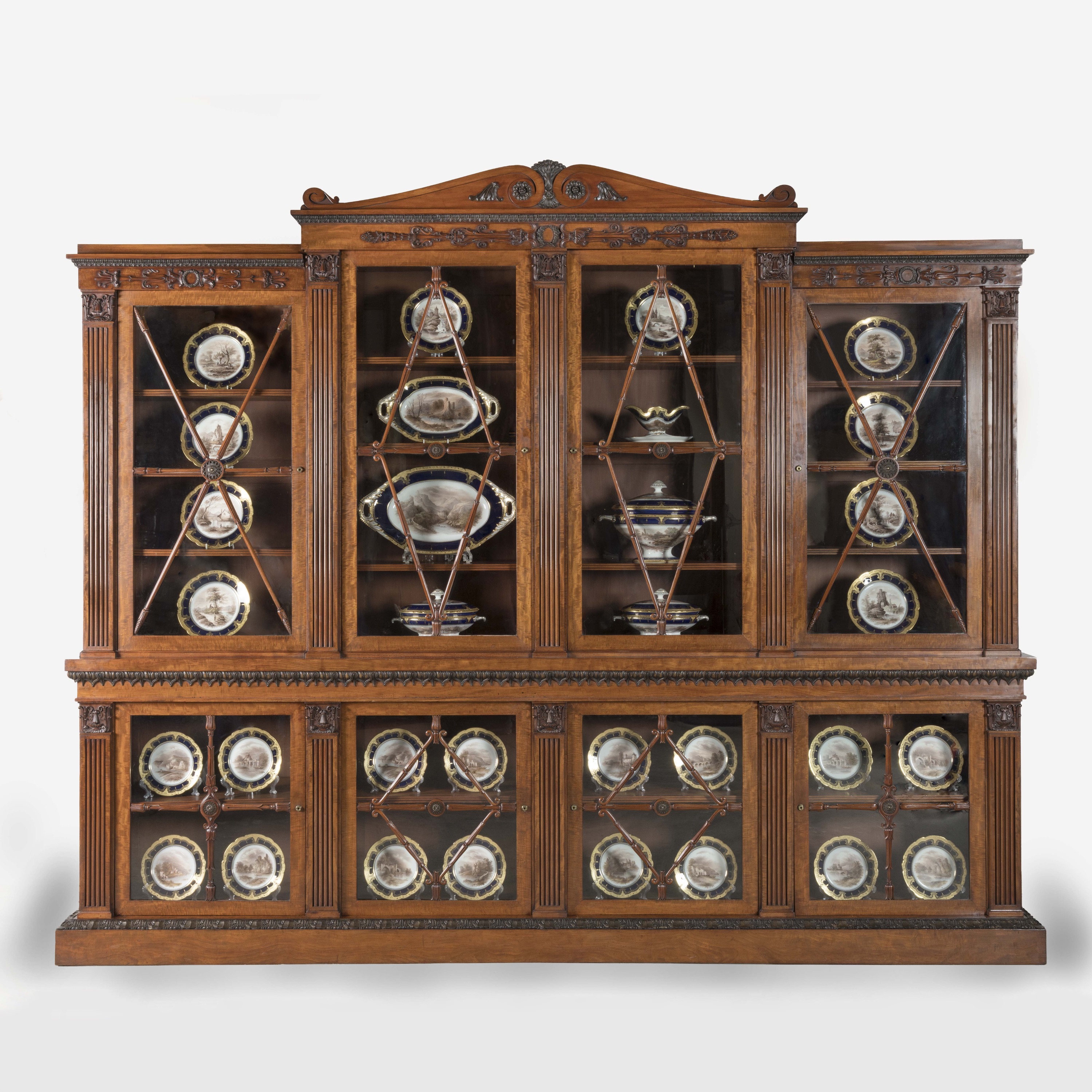
A Regency Mahogany Four Door Bookcase (ref. 10218), circa 1815, with Butchoff Antiques. Furniture Highlight at Treasure House, London, 2025.
This unparalleled lineage rests on three distinct pillars:
- The Codification of Style: The seminal role of published design standards that established verifiable construction and style benchmarks for the entire trade.
- Intellectual & Architectural Discipline: The imposition of rigorous aesthetic discipline, such as the archaeological Neo-Classicism of the Adam brothers, which ensured a timeless, architectural elegance.
- Institutional Accountability: A robust culture of archival record-keeping, perfected by dynastic firms like Gillow, which translates documented provenance directly into market premium and mitigates risk for the high-net-worth collector.
The 18th-Century 'Blueprints' of Value
That golden lineage begins with the master who first codified it. The investment integrity of 18th-century Georgian furniture is inextricably linked to the work and intellectual legacy of Thomas Chippendale. His unique position in the market stems not just from his mastery as a craftsman, but from his crucial role as a publisher who standardised and disseminated the aesthetic language of luxury furniture. The 1754 publication of The Gentleman and Cabinet-Maker's Director was a pivotal moment; it was far more than a style guide, it codified an entire design canon, making it the bedrock upon which the investment stability of the period rests.
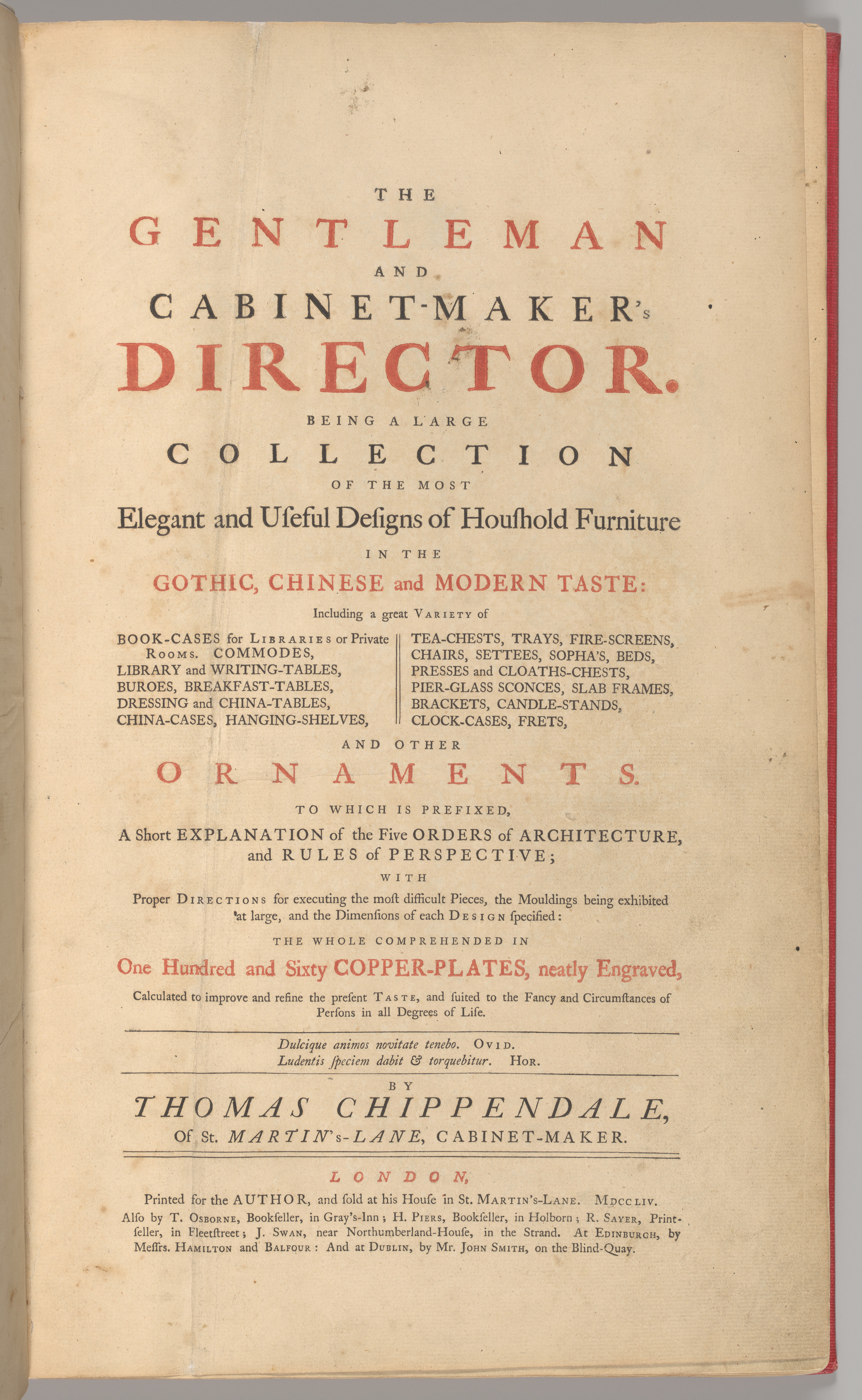
Frontispiece of Thomas Chippendale's Director of 1754 in the collection of the Metropolitan Museum of Art, New York.
This work transformed the craft by providing a "widely accessible benchmark for quality and style," encompassing the three dominant tastes of the time: the intricate Rococo, the Gothic, and the Chinese. The numerous engraved plates established a "verifiable pedigree" for new commissions. For the modern collector and Georgian furniture specialist, this published canon serves as a crucial, objective tool for authentication. It allows a piece to be measured against a definitive historical standard, defining what constitutes "pure" 18th-century English design. This benchmark is essential because, unlike later institutional houses, Thomas Chippendale rarely stamped his furniture. Therefore, provenance becomes paramount. The Director is the key to unlocking it, either through direct documentary links, like an invoice referencing a specific plate, or through technical fidelity. An unsigned piece must demonstrate the superior execution, precise carving, and high-quality timber implied by the Director's sophisticated designs to confirm its pedigree. The Director thus serves as the single most important document in the 18th-century market, providing the definitive framework required to benchmark the design pedigree and investment integrity of furniture from this era.
If Chippendale defined the technical apex of the trade, the architects Robert and James Adam established its intellectual framework. The sustained market valuation of high-end Georgian furniture owes an enormous debt to their rigorous imposition of Neo-Classical integrity. Functioning as architects and designers rather than cabinetmakers, the Adam brothers championed a "total design concept". In their vision, furniture was not an isolated object; it was an integral, subordinate part of a unified interior scheme, designed to be in perfect harmony with the wall treatments, ceiling plasterwork, and chimneypiece.
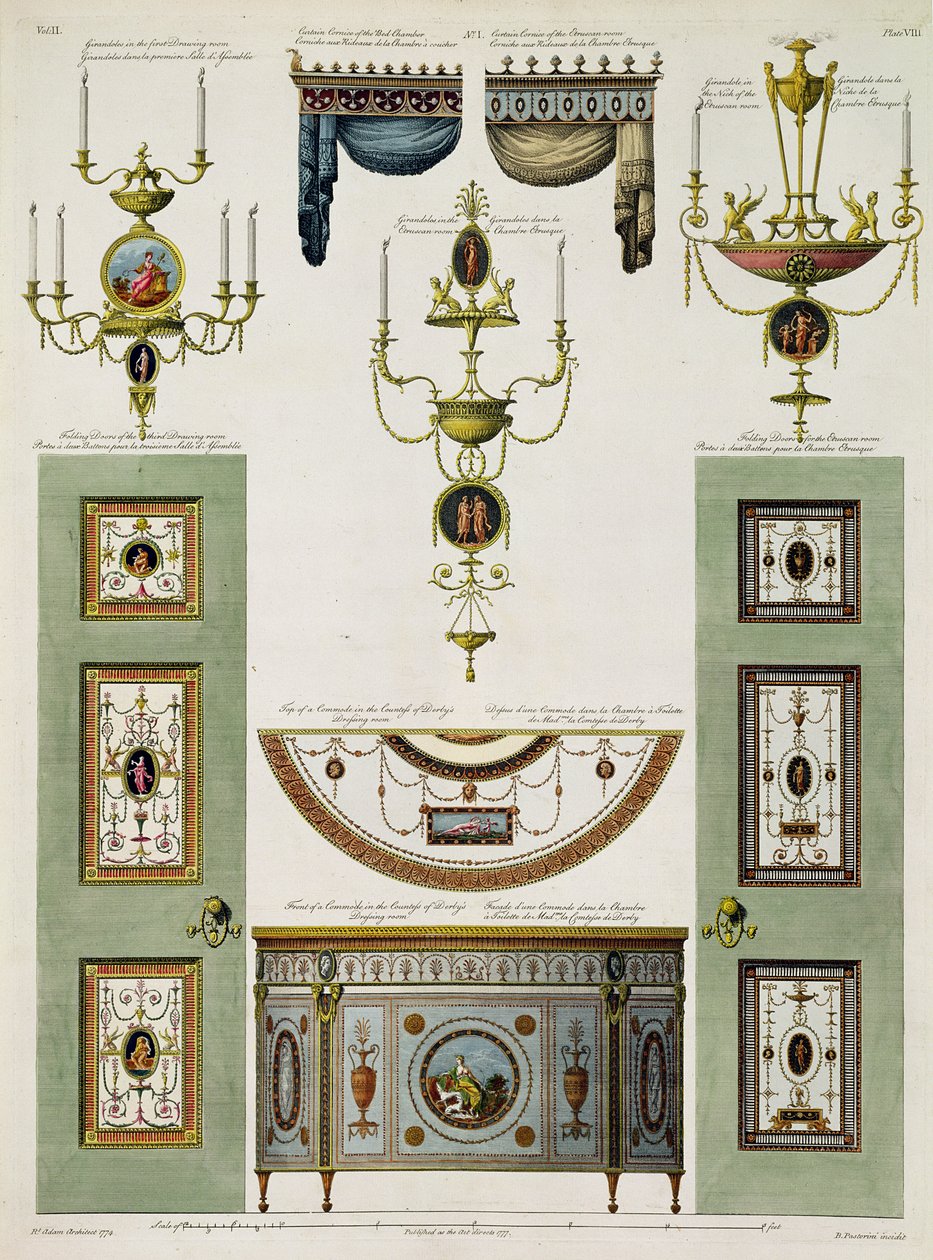
Adam Style showing the 'total design concept' championed by the brothers during the 18th century.
This unity was achieved through a scholarly "archaeological rigor", derived from their extensive studies of classical antiquity, including the ruins of Diocletian's Palace. They meticulously incorporated Roman and Greek motifs such as vases, urns, sphinxes, and patarae into their furniture designs. This architectural discipline resulted in pieces characterised by slenderness, symmetry, and delicate ornamentation, shifting the technical focus from deep carving to exquisite marquetry and contrasting veneers, such as satinwood against mahogany. This scholarly approach directly translates into enduring investment value. Because the Adam style is predicated on the timeless classical principles of harmony and balance, it possesses a profound "aesthetic longevity". It inherently "resists the cyclical devaluation that affects pieces tied to transient fashions," making an Adam-period piece a universally esteemed and timeless asset. They set the blueprint for a century of British taste, establishing the lingua franca that masters like Hepplewhite and Sheraton would later adopt.
The Institutional Guarantee: Provenance as Premium
Where the individual genius of 18th-century masters defined the blueprint for value, the 19th century perfected the model for guaranteeing it. For the risk-averse collector, this shift toward institutional accountability is the most critical factor in securing a long-term, blue-chip asset.
The firm of Gillow of Lancaster and London represents the pinnacle of this movement. Their high market valuation is predicated on one crucial factor: archival accountability. Unlike relying on subjective connoisseurship for attribution, a piece of Gillow furniture provides verifiable provenance through one of the most extensive commercial archives in history. The meticulous maintenance of job books, estimate sketches, and client ledgers that spanned generations, offers modern collectors an unparalleled ability to trace a piece's history, original cost, and specifications with remarkable precision. This documentation is the ultimate guarantee of investment integrity. It "translates historical paper trails directly into financial assurance," mitigating the primary risk of high-value antique acquisition: unproven authenticity. The presence of a "Gillow" stamp, often with a job number, acts as an explicit warranty of superior materials and construction, transforming the item from a mere attribution into a verified, dated, and provenanced object with a tangible market premium.
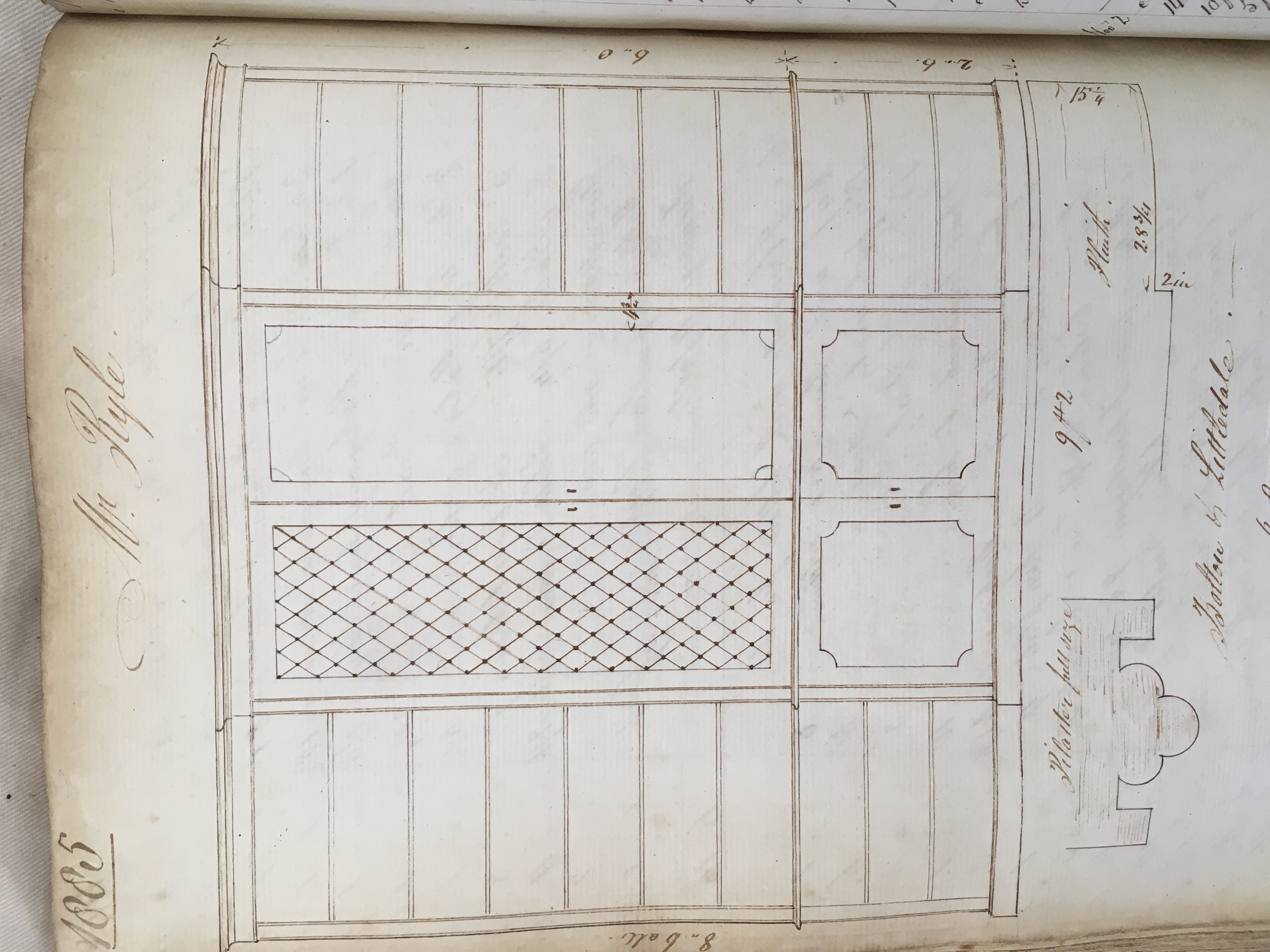
Design for a bookcase in the Gillow Archives, dated 1810. Photograph author's own.
This rigorous model of quality control and documentation was not an isolated practice; it became a national standard adopted by the great institutional houses of the Victorian era. As the 19th century ushered in the need for "mass-customisation," firms such as Holland & Sons and Hampton & Sons successfully navigated the integration of industrial scale without sacrificing prestige. Their primary strength lay in the comprehensive capacity to undertake vast, complex interior schemes for the aristocracy, institutional buildings, and the Royal Family. Managing these large-scale commissions required "strict internal quality control measures" to maintain consistency, a process that provides a valuable layer of "investment assurance" to the modern collector. Like Gillow, these firms maintained "detailed archives of commissions," providing a verifiable paper trail that reduces ambiguity and supports an asset's valuation.
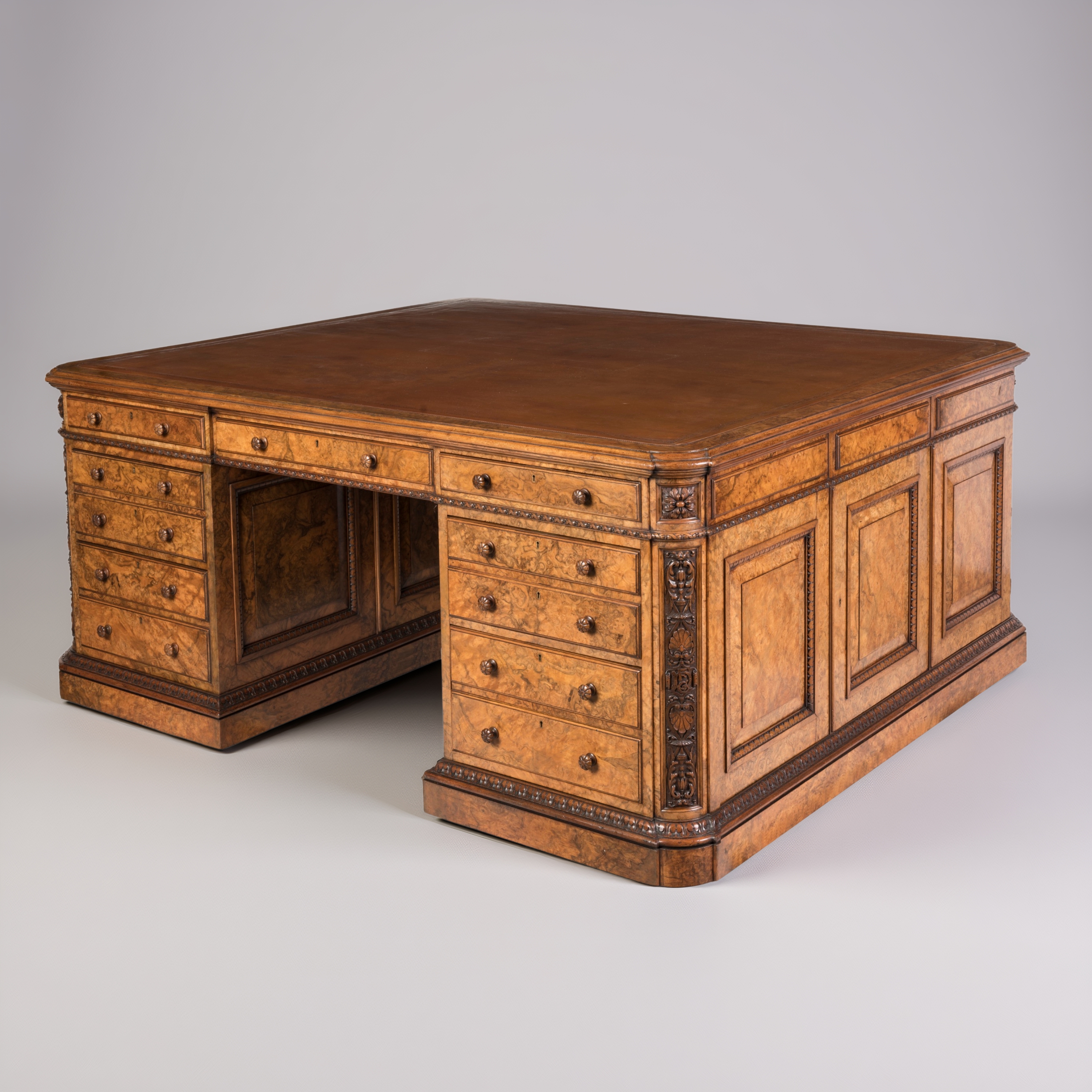
A Substantial Walnut Partners' Desk by Holland & Sons, circa 1865, with Butchoff Antiques (ref. 10145).
This commitment to accountability extended far beyond the capital. Significant regional firms, such as Lamb of Manchester, demonstrated that this institutional integrity was a national characteristic. Adhering to the same rigorous standards, Lamb of Manchester rivaled its London counterparts, securing major commissions to furnish the homes and civic buildings of the new industrial elite. These pieces are often tied to significant "local provenance" and bear the firm's stamps or labels, providing "unambiguous evidence of origin". The success of these Victorian furniture dealers, both metropolitan and regional, proves that the British blue-chip model is defined by a consistent, national capacity to deliver verifiable quality and documented history, offering the collector a uniquely stable and reliable asset class.
Hallmarks of Authenticity: What Collectors Must Look For
A piece's pedigree is written in its material and construction. For the serious collector, understanding these physical "hallmarks" is the most reliable method of antique authentication, providing tangible proof of quality that transcends stylistic opinion.
The high investment value of British furniture is fundamentally rooted in a "Material Purity Thesis". This methodology prioritised structural integrity and superior primary materials over the Continental, particularly French, emphasis on elaborate surface decoration. British cabinetmakers of the Golden Age deliberately selected timbers that offered stability, density, and aesthetic depth, ensuring the primary value lay in the substance of the wood itself.
Mahogany was the definitive timber of the Georgian and Regency periods. Its exceptional density, resistance to warping, and deep, rich figure made it the ideal medium for both sculptural carving and enduring construction. The presence of high-quality, old-growth mahogany is a primary marker of high-value work. In the late 18th century, satinwood emerged as the preferred veneer for its pale, shimmering surface, ideal for the delicate inlay favored by masters like Adam and Sheraton.
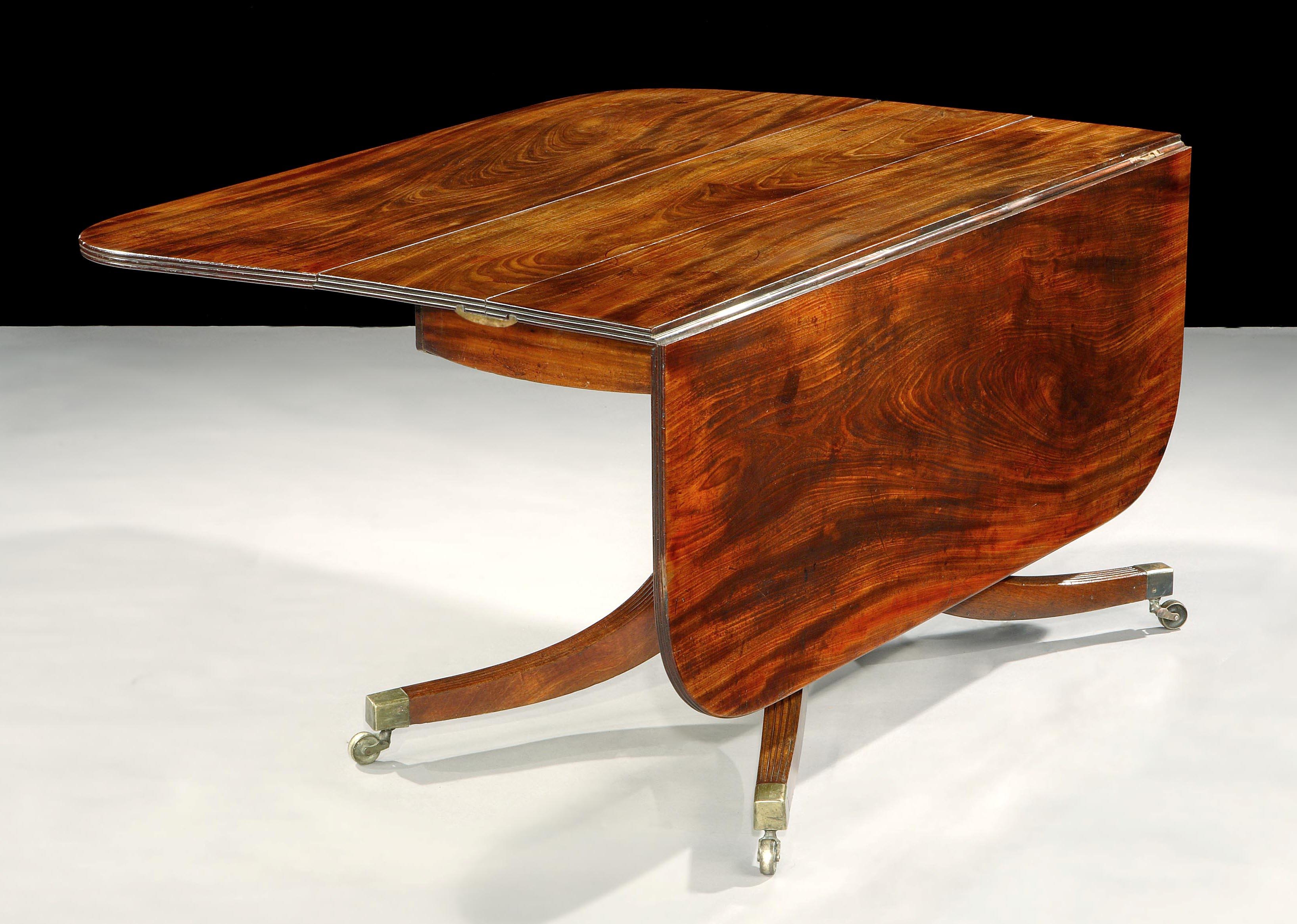
Regency Period Mahogany Dining Table by William Pocock of Covent Garden, circa 1810, previously with Butchoff Antiques.
This focus on superior timber was matched by a commitment to refined British joinery. While French ébénisterie often concealed a simpler carcass beneath complex veneers and gilt-bronze ormolu mounts, the British tradition celebrated unseen structural excellence. Precision joinery, such as meticulous dovetailing in drawer construction or robust mortise and tenon joints, served as the primary technical signature. For a connoisseur, examining the tightness and accuracy of these joints is often a more reliable indicator of 18th-century English craftsmanship than the surface decoration alone. This methodology ensured the investment value rested on the enduring quality of its structure, guaranteeing a longevity that a piece valued primarily for its delicate surface mounts could not.
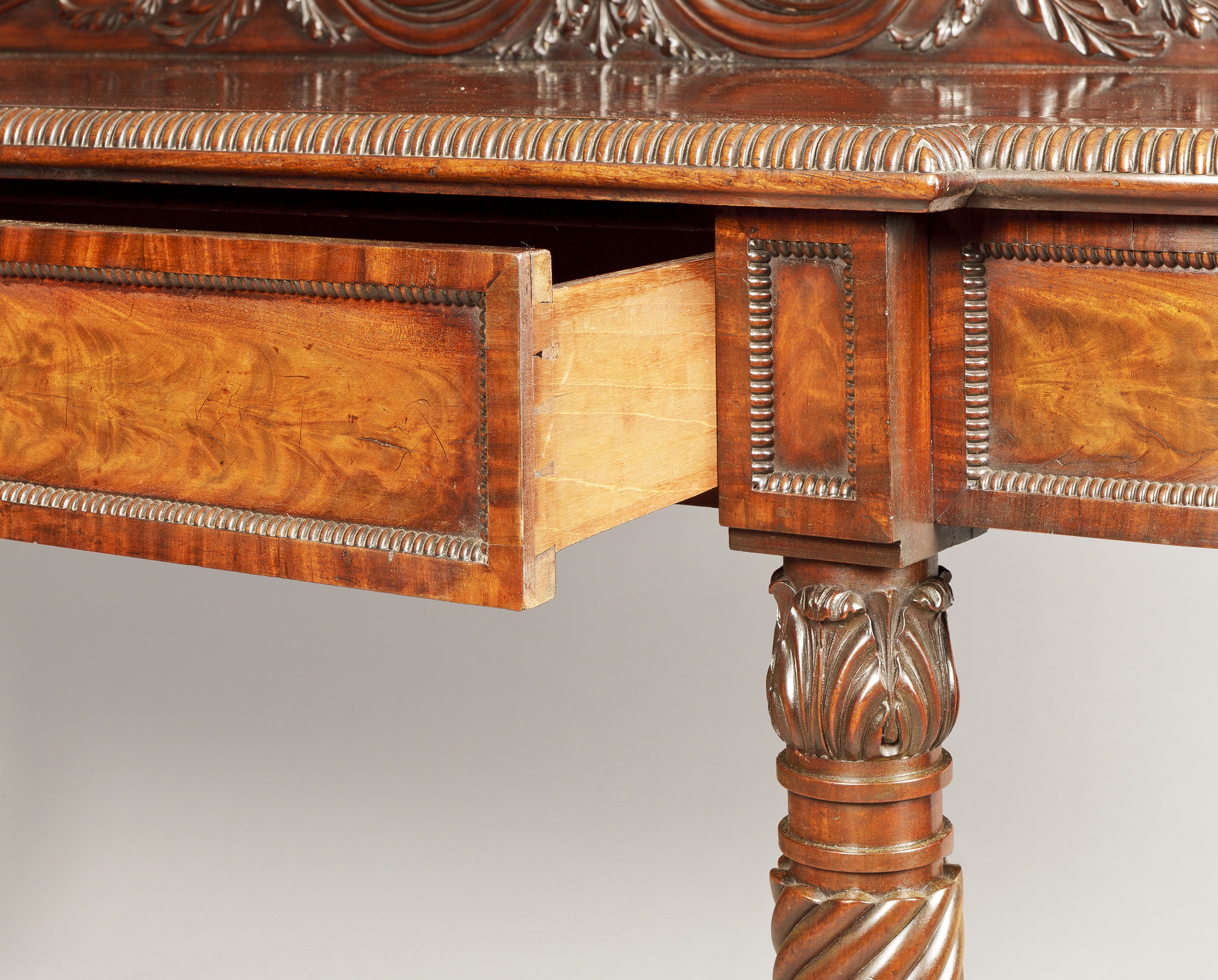
Detail of Georgian Serving Table, circa 1820, with Butchoff Antiques (ref. 7819), showing dovetail construction of the drawer.
This principle of verifiable, technical quality is perfectly illustrated by the specialist firm Howard & Sons. While other firms focused on cabinetry, Howard & Sons carved out a niche focused on the pinnacle of domestic comfort: functional excellence and bespoke upholstery connoisseurship. For collectors today, their work is valued for its unique and systematic use of verifiable markings that provide a "technical guarantee of provenance".
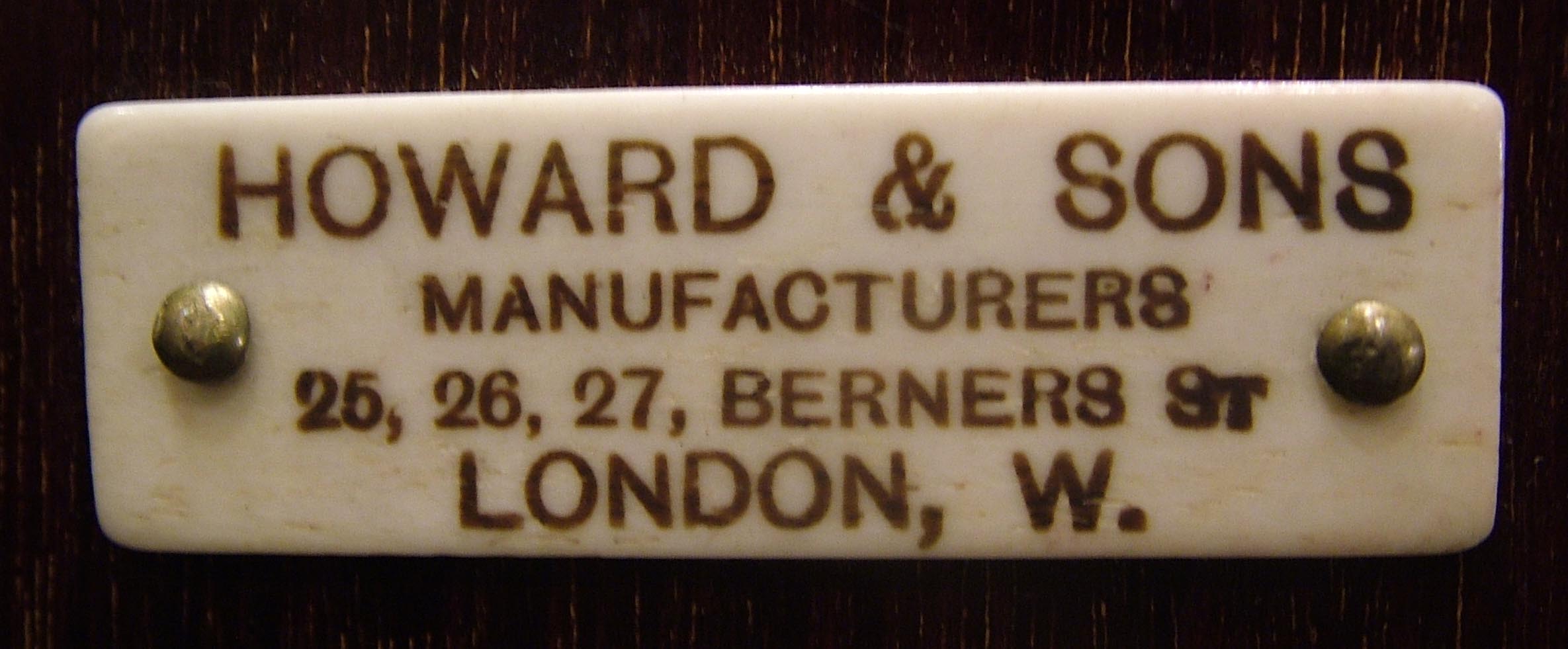
Label used by Howard & Sons. Photograph author's own.
Unlike much antique seating, which relies on stylistic attribution, Howard & Sons pieces can be definitively identified. The firm implemented a meticulous system of numbering and stamping its frames. Pieces often bear specific frame markings, serial numbers, and even date codes. This practice is crucial for authentication, as the stamps and numbers can be cross-referenced with surviving records, providing a level of certainty rarely available for upholstered furniture. The firm is particularly noted for its distinctive brass castors, which often carry the "HOWARD & SONS LONDON" stamp. The quality and wear on these original castors are a primary point of inspection for authenticators. This rigorous system of physical antique stamps and serials effectively reduces the subjectivity of valuation, transforming a Howard & Sons chair or sofa into a transparent, secure asset with verifiable authenticity.
This unbroken thread of intellectual and technical rigor connects the entire Golden Age of British design. The "investment purity" of the Regency design period, for instance, stems directly from its steadfast adherence to the classical standards established by earlier architectural masters.
The lineage begins with William Kent in the early 18th century. As a central figure in the English Palladian movement, Kent established the "architectural imperative" in furniture design. His pieces, which were often monumental, sculptural, and densely carved, were conceived as intrinsic components of the grand Palladian interiors he designed. This work established the foundational principle of British furniture as a serious, architecturally-derived collectible.
This tradition was later perfected by the intellectual apex of the Regency style, Thomas Hope. At the turn of the 19th century, Hope’s "scholarly rigor" provided the necessary discipline to maintain the integrity of British Neo-Classicism. His seminal 1807 work, Household Furniture and Interior Decoration, codified an academic approach based on meticulous studies of Greek, Roman, and Egyptian antiquity. This resulted in a refined form of Neo-Classicism, often termed Greek Revival or Egyptian Revival. Hope’s fusion of scholarly accuracy with grand, clean lines, seen in forms like the klismos chair or the use of lion monopodia, anchored the valuation of these pieces in the "enduring quality of educated taste". From Kent’s Palladianism to Hope’s antiquarianism, this continuous thread of architectural discipline ensured that British furniture remained rooted in timeless classical principles, a critical factor for capital preservation.
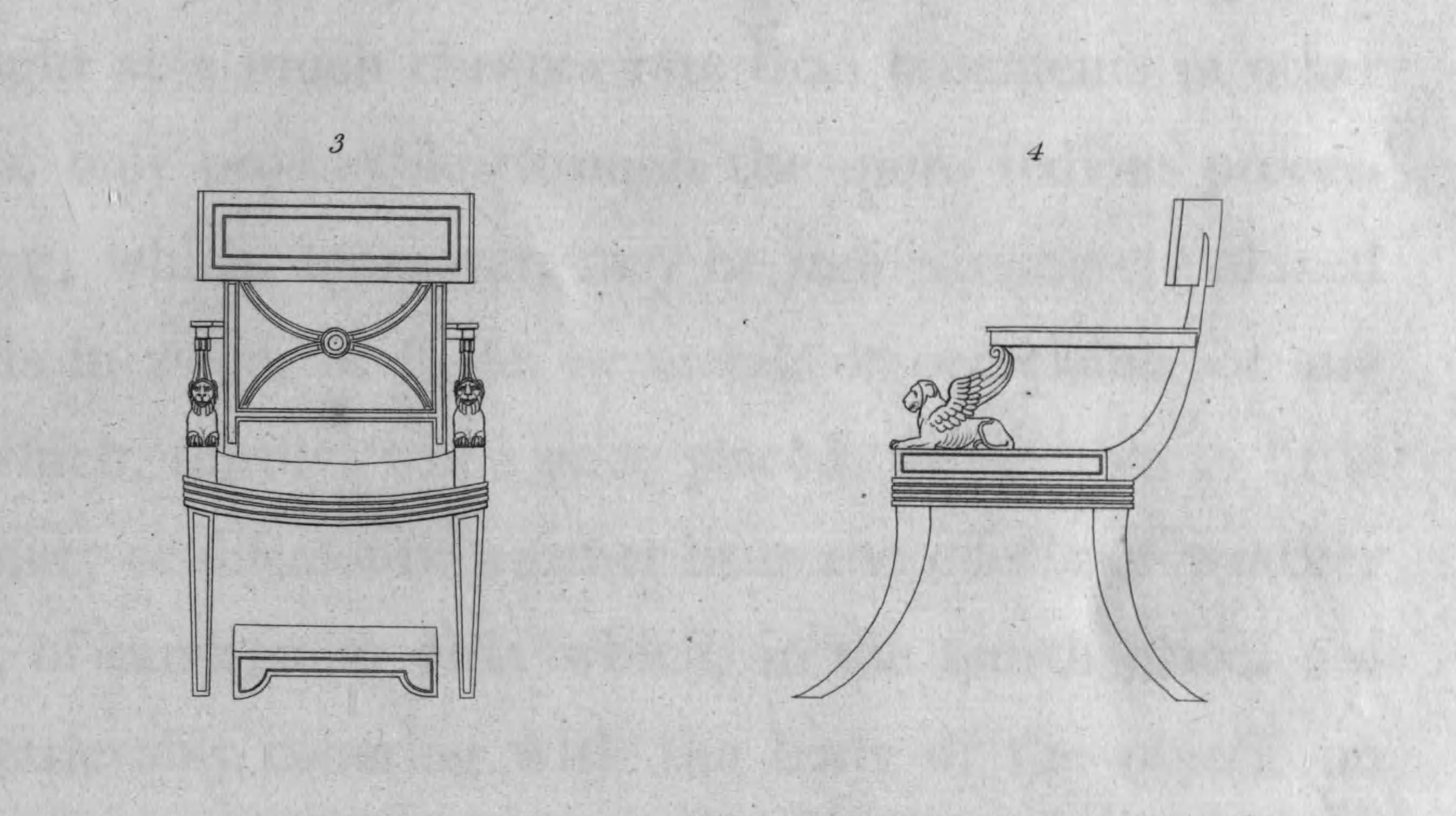
Design for a Klismos type armchair by Thomas Hope, published in 1807.
The "blue-chip" status of British cabinetmaking is, therefore, not a historical accident. It is the direct result of a traceable lineage: the published standards that created a verifiable design canon; the rigorous architectural discipline that imposed a scholarly, classical integrity to ensure timeless aesthetic appeal; the institutional accountability of firms like Gillow, whose meticulous archives provide verifiable proof that mitigates risk for the collector; and a foundational commitment to material integrity, prioritising superior timbers and structural joinery over simple surface decoration.
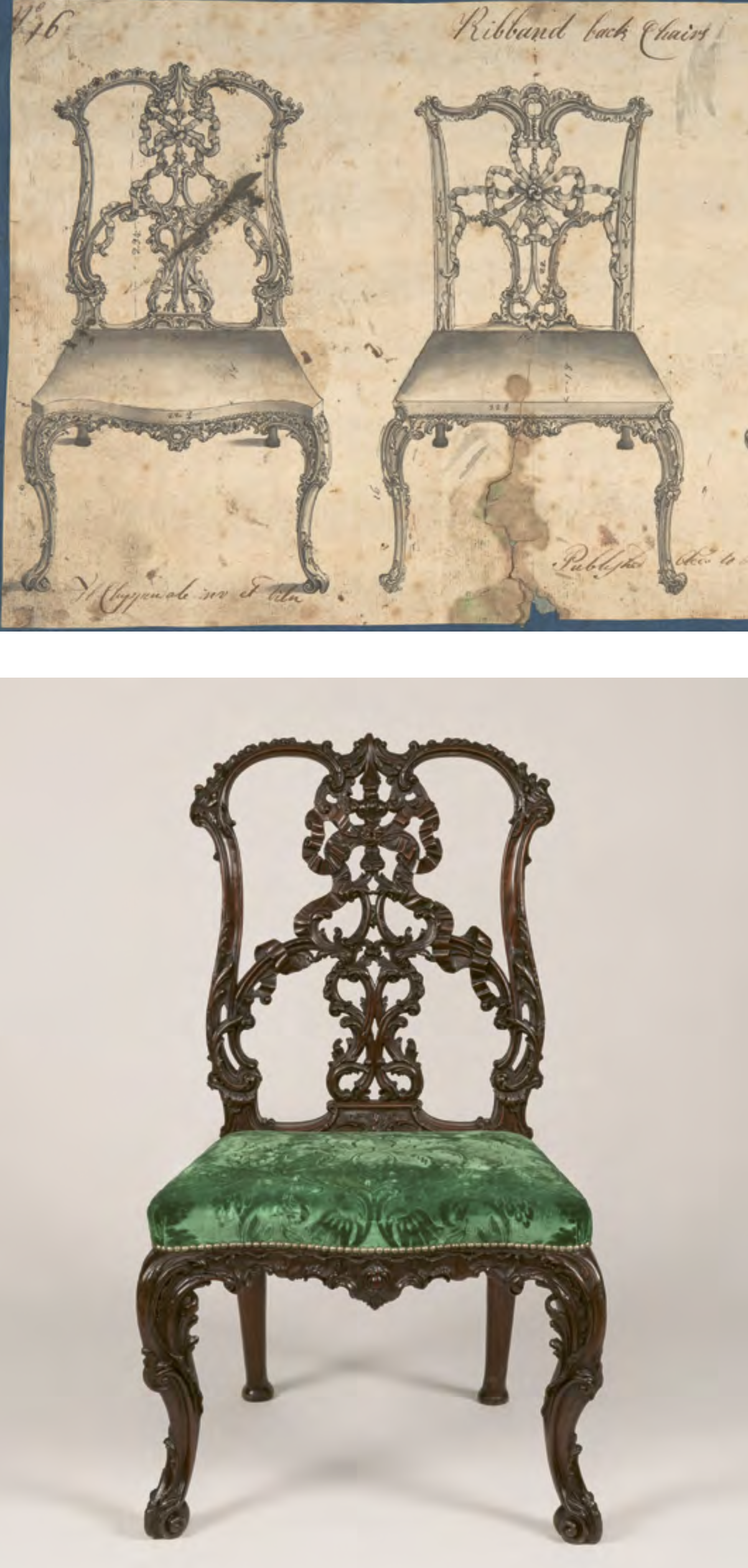
This unwavering commitment to integrity and provenance is the guiding principle of the Butchoff Antiques collection. Our passion is rooted in the "perennial pursuit to buy & sell outstanding items" that exemplify this history. We invite you to explore our curated antiques, each one expertly acquired with the deep connoisseurship this distinguished lineage demands. When you purchase from Butchoff, "you can do so with confidence", securing a verifiable asset of enduring quality, character, and style.
Writen by Rainier Schraepen

A Comprehensive Guide
The pursuit of antique lights & lamp collecting represents one of the most sophisticated and nuanced areas of decorative arts connoisseurship, combining elements of technological innovation, artistic excellence, and historical significance.
Throughout the centuries, the evolution of artificial illumination has paralleled humanity's greatest advances, from the humble oil lamps of antiquity to the revolutionary artistic achievements of the late Victorian period antiques era and beyond. This progression has left us with an extraordinary legacy of craftsmanship and design that continues to captivate serious collectors and scholars alike.
The study of antique lighting encompasses far more than mere functional objects; these pieces serve as profound markers of both technological advancement and decorative artistry. From the exquisite bronze work of French Empire period bouillotte lamps to the revolutionary artistic achievements of American studios like Tiffany and Handel, each era has contributed its unique aesthetic vocabulary to the canon of lighting design.
A pair of antique Asian cloissonné enamel lamps at Butchoff Antiques, with a large English silvered banqueting lamp in the mirror reflection.
The sophisticated collector must develop an intimate understanding of these historical periods, their distinctive characteristics, and the technical innovations that defined them. Authentication represents perhaps the most crucial aspect of antique lamp collecting, requiring a comprehensive knowledge of period-specific manufacturing techniques, materials, and artistic signatures. The ability to distinguish original patination from modern finishing, recognize authentic period electrical components, and identify legitimate maker's marks demands years of dedicated study and hands-on experience.
This expertise becomes particularly vital when evaluating pieces from highly sought-after manufacturers, where the difference between an original work and a later reproduction can represent significant variations in both historical importance and market value.
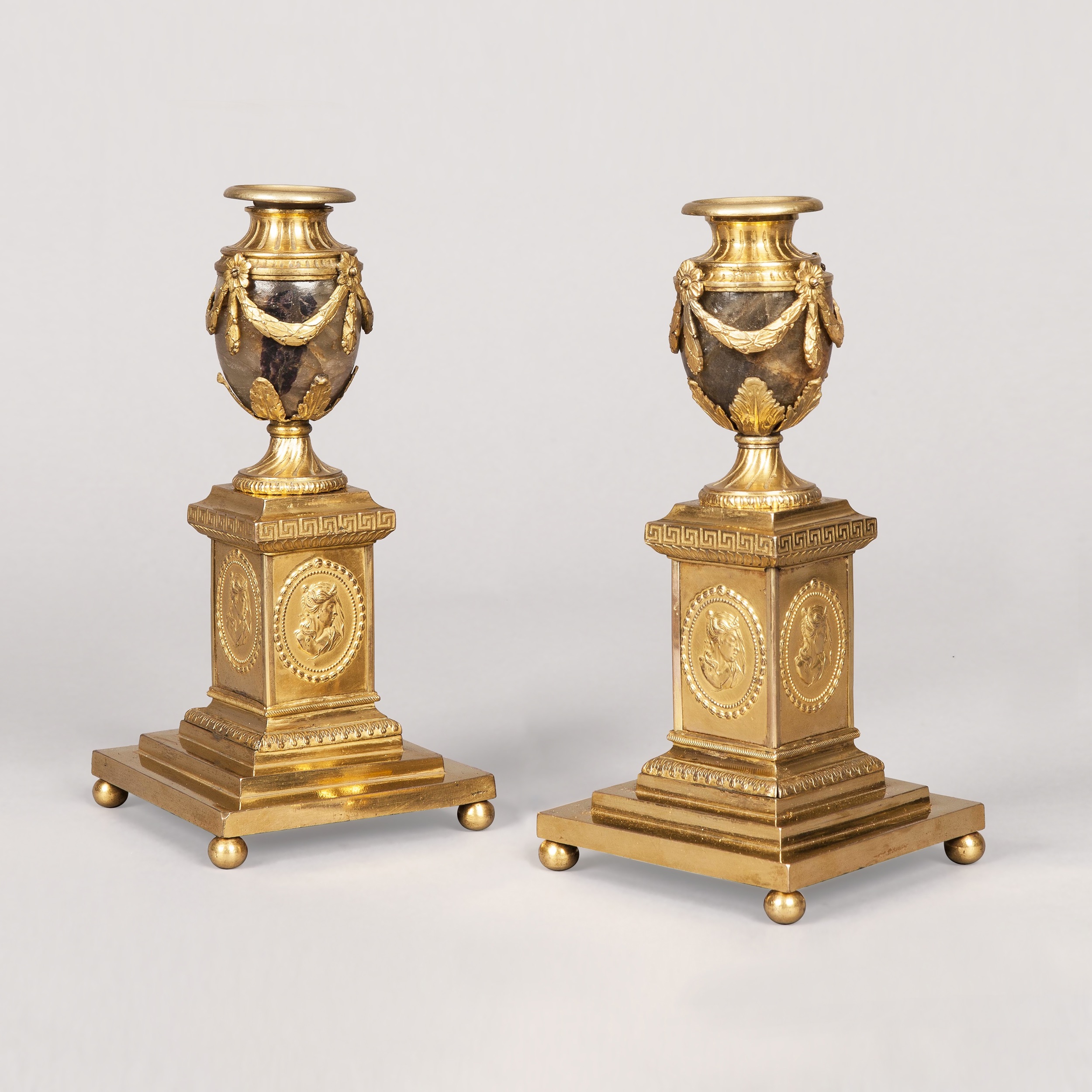
A Pair of 'Cleopatra' Candle Vases made by Matthew Boulton, c.1770, sold by Butchoff Antiques
As we delve deeper into the fascinating world of antique lighting, we shall explore the distinctive characteristics of major design movements, from the ornate complexity of Victorian Rococo Revival to the geometric precision of Art Deco, examining how each period's philosophical and artistic principles manifested in illumination design. This knowledge forms the essential foundation for any serious collector or enthusiast seeking to navigate the sophisticated market for fine antique lighting. The Georgian and Regency periods represent a golden age in British decorative lighting, marked by exceptional craftsmanship and innovative design that reflected the refined sensibilities of 18th and early 19th century aristocratic life.
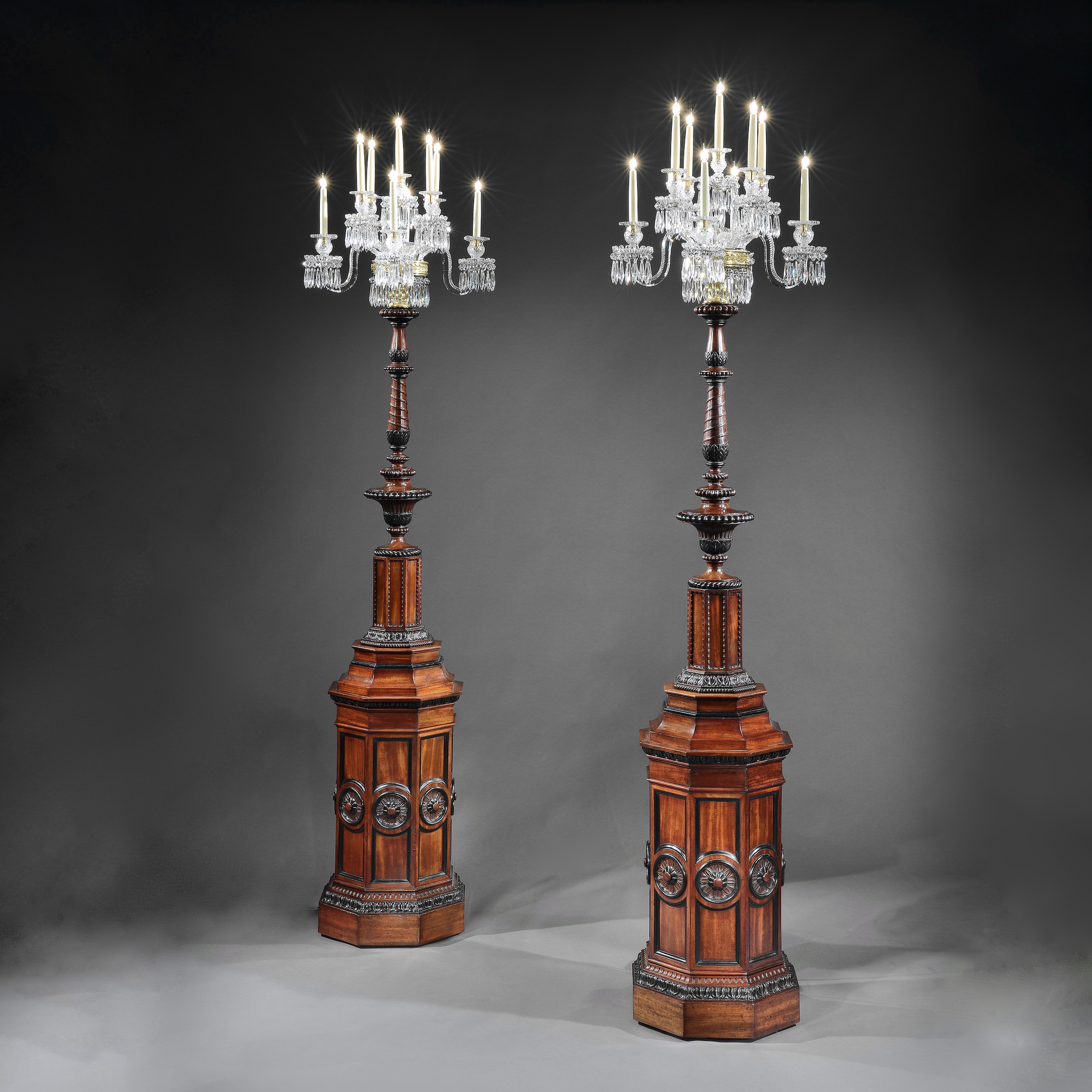
Masterpieces of Georgian lighting, these floor-standing candelabra with glass attributed to Hancock & Rixon were made circa 1825. Butchoff Antiques
During this era, master silversmiths and bronziers created extraordinary pieces that merged functionality with artistic excellence, establishing standards of quality that continue to command attention from discerning collectors today. The earliest Georgian lighting solutions predominantly featured silver and brass candelabra, with notable London workshops such as Paul de Lamerie and Matthew Boulton producing exemplary pieces characterized by their classical proportions and sophisticated embellishments. These masterworks often incorporated neoclassical elements, including acanthus leaves, Greek key patterns, and elegant fluting, while maintaining the structural integrity necessary for practical illumination. The introduction of Argand-style oil lamps in the 1780s marked a significant technological advancement, allowing for brighter, more controlled illumination while presenting new opportunities for artistic expression in brass and bronze.
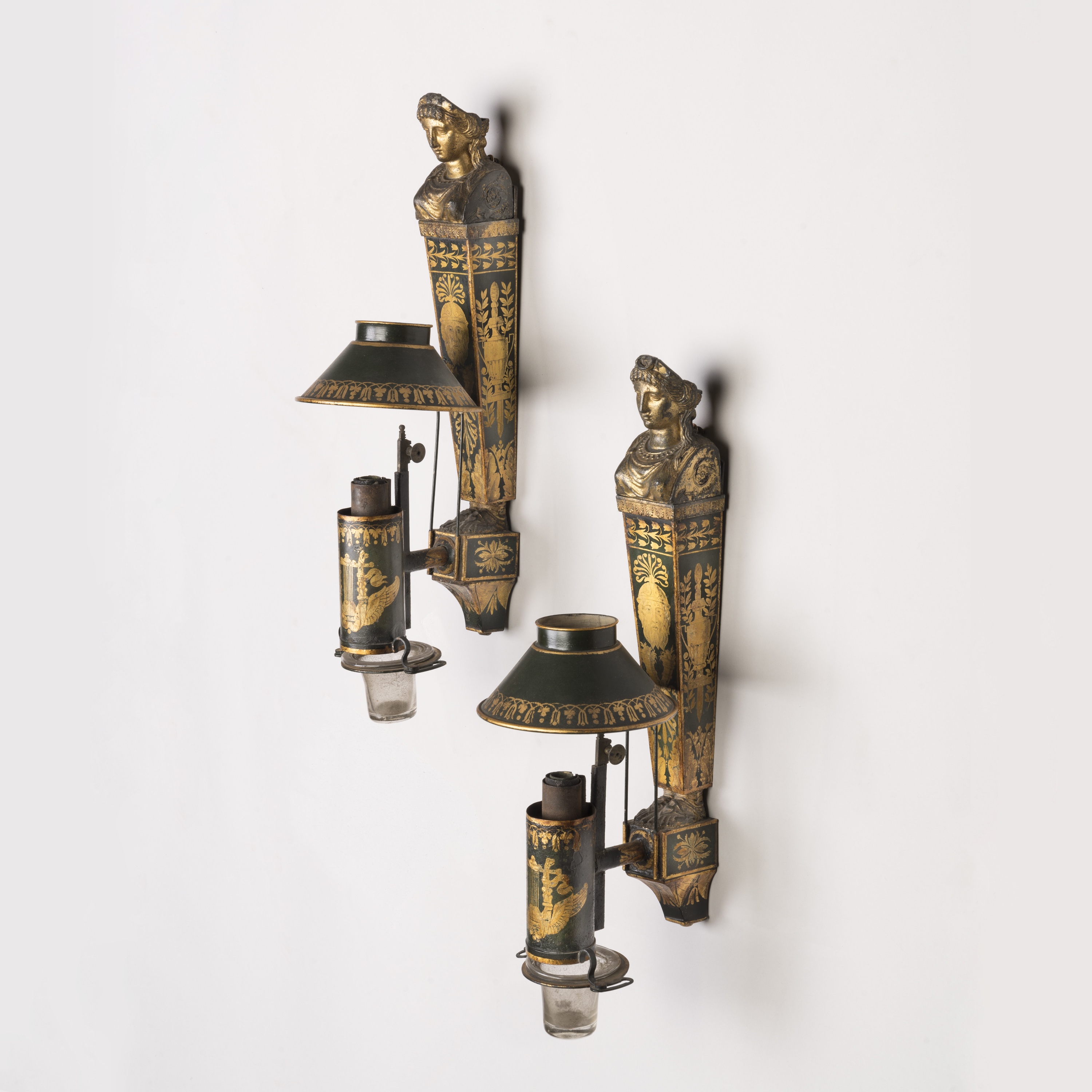
Related to the Argand Lamp, the "Quinquet" lamp, after Antoine-Arnoult Quinquet, a pharmacist in Paris, introduced a much-improved version with more brightness. Its success made it the most popular lamp of the early 19th century, until it was replaced by Kerosene lamps around 1850. Sold by Butchoff Antiques
The transition into the Regency period saw an evolution in both form and function, with craftsmen such as Benjamin Vulliamy introducing more elaborate decorative elements inspired by Egyptian and Oriental motifs. These pieces frequently featured ormolu mounts, engine-turned columns, and cut-glass hurricanes that created spectacular light effects. Authentication of pieces from this period relies heavily on proper hallmarking, particularly in silver examples, while brass and bronze pieces often bear distinctive maker's marks or workshop stamps. The most sought-after examples typically showcase exceptional chasing and casting quality, with original gilding or patination intact.
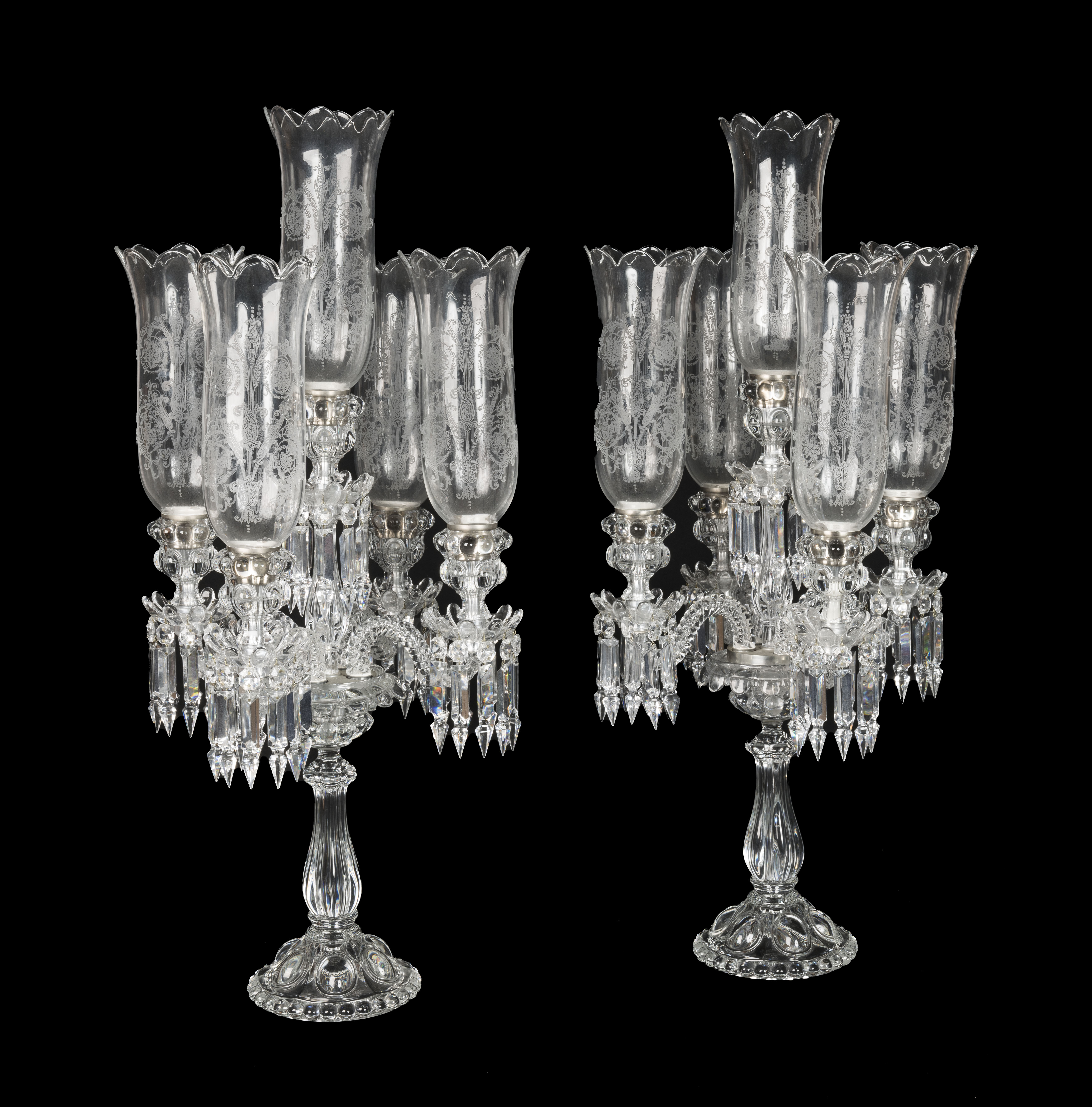
A complete pair of candelabra with hurricane shades, the bases stamped Baccarat & each shade with etched signature of Baccarat. Butchoff Antiques.
Today's market particularly values complete sets of Georgian candelabra and early Regency oil lamps that retain their original finish and demonstrate documented provenance. Pieces bearing the marks of renowned workshops, especially those with aristocratic commissioned histories, command premium prices at auction and through specialized dealers. The Victorian era heralded unprecedented innovation in domestic lighting, fundamentally transforming both the technical capabilities and aesthetic sensibilities of British illumination. The introduction of gas lighting in the 1820s sparked a revolution in lamp design, with manufacturers such as Messenger & Sons of Birmingham and Faraday & Son of London creating sophisticated brass and bronze gas fixtures that merged classical motifs with modern engineering.
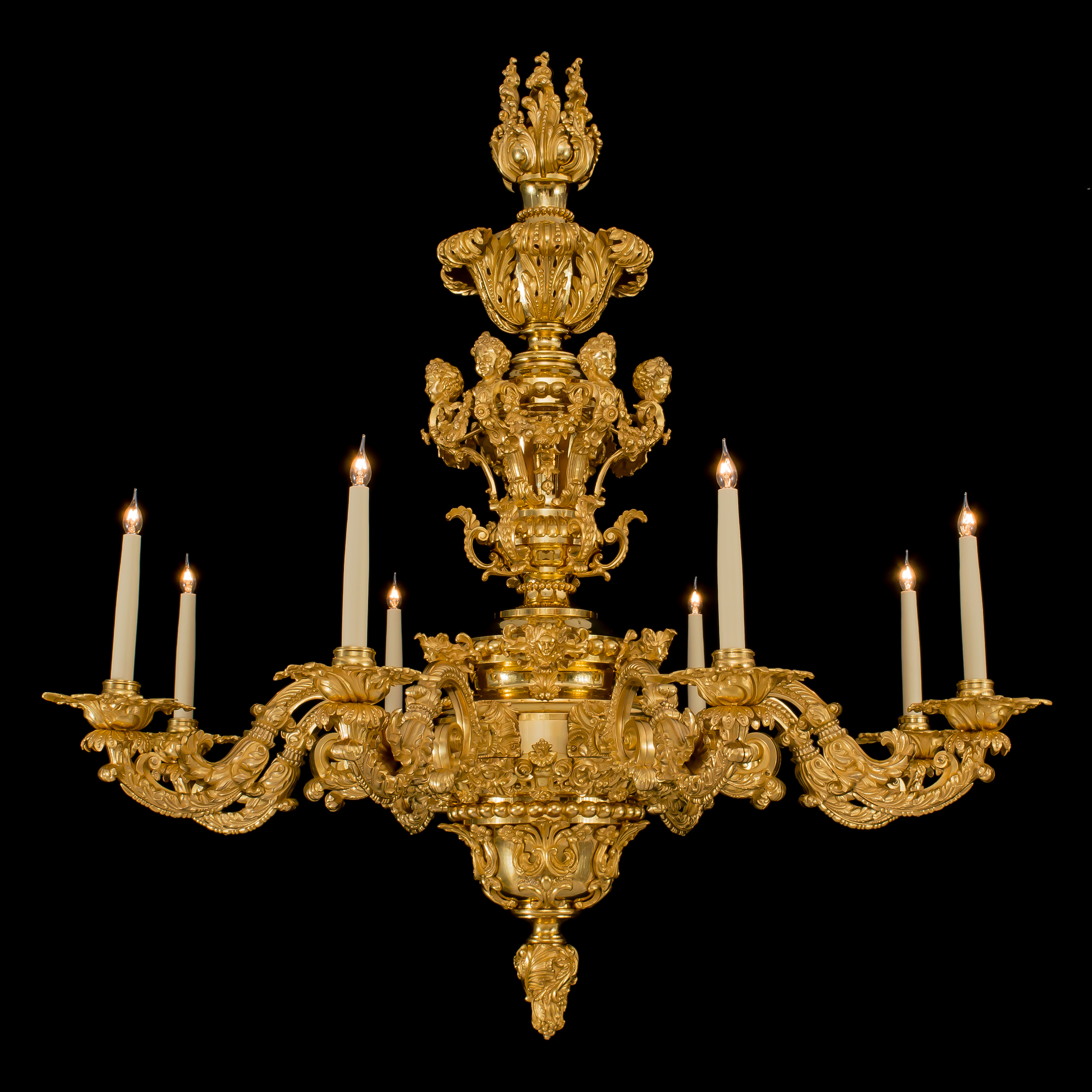
Initially designed for real candles and lowered with the help of a pulley, this gilt bronze chandelier by Messenger & Phipson, c.1825, is now fully electrified. Butchoff Antiques
The parallel evolution of oil lamp mechanisms during this period produced remarkable advances in functionality and safety. The development of the duplex burner by George Hinks in 1865 represented a significant breakthrough, allowing for brighter, more controlled illumination while maintaining the decorative elegance demanded by Victorian sensibilities. This innovation was quickly adopted by prestigious manufacturers including Hinks & Sons of Birmingham and Young & Sons of Edinburgh, who incorporated the technology into increasingly ornate designs featuring cut glass fonts and elaborate metalwork. Victorian lamp design drew inspiration from an eclectic array of historical styles, reflecting the era's fascination with revivalist aesthetics. Gothic Revival elements appeared in ecclesiastical-inspired brass work, while Rococo flourishes adorned drawing room pieces, particularly in the scrolling foliate patterns favored by firms such as F&C Osler.
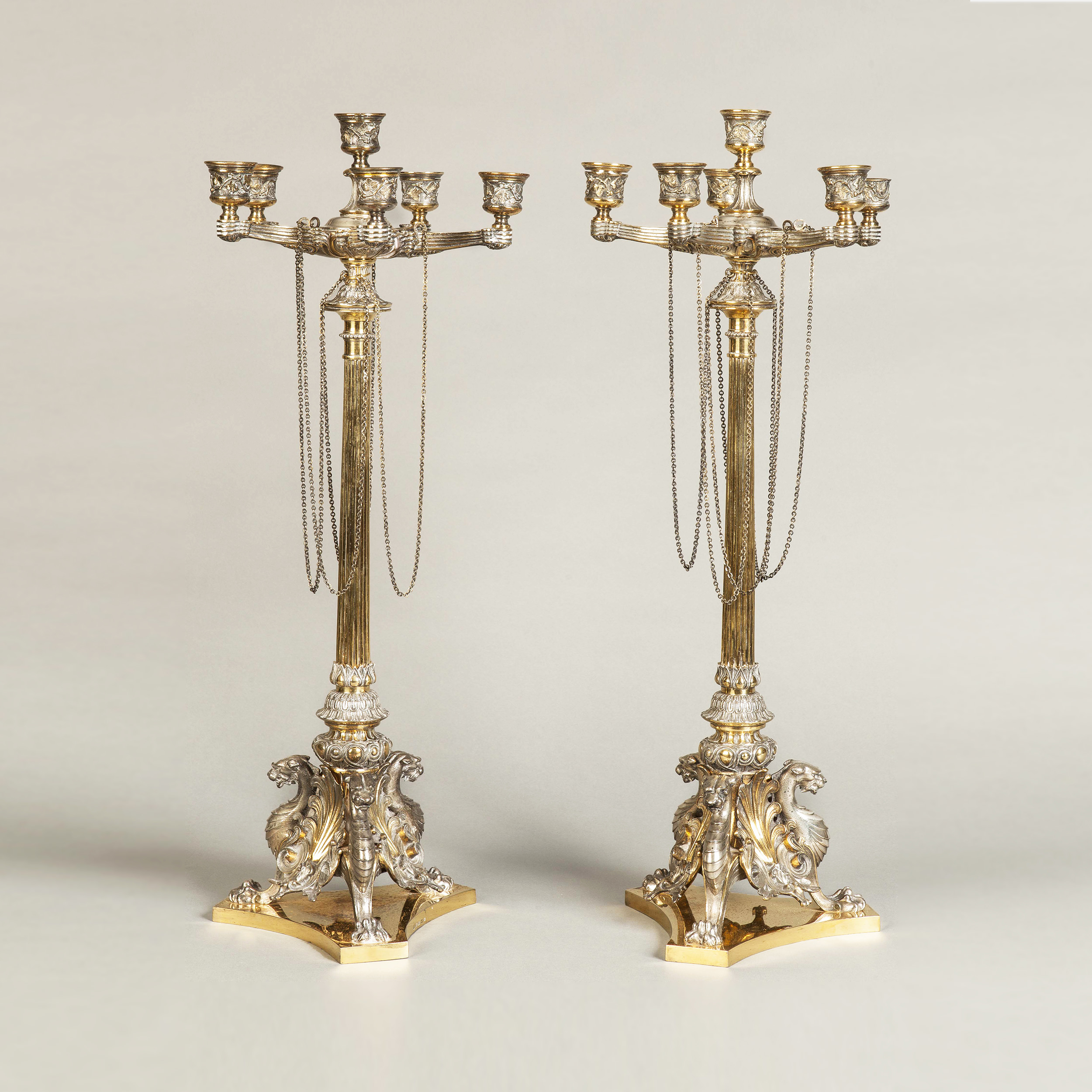
A pair of gothic-inspired silver plated and parcel gilt candelabra by Elkington & Co, c.1865. Butchoff Antiques.
The introduction of new manufacturing techniques, including improved lost-wax casting and mechanical pressing of glass components, allowed for more intricate detailing while maintaining the robust construction that characterizes genuine period pieces. The most distinguished Victorian manufacturers left distinctive markers of authenticity, from Messenger's characteristic wing nut designs to Osler's distinctive acid-etched signatures. These identifying features, combined with period-specific construction methods such as hand-cut threads and individually crafted burner mechanisms, provide crucial authentication points for modern collectors seeking genuine Victorian lighting specimens.
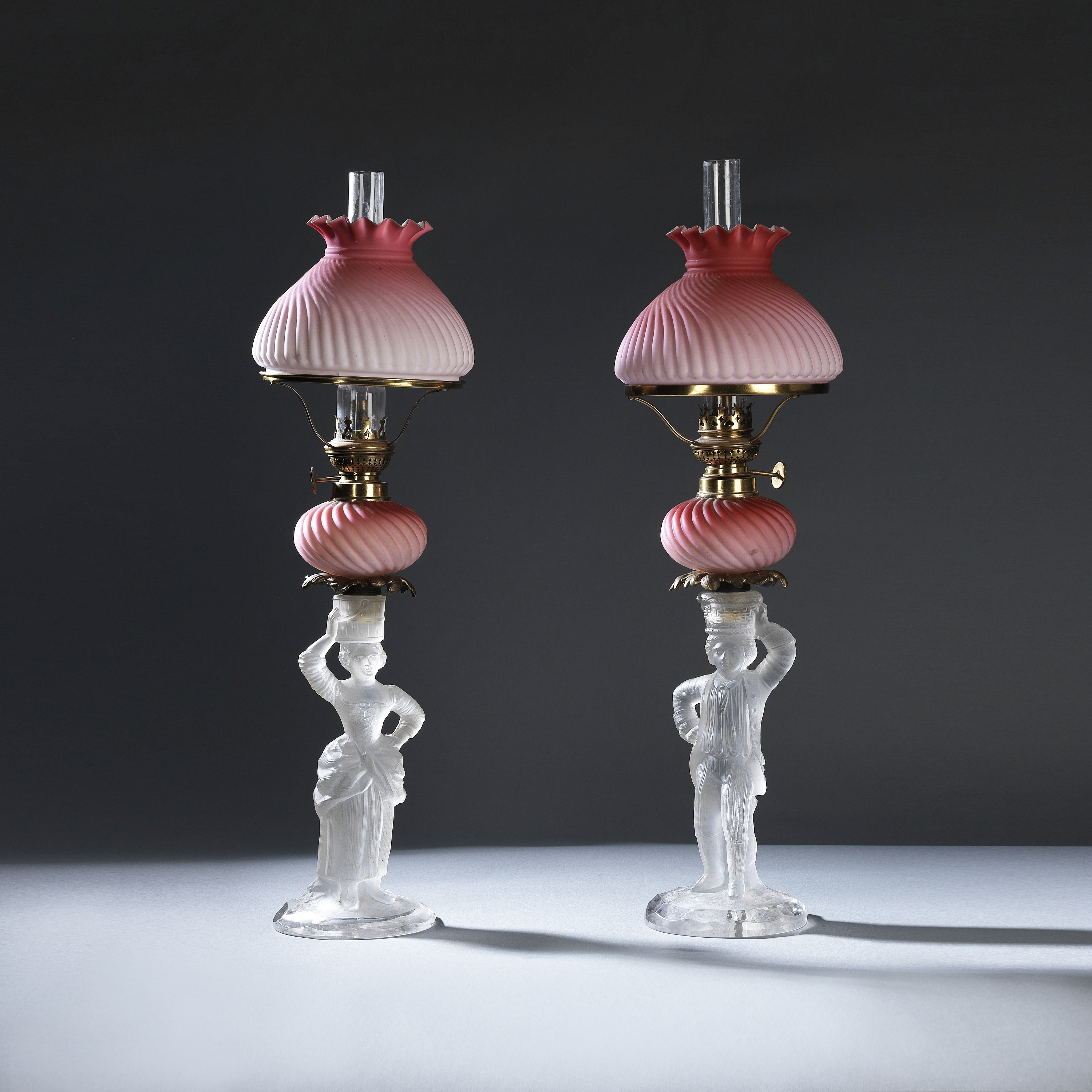
The 'Kosmos' burner was patented in the UK in 1865, by Wilde & Wessel of Berlin. The company was taken over in 1899 by Messrs Brokleman, Jager et Cie, at which point the winder mechanisms were marked 'Kosmos Brenner'. These burners were sold wholesale on a worldwide basis, and were still being manufactured up until 1974. Butchoff Antiques.
The dawn of the twentieth century ushered in revolutionary artistic movements that profoundly transformed decorative lighting design, with Art Nouveau and Art Deco establishing distinctly different approaches to lamp craftsmanship. The sinuous, nature-inspired forms of Art Nouveau found their ultimate expression in the works of Louis Comfort Tiffany, whose innovative use of opalescent glass and naturalistic themes created an entirely new vocabulary in lighting design. These celebrated pieces, particularly those featuring dragonfly motifs and flowering tree patterns, commanded extraordinary prices even in their own time, with documented sales to British nobility and industrial magnates through luxury retailers such as Liberty of London. The European interpretation of these movements, particularly in Britain, took a markedly different direction from their American counterparts. Notable British craftsmen such as W.A.S. Benson pioneered their own distinctive style, combining the flowing lines of Art Nouveau with a characteristically British restraint in ornamentation. Their works frequently featured sophisticated combinations of materials, including hand-hammered copper, brass with patinated finishes, and innovative glass treatments developed in conjunction with James Powell & Sons of Whitefriars.
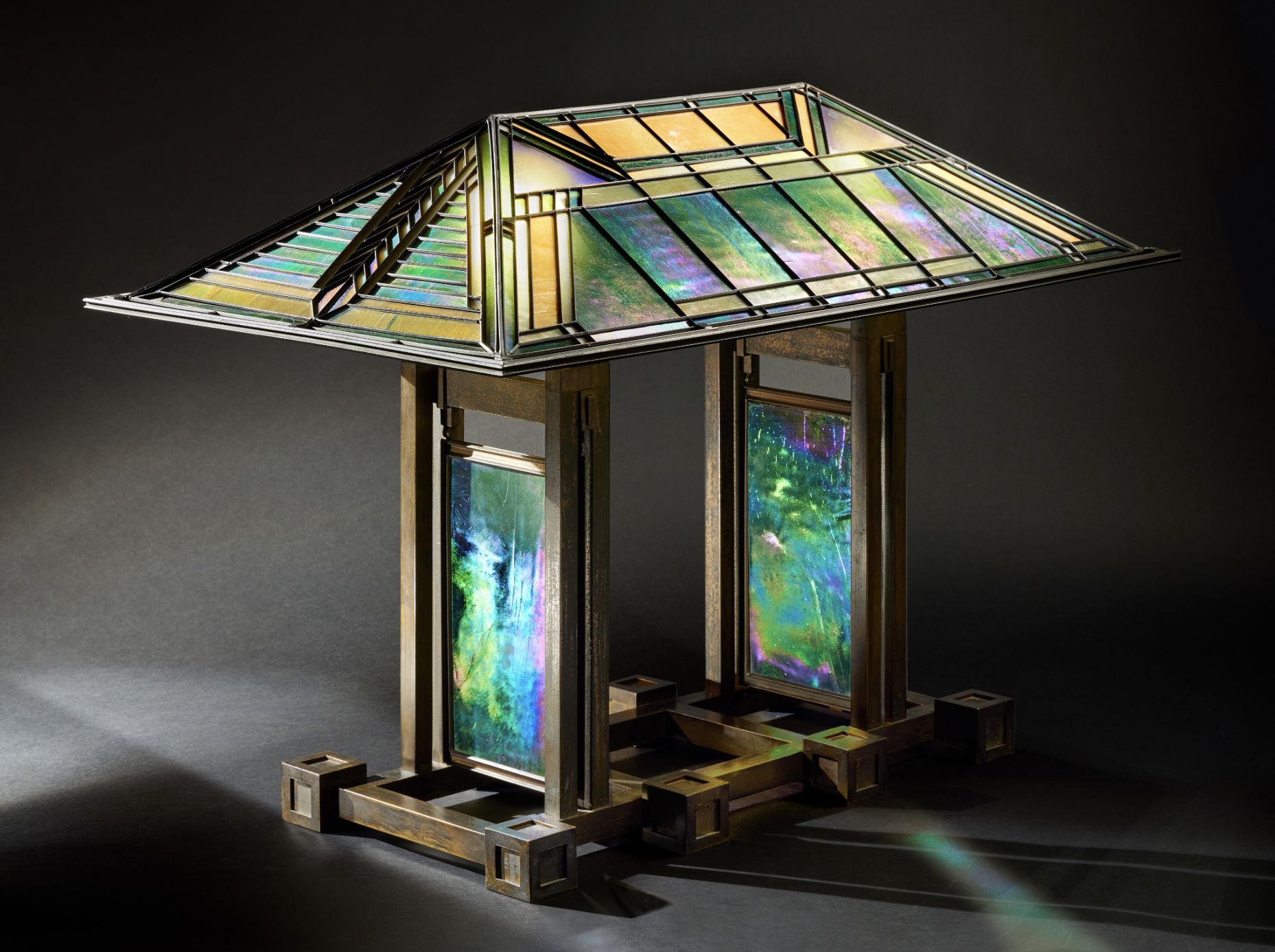
Designed by Frank Lloyd Wright, and made circa 1904 for the Thomas-Dana house in Illinois, this antique lamp broke the record for the designer & architect, achieving $7.5 million in 2025.
The transition to Art Deco in the 1920s brought a dramatic shift toward geometric precision and modern materials. British manufacturers such as Osler & Co of Birmingham embraced this new aesthetic while maintaining traditional craftsmanship standards, creating pieces that incorporated chrome-plated elements, stepped architectural forms, and innovative uses of cut and frosted glass. For contemporary collectors, authentication of pieces from this transformative period requires particular attention to period-appropriate materials and manufacturing techniques, with original electrical components and period-specific glass treatments serving as crucial indicators of authenticity. The market for these sophisticated examples of British craftsmanship continues to strengthen, with documented provenance and original condition commanding premium valuations at prestigious London auction houses. The enduring allure of antique lamps extends far beyond their decorative appeal, representing a fascinating confluence of artistic innovation, technological advancement, and cultural evolution. For the discerning collector, these illuminating artifacts offer both aesthetic pleasure and compelling investment potential, particularly as authenticated pieces from renowned manufacturers continue to appreciate in value. The preservation of these historical treasures demands a thorough understanding of proper care techniques, including specialized cleaning methods for delicate materials such as leaded glass and period-appropriate metalwork restoration approaches that maintain authenticity while ensuring structural integrity. The pursuit of antique lighting requires a methodical approach to authentication, ideally guided by established experts in the field. Professional verification services, such as those offered by respected institutions and certified appraisers, provide crucial documentation that enhances both the historical record and market value of significant pieces. The British antiques trade, with its centuries of expertise and rigorous standards, has consistently led the way in establishing authentication protocols that have become industry benchmarks. For collectors seeking to expand their knowledge, numerous scholarly resources offer invaluable insights into specific periods and makers. The archives of venerable British institutions, including the Victoria and Albert Museum and the Royal Collection, provide extensive documentation of historical lighting designs and manufacturing techniques. Contemporary collectors would do well to cultivate relationships with reputable dealers who maintain strong connections to these institutional resources while offering guidance on market trends and acquisition opportunities. The most successful collections invariably result from a combination of passionate interest, careful research, and expert consultation, ensuring that each acquisition contributes meaningfully to the preservation of our decorative arts heritage while providing sound investment value for future generations.
Written by Rainier Schraepen

It is very likely when someone thinks about English furniture, one would envision pieces which are finely crafted, brown in colour, and representing the epoch of comfort and grand English country houses – all characteristics that shape the Georgian period. This extensive period witnessed some of the greatest and most influential designers and furniture makers in England’s history, such as William Kent, Robert Adam, Thomas Chippendale, George Hepplewhite, and Thomas Sheraton.
Georgian furniture is not titled due to its physical characteristics, but the alignment of the reigns of four consecutive English Kings, fittingly all named ‘George’, spanning from 1714 to 1830. The early period was marked with England ruling the waters with ships in ports all over the world, trading for exotic goods such as spices, textiles, and woods and discovering new ornamentations for architecture and furniture design. An English banker who successfully backed such mercantile conquests built grand country house, Osterly Park. Decoration and furnishings by Thomas Chippendale and Robert Adam – the Andy Warhol’s of their time - decorated Osterly Park.
The supreme characteristic of Georgian furniture is the predominance of exotic hardwoods with striking textural grains, such as mahogany from Cuba, San Domingo, South America or the West Indies; rosewood from Brazil, Honduras, and India; and satinwood from the West Indies. A striking example of the romaticization of exotic woods is this unusual Circular Table (ref. 6767) inlaid with eight different specimen woods on mahogany ground creating an eye-catching vortex design. Woods so rare that our timbers expert, Dr Adam Bowett, could not identify them all.
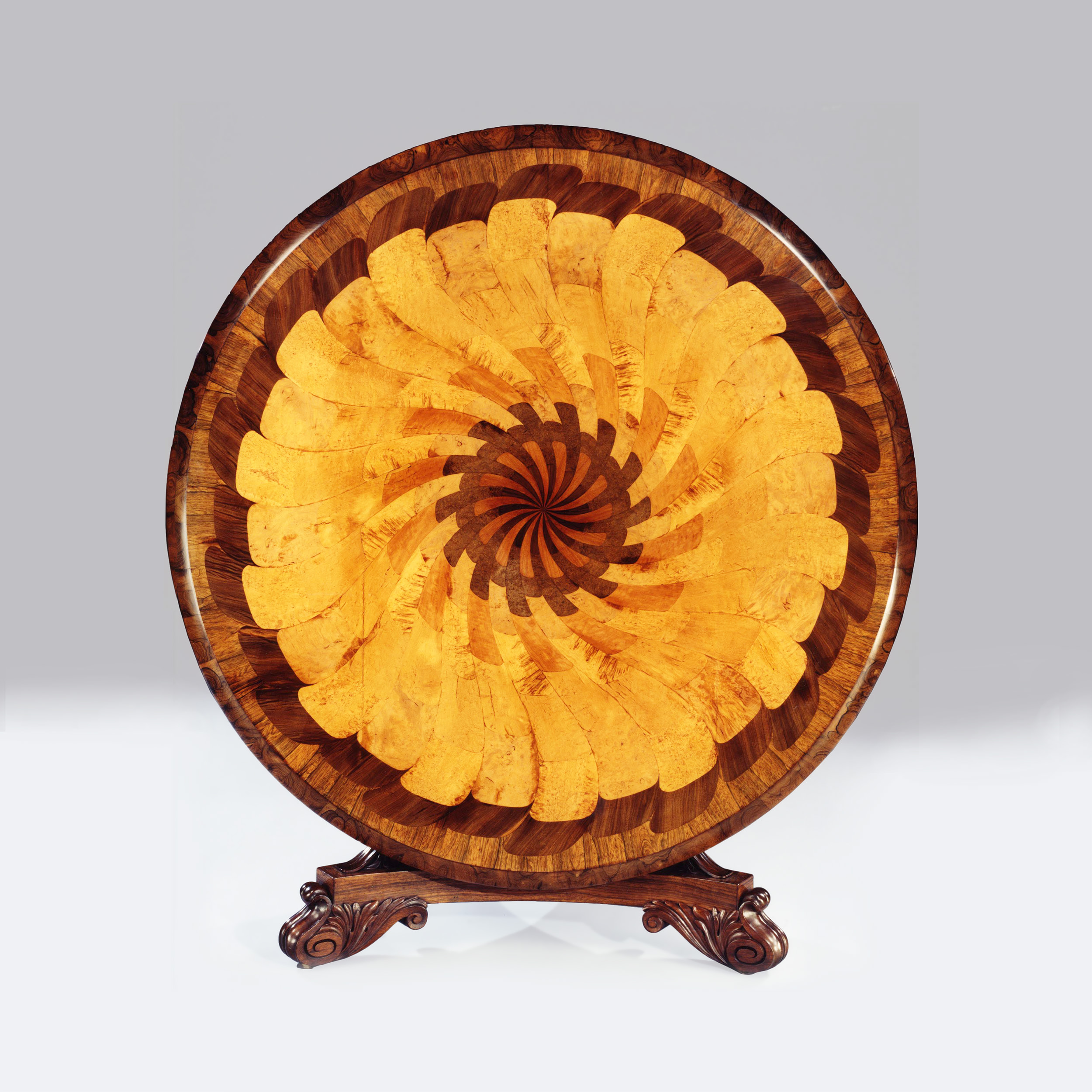
Ref. 6767, A Remarkable Late Georgian Circular Table, circa 1825. Butchoff Antiques, London.
The ornamentation of Georgian furniture is characteristically tasteful, inlaid with contrasting woods or gilded in gold leaf, and ornamentation of carvings with architectural motifs inspired by Classical Greece and China. A secretaire bookcase (ref. 7139), attributed to John McLean of London, incorporates the finest qualities of Georgian furniture. The bookcase rises from compressed ball brass feet and is constructed from a well-figured goncalo alves timer which is tastefully accented with gilt brass accents inspired by Classical Antiquity.
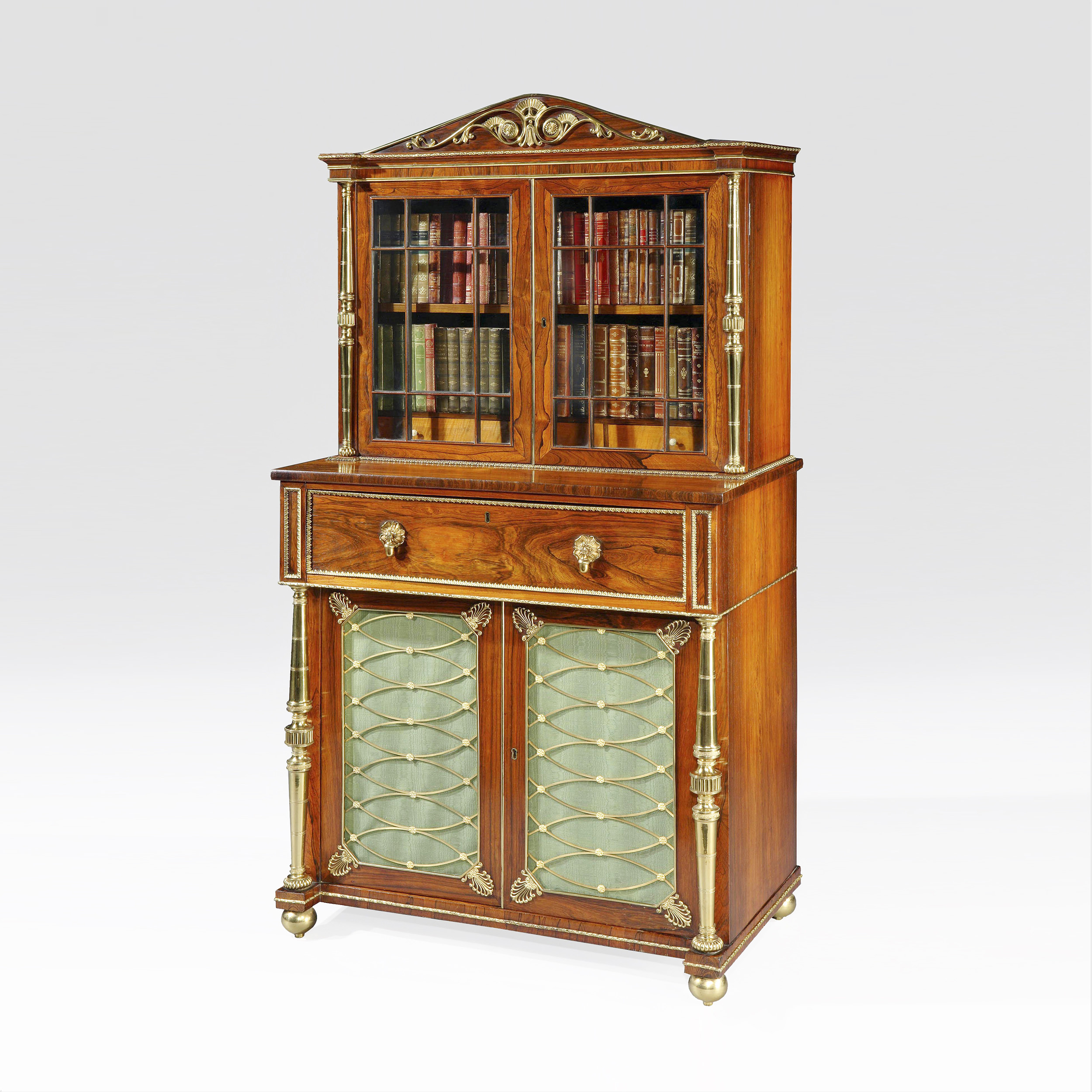
Ref. 7139, A Regency Period Secretaire Bookcase, attributed to John McLean of London, circa 1810. Butchoff Antiques, London.
The Georgian Period was the golden age of household entertainment. Grand homes such as Chiswick House in London were built with the intention to entertain and showcase fine art and contemporary interior decoration. Hosts would have stylish and functional furnishings and objects to entertain guests for hours or even days. Serving tables were and still are very utilitarian pieces for most rooms, or principally entertaining rooms, providing surfaces to hold silver serving platters dressed with food, porcelain ceramics, candelabra, fresh flowers or decorative objects.
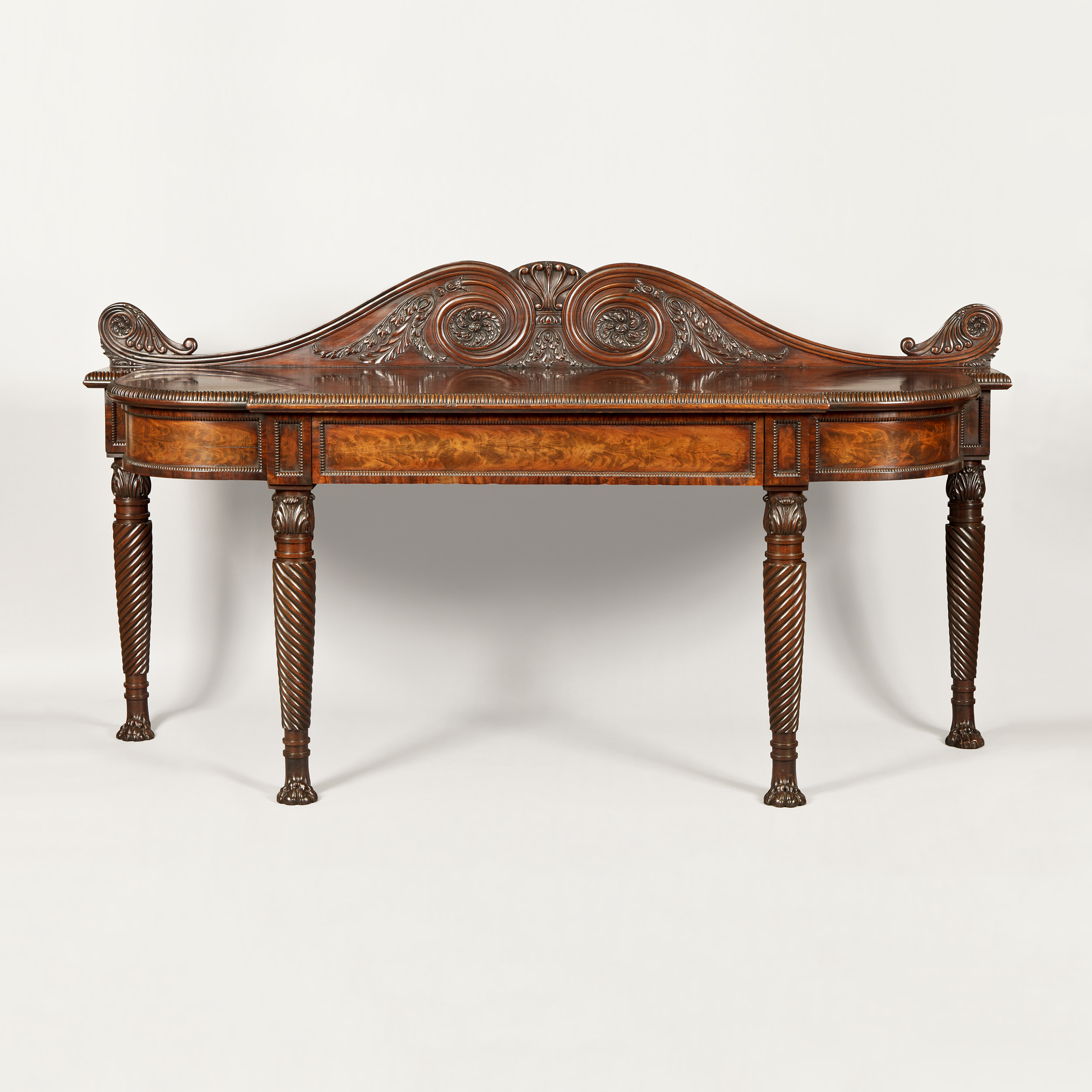
Ref. 7819, A Very Fine Georgian Serving Table of the Regency Period, circa 1820. Butchoff Antiques, London.
Often a decorative wine cooler would sit beneath, filled with ice and beverages, and on either side of the table would sit coordinating cupboards housing plates and silver ware. Such an arrangement would be very similar to this mahogany Georgian Serving Table (ref. 7819) with Chinese inpsired ‘hairy paw’ feet and a decorative serpentine back incorporating well executed Graeco-Roman carvings, with this open top mahogany wine cooler (ref. 5919), and this pair of side cupboards (ref. 8382) adorned with similar carvings.
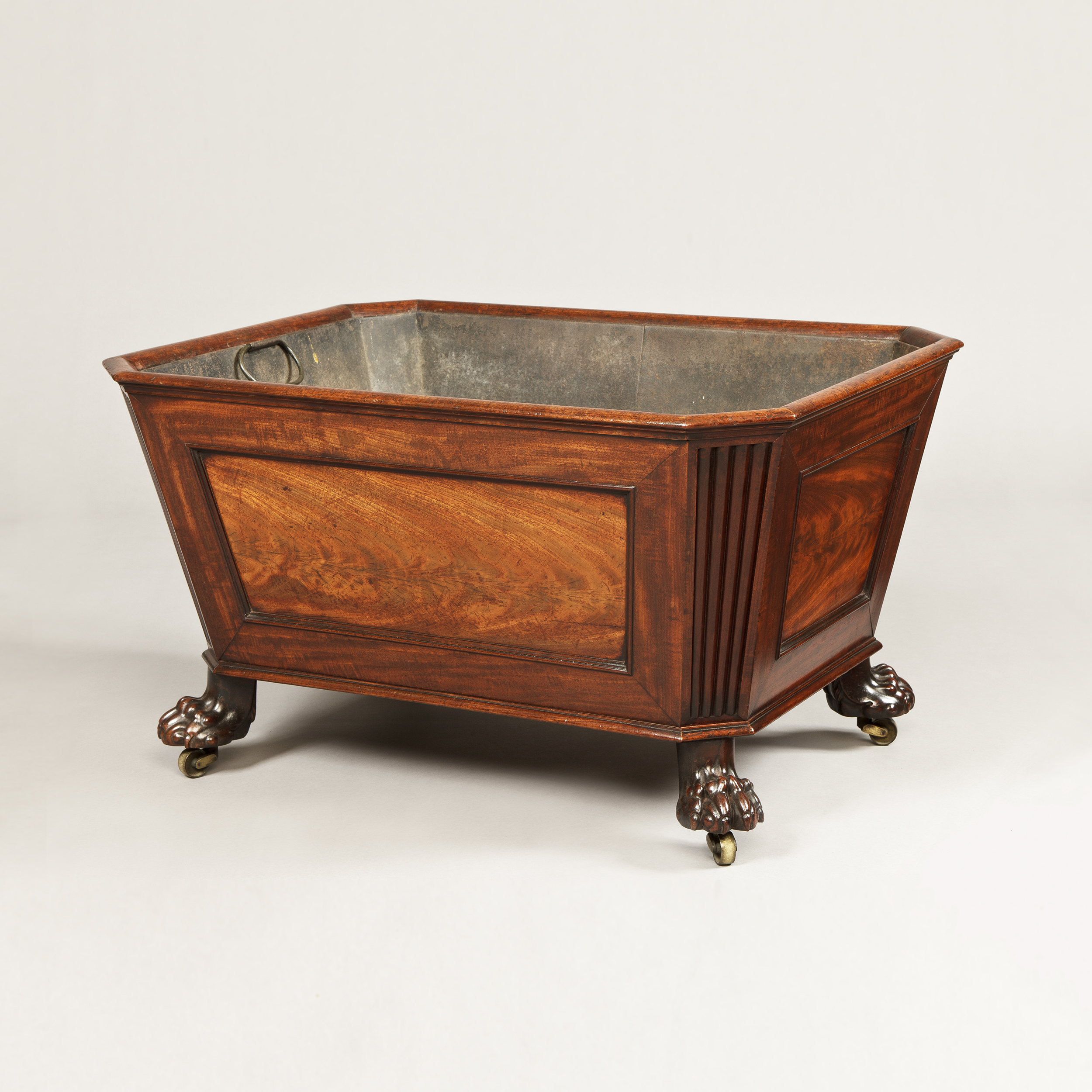
Ref. 5919, A Fine Quality Mahogany Open Top George III Wine Cooler, circa 1815. Previsouly with Butchoff Antiques, London.
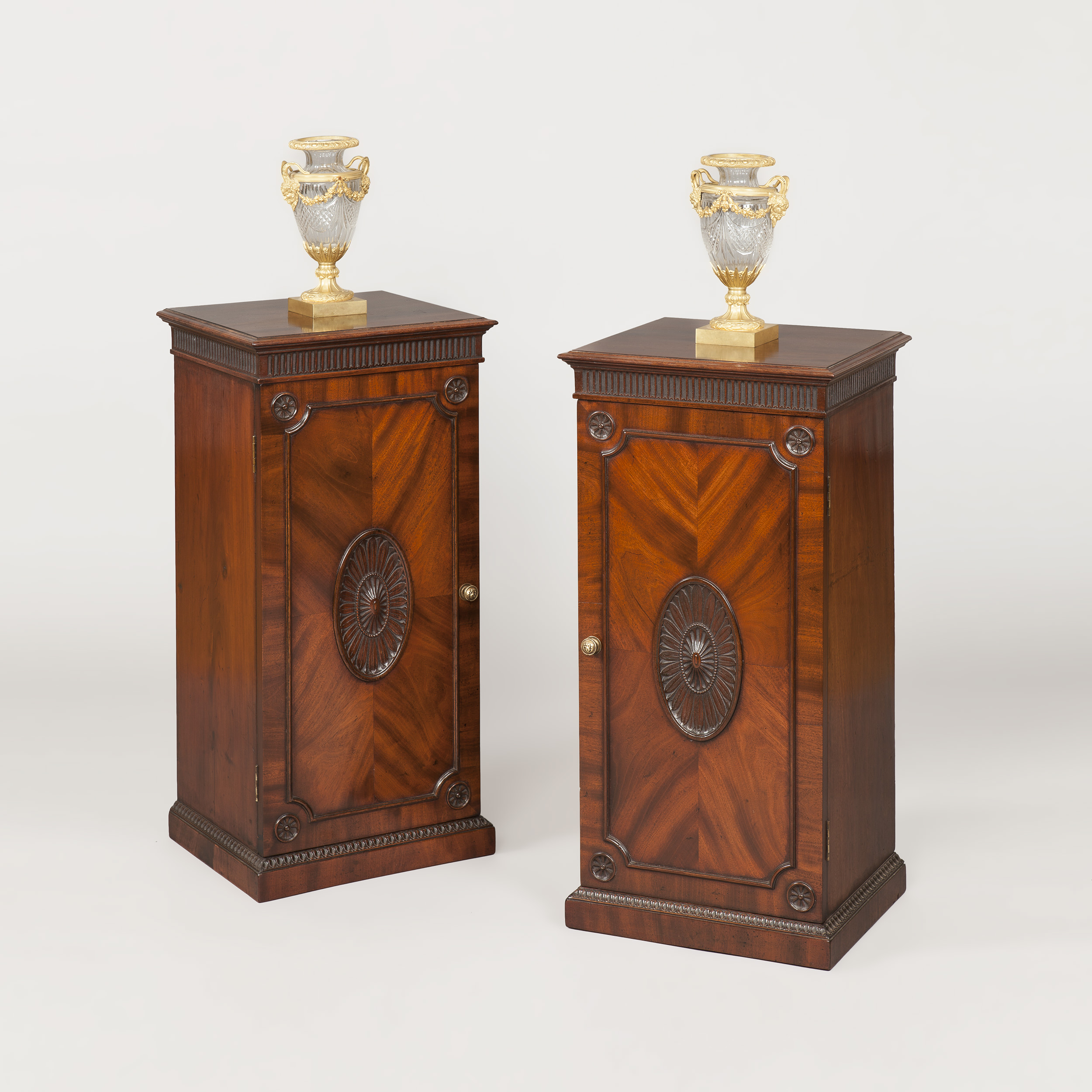
Ref. 8382, A Pair of Georgian Side Cupboards, circa 1820. Previously with Butchoff Antiques, London.
Naturally as the Georgian period came to a close, the style had developed aesthetically over time. Progressing from subtle and fine carved details to more dramatic carvings that would evolve into the Regency Period. An example of the progression is this Pair of Late Georgian Period Armorial Armchairs (ref. 8557). As their grand size, curving and tapering back legs, and robust carvings represent awareness for new designs; yet also keep in the principles of the Georgian period.
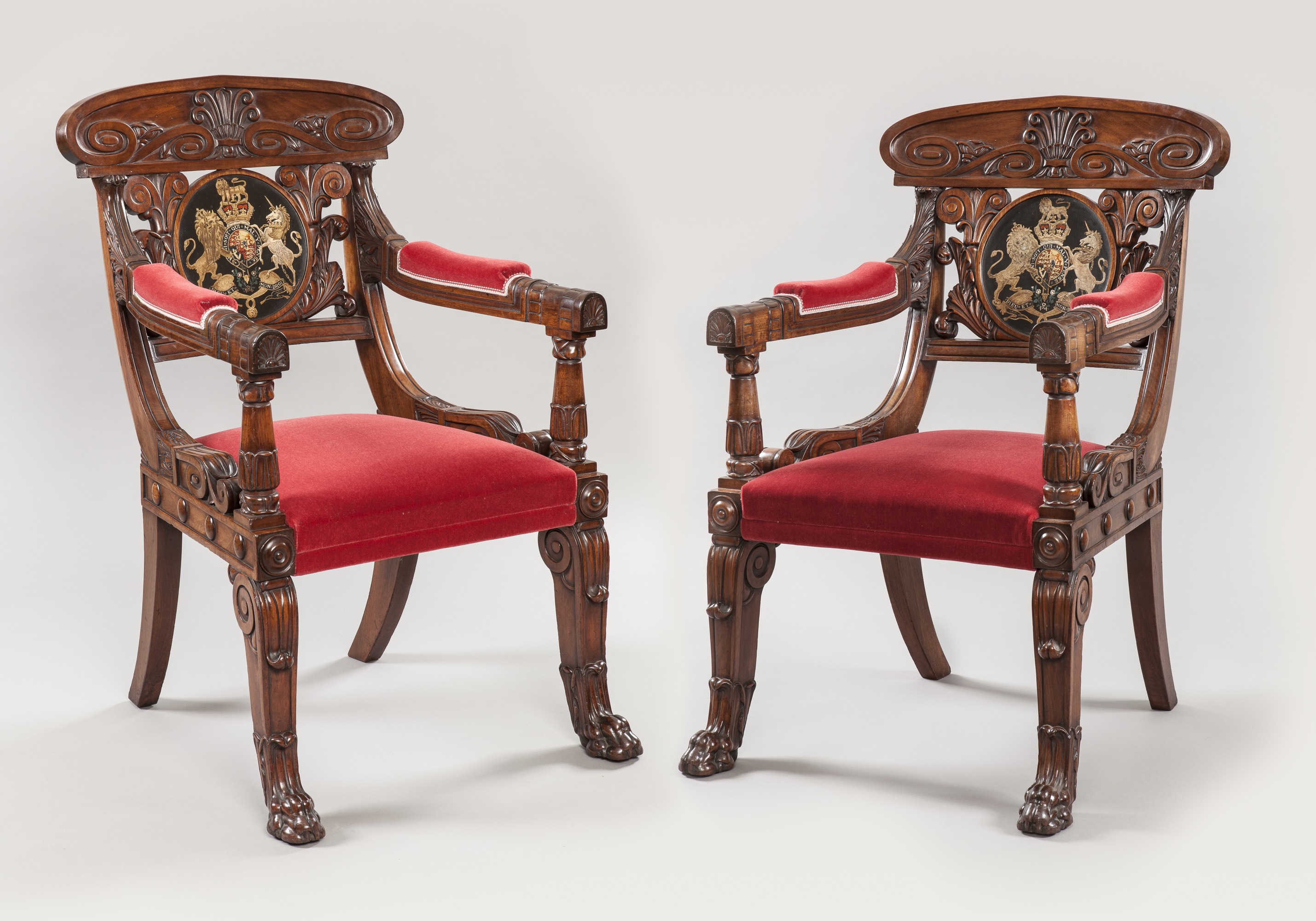
Ref. 8557, A Pair of Late Georgian Armorial Armchairs of Important Size, circa 1825. Previously with Butchoff Antiques, London.
The Georgian period is a hallmark for English design and decoration. The taste for Georgian furniture has never necessarily gone too far out of style. By the mid-twentieth century Georgian furniture was revived in both England and America through the interior decorating style renowned as the ‘English Country House Style’, which still continues today to influence contemporary designers and decorating trends.
By Rainier Schraepen
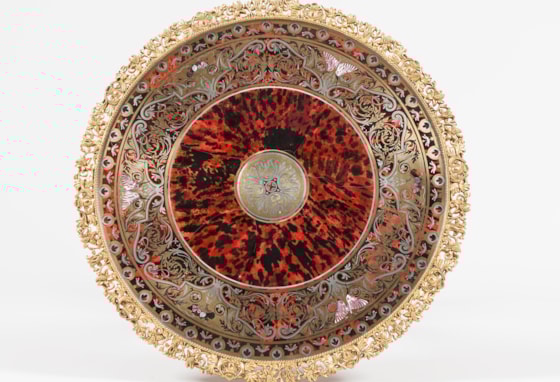
Marquetry is the art of creating intricate pictures and elaborate designs on furniture by skilfully cutting and fitting together thin pieces of domestic and exotic woods, horn, ivory, metal, shell, and other precious materials. Marquetry designs are derived from arabesque and grotesque ornament. While this highly specialized and studied art has roots in ancient times, it was brought to a high level of refinement and popularity in the 17th and 18th centuries in France.
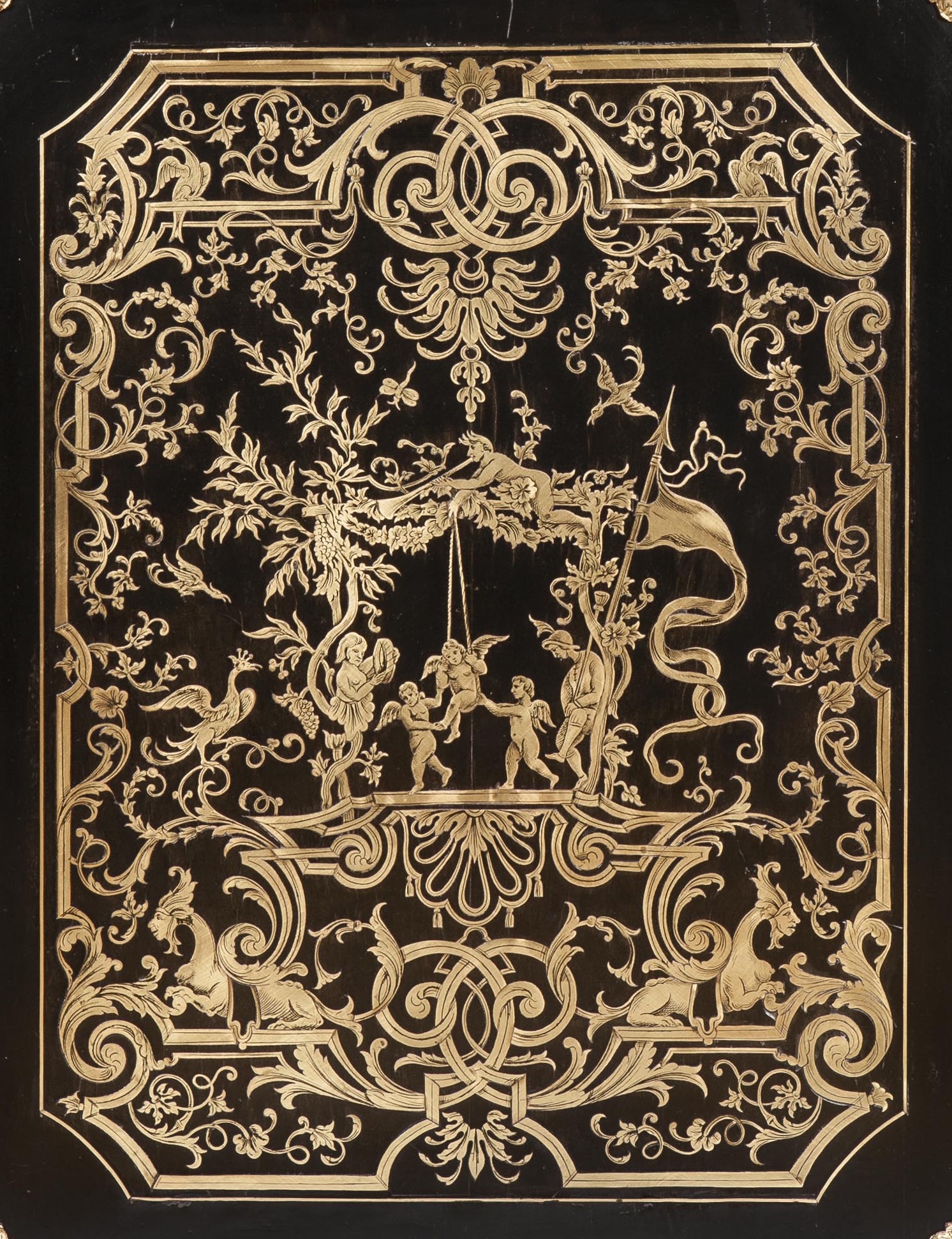
Figure 1. A True Pair of Side Cabinets in the Manner of Andre Charles Boulle (detail). Previously with Butchoff Antiques, London.
André-Charles Boulle’s name is synonymous with the technique known as ‘Boulle’ marquetry. Although not the inventor of the craft - Boulle’s skillful practice of combining contrasting black ebony with gilded bronze and tortoiseshell inlaid with intricate designs of silver-toned pewter and brass is associated as one of the most opulent and expensive form of decoration of furniture. Boulle’s work took two different forms: première partie - pattern in metals with the background in tortoiseshell; and contre partie - pattern in tortoiseshell with the background in metal. Occasionally tortoiseshell is lined on the reverse with a tinted metal foils, such as gold leaf or red, to enhance the naturally spotted patterns of the shell.
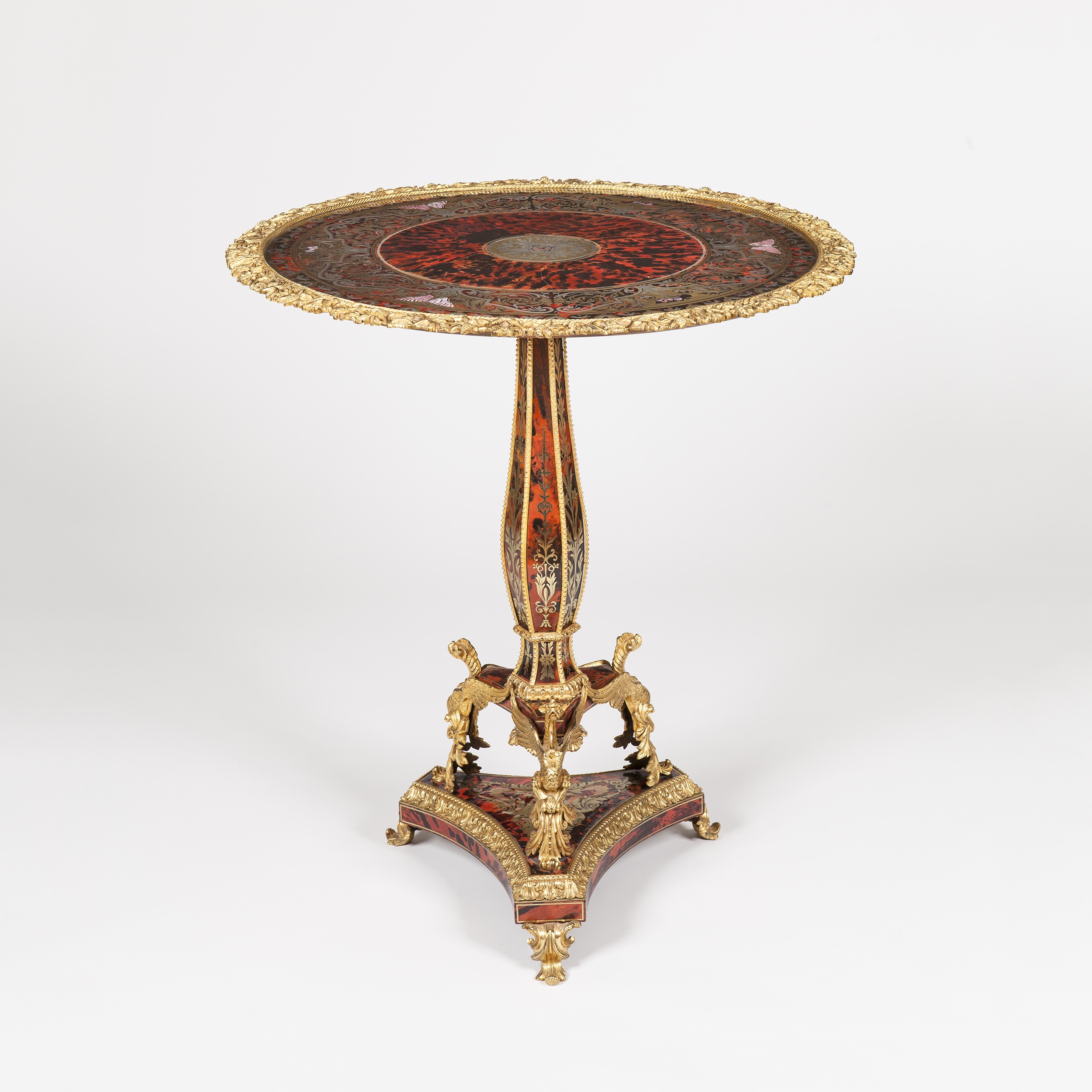
Figure 2. A 'Boulle' Marquetry Guéridon. Previously with Butchoff Antiques, London.
Imagine how these pieces of furniture would have looked in the early 18th century. An interior room only lit by daylight and candlelight at night, and how the brass inlay and gilt bronze mounts would have brilliantly flickered amongst the dark. They would have been beacons of light reflecting an impression of grandeur and wealth. The combination of gilt bronze and brass surfaces were revolutionary to the furniture and decoration world.
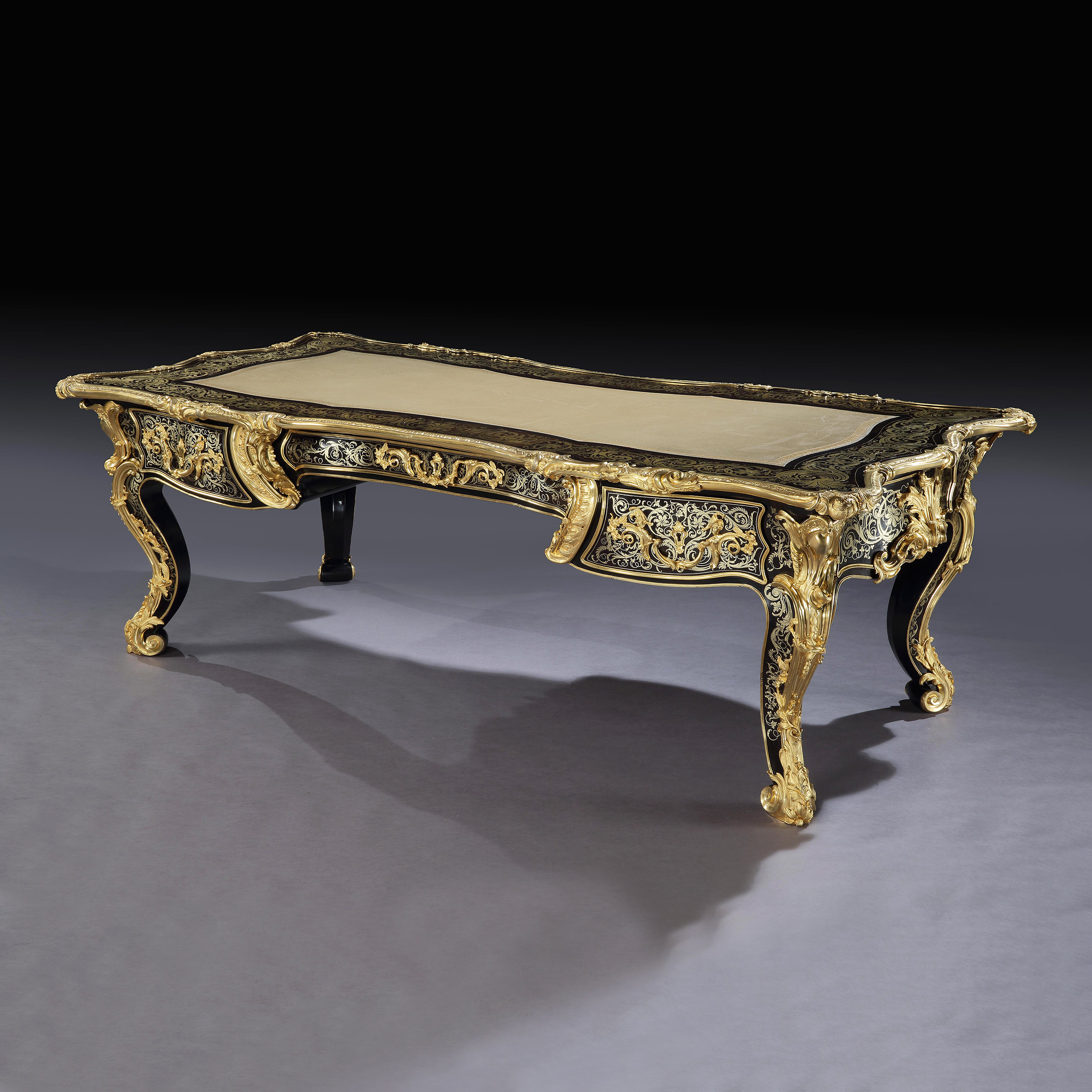
Figure 3. A Bureau Plat in the Louis XIV Manner, by Toms and Luscombe shown at the 1862 International Exhibition. Butchoff Antiques, London.
Over forty-two years, Boulle supplied furniture and interior finishes for King Louis XV and XIV, the Queen, the Grand Dauphin, and many financiers, ministers and important officials throughout Europe. Currently many of Boulle’s attributed works are in some of the finest museums, as well as royal and private collections throughout the world. An authenticated work at auction today would cost quite the fortune, let alone the materials to create a custom-made piece.
Boulle lived from 1642 – 1732 and was received as a Maître Ébéniste in 1666 quickly becoming known as the most skillful artisan in Paris. He was appointed by King XV to ‘Ébéniste du Roi’ in 1672 granting him the royal privilege of lodging in the Palais du Louvre with special permission to work in both bronze and wood. He produced furniture as well as works in gilt bronze, such as chandeliers, wall lights, mounts for furniture, interior decorative details and parquet floors.
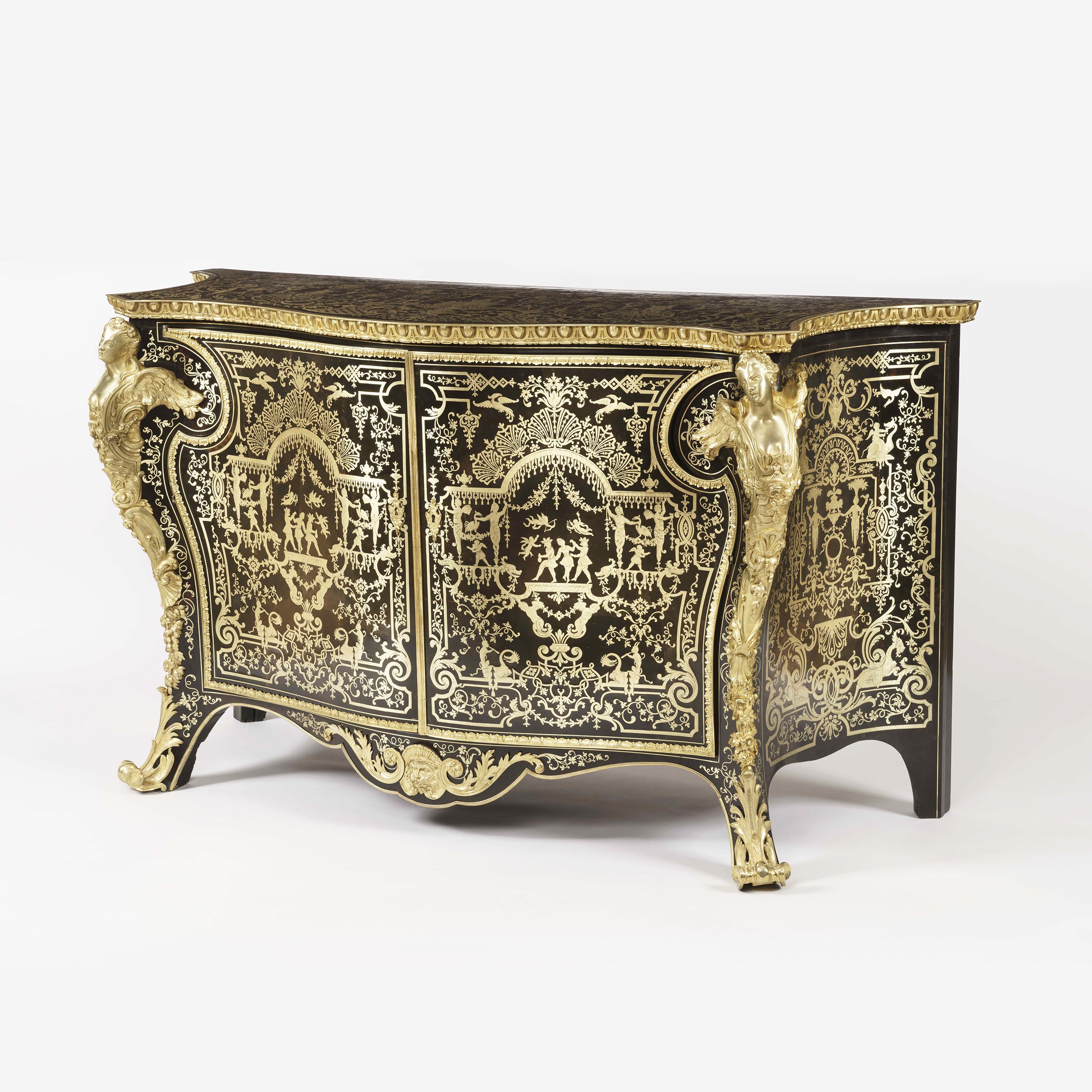
Figure 4. A Fine Commode, by Mellier and Company in the Manner of André-Charles Boulle. Butchoff Antiques, London.
Boulle’s influence in the design and furniture world has lasted for hundreds of years. This has been aided by the circulation of his designs illustrated in books of engravings, published around 1720. Designs included various models of furniture, such as bureau plats, tables, cabinets, pedestals and clocks, offering options for different forms and features, such as assorted leg styles, marquetry decoration, and gilt bronze mounts. An example is of this stylistic influence is the conception of this highly unusual serpentine commode by Mellier (Ref. 9045, fig. 4) constructed in tortoiseshell and brass in premiere-partie Boulle work.
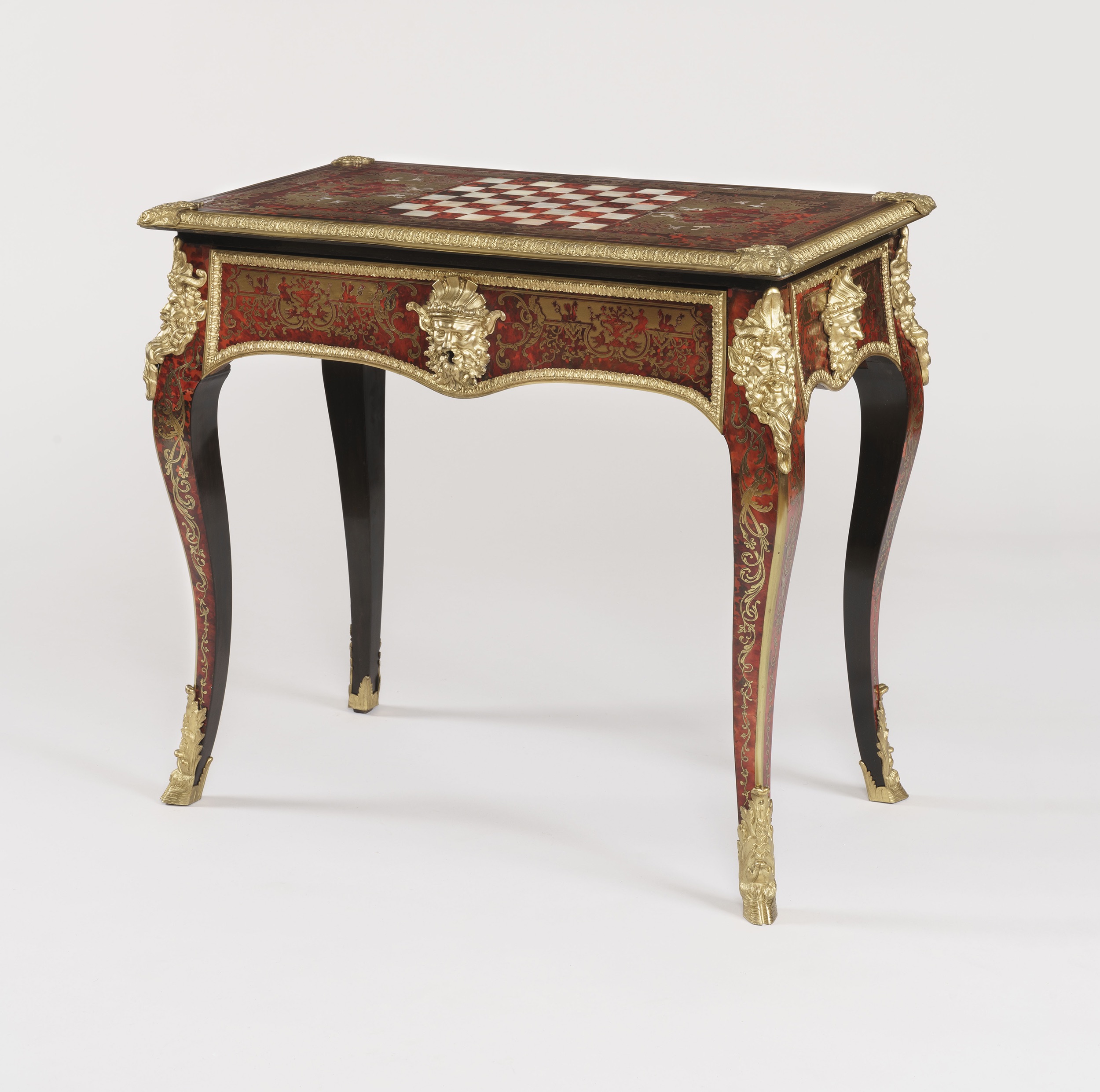
Figure 5. A Fine Games Table of the George IV Period, attributed to Thomas Parker. Butchoff Antiques, London.
Boulle’s ormolu bronze mounts were largely inspired by Classical mythology, such as the Bacchus mask as seen on this bureau plat (fig. 6) symbolically portrayed with grape vine garlands and a crown. The bureau plat demonstrates a beautiful and eye-catching play of contrasting black ebony wood against the gold of gilded bronze and brass inlay. The drawers are enriched with tortoiseshell ground and foliate brass ornamentation and all four corners are mounted with female masks which flow into foliate waterfalls melting into the ebony and brass inlay.
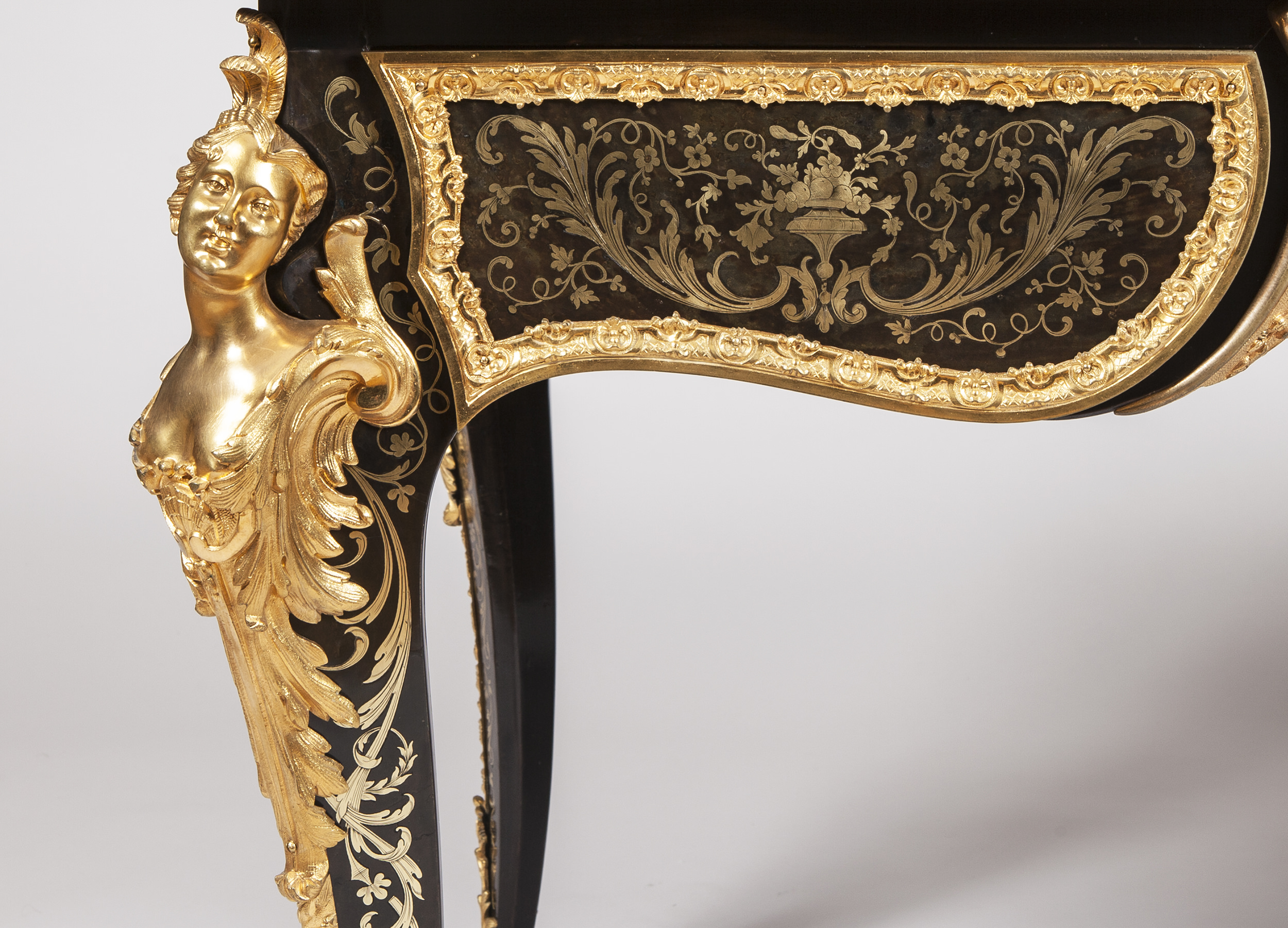
Figure 6. A Fine Bureau Plat in the Manner of André-Charles Boulle. Butchoff Antiques, London.
The inspiration for the Bacchus mount designs likely derive from a medal cabinet attributed to André Charles Boulle dated circa 1710-15 that is now in the J. Paul Getty Museum (84.DA.58) in Los Angeles, California.
by Rainier Schraepen
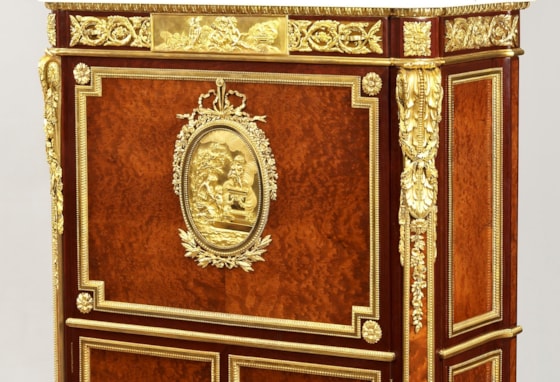
The Louis XVI style is one of the most prominent and most often imitated styles for furniture and interior decoration. The style, of course, is named after the French King Louis-Auguste who succeeded Louis XIV and Louis XV, both of whom are also associated with their own iconic styles of furniture and interior decoration.
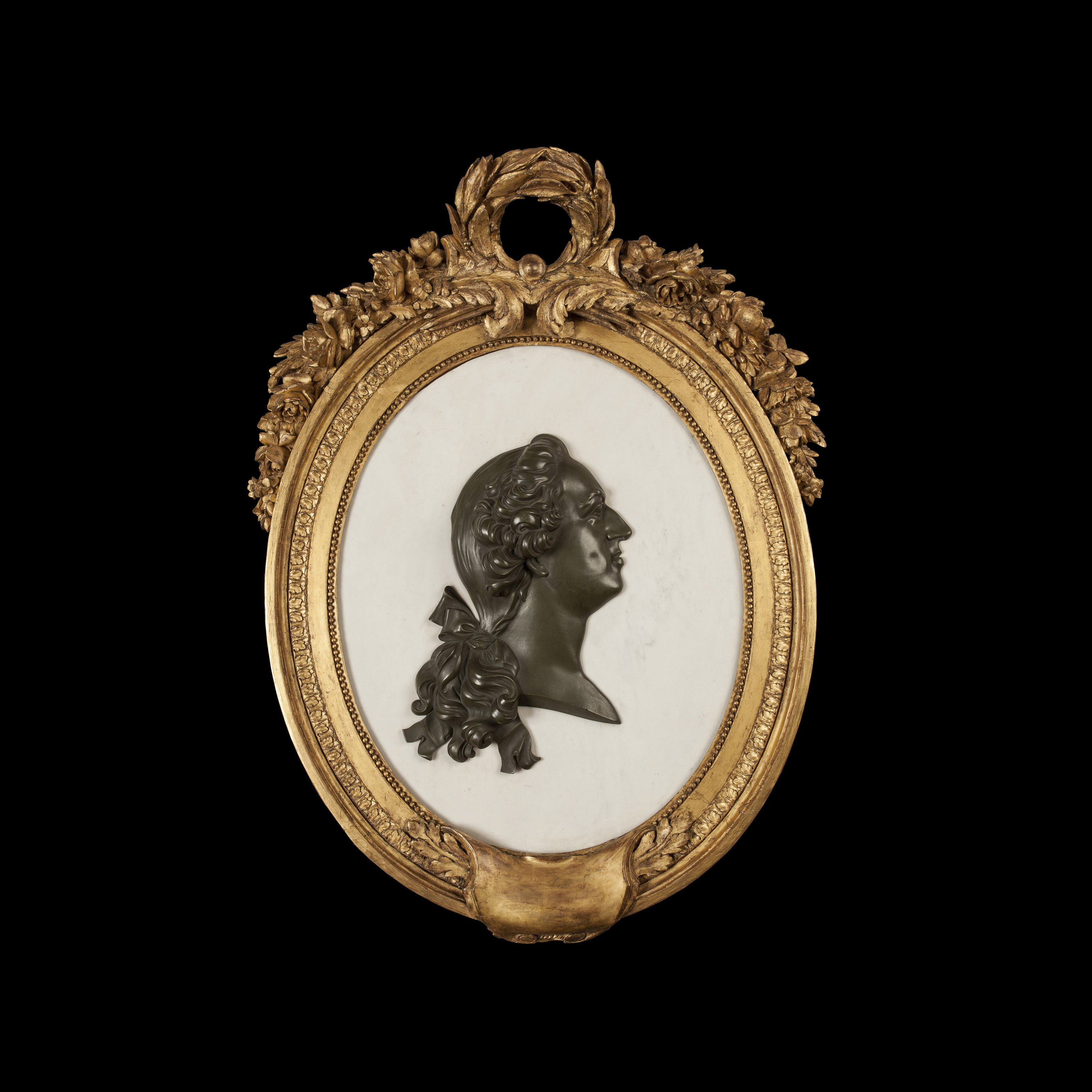
Figure 1. A Marble And Bronze Neo-Classical Portrait Of King Louis XVI. Previously with Butchoff Antiques, London.
The Louis XVI style dates from around 1760 to 1790, and follows the ideals of the English Neoclassical style with which it coincided: a return to the principles and aesthetics of Classical Antiquity. The style is characterized by an emphasis on straight lines and classically inspired decorative motifs.
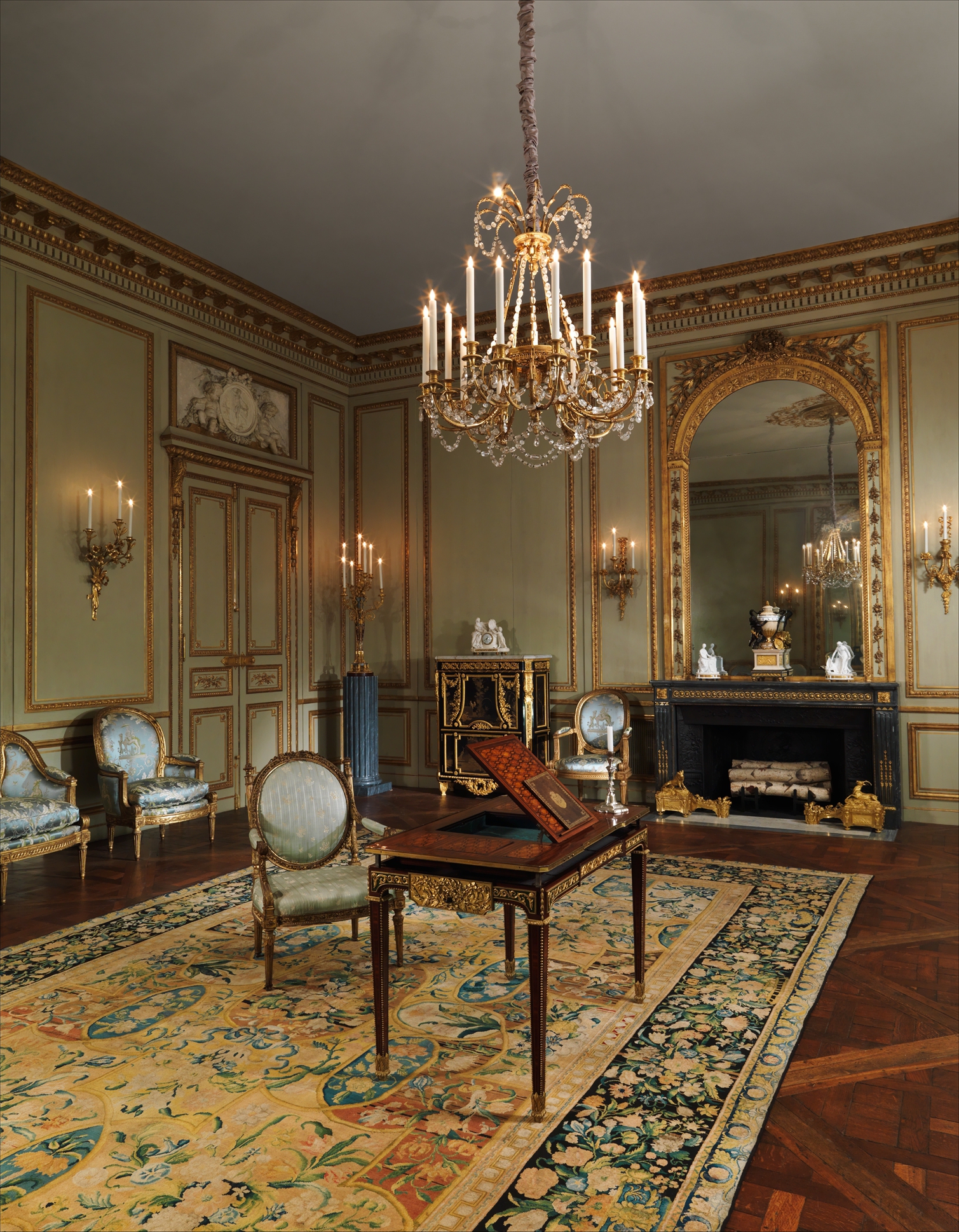
Figure 2. Grand Salon from the Hôtel de Tessé, Paris , ca. 1768–72.
Made by Nicolas Huyot. On view at The Met Fifth Avenue in Gallery 528.
There is a restraint in decoration compared to the previous Louis XV and Rococo periods, though it is no less opulent or lacking in gilded surfaces. Louis XVI furniture features less floral marquetry, instead showcasing solid veneers of wood framed by straight classically inspired gilt bronze mounts, as shown in this pair of ormolu-mounted plum pudding mahogany occasional tables by Paul Sormani (fig. 3).
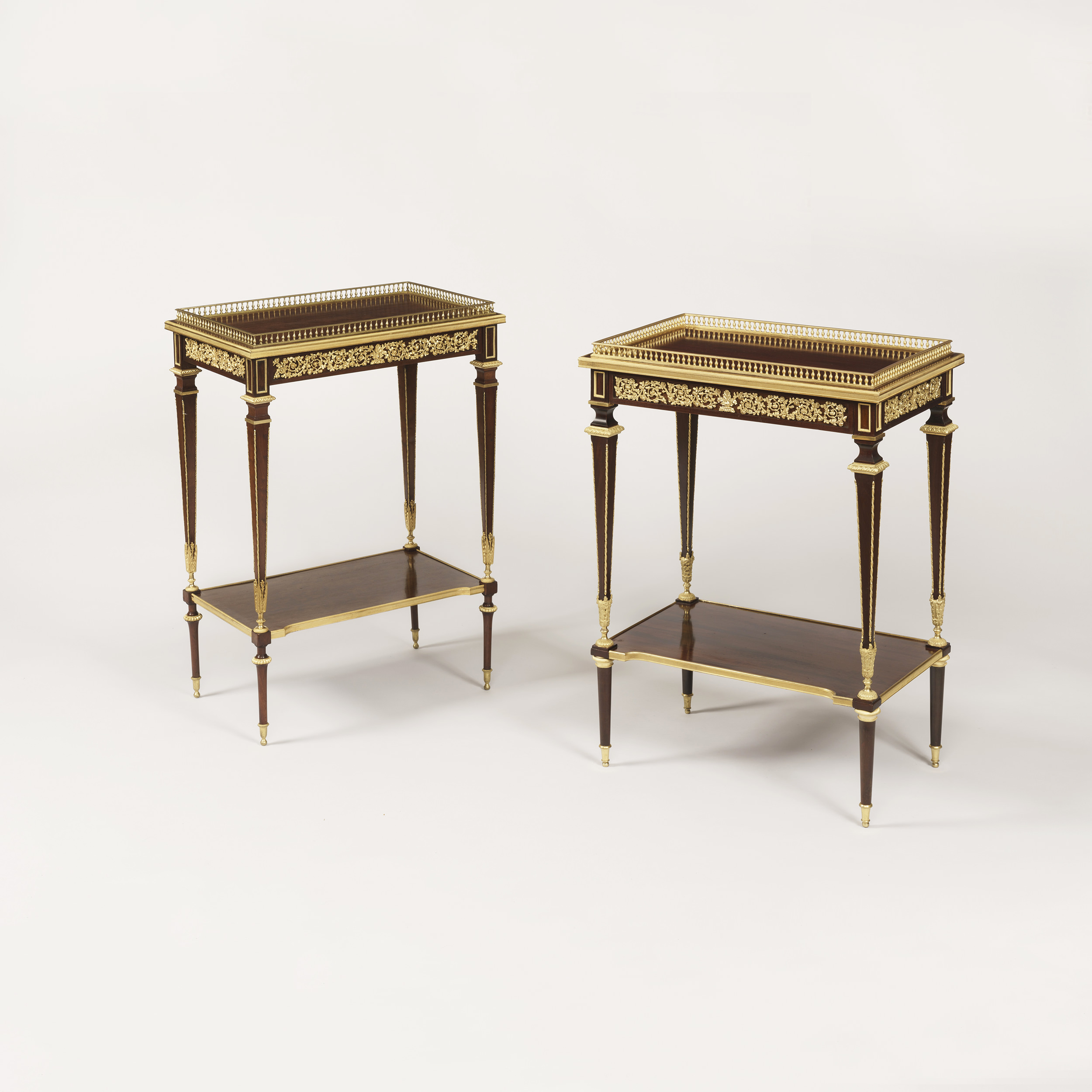
Figure 3. A Matched Pair of Side Tables in the Louis XVIth Manner, by Paul Sormani. Previously with Butchoff Antiques, London.
The burgeoning style was supported and encouraged by the Queen, Marie-Antoinette, who commissioned the decoration and furnishings for her many apartments at the royal residences of Versailles (fig. 4), Saint-Cloud, Petit Trianon, and Grand Trianon in this latest fashion.
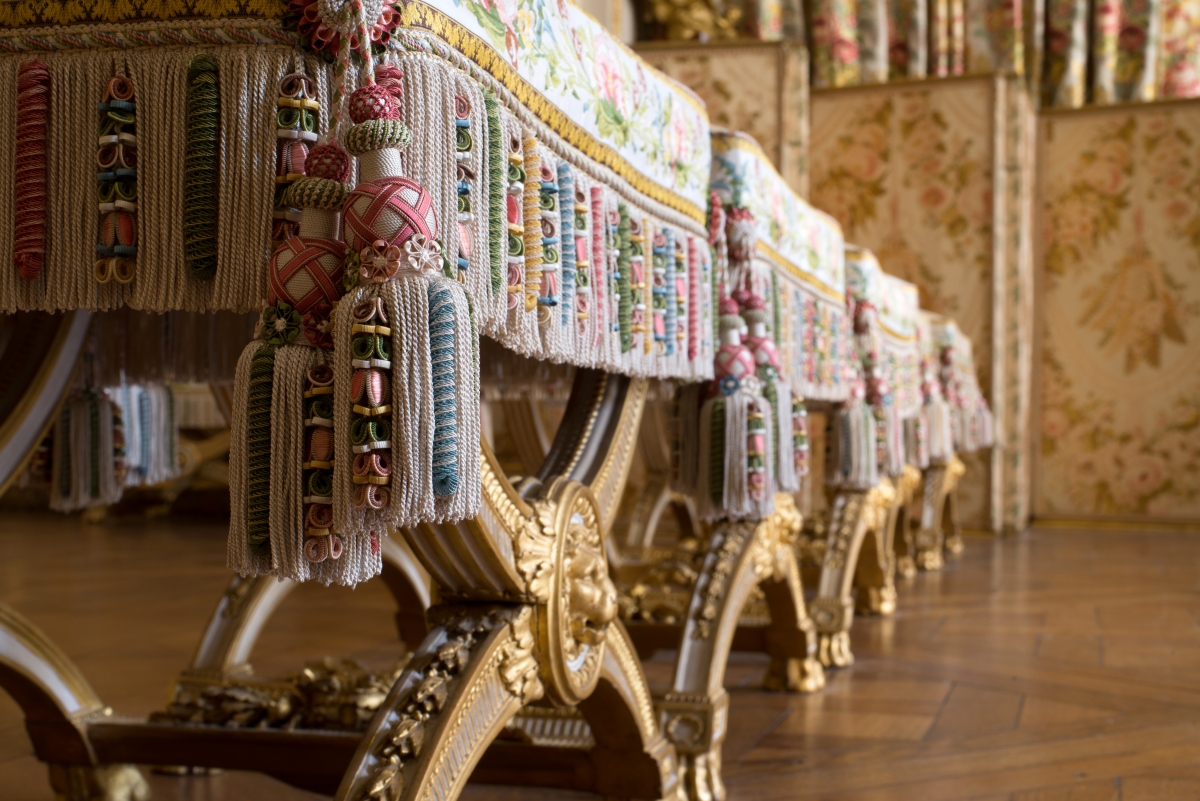
Figure 4. Louis XVI's Clothes Cabinet, Château de Versailles. Courtesy of Palace of Versailles.
The French Revolution (1789-1799) forced hundreds of millions worth of possessions and property of the Crown to be sold, making many of these pieces available on the art market. Many items were destroyed, while others have trickled down into today's galleries and museums throughout the world, such as the Louvre, the Metropolitan Museum of Art, the Victoria and Albert Musuem, and the Wallace Collection.
The importance, beauty, and rarity of these furnishings and objects d’art became increasingly widely recognised, as an international crowd of wealthy individuals and members of the aristocracy began to enthusiastically collect them. In the second-half of the nineteenth century, many faithful copies or similar models were commissioned for private collections, including many of the pieces pictured in this article.
Riesener supplied furniture of incredible luxury, demonstrating his ingenious sense of design and meticulous craftsmanship. Pieces included materials of imported Japanese lacquer with gilt, mother-of-pearl, and richly gilded ormolu mounts. A commode now at the Metropolitan Museum of Art was made by Riesener in 1783 (20.155.12) for Marie Antoinette’s Cabinet Interieur at Versailles, likely inspired this model by Henry Dasson (fig. 5), which is adorned with similarly finely cast gilt bronze mounts and imported black and gilt dusted Japanese panels.
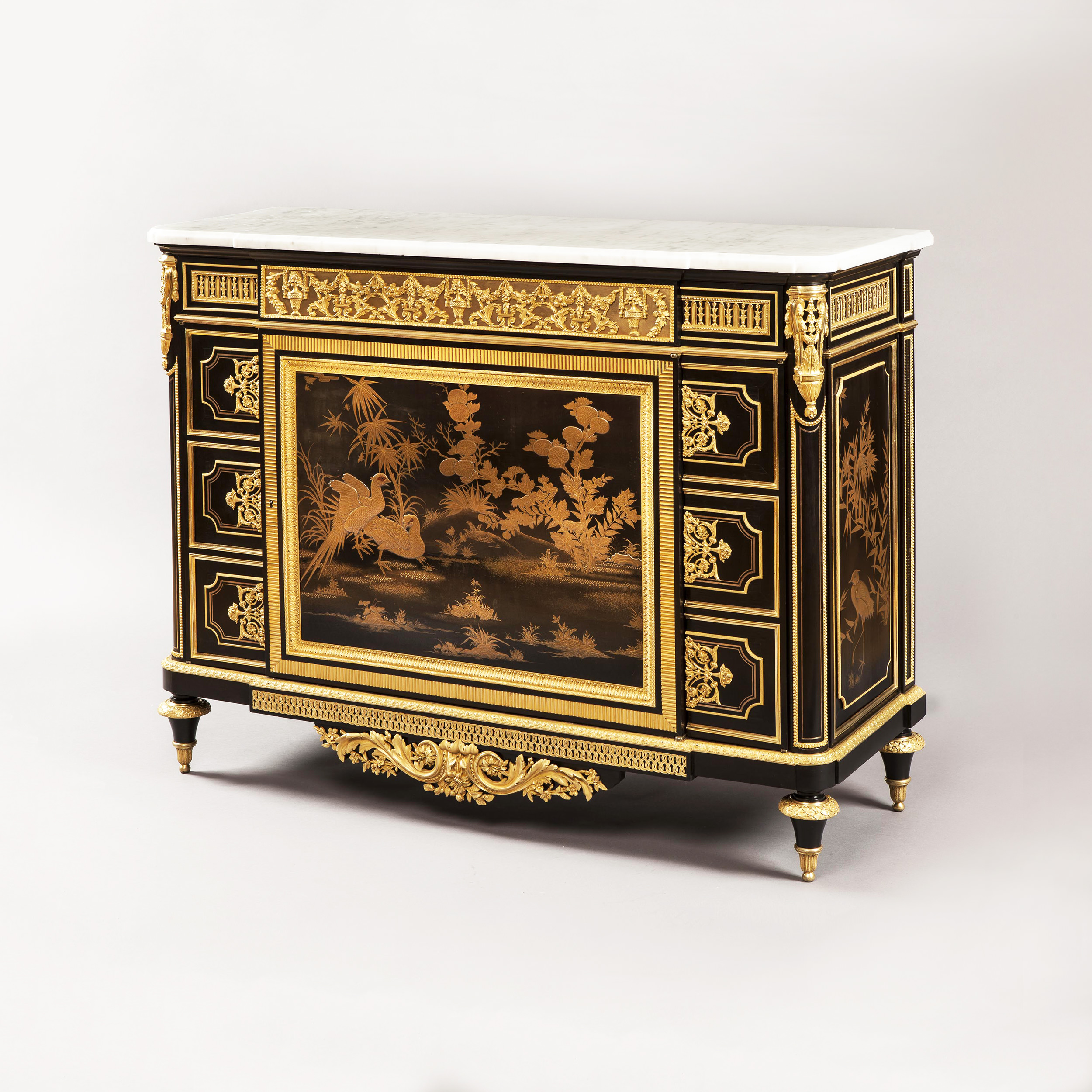
Figure 5. A Magnificent Louis XVI Style Commode, firmly attributed to Henry Dasson of Paris. Previously with Butchoff Antiques, London.
This bespoke English secretaire (fig. 6) was made after a model by Riesener, circa 1783, delivered for Marie-Antoinette’s private study at the château of Versailles, and which is now part of the Wallace Collection, London (F303). The central bronze mount on the drop-front depicts a classically inspired allegorical scene of ‘A Sacrifice of Love’, which was likely intended for the Queen’s amusement.

Figure 6. An Exceptionally Rare Secrétaire, after the J.H. Riesener example in The Wallace Collection. Previously with Butchoff Antiques, London.
Adam Weisweiler (1744–1820) is notable for his designs and selling his works works through merchants, such as Daguerre, who had royal ties, and fellow ébenistes like Riesener.
He is especially well known for his trademark-interlaced stretcher, demonstrated on this fine escritoire after a design by Weisweiler (fig. 7). The significance of this piece is that it is similar or based upon the design of a secretaire attributed to Weisweiler, circa 1790, that is believed to have been one of the last pieces delivered by Daguerre for Marie-Antoinette at Versailles before the Revolution, and is now in the collection of the Metropolitan Museum of Art (58.75.57).
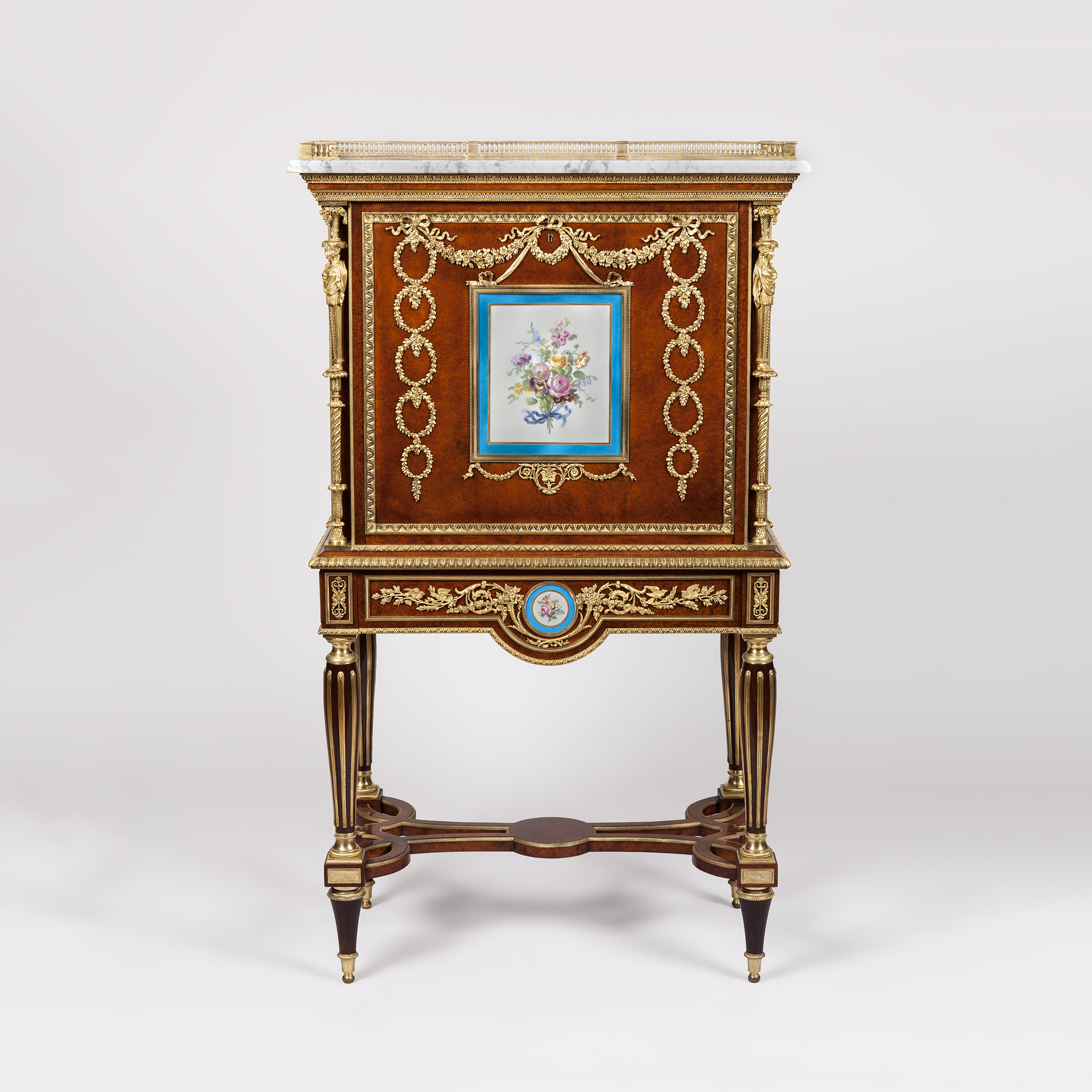
Figure 7. A Fine Escritoire, after a Design by Adam Weisweiler. Previously with Butchoff Antiques, London.
Giltwood chairs and settees were principal pieces of decoration and function in Louis XVI interiors, like this pair of giltwood armchairs (fig. 8). Chair frames were hand-carved out of wood, such as fruitwood, beech or walnut, and sometimes incorporated gesso, and adorned with decorative motifs of florals, foliates, garlands and classical figures. Upholstery was typically of hand-sewn silks in floral or classical designs, or damask or tapestry in colours of creams and pastel colours. Seating was either pushed against a wall or in the center of the room, likely accompanied by elegant and classically inspired side tables (fig. 9), conducive to conversation.
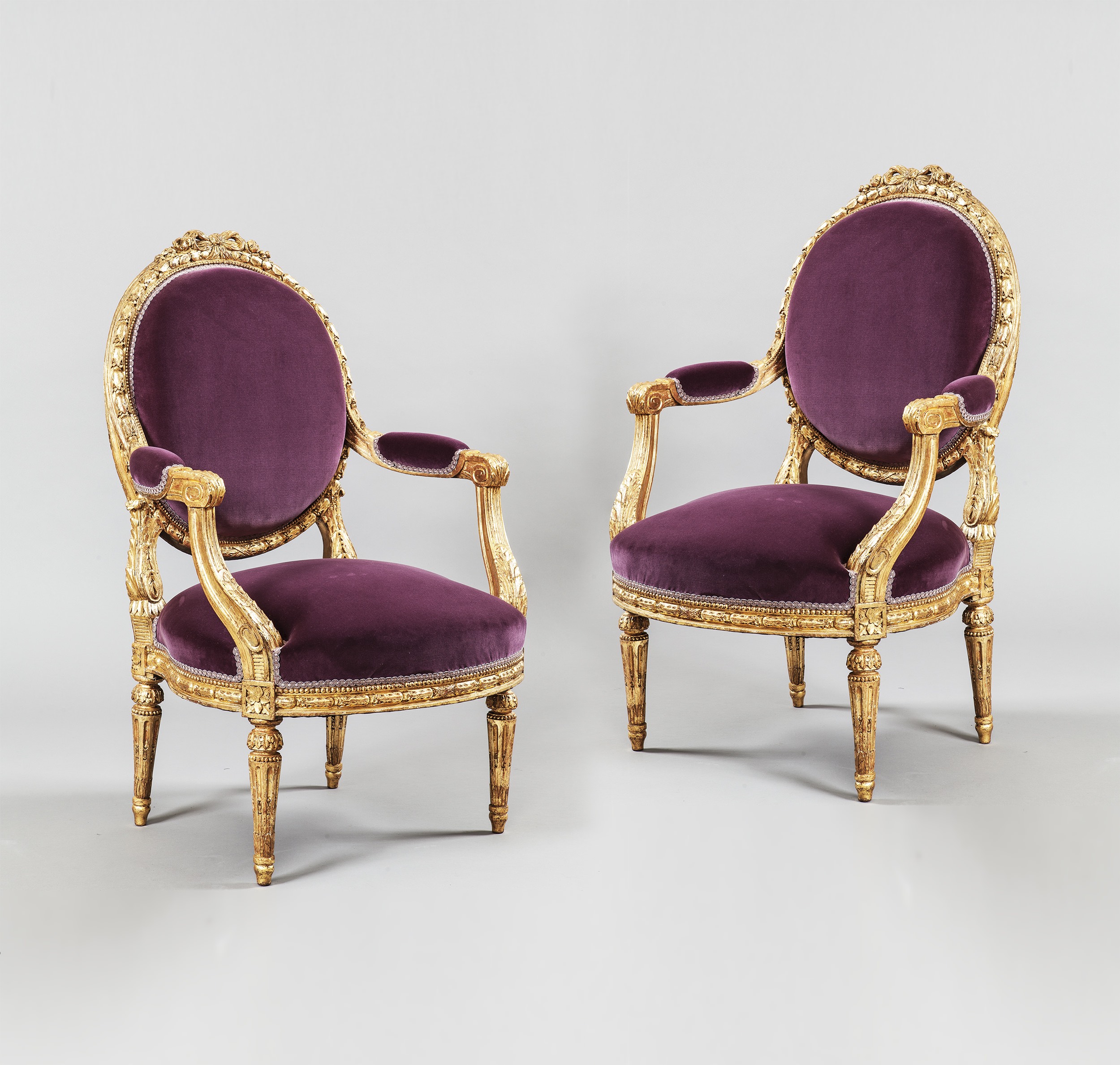
Figure 8. A Pair of Fauteuils in the Louis XVI Manner. Butchoff Antiques, London.
Although the reign of Louis XVI and Marie-Antoinette did not last, the associated style of decoration and furnishings of this period have been long regarded and admired, and artifacts of this prominent aesthetic will continue to be highly valued and collected.
![A Fine Guéridon in the Manner of Adam Weisweiler by Henry Dasson Constructed in Brocatelle d'Espagne marble and mahogany, with finely cast and chased gilt bronze mounts; the top tier of circular form supported on cluster legs of bamboo shape in the typical manner of Weisweiler. The columns joined by a concave-shaped lower tier supported by flared feet dressed with gilt bronze sabots. This celebrated model of gueridon exemplifies the height of taste at the end of the eighteenth century, it was given by Madame du Barry (1743-1793) to the duc de Brissac, delivered by Lignereux and Daguerre. Daguerre's inventory describes a table of corresponding description "Une petite table ronde forme de guéridon en racine de bois d'acajou poli sur trois pieds doubles en bronze doré façon de bambous avec entrejambe à tablettes et camé de porcelaine ornant la tablette supérieure prisée trois cent francs." (Segoura, Maurice, and Patricia Lemonnier. Weisweiler. Paris: Monelle Hayot, 1983.) Henry Dasson became renowned in the nineteenth century for his furniture based on historical designs, often incorporating stylistic elements created by Weisweiler (see Payne, Christopher. Paris Furniture: The Luxury Market of the 19th Century. [S.L.]: Editions D'art Monelle, 2018.). Christopher Payne maintains that "His [Dasson's] best work must be the combinations of elements from Riesener and Weisweiler in a modernised Louis XVI manner" (p. 315) as seen in the present gueridon. Signed and dated 'Henry Dasson. 1878.' French, 1878 Dimensions: H: 26 in / 65 cm | Dia: 15 in / 37 cm](https://images.butchoff.com/magallery/ButchoffMedia/BlogDescription/1922019T165331.26.jpg)
Figure 9. A Fine Guéridon in the Manner of Adam Weisweiler, by Henry Dasson. Previously with Butchoff Antiques, London.
by Rainier Schraepen