Vip access

 Favourites


















An Exceptional Marquetry Inlaid Cabinet Firmly Attributed to Collinson & Lock


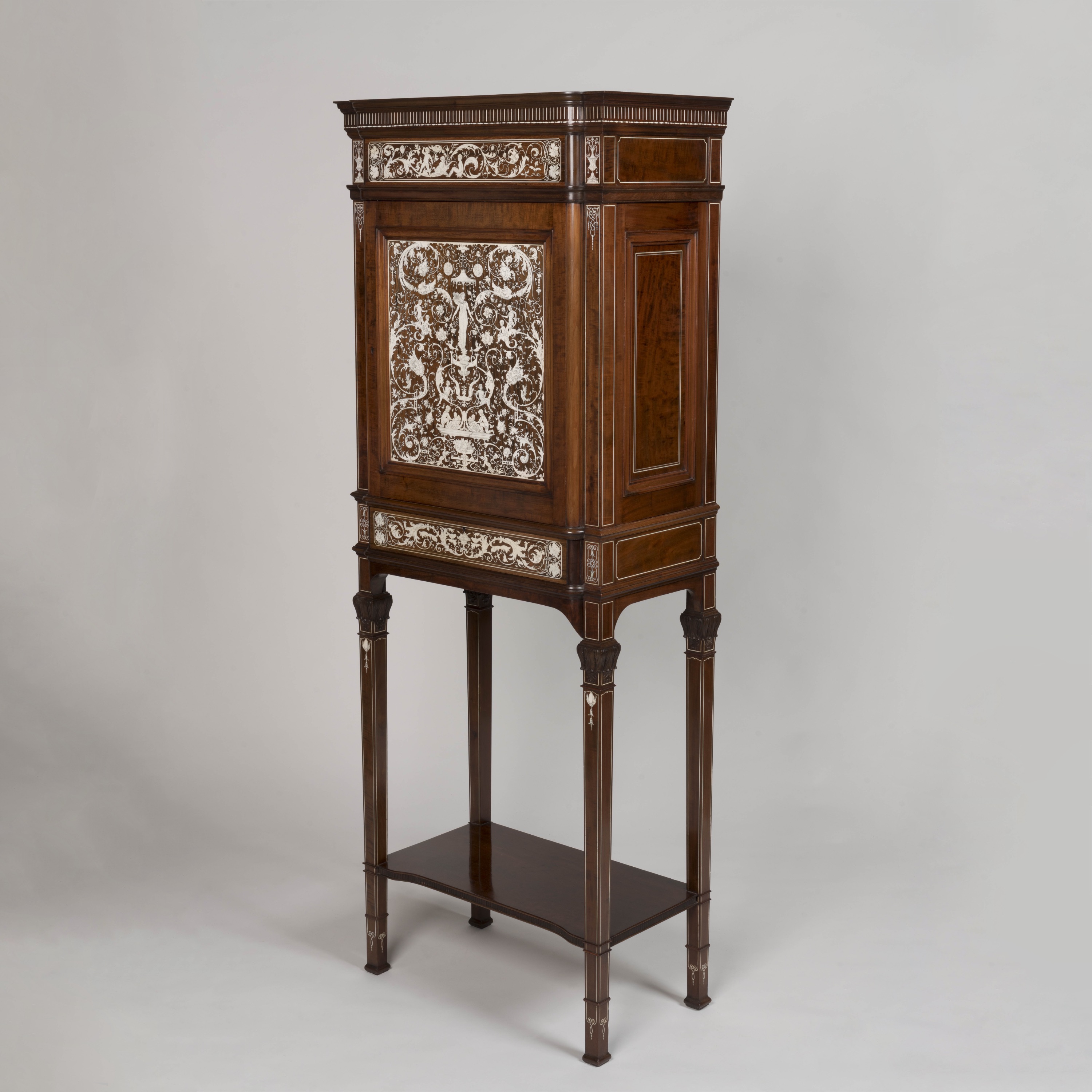


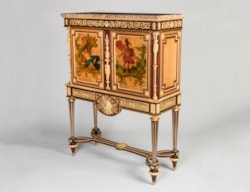
An Exceptional Marquetry Inlaid Cabinet Firmly Attributed to Collinson & Lock
Dimensions: H: 66 in / 167 cm | W: 25 in/ 64 cm | D: 15 in / 38 cm
PRICE: £25,000

An Exceptional Marquetry Inlaid Cabinet Firmly Attributed to Collinson & Lock
Constructed from mahogany and inlaid throughout with complex marquetry designs of engraved ivory on a rosewood ground, the cabinet-on-stand of slight breakfront with a faux dentil cornice, the panelled sides and corners with fine inlaid stringing, the central door with a large marquetry panel of symmetric Renaissance design consisting of scrolling arabesques populated by a robed female figure below a canopy, surrounded by birds of paradise, reclining figures, bunches of fruit, stylised masks, engraved medallions and a plethora of ornamental foliage, the hinged door opening to reveal a shelved interior, with a drawer in the apron and frieze entablature of conforming inlaid design, the ivory-strung square sectioned legs with carved capitals and joined by an undertier.
English, circa 1890
This item contains less than 10% ivory and has been registered with Defra.
Although the present cabinet is unsigned, it bears all the hallmarks of Collinson & Lock's furniture output at the height of their popularity during the 1880s and 1890s. Starting from 1885, the firm employed Stephen Webb who designed the recognisable and distinctive Renaissance revival marquetry designs. The collaboration continued until Collinson & Lock was absorbed by Waring & Gillows in 1897, for who Webb continued working in some capacity. Several related cabinets incorporating similar marquetry, previously with Butchoff, stamped Collinson & Lock. Another cabinet also designed by Webb and stamped Collinson & Lock, in the permanent collection of the Victoria & Albert Museum (W.20:1, 2-1971).
Collinson & Lock (1870-1897)
Collinson & Lock was a prominent London furniture-making firm that operated from 1870 to 1897. Founded by Francis Collinson and George Lock, former employees of Jackson and Graham, the partnership began by acquiring Herring and Company on Fleet Street. The firm quickly established itself as a leader in the Art Furniture movement, producing high-quality pieces in styles ranging from Anglo-Japanese to Renaissance revival, Old English, and Gothic.
The company collaborated with leading designers including E.W. Godwin, T.E. Collcutt, Bruce Talbert, and Stephen Webb, who became their principal in-house designer around 1885. Their 1871 Artistic Furniture catalogue helped popularize simpler, more practical designs across Britain. They exhibited successfully at major international exhibitions in Vienna, Philadelphia, Paris, and Chicago, winning numerous medals.
In 1885, Collinson & Lock merged with their former employers Jackson and Graham, moving to Oxford Street. The firm served distinguished clients including royalty and the Rothschild family, and completed significant commercial projects like the Savoy Theatre and Hotel. After George Lock withdrew his investment in 1896, the company went into liquidation and was absorbed by Waring and Gillow in 1897, ending nearly three decades of influential design work that helped shape Victorian decorative arts.
Comparative Literature:
Edwards, Clive. Collinson & Lock: Art Furnishers Interior Decorators and Designers 1870-1900. Matador, 2022, discussing and illustrating related cabinets.
Payne, Christopher. British Furniture 1820 to 1920 : The Luxury Market. ACC Art Books 2023, pp. 378-380 (illus. figs. 7.86- 7.90), for related cabinets by Collinson & Lock.
You may also like


A Pair of Porcelain-Mounted Pier Cabinets
A Pair of Marquetry Display Cabinets By Edmund Kahn
A Matched Pair of Drawing Room Cabinet of the Aesthetic Period attributed to Jackson & Graham
A Petite Chinoiserie Lacquered Display Case Attributed to Hille & Co
A Coromandel and Satinwood Folio Stand Firmly attributed to Jackson & Graham

A Regency Period Metamorphic Bureau Cabinet By Gillows
Recently viewed