Vip access

 Favourites



















January 2026
Rococo Furniture: Curves, Grandeur and the Art of Excess

The Rococo: Curves, Grandeur and the Art of Excess
The word "rococo" was never used by the people who created it. In the salons and ateliers of 1730s Paris, the style was known simply as the "gout moderne", the modern taste, a name that captures something essential about its spirit. It was new, it was fashionable, and it was deliberately opposed to everything that had come before. The term "rococo" arrived later, coined by neoclassical critics as a derisive conflation of "rocaille", the shell-encrusted rockwork of aristocratic grottoes, and "barocco", the Italian word for Baroque. What began as an insult became the name of one of the most seductive decorative movements in European history.
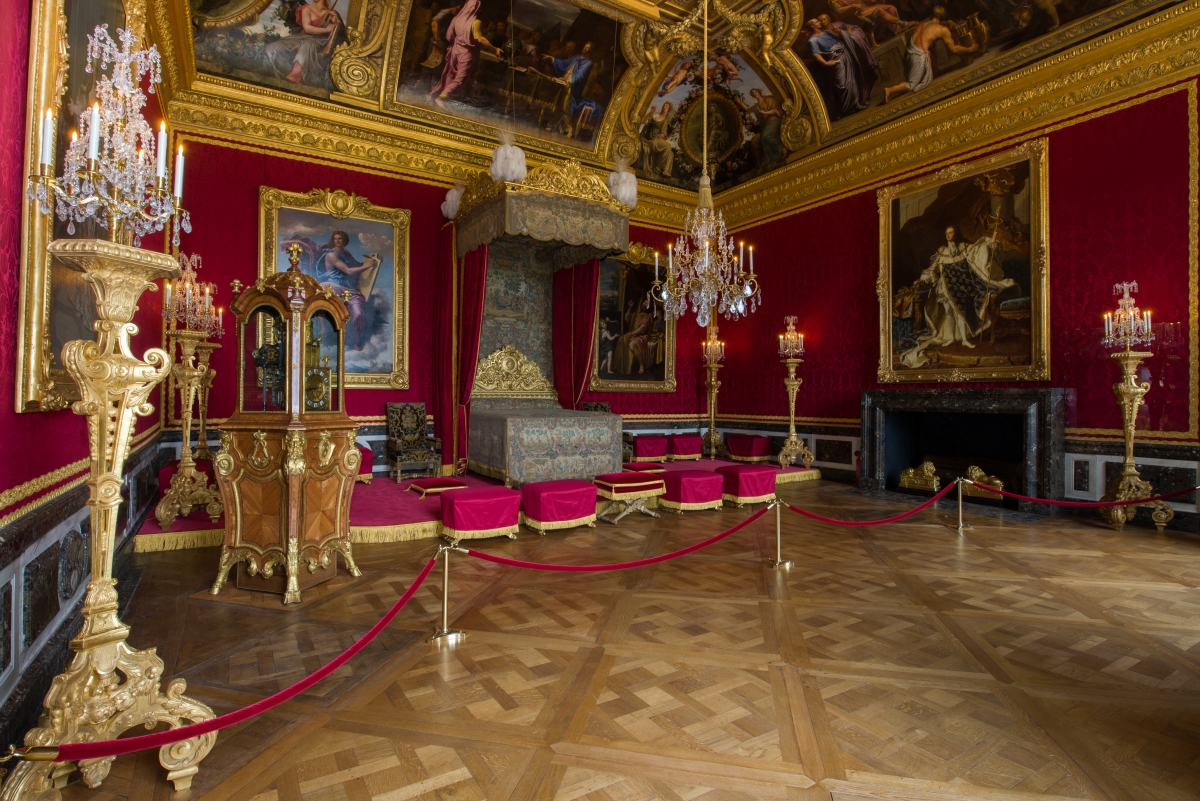
The grand interiors at Versailles epitomised the Louis XIV style, favored by the great Sun King. The rococo was a deliberate reaction to these established styles.
Rococo furniture emerged not at the royal court but in the private townhouses of Paris. When Philippe, duc d'Orleans, moved the seat of power from Versailles to the Palais Royal during his regency (1715-1723), the aristocracy followed. The rigid ceremony of Louis XIV's court gave way to a more intimate social life, and the new Parisian residences demanded furniture to match: lighter, more personal, and suited to the smaller salons and boudoirs where daily life was actually lived. From this migration grew the first decorative style shaped by private taste rather than royal decree, and its influence would sweep across the whole of Europe within a generation.
The French Court and the Influence of Madame de Pompadour
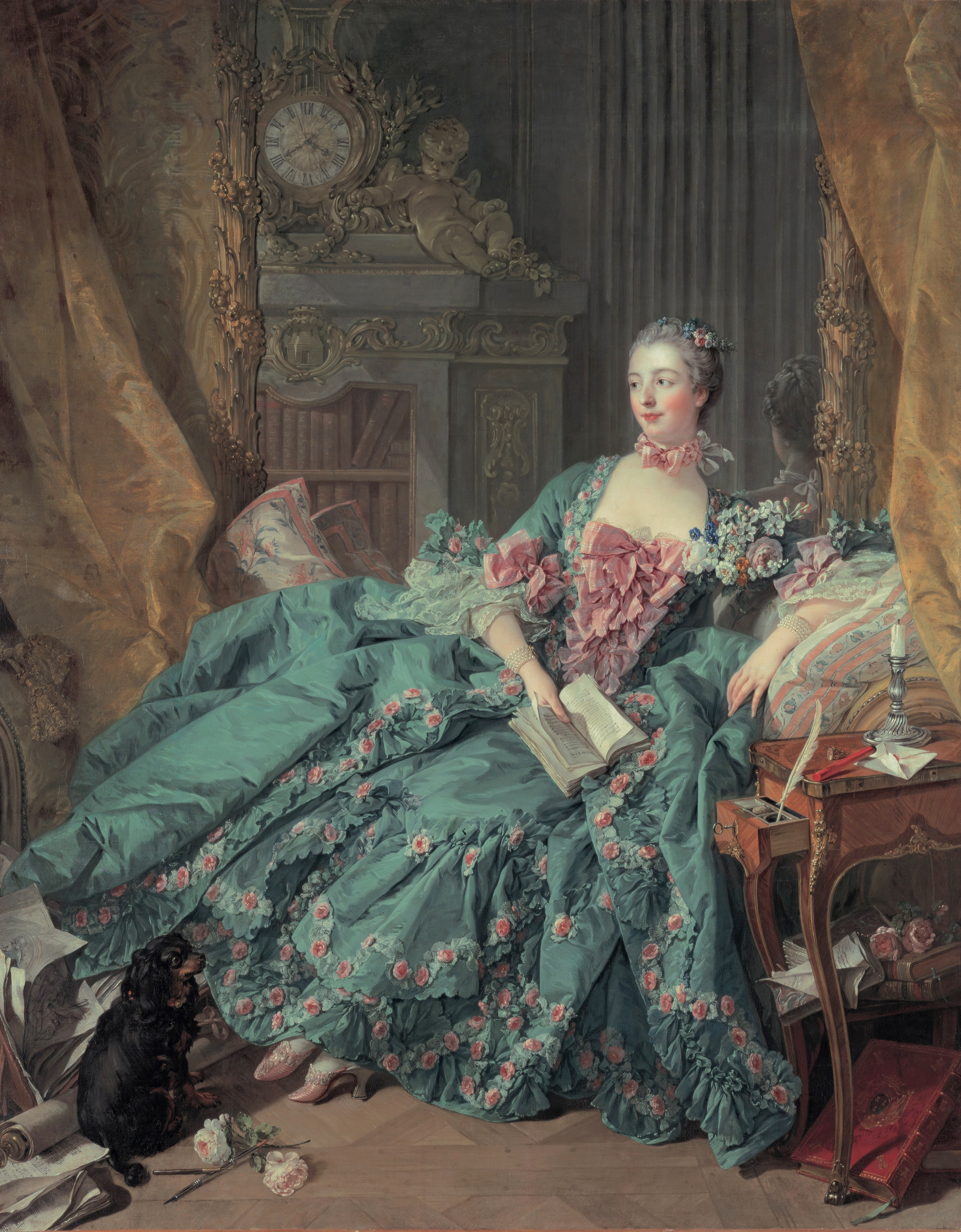
The new face of Rococo: Madame de Pompadour, painted here by François Boucher in 1756.
The popularity of the Rococo owed an enormous amount to two figures: Louis XV himself, and his celebrated mistress, Madame de Pompadour. She was a knowledgeable patron of the arts and an important client of the marchands merciers, the luxury furniture dealers who served as arbiters of fashionable taste. Her ability to create an atmosphere of intimacy in which the king could relax shaped the fashion for interiors that were at once luxurious and genuinely comfortable, a combination that had rarely been achieved before.
The transformation was physical as well as social. At Versailles, Fontainebleau, and Compiegne, small intimate rooms were planned, decorated, and furnished to satisfy the contemporary taste for informality. Around these royal palaces, smaller chateaux proliferated: Choisy, Louveciennes, and Bellevue, which Pompadour furnished alongside the Chateau de Champs and residences at La Celle and Aunay. Fashion demanded different suites of upholstered furniture to suit the seasons of the year, and entirely new types of furniture, reduced in scale, were needed for the salons, boudoirs, and bedrooms where daily life was actually spent. Chairs were still arranged around the walls of a room in formal array, but lighter, more mobile chairs known as chaises courantes could now be drawn into the room to encourage conversation.
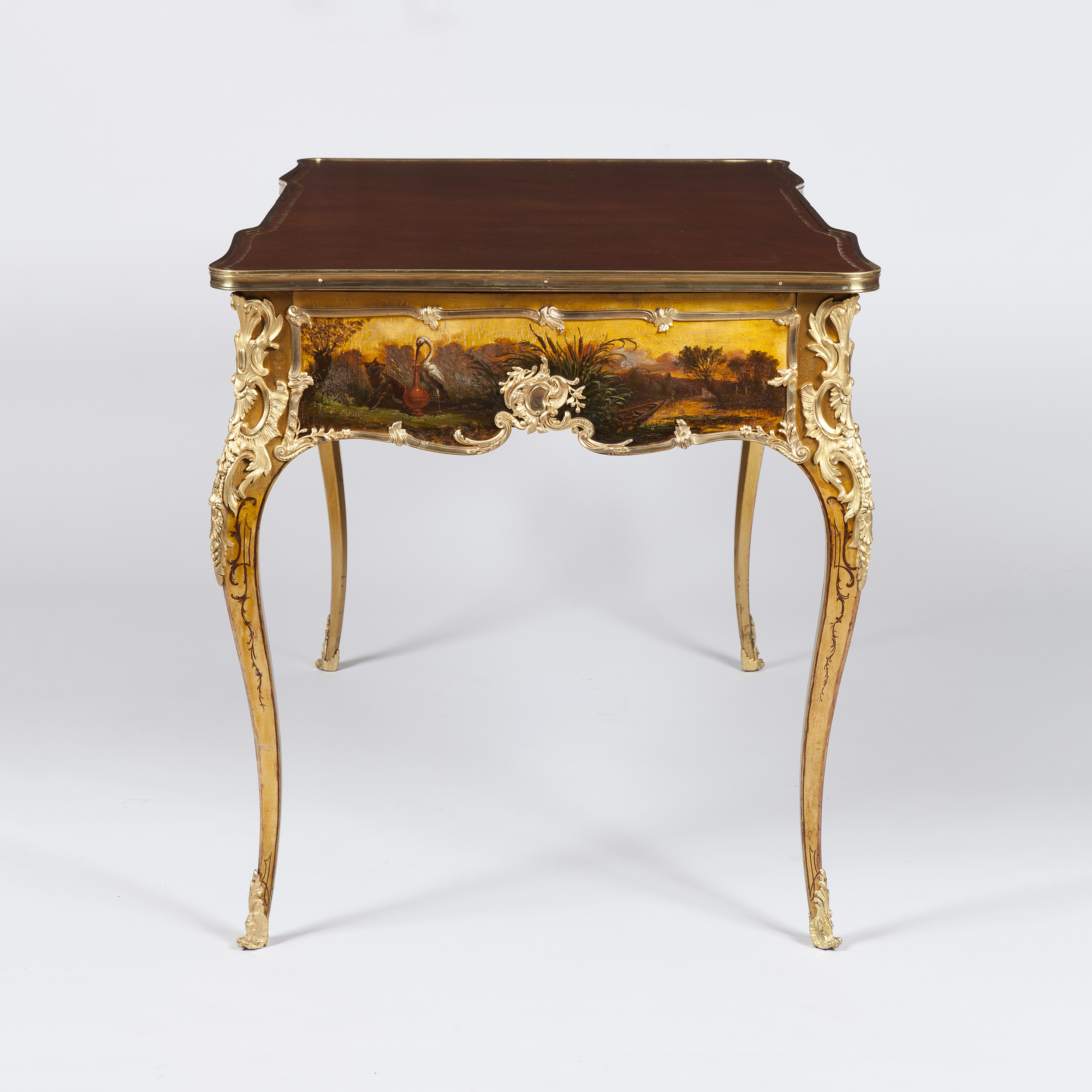
This Louis XV style bureau plat, made in the 19th century by Henri Picard, is decorated with Vernis Martin, made fashionable during the Rococo period. From Butchoff Antiques.
Pompadour's patronage extended to decorative techniques such as vernis Martin, the celebrated French lacquer named after the Martin brothers who held a royal patent. She was portrayed by the Swedish painter Alexandre Roslin seated before a "coquillier," a small cabinet designed to house a collection of shells, reflecting the fashionable taste for natural curiosities that permeated the period.
The marchands merciers were central to this world. They were men of stature, in close touch with purchasers whose taste they understood and whose appetite for novelty they fostered. They influenced the ebenistes through the orders they placed and coordinated the work of craftsmen belonging to different guilds. Leading figures such as Lazare Duvaux, Simon-Philippe Poirier, and Dominique Daguerre wielded considerable power in matters of taste, acting as intermediaries between patron and maker.
The Defining Characteristics of Rococo Furniture
The Rococo, for all its complexity, is easy to read. It can be characterised, as Christopher Payne has observed, as having "no straight lines." At its height, the style's proponents advocated asymmetry, though in France the later manifestations were more ordered, with subtle rather than full-blown asymmetry retaining harmonious proportions. Naturalistic motifs were adapted into abstract forms: C-scrolls, S-scrolls, stylised acanthus leaves, scallop shells, and carved ornament evoking, in its restless energy, the continuous movement of waves.
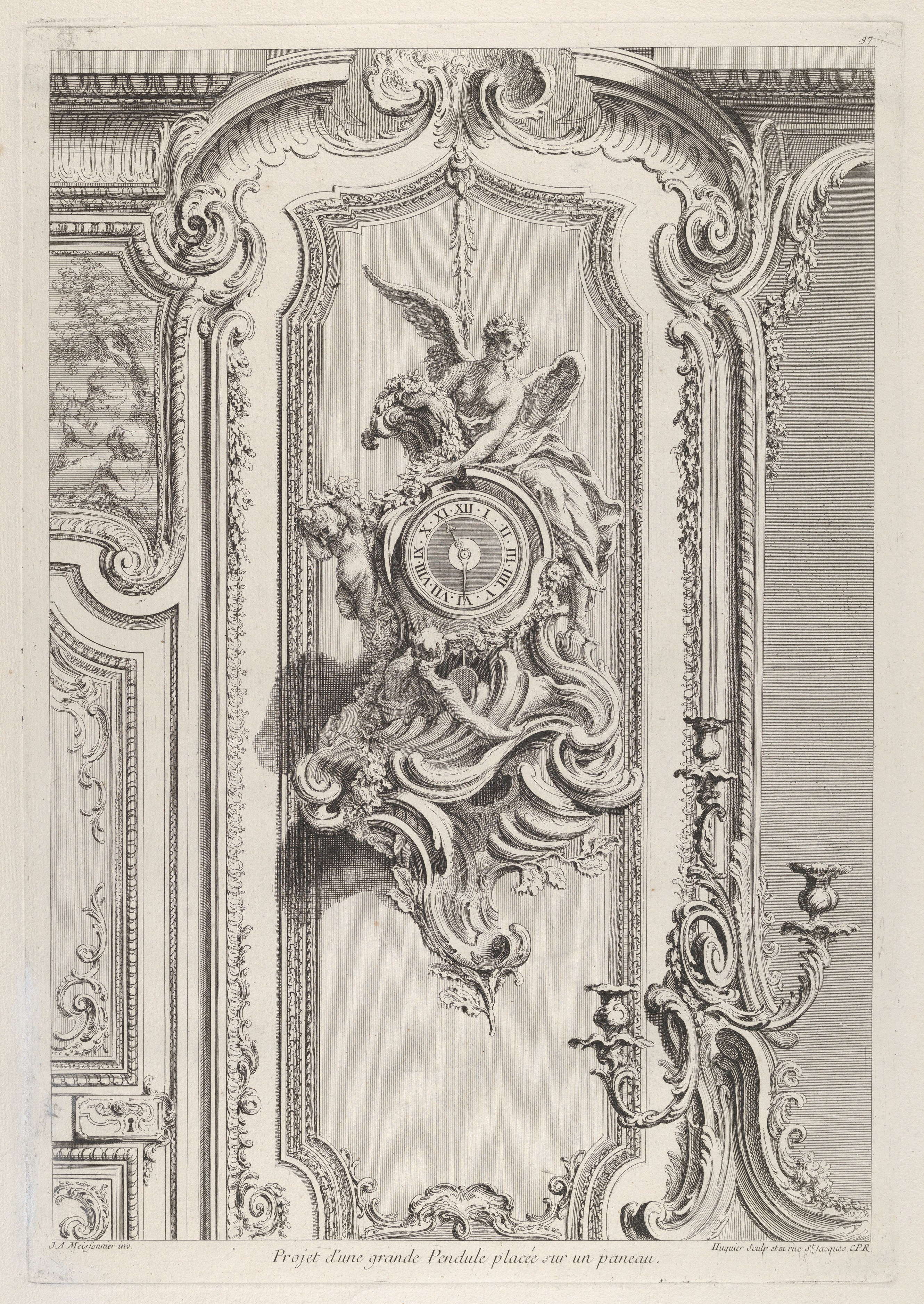
Exuberant asymmetrical Rococo was typical of Meissonnier's inventive designs, disseminated by his published engravings during the first half of the eighteenth century.
Two designers defined the poles of Rococo ornament. Juste-Aurele Meissonnier (1695-1750), of Piedmontese origin, introduced swirling, asymmetrical forms that depended upon the subtle play of curves to achieve their provocative charm. Nicolas Pineau (1684-1754), by contrast, reflected the true character of French rocaille: supple and graceful lines, with ornament of shells, flowers, and palms clearly defined on curving surfaces. Pineau's designs were engraved by Mariette and widely used in mid-eighteenth century workshops, shaping the visual language of a generation of furniture makers.
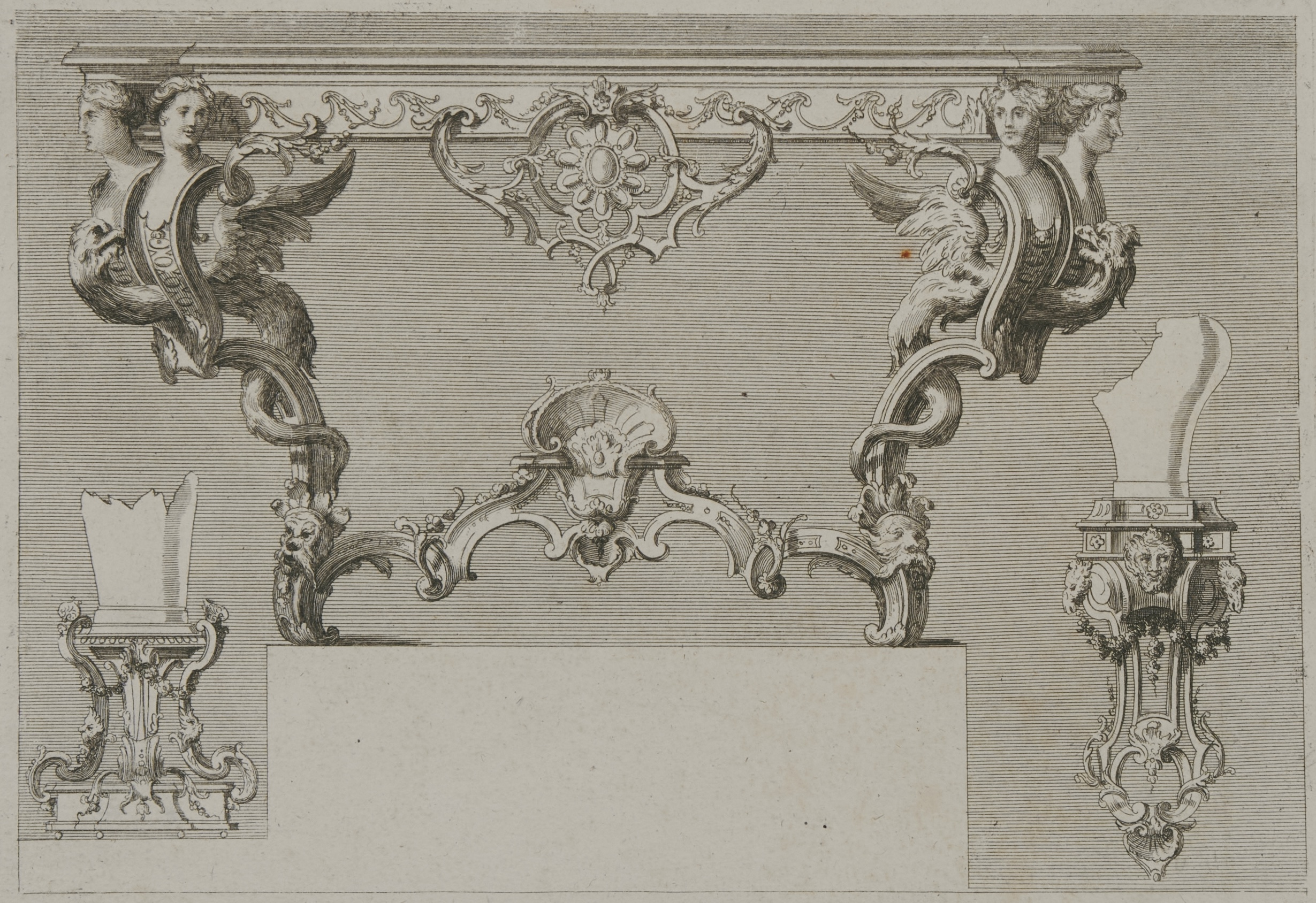
Pineau's graceful designs, while less inventive than Meissonnier's, were more readily translated into real-world objects and interiors.
Cabinet pieces relied on elongated, supple curves with legs of cabriole type, a form whose name derives from the French for a leap in dance. The cabriole leg was extraordinarily labour-intensive to produce: a single veneered example might take two days to shape and another two to veneer. Marquetry and exotic wood veneers in kingwood, rosewood, and tulipwood threw into relief the sparkling gilt-bronze mounts, with handles composed of curling foliage, cartouches, and volutes.
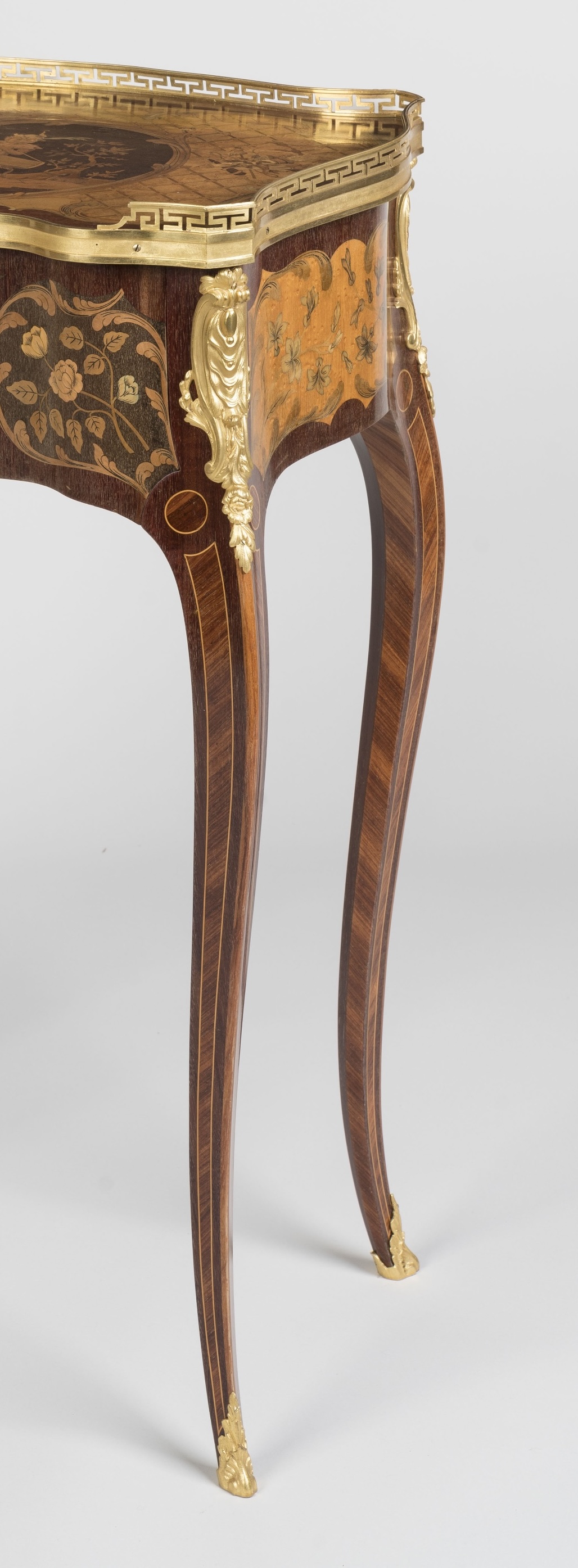
Cabriole legs, ormolu mounts, exotic woods and marquetry all come together in this Rococo style table, made by Beurdeley of Paris during the nineteenth century. From Butchoff Antiques.
The bombe commode, with its swelling convex form, became one of the most fashionable furniture types between roughly 1730 and 1760, enriched with elaborate ormolu and often serving as the centrepiece of a room. Seat furniture evolved in parallel. The bergere, with its closed upholstered sides and thick cushion, the duchesse brisee (a day-bed in two or three parts), and deep armchairs known as veilleuses were all developed to serve the new informality. Even the colours of Versailles softened during this period, with rooms painted in couleur d'eau, petit vert, jonquille, and gris de perle rather than the heavy gilding of the previous reign.
The Parisian Workshops and Guild System
Every piece of Rococo furniture was a collective work. The guild system rigidly separated the crafts involved in its production. The menuisier, or joiner, worked the solid wood: cutting, shaping, carving, and joining. The carver contributed decoration in relief, the painter and gilder added colour, and the upholsterer furnished seats and beds. Rivalries between these guilds were intense; according to Andre Roubo, a practising menuisier whose treatise L'Art du Menuisier appeared between 1769 and 1775, joiners frequently carved small decorative motifs themselves rather than cede the work to a specialist.
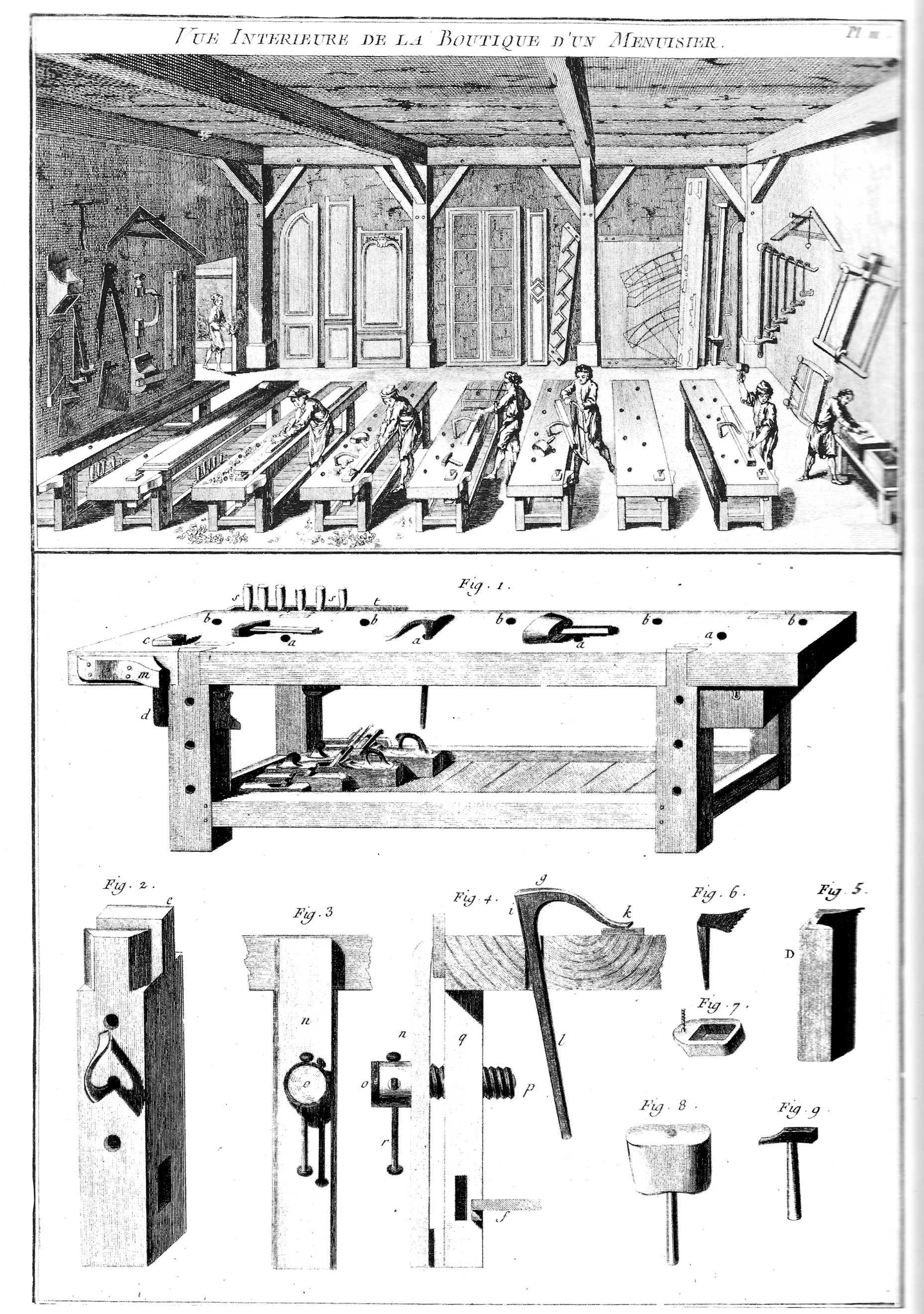
Plate 11 from Roubo's treatise on cabinetmaking.
The art of veneering added another specialisation. The craftsmen who practised it were known as ebenistes, a term derived from "menuisiers en ebene," and in 1743 the guild formally recognised their status, becoming the Corporation des Menuisiers-Ebenistes. From that year, every piece was required to bear the maker's stamp. Workshops were inspected four times a year, and substandard furniture was confiscated. The stamps were usually hidden, which suited the marchands merciers, who preferred their clients not to approach the makers directly. Royal furniture alone was exempt, as those craftsmen served the king outside the guild's control.
Gilt-bronze mounts added yet another specialist: the fondeur-ciseleur, or bronze caster and chaser. The cost of modelling sculptural mounts was extraordinary, often three to five times greater than the cabinet work and veneering combined. Master models were jealously guarded and handed down through generations.
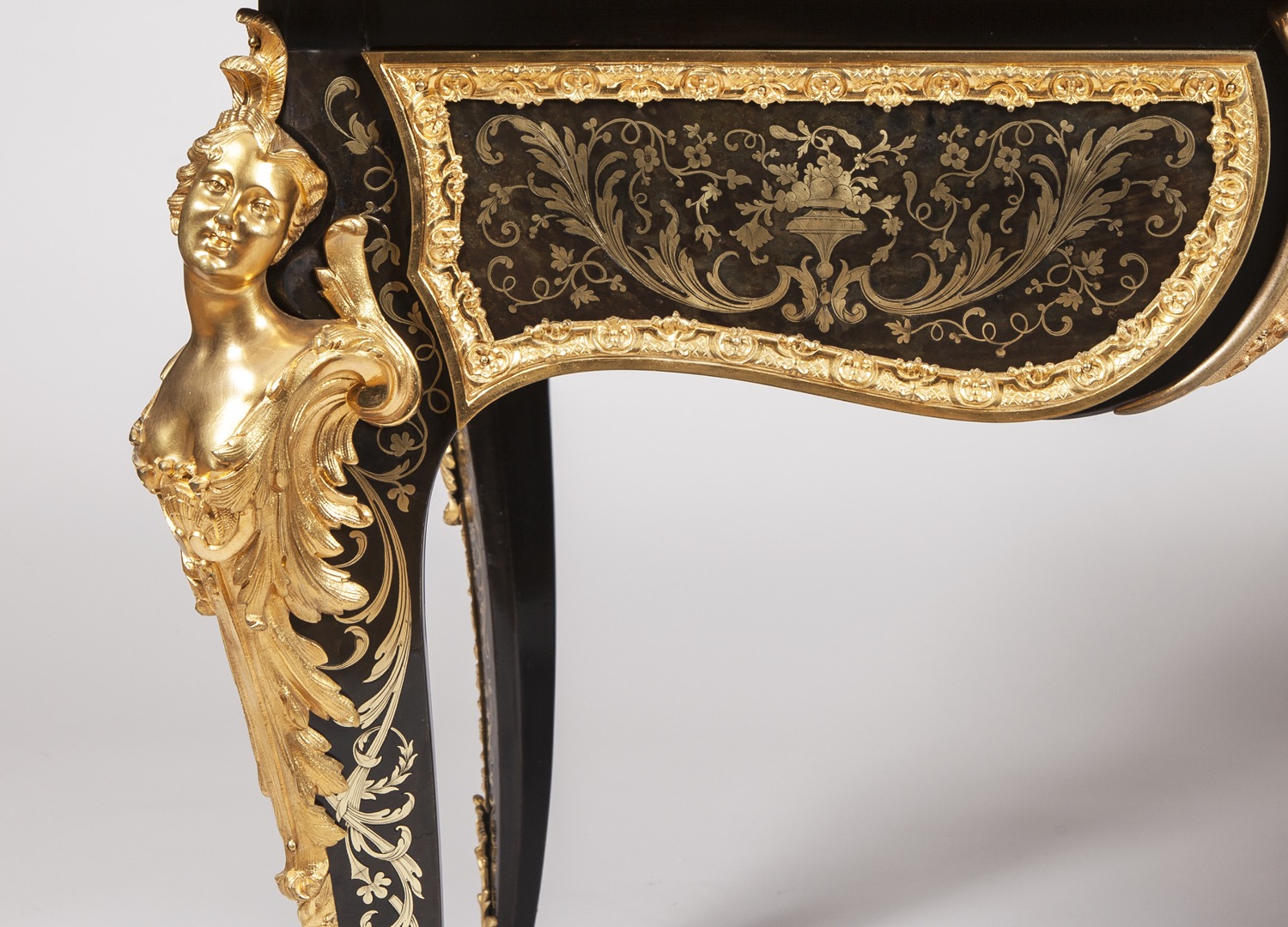
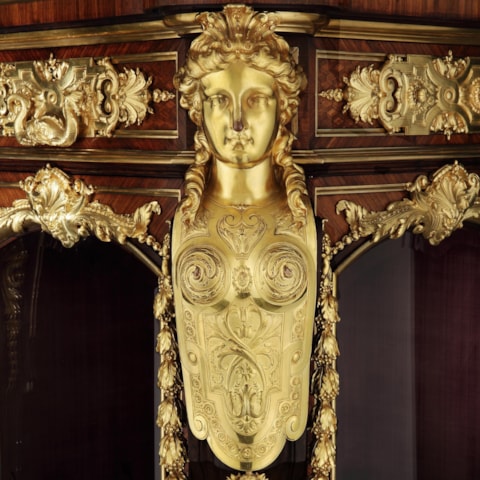
Figural espagnolettes, such as those seen on the bureau plat, were cast by makers such as Charles Cressent and mounted on his own furniture, breaking earlier conventions. Image: Butchoff Antiques.
The makers themselves were remarkable. Charles Cressent, who worked for the Regent and wealthy financiers from 1719 to 1757, broke convention by casting his own bronze mounts, producing the characteristic espagnolettes and faun masks that defined early Rococo furniture. Bernard II Vanrisamburgh, known by his guild stamp BVRB, was among the finest ebenistes of his generation, particularly skilled in working oriental lacquer to fit the complex curves of bombe commodes. Jean-Francois Oeben, named ebeniste du roi in 1754, combined mechanical ingenuity with superb craftsmanship, devising furniture with concealed drawers released by hidden mechanisms. Many of these masters were immigrants, drawn to Paris by the exceptional demand for furniture: Flemings such as Vanrisamburgh and Roger Vandercruse, and Germans including Oeben and his successor Jean-Henri Riesener, a tradition of Parisian craftsmanship that later masters such as François Linke would sustain into the twentieth century.
Rococo Across Europe
The Rococo was born in Paris, but its influence radiated across the Continent, adapted everywhere to local traditions and temperaments. In England, the development was gradual. The earliest Rococo carved mahogany chairs, inspired by engravings published in London in 1736 by the Italian Gaetano Brunetti, are curiously heavy, as though the carver were more accustomed to weighty Baroque forms than the curvaceous elegance of French example.
It was Matthias Lock who first interpreted French rocaille with genuine freedom. His sets of designs for mirrors and tables, published in 1744 and 1746, included C-scrolls, flowers, and masks, with birds, winged dragons, and leaping hounds entwined in frothy, wave-like ornaments. Lock's workshop was in Tottenham Court Road, and his designs provided a challenge and a model for English carvers. Thomas Chippendale, who was probably in close touch with Lock, published his celebrated Gentleman and Cabinet-Maker's Director, the first book solely devoted to furniture in England. The Director was enormously influential, offering patrons a choice and craftsmen a model that could be varied at will. Its designs for chairs with pierced and carved splats, cabriole legs, and serpentine commodes drew freely on the Rococo repertoire.
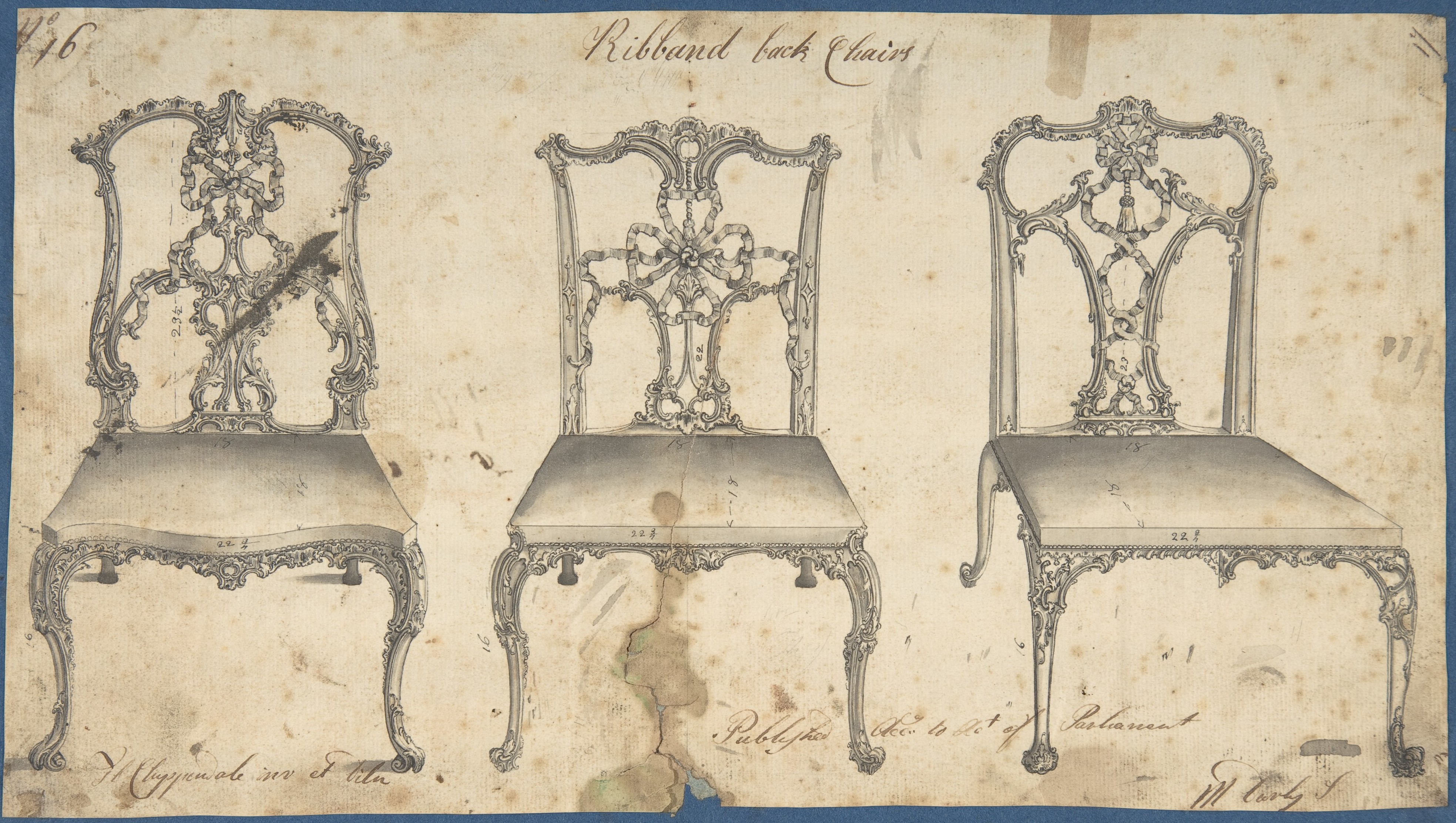
Chippendale's so-called Ribband-back chairs exemplify the taste for French rococo styles in English furniture design.
In Germany, the style achieved a different character entirely. Rococo interiors in scintillating white and gold, or blue and silver, adorned palatial residences well before mid-century. At Bayreuth, court sculptors produced carved console tables of remarkable exuberance, with bold, fluid carving and flame-like motifs. Frederick the Great's palaces at Potsdam featured stucco decorations that rivalled even Bavaria and, as Helena Hayward observed, quite overshadowed their French prototypes. It was in one such room that Bach played for the king on a theme Frederick himself had composed.
Elsewhere, the Rococo took on still other forms. In Italy, it merged with existing Baroque traditions. In Spain, japanned chairs were decorated with rocaille ornaments and parcel-gilded, bridging the gap between solid tradition and French fashion. In Scandinavia, French motifs were carved in a characteristically naive manner, often rather large, picked out with gilding in a distinctively Danish style.
The Decline and the Turn to Neoclassicism
The Rococo was already under attack before mid-century. In 1754, the engraver Nicolas Cochin published a plea in the Mercure for a return to "the way of good taste of the preceding century." It was Cochin, this arch-enemy of the Rococo, who had been chosen to accompany Madame de Pompadour's brother, the future Marquis de Marigny, on his formative travels to Italy between 1749 and 1751, a journey that would help plant the seeds of the style's displacement.
The catalyst for change came from archaeology. Systematic excavation began at Herculaneum in 1738 and at Pompeii in 1748. Piranesi's engravings of Ancient Rome, published from 1748, were distributed widely, and subsequent works such as Robert Wood's Ruins of Palmyra (1753) and Ruins of Balbec (1757) fuelled a growing thirst for classical antiquity. The Comte de Caylus, a noted antiquarian whose circle included Louis XV's foreign minister the Duc de Choiseul, published six volumes of ancient artefacts between 1752 and 1755. By 1759, d'Alembert could write that "a most remarkable change in our ideas has taken place."
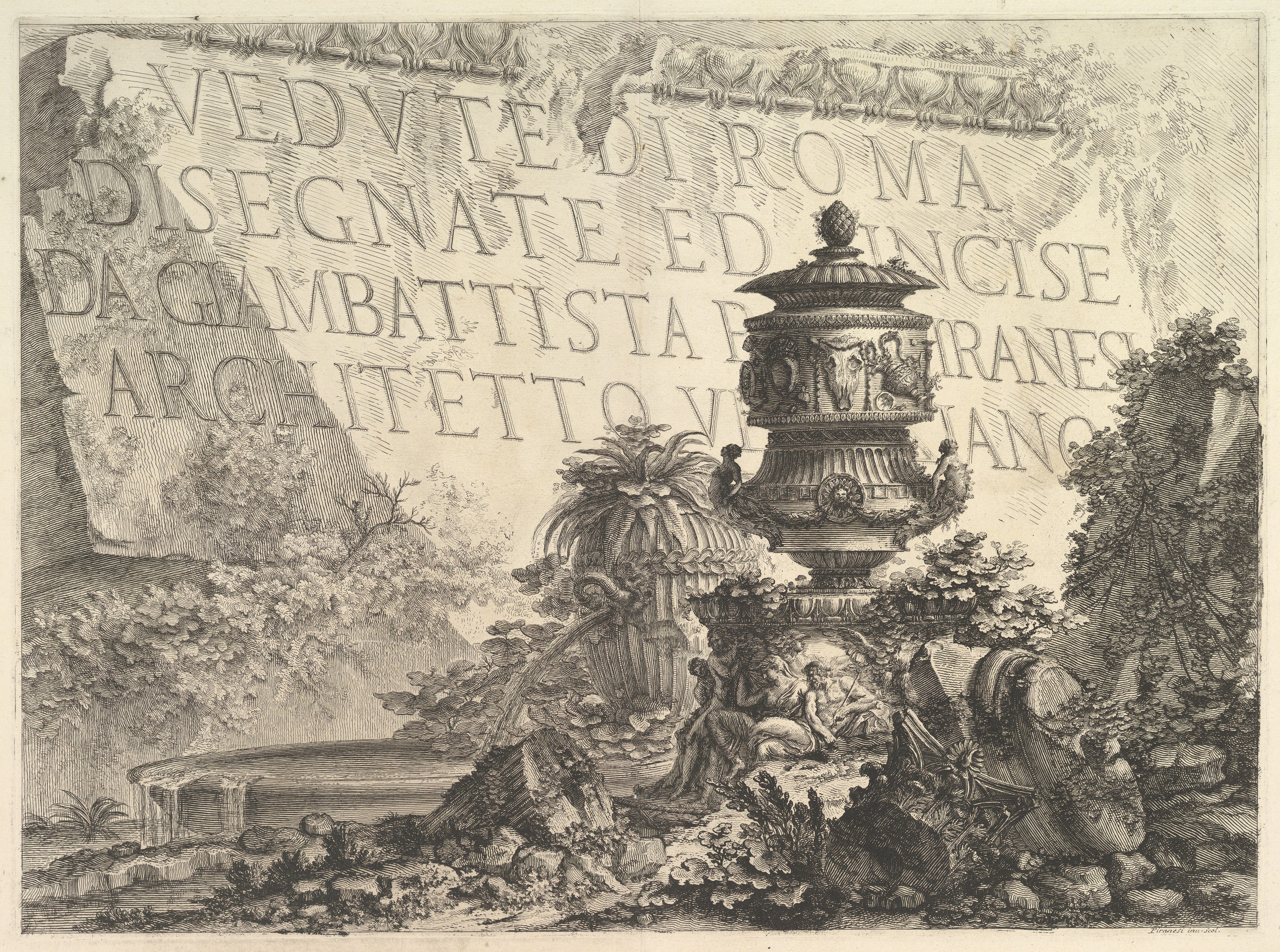
The frontispiece of Piranesi's book 'Views of Ancient Rome' clearly signals a turn toward neoclassicism and a return to Greco-Roman ideals.
The Transitional style (c.1760-1775) marked the Rococo's gradual displacement. The bombe form fell from fashion and greater rectangularity was introduced, often with a central breakfront panel. Straight tapering legs replaced the cabriole, and fluted columns replaced sinuous curves. The commode "a la grecque," a model favoured by Pompadour herself, signalled the new direction. Jean-Francois Oeben, the very ebeniste du roi who had mastered Rococo mechanics, was among the first and most important makers to produce furniture in this emerging taste.
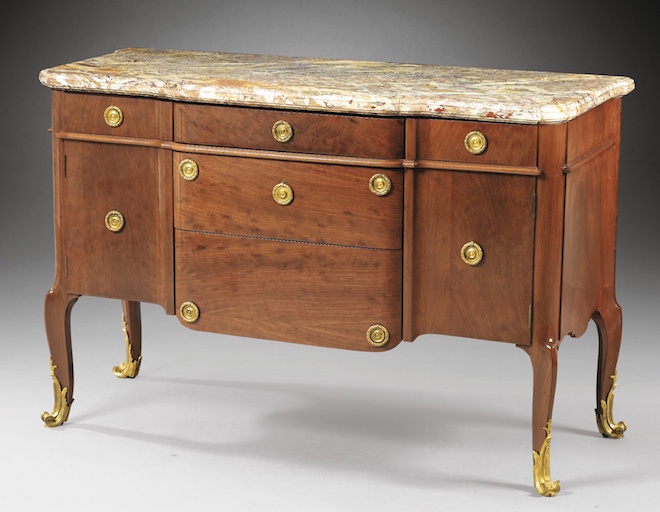
This commode à la grecque, ordered by Madame de Pompadour, made by Oeben, shows the cabinetmakers' conscious move away from curved forms toward rectilinear designs. Sold at Sotheby's.
The king himself never wavered. Louis XV always preferred the Rococo, and when he died in 1774, Neoclassicism had already dispossessed it. The style he loved had run its course in barely forty years, consumed by the very restlessness and appetite for novelty that had brought it into being.
A Decorators' Style
The Rococo has never entirely gone away. Since its original decline in the 1770s, the style has experienced repeated cycles of revival, each generation finding in its curves and gilding something that the prevailing fashion lacked. The first major revival occurred in England from the 1820s, when gilt chairs and settees appeared at Tatton Park and Rococo interiors were created at Belvoir Castle and Apsley House. As Hayward observed, the Rococo offered "a curvilinear luxuriance" that provided relief from rectilinear fashions, and it carried none of the lofty associations of the classical or the nationalistic overtones of the Gothic. It was, she noted, "a decorators' style," and decorators have returned to it ever since.
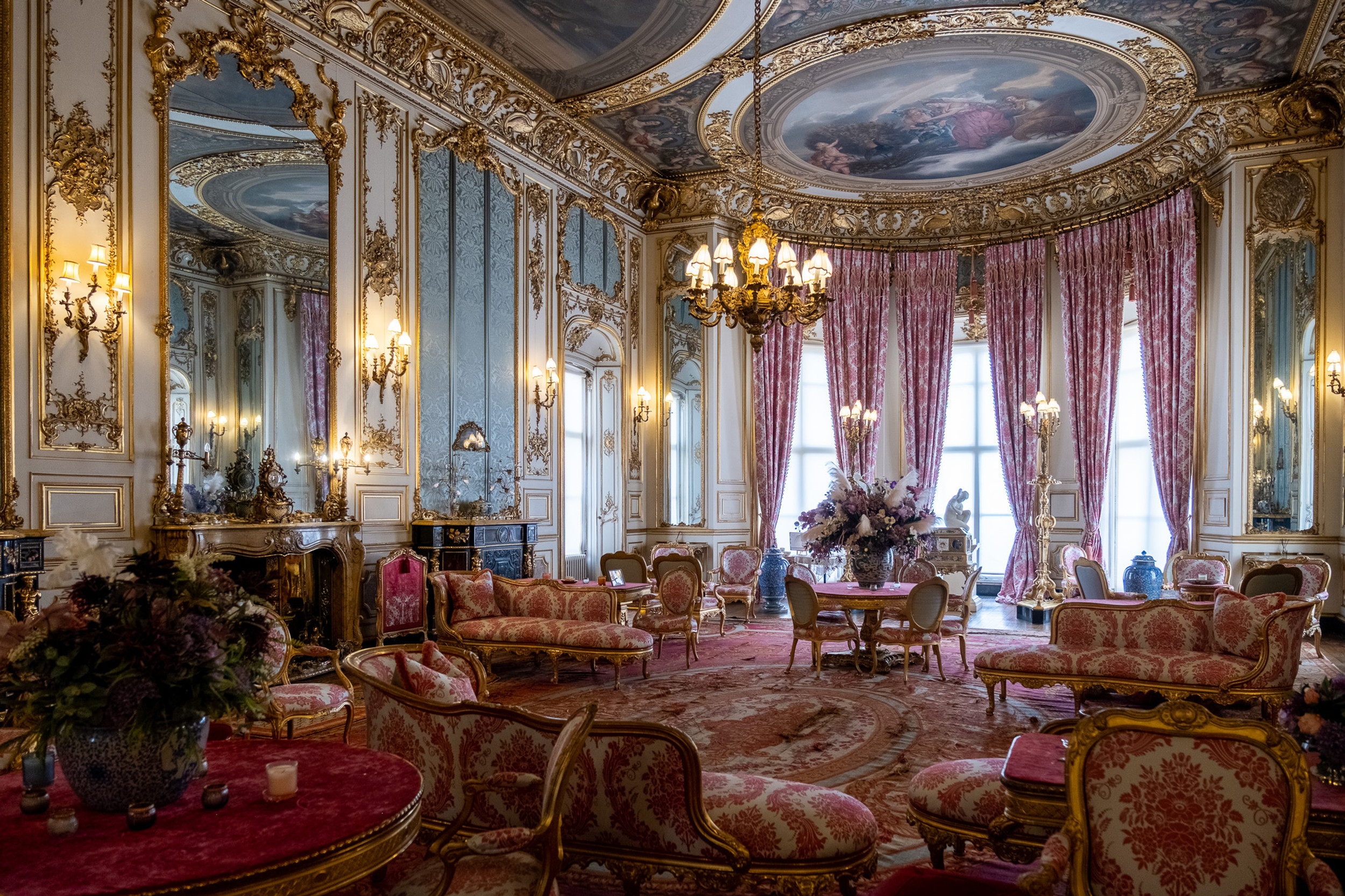
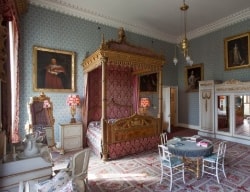
The interiors at Belvoir Castle, seat of the Duke and Duchess of Rutland, was decorated in the nineteenth century Rococo style.
In nineteenth-century Paris, the leading ebenistes sustained the tradition through their own revivals. Alfred-Emmanuel Beurdeley produced exquisite tables in the Louis XV manner around 1880, working in kingwood, amaranth, and tulipwood with gilded bronze mounts, directly inspired by celebrated eighteenth-century models. The Napoleon III period (1852-1870) saw a particularly vigorous return to Rococo motifs, combining earlier artistic influences with the technical capabilities of a new industrial age.
That same impulse continues today. Rococo furniture is experiencing a resurgence in high-end residential interiors, particularly in London townhouses and country estates where generous ceiling heights and well-proportioned rooms can accommodate its scale. The organic curves and asymmetry of a Rococo commode or console table provide a natural counterpoint to the clean lines of modern architecture, a tension that designers use deliberately to bring warmth and visual interest to contemporary spaces. Drawing rooms, principal bedrooms, and entrance halls remain the rooms best suited to Rococo statement pieces, just as A.J. Downing recommended boudoirs and parlours for the style in the 1850s.
The key, as it has always been, is confidence rather than pastiche. Throughout the eighteenth century itself, Rococo furniture sat alongside earlier Baroque pieces and, by the 1760s, beside the first Neoclassical experiments. A single gilded commode or pair of fauteuils, placed with conviction in an otherwise restrained scheme, can anchor a room in a way that no contemporary reproduction achieves. The Rococo has lasted precisely because it was the first style to put comfort and private pleasure at the centre of furniture design, and that instinct remains as compelling now as it was in the salons of 1730s Paris.
Written by Rainier Schraepen