Vip access

 Favourites


















May 2026
Mahogany Furniture: From Caribbean Forest to Georgian Masterpiece

Trace mahogany's journey from the Caribbean to the workshops of Chippendale and beyond. Discover the species, techniques, and trade that defined an era of furniture.
Mahogany is the wood that built the golden age of European furniture. No other timber has shaped the course of cabinetmaking so profoundly, nor held its place in the affections of collectors so consistently across three centuries. From the mid-eighteenth century, when it displaced walnut as the material of choice in the finest London workshops, to the Empire salons of Napoleonic Paris, where it provided the sombre foil to gilt bronze mounts of the highest quality, mahogany defined what serious furniture looked like. Its journey from the tropical forests of the Caribbean to the drawing rooms of Georgian England is a story of trade, taste, and craftsmanship on a remarkable scale.
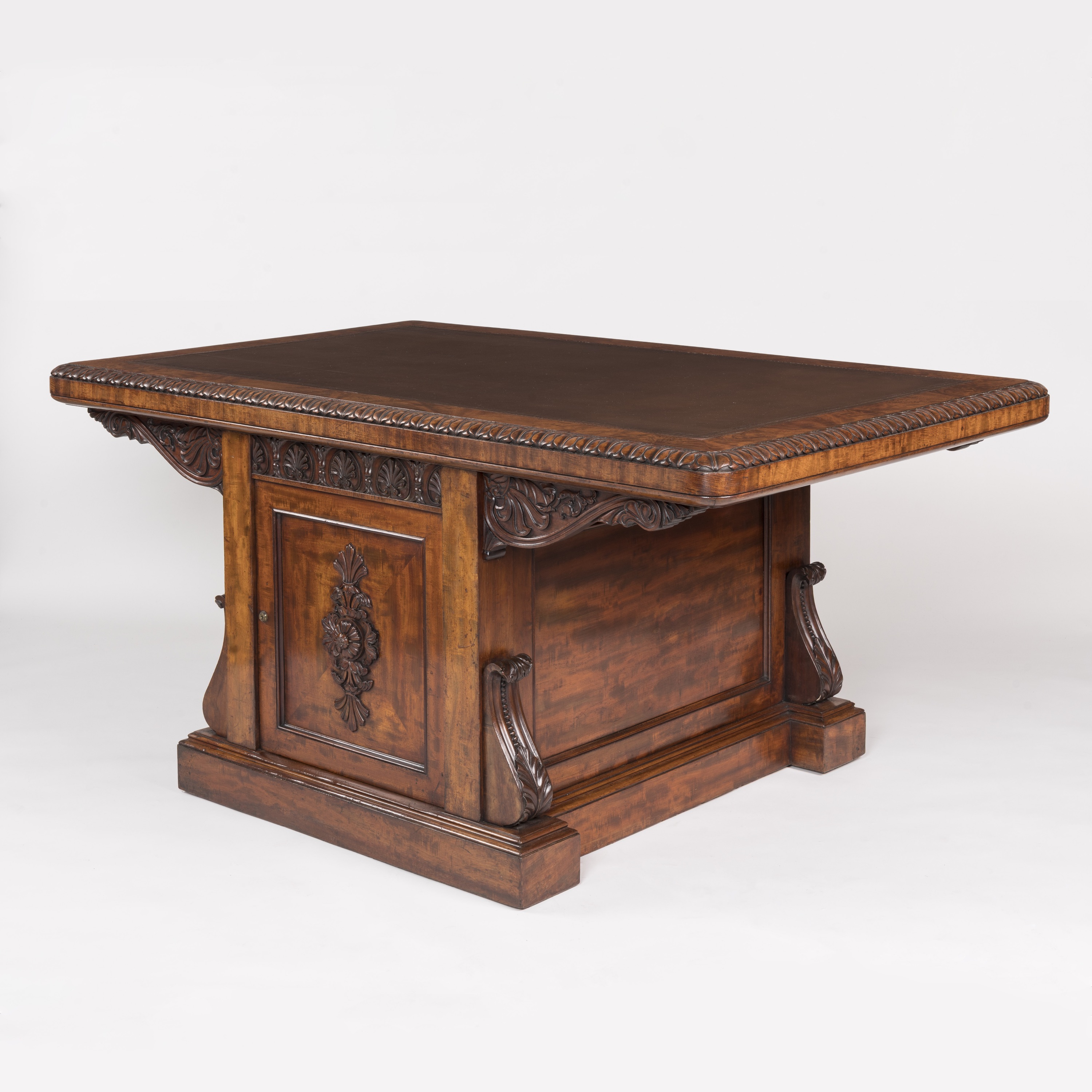
A Most Unusual William IV Library Table, made using San Domingo mahogany, circa 1830. Butchoff Antiques, London.
The timber arrived in Britain through the ports of the north-west coast, shipped from Cuba, San Domingo, and Honduras in logs that could weigh several tons and fetch over a thousand pounds apiece. It was harder than walnut, more resistant to insects, warmer in colour, and capable of producing boards wide enough for table tops and panels that no European wood could match. In the hands of Thomas Chippendale, whose Director of 1754 made mahogany the defining material of fashionable furniture, it enabled forms of carving and construction that would have been impossible in any other wood. In the hands of Georges Jacob in Paris, it crossed national boundaries and became the preferred timber of French chairmaking. In the hands of the Victorian and Edwardian revivalist trade, it sustained an industry that consumed over a million tons of hardwood in the years before the First World War.
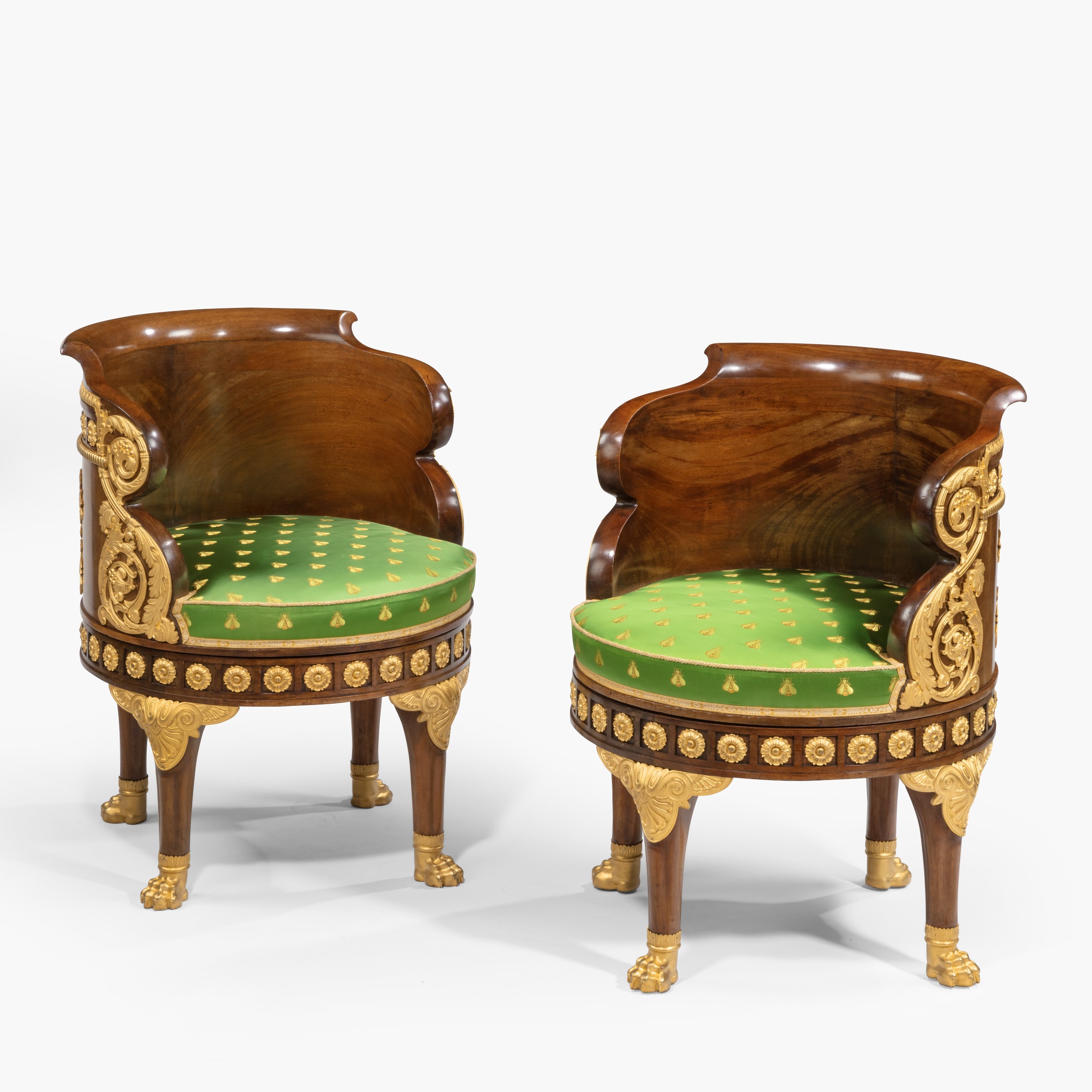
A Pair of French Ormolu-Mounted Fauteuils de Bureau of the Napoleon III Period, made from flamed mahogany, circa 1860. Butchoff Antiques, London.
A Tropical Timber Comes to Europe
Three species of mahogany dominated the European trade, and the differences between them mattered greatly to the men who worked them. Cuban mahogany, also known as Santo Domingo or Spanish mahogany, was the most prized of all. A dense, close-grained timber of warm reddish-brown colour, it was superb for carving, resistant to the attacks of insects, and capable of taking a polish of extraordinary depth and lustre. Sheraton, writing in the 1790s, was emphatic about its superiority for chairmaking: “the kind of mahogany employed in chair making ought to be Spanish or Cuban, of a clean straight grain. Wood of this quality will rub bright and keep cleaner than any Honduras wood.”
Honduras mahogany was a different proposition. Lighter in weight and golden in tone, it lacked the density required for deep carving but produced veneers of spectacular beauty, the figured grain patterns that cabinetmakers called flame, curl, and plum-pudding. It was the wood of choice for the broad surfaces of secretaire cabinets, bookcase doors, and table tops, where the decorative character of the grain could be displayed to greatest advantage. Its one weakness was impermanence of colour: the rich golden tones that made it so desirable when new have in many cases faded over two centuries to a paler, less emphatic hue.
The ports on the north-west English coast were the first landfall after the long voyage from the Caribbean. Liverpool and Lancaster handled the bulk of the trade, and the Lancaster firm of Gillows exploited its geographical advantage with particular shrewdness, securing first choice of the finest imported logs before they reached the London market. The scale of the trade was staggering. A single auction in Liverpool in April 1873 advertised nearly 170,000 feet of mahogany, with one ship alone, the Clementine, bringing 48,000 feet from Honduras. Individual logs, sometimes three feet square, could be worth over a thousand pounds. The annual value of British mahogany imports stood at £680,000 prior to 1873, and between 1880 and 1883 over 1.2 million bales were imported into Liverpool each year. At the Great Exhibition of 1851, firms displayed a portion of a mammoth log of Santo Domingo mahogany, a spectacle calculated to impress visitors with the sheer abundance of the material that had transformed their domestic interiors.
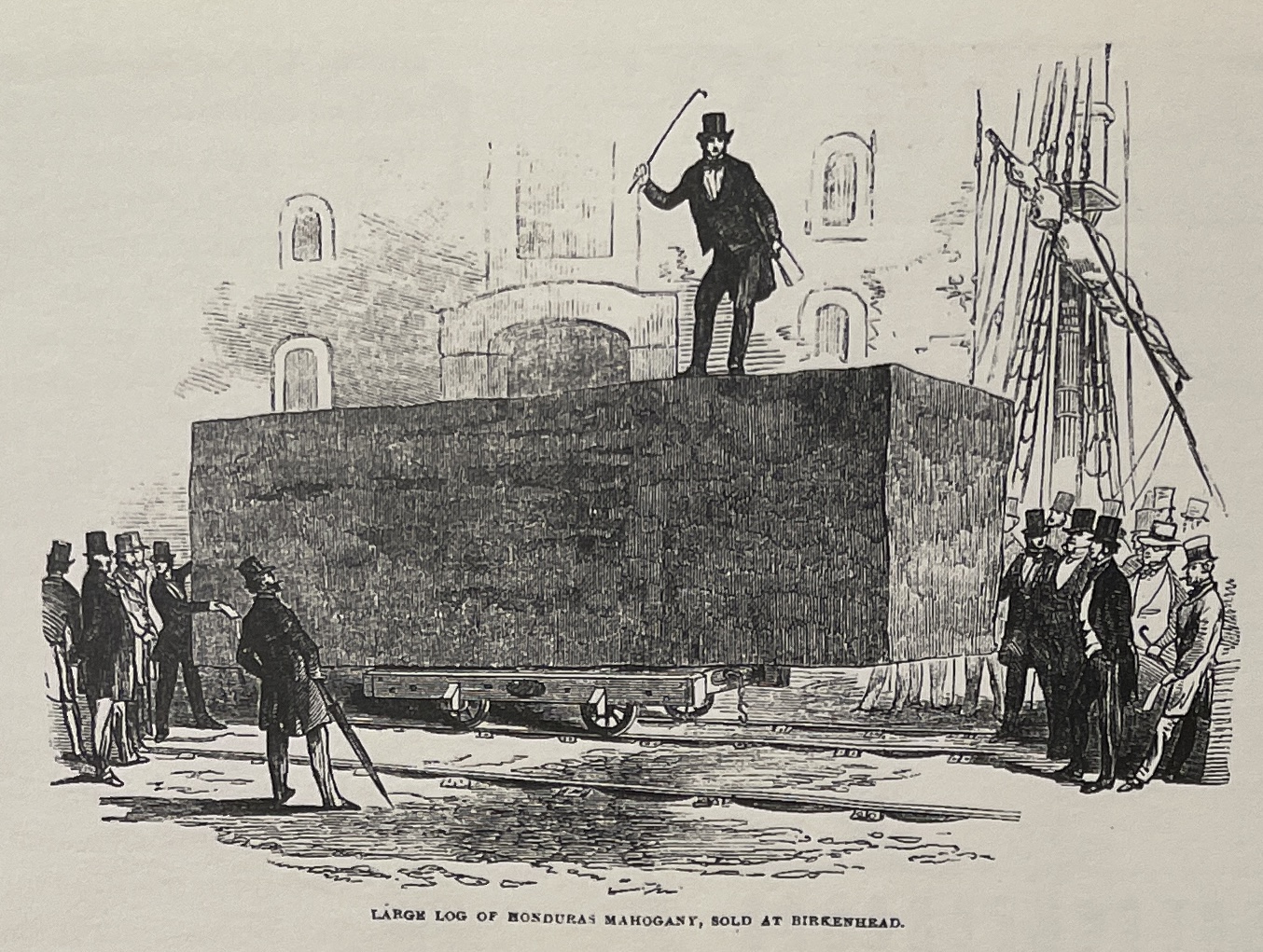
Giant mahogany log being sold at Birkenhead, engraving from the Illustrated London News (1851).
From Walnut to Mahogany
The replacement of walnut by mahogany was the most significant shift in the material history of English furniture, but it happened gradually rather than overnight. Chairs were made in either walnut or mahogany until the middle of the eighteenth century, the newer wood only slowly gaining ground as its practical advantages became apparent and the supply chains from the Caribbean matured. Those advantages were, in the end, decisive. Walnut was vulnerable to woodworm in a way that mahogany was not. Walnut boards were rarely wide enough for the large surfaces that fashionable furniture increasingly demanded. And walnut, for all its beauty, could not sustain the deep undercut carving and elaborate pierced work that the Rococo taste of the 1740s and 1750s required. Mahogany could do all of these things, and its warm, lustrous colour was at least the equal of walnut in visual appeal.
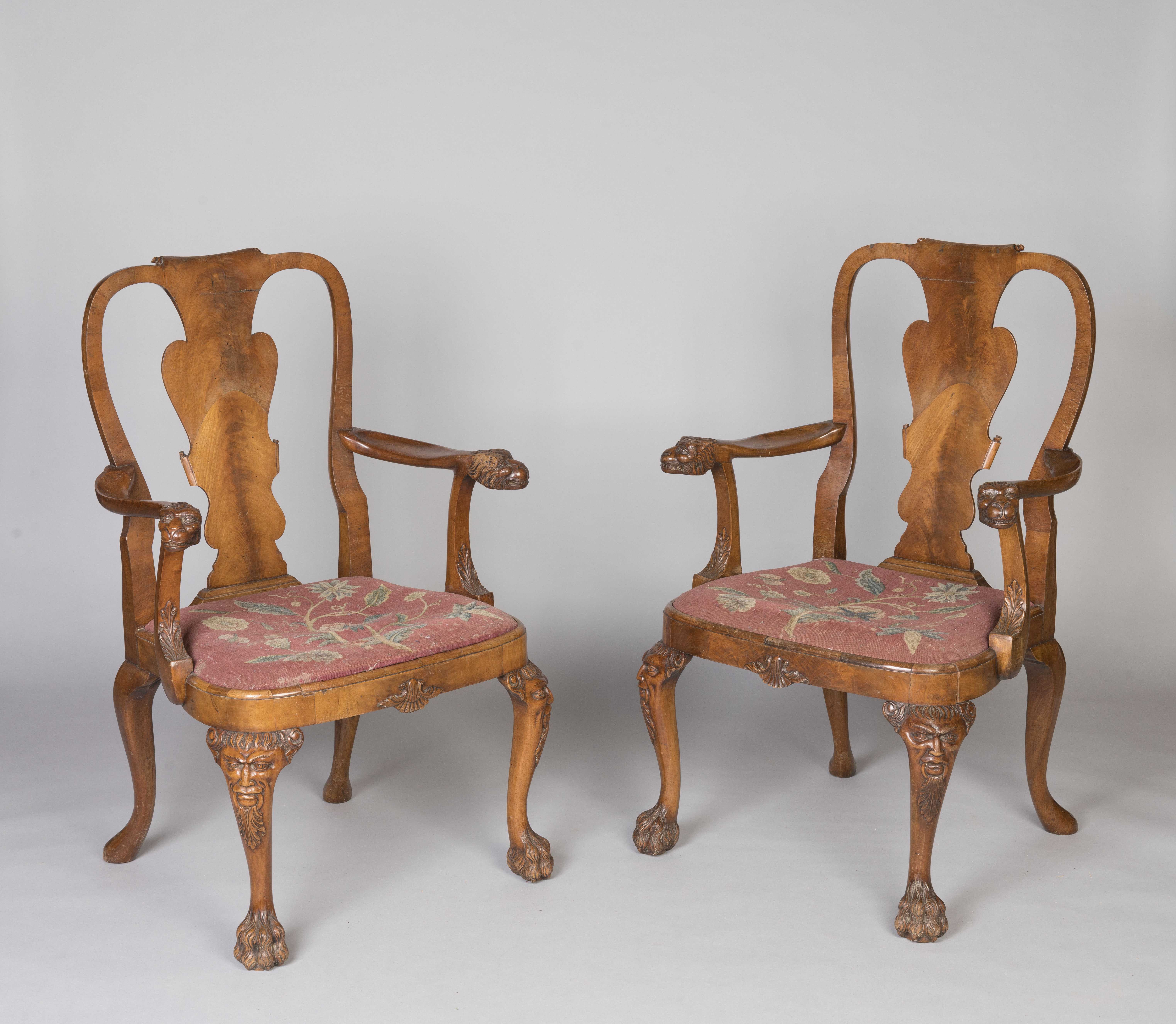
George I Style Walnut armchairs, circa 1900. Pre-dating mahoganys popularity, walnut was more susceptible to woodworm and only allowed for shallow carving. Butchoff Antiques, London.
The relative value of the two timbers tells its own story. By the 1870s, walnut imports were worth about one-seventh those of mahogany. At a single Liverpool auction, nearly 170,000 feet of mahogany was on offer against barely 11,000 feet of Circassian walnut. The economic logic was clear: mahogany was available in greater quantity, in larger dimensions, and with a wider range of decorative figuring than any European timber could match. Cabinetmakers who had grown up working in walnut found that mahogany opened possibilities of form and ornament that the older wood had never permitted.
The transition happened at different speeds across Europe. In England, mahogany was firmly established by the 1740s and dominant by the 1760s. In Germany, it was not much used before the latter part of the century. In Scandinavia, walnut and native birch persisted well into the second half of the eighteenth century before mahogany supplanted them, and even then the Scandinavian cabinetmakers often relieved their mahogany furniture with panels of marquetry in light-coloured birchwood, producing a distinctive regional character that owed as much to local tradition as to the imported timber.
The Age of Chippendale
The mid-eighteenth century was the golden age of mahogany furniture, and the name most closely associated with it is Thomas Chippendale. By the time Chippendale moved to St Martin’s Lane in 1752, mahogany had become the most popular wood in the English furniture trade. Two years later he published The Gentleman and Cabinet-Maker’s Director, the most influential pattern book of the century, and its designs exploited mahogany’s unique properties with a confidence that no previous publication had matched. The elaborate pierced and carved splats of his chair designs, the bold cabriole legs with their claw-and-ball feet, the intricate fretwork galleries of his china tables, all depended on a timber that was hard enough to hold fine detail, strong enough to support pierced ornament without splitting, and available in boards wide enough for the generous proportions that the Rococo taste demanded.
Mahogany enabled furniture forms that walnut could never have sustained. The fretwork that Chippendale applied to table galleries and chair legs was made as a three-piece cross-grained laminate, a technique that relied on mahogany’s dimensional stability and resistance to splitting along the grain. The deep undercut carving of his Director designs, with their cabochons, leaf ornament, and scrolling acanthus, required a timber that would not crumble under the chisel. Cuban mahogany, crisp and close-grained, was the ideal material for this work, and the finest Chippendale chairs are carved from solid Cuban stock with a precision and depth of relief that remains technically impressive nearly three centuries later.
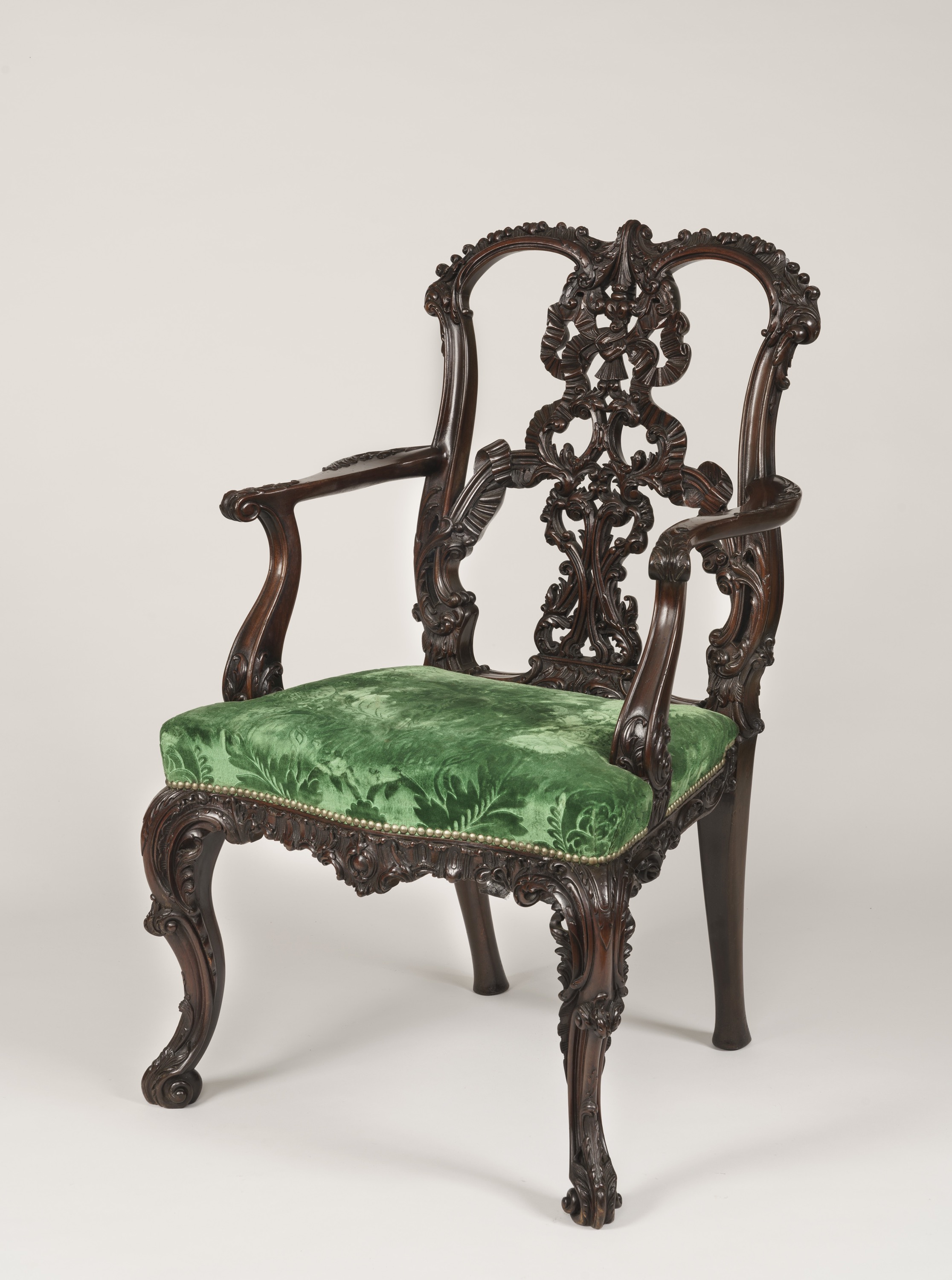
One chair of a set of Twelve Dining Chairs after the original design of Thomas Chippendale, by Hindley and Wilkinson, circa 1890, showing the decorative possibilities offered my mahogany. Butchoff Antiques, London.
The Director’s influence extended well beyond Chippendale’s own workshop. The pattern book was taken up by cabinetmakers across England, and by the 1760s mahogany furniture in the Chippendale manner was being produced at every level of the trade. The pedestal desk, standing in the centre of a gentleman’s library, became a quintessential mahogany form. At Harewood House in Yorkshire, the furniture supplied for Robert Adam’s interiors is of rich golden mahogany ornamented with mounts of English ormolu of the greatest richness, a demonstration of what the timber could achieve when combined with the finest metalwork and the most sophisticated architectural setting. Hepplewhite’s Cabinet-Maker and Upholsterer’s Guide of 1788 and Sheraton’s Drawing Book of 1791 extended the mahogany tradition into lighter, more elegant neoclassical forms, their designs relying on contrasting inlays of satinwood, harewood, and boxwood against mahogany ground to produce effects of great delicacy.
The Art of the Grain
If Chippendale and his contemporaries prized mahogany for its carving properties, the cabinetmakers of the later eighteenth and early nineteenth centuries exploited its decorative grain with equal ingenuity. The way a log was cut determined the character of the veneer it yielded, and the finest workshops developed a connoisseur’s vocabulary for the different types of figuring that mahogany could produce.
Flame figuring was the most celebrated. The log was cut to show off the rich patterning of the grain in streaks that resembled a leaping flame, and only the most affluent workshops could afford the carefully matched sheets of veneer required to dress a large bookcase or secretaire in this manner. Gillows of Lancaster, with their privileged access to the timber auctions at the nearby docks, were particularly well placed to secure flame-figured stock of the highest quality. Stop mottle, also called roe and mottle, was rarer still, an exceptional figuring that produced a shimmering, almost three-dimensional effect across the surface of the wood. Christopher Payne, the furniture historian, noted that this veneer “could only be afforded by the best makers whose clients had deep pockets.” Plum-pudding mahogany, with its distinctive mottled figuring, offered yet another decorative possibility, while quarter veneering arranged four sheets cut from the same log in a symmetrical pattern that created a formal, architectural effect suited to the panels of wardrobes and cabinet doors.
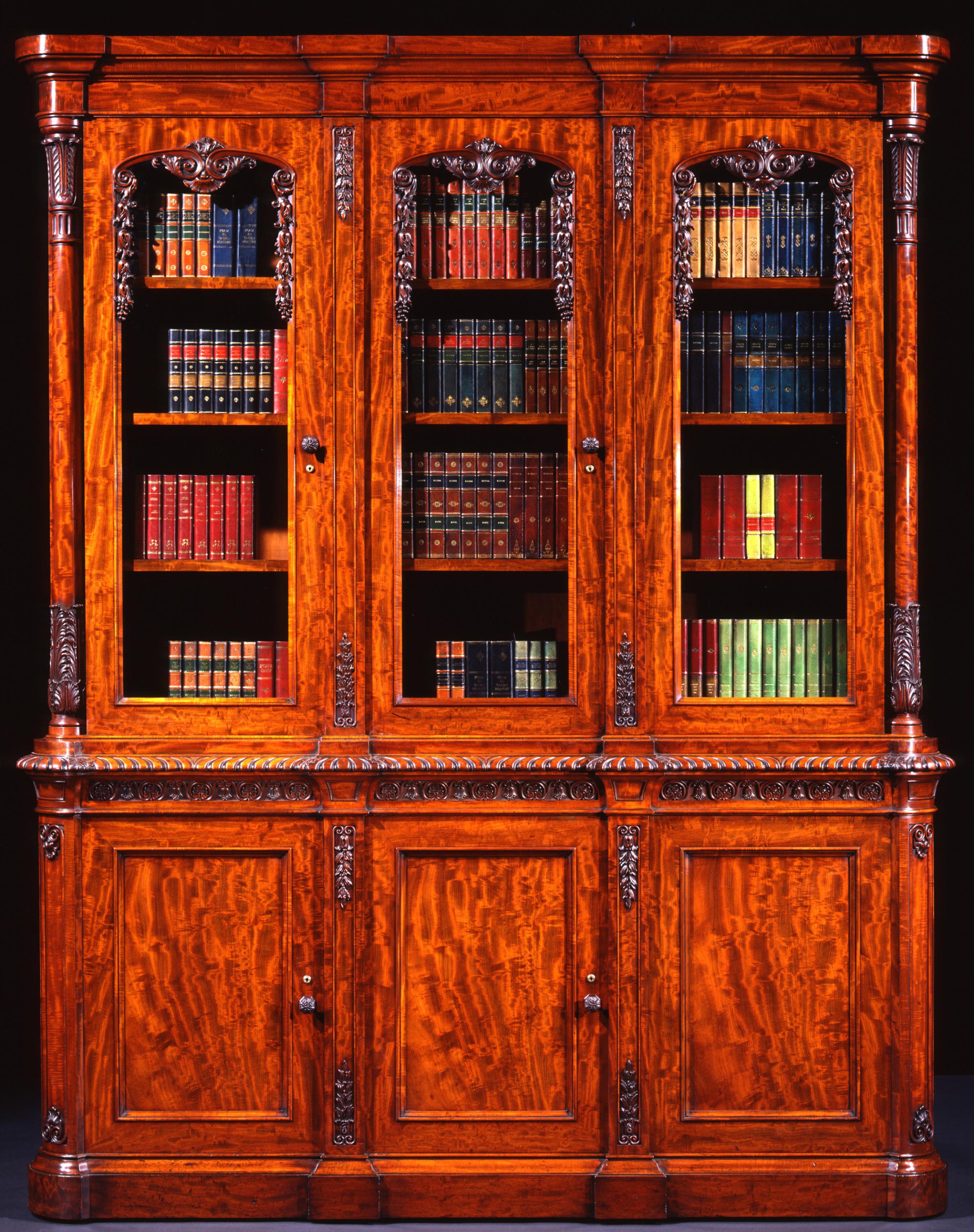
Bookcase by T & G Seddon, circa 1840.The veneers show a combination of roe and mottle, called 'stop mottle.' Butchoff Antiques, London.
The choice between solid mahogany and veneered construction was itself a matter of judgement and expense. Cuban mahogany was typically used solid for chairs, table frames, and structural elements where strength and carving quality mattered most. Honduras mahogany, with its lighter weight and more spectacular grain, was the preferred choice for veneered surfaces. For the finest case furniture, the distinction could be dramatic. Holland and Sons, one of the leading Victorian cabinet-making firms, cut the bombé tops and sides of their most extravagant pieces from solid mahogany rather than veneering them, a display of material profligacy that announced the quality of the commission. In French furniture of the Louis XVI period, large panels of plain mahogany veneer were cut from the junction of branches and trunk, where the stress of growth produced the most striking and unpredictable figure.
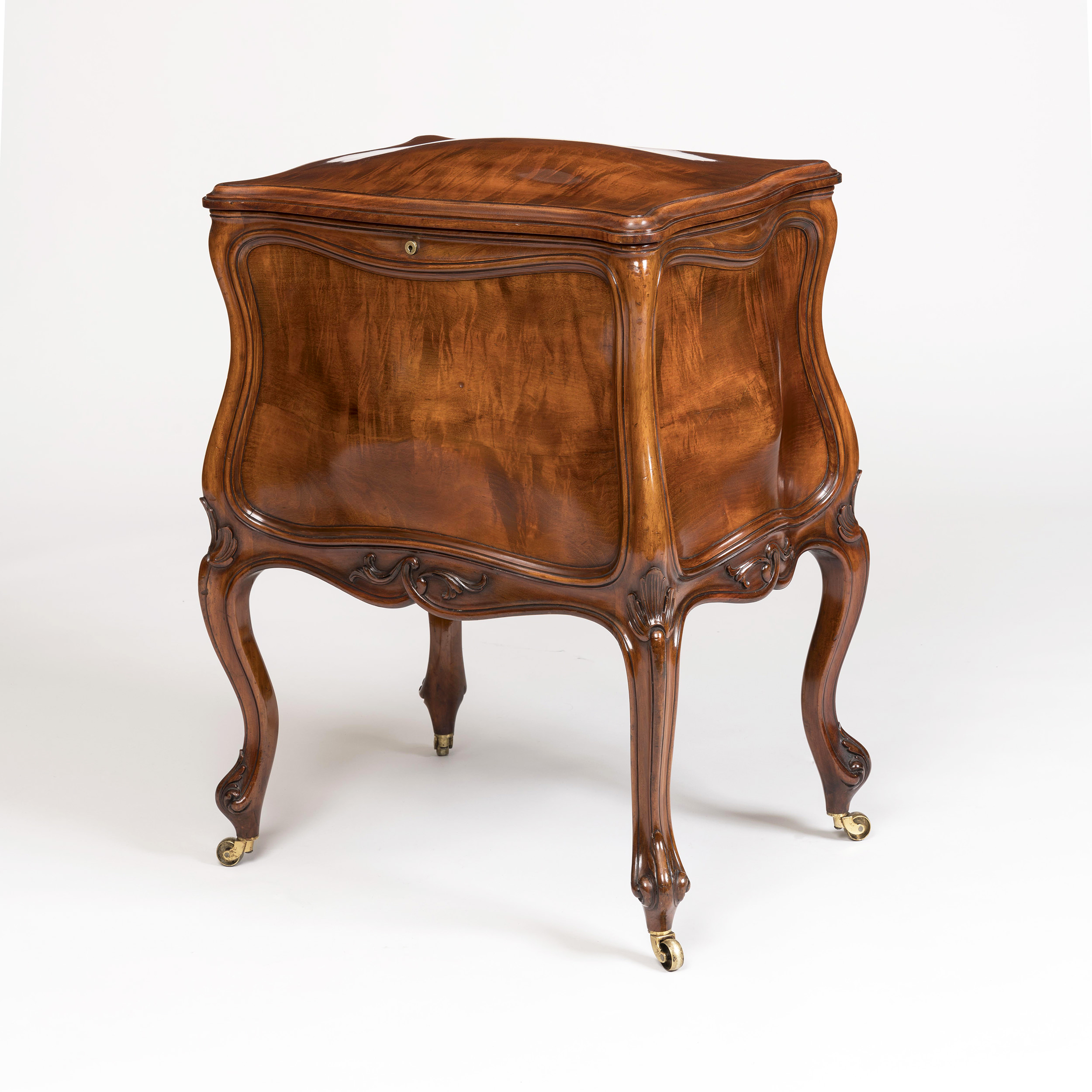
No expense spared, this solid mahogany wine cooler by Holland & Sons has beautifully carved and shaped bombé surfaces. Butchoff Antiques, London.
Mahogany Crosses the Channel
Mahogany’s conquest of the English furniture trade was watched with close attention in Paris, and it was not long before French makers began to adopt the timber that had transformed their rivals’ workshops. Georges Jacob, the most inventive chairmaker of the late eighteenth century, was possibly the first Parisian craftsman to use mahogany for the construction of chairs, a fashion he adopted explicitly from English practice. Such was the influence of Chippendale’s designs upon him that Jacob’s chairs in the Chinese taste closely reflected the manner of the Director, an unusual instance of English style crossing the Channel in a trade that more often flowed in the opposite direction.
By the 1780s, plainer mahogany veneers had become fashionable in the workshops of Paris, though the French approach to the timber differed fundamentally from the English. Where an English cabinetmaker might allow the beauty of the wood to speak for itself, embellished only with restrained inlay or crossbanding, a Parisian craftsman enriched his mahogany surfaces with gilt-bronze mounts of the most exquisite quality. Jean-Henri Riesener, the greatest cabinetmaker of the Louis XVI period, used mahogany veneers enriched with delicate festoons of flowers in gilt bronze, producing an effect of controlled opulence that neither timber nor metalwork could have achieved alone. The large panels of plain mahogany veneer that distinguish the finest Louis XVI cabinet pieces were cut from the junction of branches and trunk, where the grain produced a figure of particular richness, and dressed with mounts whose cost could amount to two-thirds of the total price of the piece.
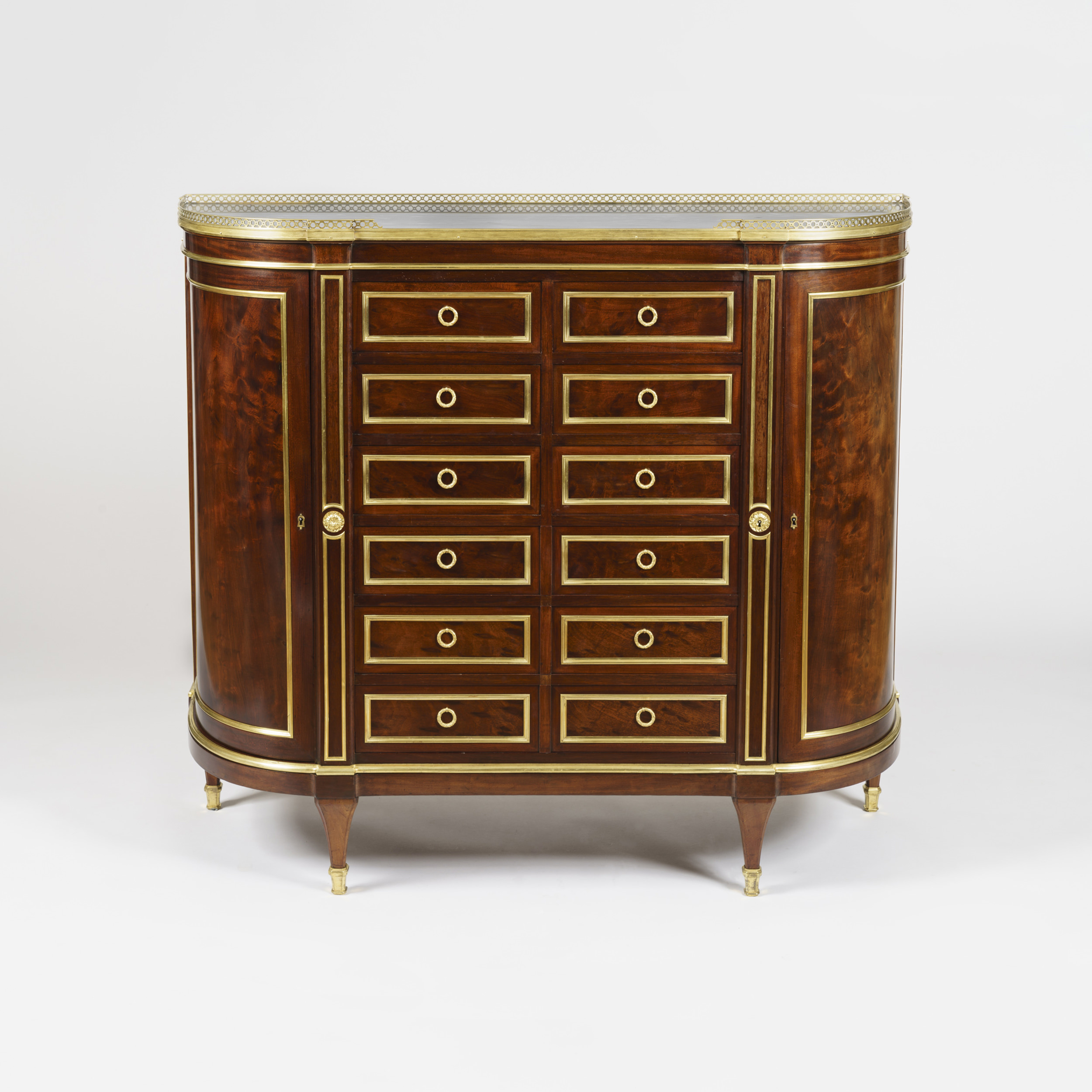
A Fine Side Cabinet in the Louis XVI manner, By G. Durand of Paris, using flamed mahogany in combination with refined ormolu mounts in the style first popularised by Jean-Henri Riesener and other Louis XVI period cabinetmakers. Butchoff Antiques, London.
Napoleon’s continental blockade of 1806 gave mahogany an unexpected prominence in French furniture history. By preventing the importation of mahogany from the English colonies, the blockade had the double effect of exaggerating the value of a timber that was already the favourite wood of the Empire period, and of intensifying the use of indigenous woods, including walnut, oak, elm, and ash, as substitutes. Empire furniture used dark mahogany in contrast with gilt bronze mounts to create a sombre, masculine aesthetic that suited the military grandeur Napoleon wished to project. When mahogany became available again after the fall of the Empire, it resumed its place as the preferred timber for the most ambitious Parisian cabinetwork. In the later nineteenth century, François Linke used the finest mahogany to heighten the contrast with his expensively chased and gilded bronze mounts, and Henry Dasson, one of the most accomplished makers of the period, always selected the best mahogany and paired it with well-chased mercury gilded bronze of the highest quality.
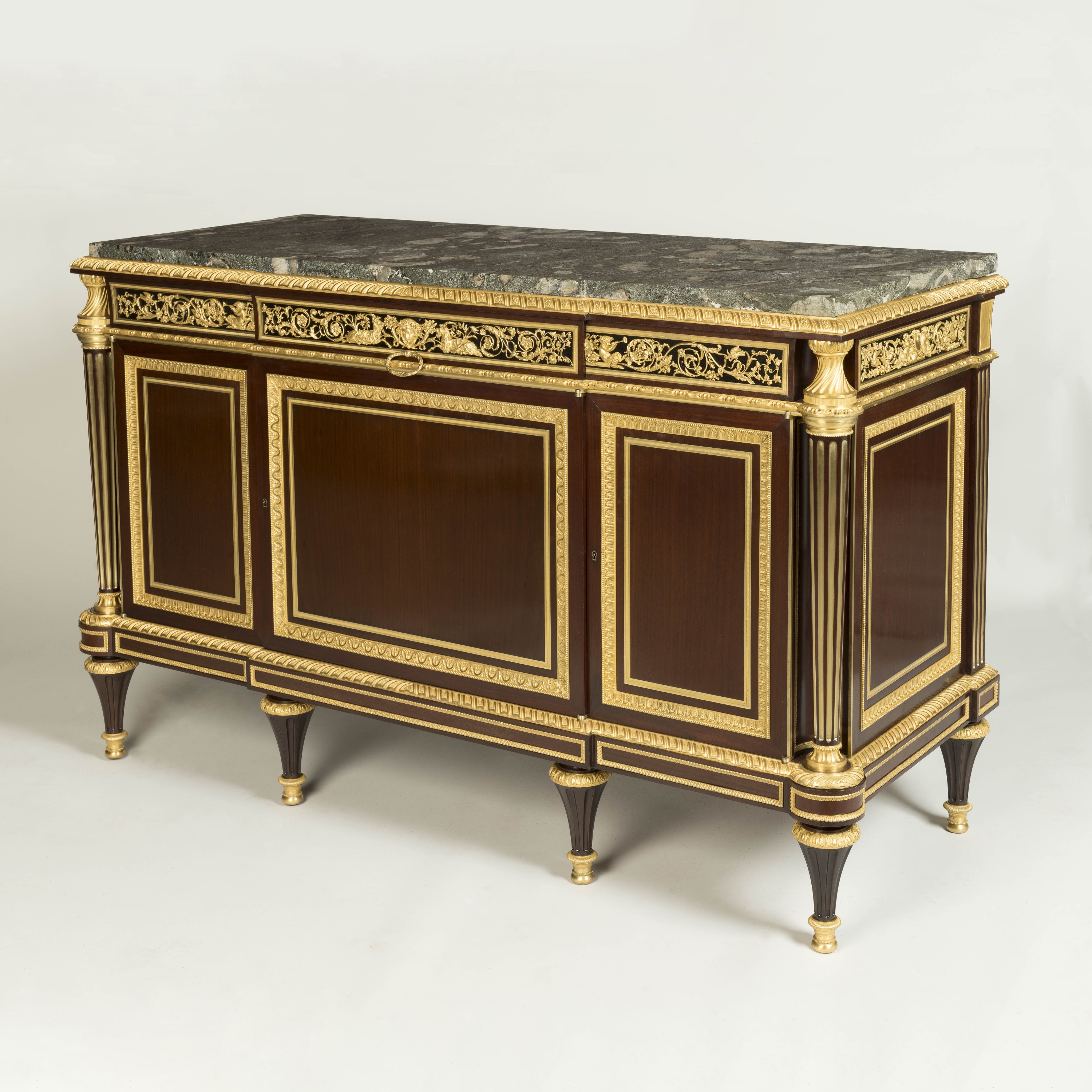
An Important Louis XVI Style Commode by Henry Dasson, After the Design by Adam Weisweiler for the King's Cabinet at Saint-Cloud, dated 1887, showing the French cabinetmaker's preference for plain mahogany veneers combined with ormolu. Butchoff Antiques, London.
A Timber for the Ages
The mahogany trade survived wars, blockades, and shifts in fashion, but by the second half of the nineteenth century the supply was beginning to change. Imports fell from over 54,000 tons in 1875 to barely 27,000 tons two years later, and the finest Cuban and San Domingo logs were becoming increasingly scarce. African mahoganies, cheaper and more abundant, filled the gap, but they lacked the density and carving quality that had made Caribbean mahogany the supreme furniture timber of the eighteenth century.
Fashion, too, played its part. Rosewood briefly overtook mahogany during the Regency, and a generation later the Aesthetic movement treated Georgian mahogany furniture with something approaching contempt. Oscar Wilde’s circle reportedly hurled their parents’ mahogany pieces into the streets, though it is worth noting that at exactly the same moment the Georgian Revival was gaining commercial ground. The architect E.W. Godwin, a leading figure of the Aesthetic movement, confessed to hunting up second-hand shops for eighteenth-century mahogany work inlaid with satinwood, and concluded that “the eighteenth century won the competition.” The Chippendale and Hepplewhite styles were widely reproduced in mahogany through the Edwardian era, and by the outbreak of the First World War the British cabinet-making industry was consuming over a million tons of mahogany and other hardwoods each year.
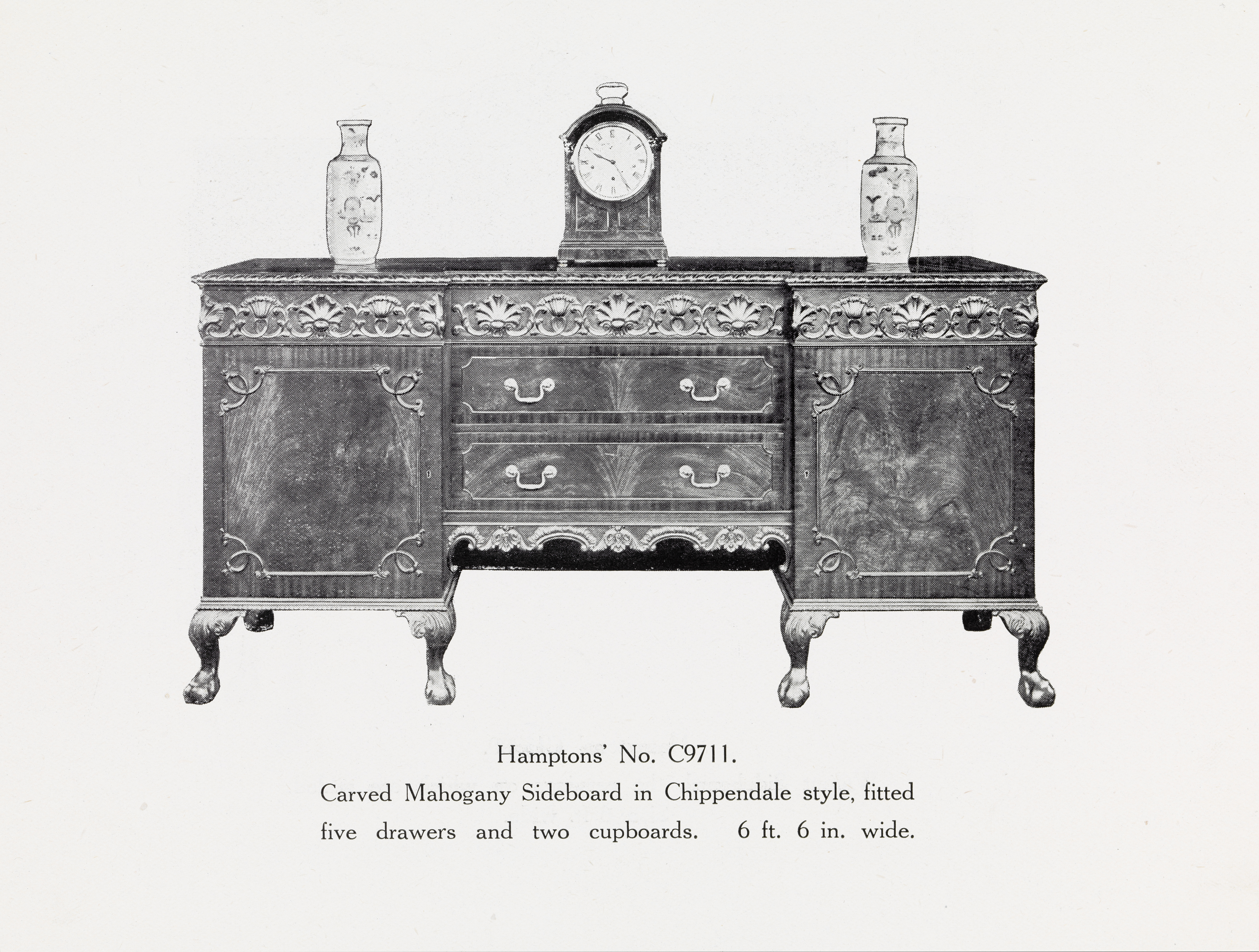
Hampton's reinterpretation of the Chippendale style, as seen in their sales catalogue, circa 1910-1920. Butchoff Antiques, London.
The qualities that made mahogany indispensable to Chippendale and Riesener remain precisely the qualities that make it compelling to collectors and designers today. A well-chosen piece of mahogany furniture introduces warmth, depth of colour, and a richness of surface that few other materials can equal. The timber’s natural resistance to decay means that Georgian mahogany pieces have survived in better condition than their walnut predecessors, and the finest examples retain the crispness of their original carving after two and a half centuries of use. For interior designers, mahogany offers the particular advantage of versatility across styles: a Chippendale chair, a Hepplewhite sideboard, and an Empire bureau can each hold its place in a contemporary setting because the warmth and authority of the timber transcends the period detail of any individual design. The trees that yielded the finest Cuban and San Domingo logs are now protected, and timber of comparable quality is no longer available at any price. The mahogany furniture of the eighteenth and early nineteenth centuries represents a combination of material, craftsmanship, and design that cannot be repeated.
written by Rainier Schraepen