Vip access

 Favourites


















May 2026
Louis XIV Furniture: The Sun King's Revolution in Design

Louis XIV: The Sun King’s Furniture Revolution
No French monarch understood the political power of beautiful objects as clearly as Louis XIV. From the moment he assumed personal rule in 1661, the Sun King set about transforming the decorative arts into instruments of royal authority, recruiting the finest craftsmen in Europe to furnish palaces of unprecedented splendour and establishing a system of state-controlled workshops that would make Paris the undisputed centre of luxury production for the next two centuries. The furniture created under his patronage was political: designed to project the majesty of the throne, to regulate the rituals of court life, and to demonstrate to every visiting ambassador and nobleman that France had surpassed Italy as the arbiter of European taste.
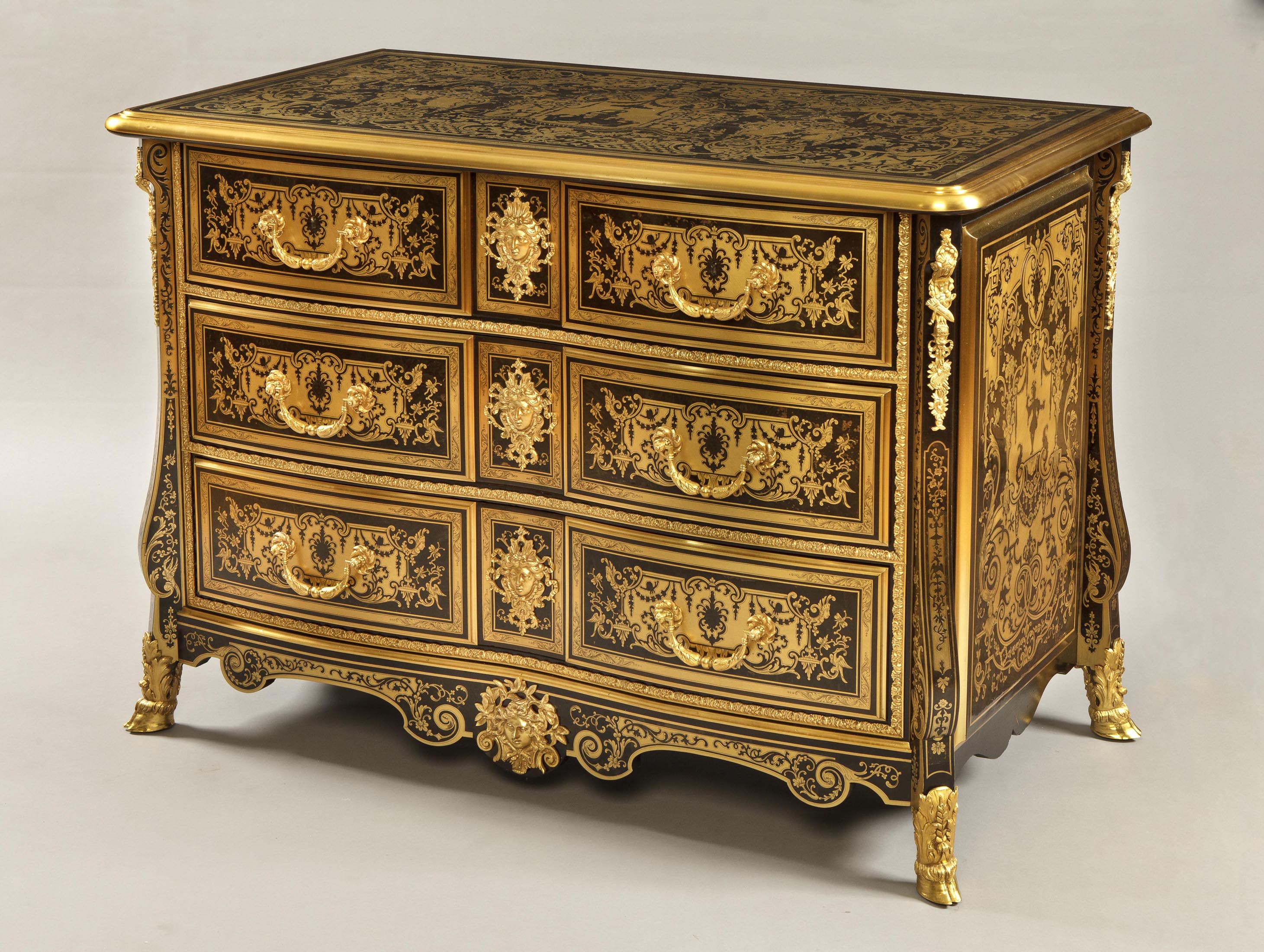
A superlative example of a Louis XIV Style commode. Even though made during the 19th century, the form and design is a pure Louis XIV era invention, and relates to commodes at the Wallace Collection in London and those supplied to the Grand Trianon by André-Charles Boule between 1708-1709. Previously with Butchoff Antiques.
The reign gave the history of cabinetmaking one towering figure, Andre-Charles Boulle, whose mastery of brass, tortoiseshell, and gilt bronze created a vocabulary of forms and techniques that has never been surpassed. It gave European interiors three furniture types that would dominate for the next three hundred years: the commode, the bureau plat, and the side cabinet. And in the Gobelins manufactory it established an institutional model for the collaboration of artists, craftsmen, and designers that no subsequent regime has equalled, along with the principle of the unified interior that would become the organising idea of every great house from Stockholm to St Petersburg.
The Manufacture Royale
The centralisation of the arts under Louis XIV had an unlikely precursor. Nicolas Fouquet, the Surintendant des Finances, had established workshops at Maincy to furnish his chateau at Vaux-le-Vicomte, and it was there that he discovered the exceptional qualities of the painter Charles Le Brun. The costly excellence of Vaux-le-Vicomte brought about Fouquet’s arrest in 1661 on charges of peculation, but it had the merit of bringing Le Brun to the attention of the young King. Louis resolved that such talent should serve the Crown, not a subject.
In 1664, Louis appointed Jean-Baptiste Colbert as Surintendant des Batiments, effectively a minister for the arts. Colbert purchased the premises of the Gobelins brothers on the outskirts of Paris, until then a tapestry workshop, and expanded them into the Manufacture des meubles de la Couronne, charged with furnishing the royal residences and developing a national style. Le Brun was placed in overall control, with a duty not only to administer the workshops but to provide all the designs used in the manufactory. His authority extended to every detail: architecture, painting, sculpture, tapestry, metalwork, and furniture were to be conceived as a single unified scheme, consecrated to the glory of the monarch.
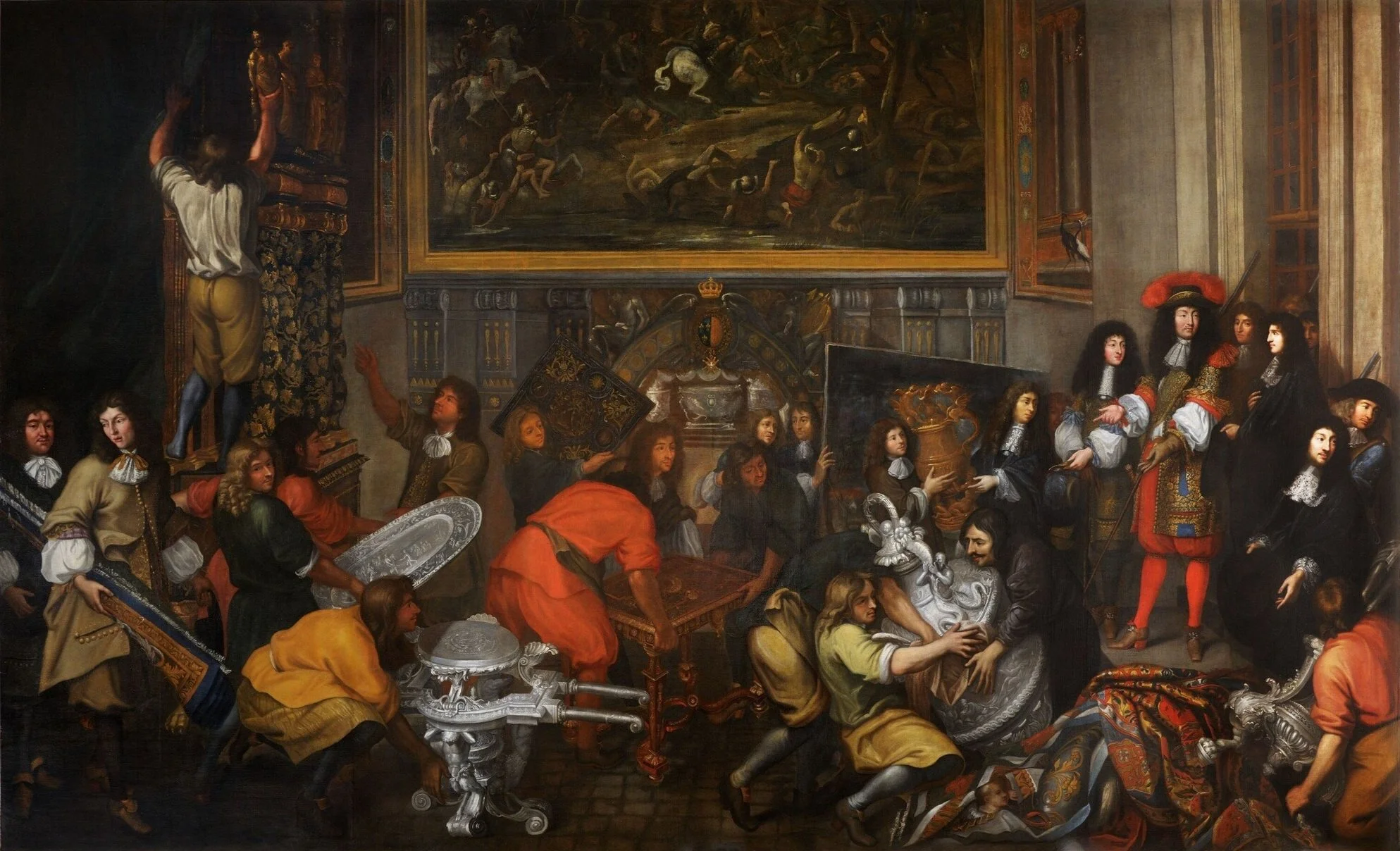
A Royal visit to the Gobelins workshops, as painted by Simon Renard de Saint-André, circa 1667-1669. A tapestry of identical design was woven at Gobelins, promoting all the riches which were produced their for the glory of the Crown.
Le Brun’s genius lay in recognising that the Gobelins could not succeed as a purely French enterprise. He retained the Flemish, Italian, and Dutch craftsmen who had been drawn to Paris, understanding that it was through collaboration with these immigrants that French workshops would acquire their unrivalled mastery. The arrangement worked. By the end of Louis XIV’s reign, Paris was internationally renowned as the premier centre for luxury goods in Europe, and French fashions in furniture and interior design spread far and wide across the Continent. A tapestry woven at the Gobelins between 1667 and 1672, still displayed at Versailles, records the moment of triumph: it shows Louis, conspicuous in shoes with red heels, accompanied by Colbert on an official visit to the workshops. Craftsmen present him with objects in silver and bronze, while the Dutch-born cabinetmaker Pierre Gole carries the top of a marquetry table and the Italian Domenico Cucci stands beside the spectacular hardstone cabinets he had made for the King at enormous expense.
Andre-Charles Boulle
The closure of the Gobelins between 1694 and 1697, brought about by the financial strains of Louis XIV’s wars, saw the rise of the man who would become the most celebrated cabinetmaker in French history. Andre-Charles Boulle had been working in the Louvre workshops since before 1666, when he became a master cabinetmaker in his early twenties. The son of a cabinetmaker and an avid collector of paintings, prints, and drawings, he had received a royal warrant exempting him from the restrictive guild regulations and was granted a patent as sculpteur en mosaique, a title that acknowledged the artistic ambition of his work.
Boulle’s name has become synonymous with the technique of decorating furniture with a marquetry of brass and tortoiseshell, a method that was employed almost continuously throughout the eighteenth and nineteenth centuries. The technique involved cutting sheets of brass and shell together, producing two versions of the same design: premiere partie, with brass on a shell ground, and contre partie, with shell on a brass ground. But this was not his only, nor even his first, skill. Boulle began as a master of wood marquetry, the “paintings in wood” inspired by Dutch and French artists such as Jean-Baptiste Monnoyer, and his metal marquetry designs were almost exclusively based on his own drawings, a reflection of his training as a draughtsman and collector.
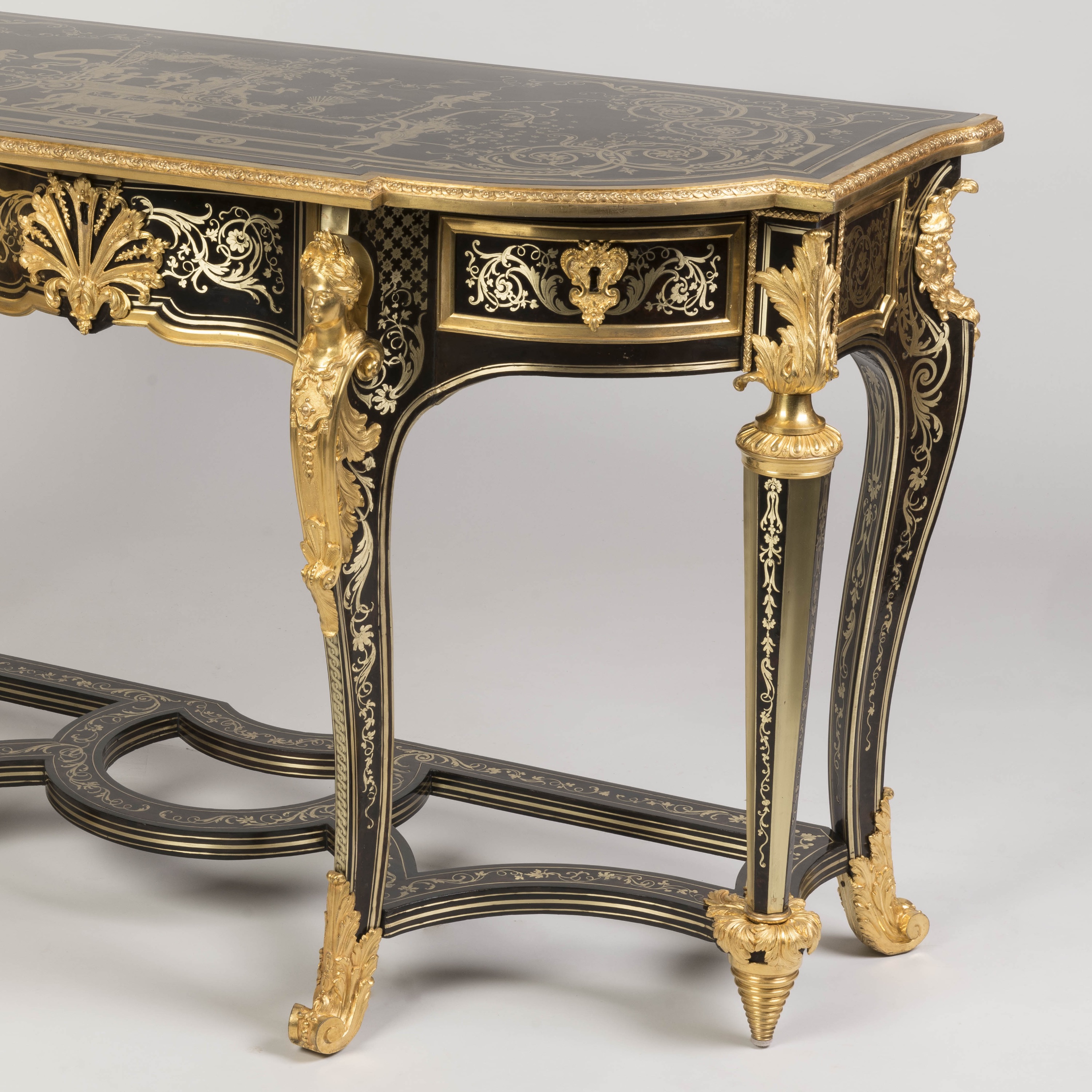
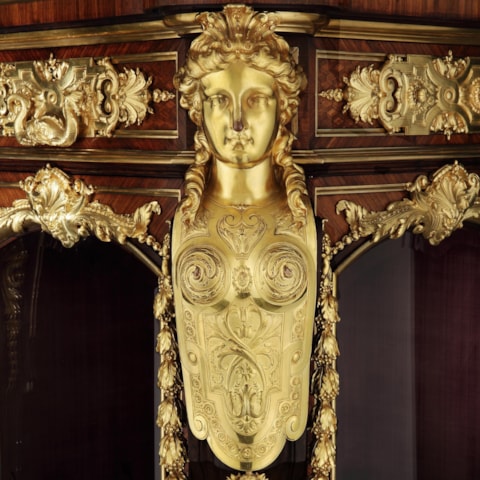
No longer merely serving a protective function, André-Charles Boulle turned metal mounts into gilded decorative masterpieces, fusing flawlessly with the shapes and forms of the furniture he designed. Butchoff Antiques, London.
What set Boulle apart from every contemporary was his complete mastery of the relationship between cabinetwork and gilt-bronze mounts. The mounts on earlier furniture had served a largely protective function, guarding vulnerable edges and corners. Boulle took them to a different, sculptural level, modelling the mounts himself and personally supervising their casting. The quality and coherence of these mounts distinguished his furniture from that of every other maker of the period, and the fusion of carcase and bronze that he perfected has been described as perhaps the most characteristic and influential innovation in furniture of the Grand Siecle. His great cupboards were the showpieces of the age. His bureau plat, with its tall sinuous legs freed from stretchers, foreshadowed a form that would dominate writing furniture for the next century. His sons perpetuated and adapted the house style of mixed-media veneers until the fall of the French monarchy in 1792, a continuity of workshop practice spanning more than a century.
The Furniture of Versailles
When the Court was installed at Versailles in 1682, the furniture in the Grande Galerie, the Salon de la Guerre, and the Chambre du Roi was almost exclusively of silver. The throne was silver. The orange-tree tubs, the ewers, the braziers, the fire-dogs, the chandeliers, and the candelabra were all of silver, hung with cut-glass pendants. It was a luxury that only Louis XIV could afford, and it announced to every visitor that France possessed wealth and craftsmanship beyond the reach of any rival. But the financial strains of frequent war brought this magnificent display to an abrupt end. The sumptuary edict of 1689 consigned the greater part of these grandiose pieces to the melting-pot, and the silver furniture of Versailles passed from reality into legend.
The loss gave an unexpected impetus to the development of gilt bronze. Cheaper than silver but no less opulent in appearance, gilt bronze lent itself as a substitute whose gold reflections added to the glittering ambience of a room lit by sunlight or candlelight. In Boulle’s hands, the material achieved an expressive power that silver had never possessed: his mounts were not merely protective or decorative but sculptural, integral to the design of the piece rather than applied to its surface. The edict of 1689, intended as an act of wartime austerity, thus launched the material that would define French furniture for the next two centuries.
The reign also saw the invention of three furniture forms that would prove equally lasting. The commode, first delivered for Louis XIV’s bedroom at the Grand Trianon in 1708, was an entirely new article of furniture, its early form resembling a sarcophagus resting on heavy feet. By 1715, Boulle had developed a lighter version with only two tiers of drawers on slender legs, and the commode would go on to become the most popular form of French case furniture for the next three hundred years. The bureau plat replaced the cumbersome writing desk with eight legs, offering a broad flat surface supported on four elegant cabriole legs. The meuble d’appui, or side cabinet, was designed to sit lower than the older cabinet on stand, allowing connoisseurs to display paintings above it, a form that would be revived with particular enthusiasm in the nineteenth century under the name credenza.
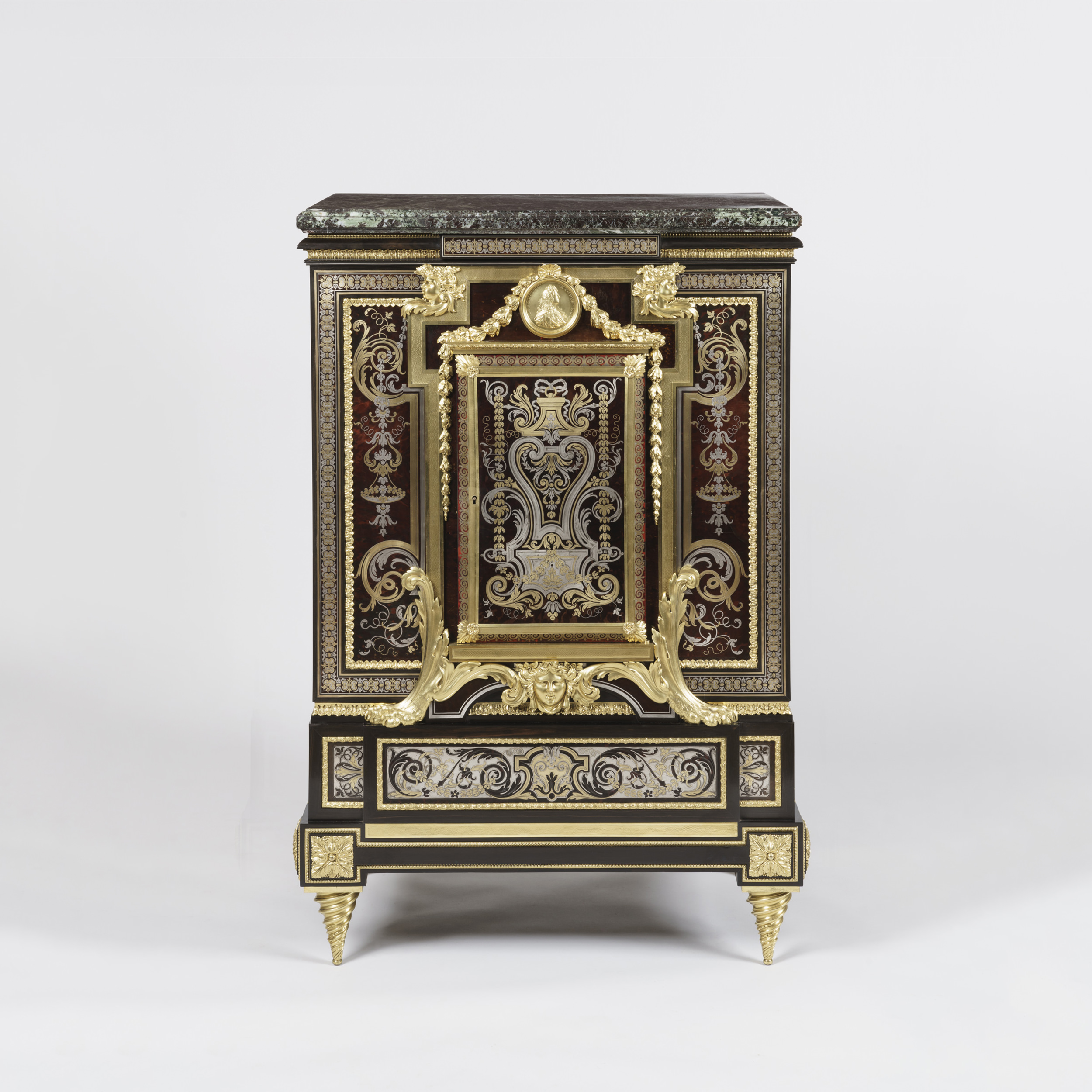
The Louis XIV ushered in a new type of cabinet, called a 'meuble d'appui' which was lower the previous Renaissance cabinets. Previously with Butchoff Antiques.
The Craftsmen of the Grand Siecle
Boulle did not work alone. The Gobelins and the Louvre workshops housed a constellation of talent, much of it foreign-born, whose collective achievement was to establish French supremacy in every branch of the decorative arts. Pierre Gole, a Dutchman, delivered his first commission for the Louvre in 1661 and continued to supply royal furniture until his death. His speciality was floral marquetry of extraordinary delicacy, and a cabinet he made for Monsieur, the King’s brother, survives in the Victoria and Albert Museum. Domenico Cucci, an Italian sculptor and metalworker, made a series of spectacular cabinets at huge expense for the King, with stunning hardstone inlays of flowers and birds produced at the Gobelins in deliberate emulation of the Grand Ducal workshops in Tuscany. These cabinets, with doors that opened to reveal series of drawers hiding collections of precious stones, were forerunners of the glazed vitrine that would develop in the following century. Alexandre-Jean Oppenordt, also Dutch-born, was given lodgings at the Louvre in 1684 and delivered twelve marquetry cabinets for Versailles before making a pair of commodes after designs by Jean Berain that anticipated an entirely new direction in furniture design.
Berain himself, appointed dessinateur de la Chambre du roi, was perhaps the most influential decorator of the later part of the reign. Where Le Brun’s vocabulary had been monumental and architectural, Berain developed a style of linear arabesques that combined the grotesques of antiquity with exotic figures in Chinese costumes, anthropomorphic monkeys, and fabulous mythological beasts. His lighter, more playful decorative language eased the transition from the heavy Baroque of Louis XIV toward the elegance of the Regence, and his influence on Boulle was so close that it is often difficult to distinguish the part played by each in the design of furniture. The decorative vocabulary of the period as a whole drew on classical antiquity with a grandeur that matched the monarch’s ambitions: acanthus, laurel, and lotus; lions’ heads, rams’ heads, griffins, and dolphins; and the royal insignia of the interlaced Ls, the fleur-de-lis, and the sunburst emblem of the Roi-Soleil, stamped on every surface as a reminder of who commanded this extraordinary enterprise.
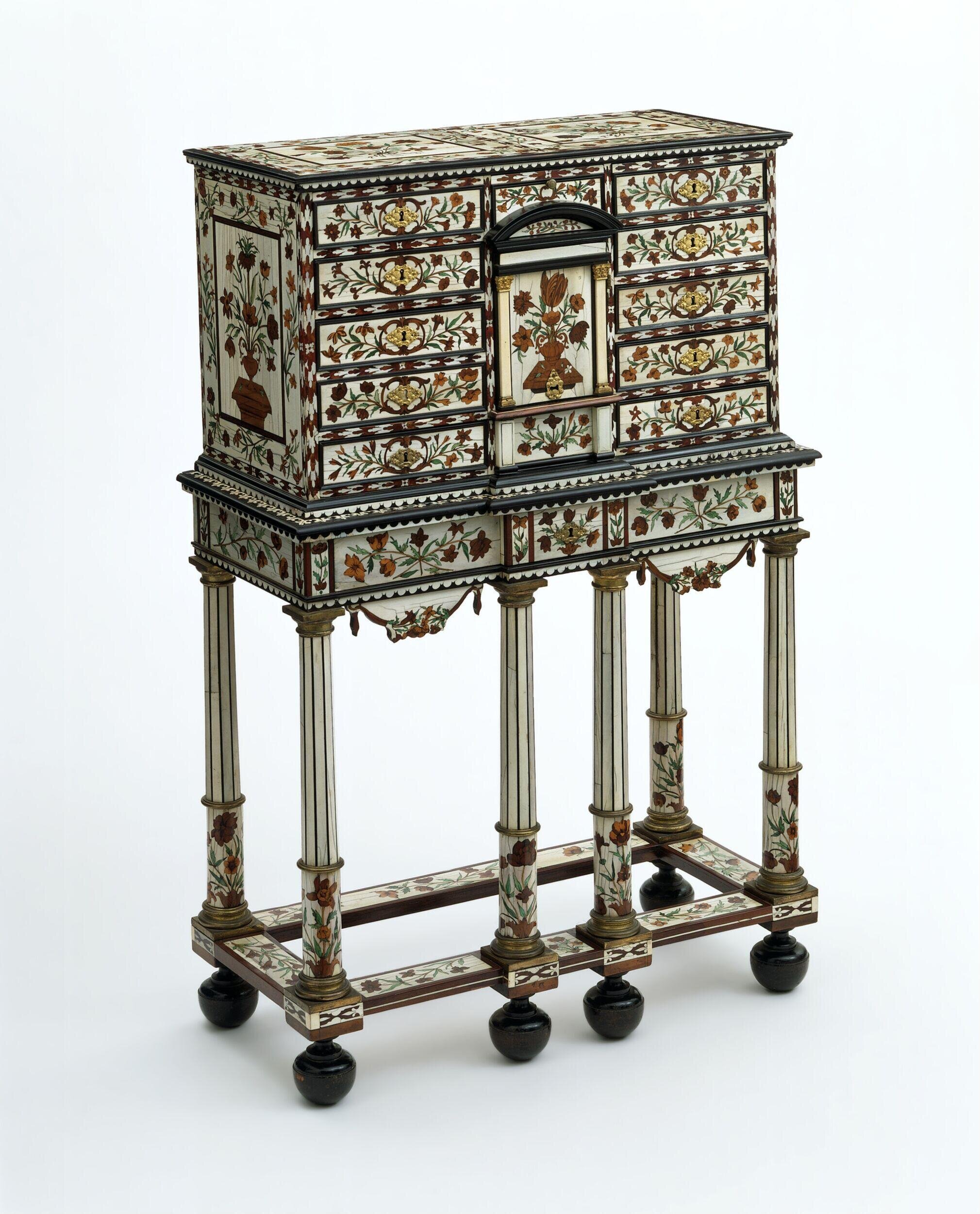
Specialising in floral marquetry, Pierre Gole was a furniture maker based at the Louvre workshops. This cabinet-on-stand (1661-1665), almost certainly made for the King's brother, is on display at the Victoria & Albert Museum in London.
The Boulle Revival
The fashion for Boulle furniture never entirely disappeared after the Revolution, but in the nineteenth century it enjoyed a revival of remarkable breadth, achieving a more widespread popularity even than it had known in the previous century. The highly skilled and sophisticated nature of Boulle’s work meant that only the very best makers attempted copies or reinterpretations: Beurdeley, Sormani, Fourdinois, Dasson, and Linke among them. The challenge was not merely technical but artistic, for Boulle’s designs depended on a unity of cabinetwork and bronze that demanded mastery of both disciplines.
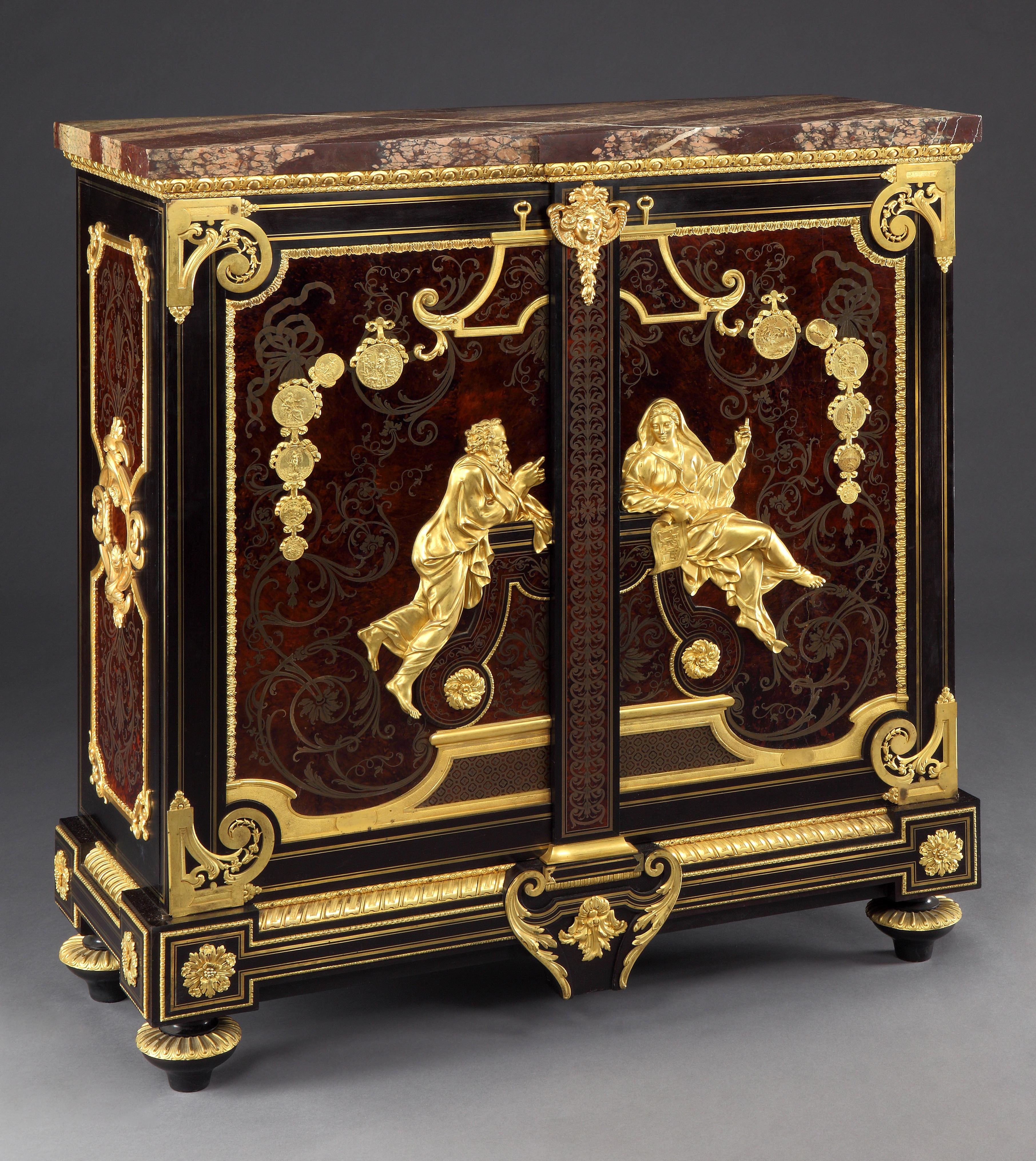
This meuble d'appui by Henry Dasson has exquisite ormolu mounts and première partie marquetry. It is based on earlier designs completed under Boulle himself between 1705-1715, working for the French Crown. Previously with Butchoff Antiques, London.
Henry Dasson, whose skills as a bronzier were unmatched in the later nineteenth century, produced Boulle-revival pieces of extraordinary quality, working in the styles of Louis XIV, XV, and XVI with equal authority. When his workshop effects were auctioned in 1894, the master patterns for his bronze mounts were purchased by Francois Linke, who used them to make his own faithful copy of the celebrated “Sun King” cabinet in 1913, a pair of cabinets on stands bearing the distinctive gilt-bronze figure of Louis XIV dressed as a Roman emperor on a turtle-shell ground. The original pair by Boulle survives in the Louvre, and no other eighteenth-century examples are known. In London, Charles Blake made copies of the Trianon commodes that Boulle had delivered for Louis XIV’s bedroom in 1708, while the Italian-born firm Nosotti offered a copy of a small Boulle cabinet with a plaque of Louis XIV for 250 guineas after the Hamilton Palace sale of 1882, where the original had realised £2,310. Befort Jeune specialised in furniture that adapted the Louis XIV style to the smaller proportions of mid-nineteenth-century rooms, demonstrating that Boulle’s designs, conceived for the grandest palace in Europe, could be successfully domesticated without losing their essential character.
A Style That Conquered Europe
Louis XIV’s greatest legacy to the decorative arts was not any single technique or furniture form but a principle: that the interior of a room should be conceived as a unified work of art, with furniture, panelling, hangings, and objets d’art designed together under a single directing intelligence. Under Le Brun, this idea was realised at Versailles with a completeness that no previous court had attempted, and the engraved designs published from the late seventeenth century onwards spread the model across Europe with extraordinary speed. Danish and Swedish monarchs set out to emulate the Grand Monarch as best they could. The Elector of Bavaria furnished his palaces in conscious imitation of Versailles. In Russia, Peter the Great looked to French models for the decoration of his new capital at St Petersburg.

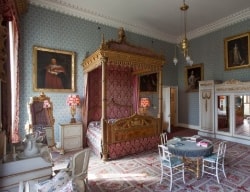
The Louis XIV period pioneered decorative schemes whereby furniture, textiles, lighting and objects were all designed to adhere together as a 'unified work of art.' This room at the Metropolitan Museum of Art in New York gives us a glimpse into a period-specific Louis XIV bedchamber.
The influence spread through individual craftsmen as well as through published designs. Daniel Marot, who had trained under Le Pautre and worked in Boulle’s own workshop, was compelled to leave France by the Revocation of the Edict of Nantes in 1685 and carried the French Baroque style to the Netherlands and thence to England in the service of William III. In London, the cabinetmaker Gerrit Jensen employed a marquetry of tortoiseshell, brass, and pewter similar to the technique being perfected by Boulle in Paris, producing some of the earliest English furniture in the French taste. The thread of influence runs directly through to the greatest makers of the following century: Jean-Francois Oeben, who would create the celebrated bureau du roi, was himself a pupil of the sons of Boulle, and Riesener, Oeben’s successor and the foremost cabinetmaker of the Louis XVI period, made a console table in Boulle marquetry after the master’s own designs, an act of homage that acknowledged the debt the entire French furniture tradition owed to the craftsmen of the Grand Siecle.
For collectors and designers today, Louis XIV furniture represents the moment at which French cabinetmaking achieved its identity. The forms invented under the Sun King’s patronage, the commode, the bureau plat, the side cabinet, remain staples of the European interior. The gilt-bronze mounts that Boulle elevated to an art form continue to define the highest level of craftsmanship in French furniture. And the principle of the unified interior, first realised in the state apartments of Versailles, remains the foundation on which every serious scheme of decoration is built.
written by Rainier Schraepen