Vip access

 Favourites



















August 2026
Victorian Furniture: The Style That Defined an Era

Victorian Furniture: The Style That Defined an Era
When Joseph Paxton’s Crystal Palace opened in Hyde Park on 1 May 1851, it housed more than thirteen thousand exhibits beneath its glass and iron canopy. Furniture occupied a substantial share of the floor space, and what visitors saw there was unlike anything that had come before. Carved sideboards rose to the height of a tall man, their panels cut with whole narrative scenes. Coil-sprung chairs offered a depth of comfort no eighteenth-century upholsterer could have produced, and machine-cut ornament covered surface after surface in quantities no hand carver could equal. The Great Exhibition gathered the contradictions of Victorian furniture into a single building, where revival designs pulled from half a dozen historical periods sat alongside technical bravura made possible by industrial machinery. The public debate that followed asked whether the result was art, novelty, or vulgarity dressed in the clothes of art.
The style’s design vocabulary was already forming in the late Regency, well before Victoria’s accession in 1837, and continued to influence Edwardian production for years after her death in 1901. It was the first style produced for a mass middle-class market and the first to introduce the matching parlour suite as a standard purchase. It was also the most stylistically restless period in the history of British furniture. Designers and cabinetmakers borrowed openly from Gothic, Rococo, Renaissance, Elizabethan and Tudor sources, sometimes blending them within a single object. The era earned its reputation through ambition and through the sheer volume of furniture produced for the homes of industrial Britain.
A Reign Defined by Revival
The defining habit of Victorian design was its tendency to look backwards. No major Victorian style is original to the period. Every important strand of Victorian furniture re-imagines an earlier one, and several re-imagine multiple periods at once. Critics at the time called this contest of styles the "Battle of the Styles", and it ran without resolution from the 1830s until the closing decades of the century.
The Gothic Revival came first and gave the era much of its early character. Its leading voice was A.W.N. Pugin, who established his furniture workshop at 12 Hart Street in Covent Garden in 1829 in his late teens, and whose sense of design was inseparable from his religious convictions. For Pugin, Gothic was not a fashion but a Christian and moral architecture. His furniture for Windsor Castle, his collaboration with Charles Barry on the new Palace of Westminster, and his published volume "The True Principles of Pointed or Christian Architecture" of 1841 gave Gothic Revival a coherence the other revivals never quite matched. The visual grammar drew from medieval cathedrals: pointed arches, quatrefoils, trefoils, and heraldic motifs, often executed in oak and fitted with the highly individual brass handles Pugin designed himself. After his death at forty in 1852, his son Edward Welby Pugin carried the style on with a more flamboyant and French-inflected hand.
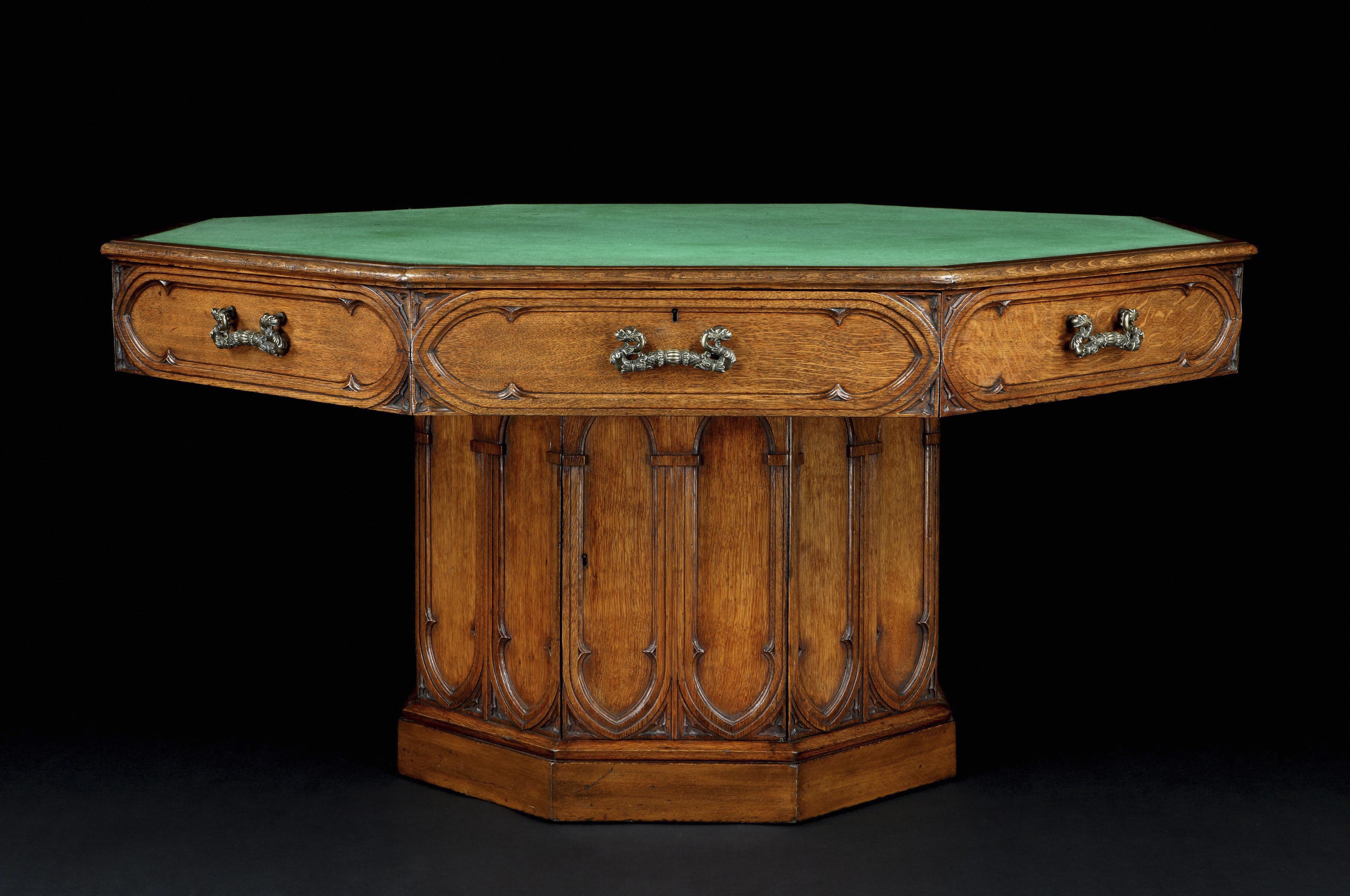
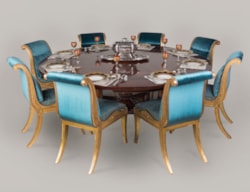
This royal table, sold by Butchoff Antiques, has all the hallmarks of Pugin's gothic revival. The table came from Windsor Castle, and has an inventory stamp from Queen Victoria's reign, dated 1873.
Rococo Revival emerged alongside the Gothic and reached its peak in the 1840s and 1850s. It revisited the cabriole leg of mid-eighteenth-century France, the deeply incised "finger-mouldings" that follow the curves of the wood, and naturalistic carvings of grapes, roses and acanthus. The distinction between an original Louis XV piece and a Victorian Rococo Revival cabinet matters both commercially and to the connoisseur. Revival pieces are heavier, more emphatic in their carving, and produced with the assistance of the band saw and steam-powered lathe rather than entirely by hand. Renaissance Revival followed in the 1860s and 1870s as a deliberate reaction against Rococo’s softness, favouring pediments, columns and heavy cresting, often with marquetry panels and gilt-bronze mounts; Italian craftsmen such as Giovanni Battista Gatti supplied elaborately inlaid cabinets to British and Continental collectors throughout the period. Tudor and Elizabethan revivals found their place in halls and dining rooms, where heavy oak with twist-turned columns evoked the perceived solidity of an older England. Each revival made its own argument about what English furniture ought to be, and the period accommodated all of them simultaneously.
Britain’s Great Cabinetmakers
Gillows of Lancaster supplied luxury furniture to the British market across the entire span of the Victorian era and well beyond. Founded by Robert Gillow in the 1730s, the firm was still producing pieces of the first rank into the 1890s. Its Lancaster workshops sat close to the docks and had first call on imported timbers, and a Gillows mahogany dining suite was understood throughout the period as a benchmark of quality. The firm’s stamp, with the company name divided by a small dot, came into use around 1795 and remains an important indicator of authentic Gillows pieces today; some examples carry an additional stamp identifying the journeyman, with names such as James Lawson recurring through the records. Thousands of design drawings and "Estimate Sketch Books" survive in the Lancaster archives, which is part of what makes secure attribution possible. Gillows also kept a London showroom on Oxford Street and supplied principal English country houses; after merger the firm became Waring & Gillows and continued in business into the twentieth century.
Holland & Sons of London was the comparable name in the south, descended from the cabinetmaker Thomas Dowbiggin whose name was retained on the firm’s letterhead until around 1902. Holland & Sons produced furniture for Buckingham Palace, the Houses of Parliament and the Royal Collection, and was the supplier of choice for nineteenth-century state commissions where quality and discretion were equally required.
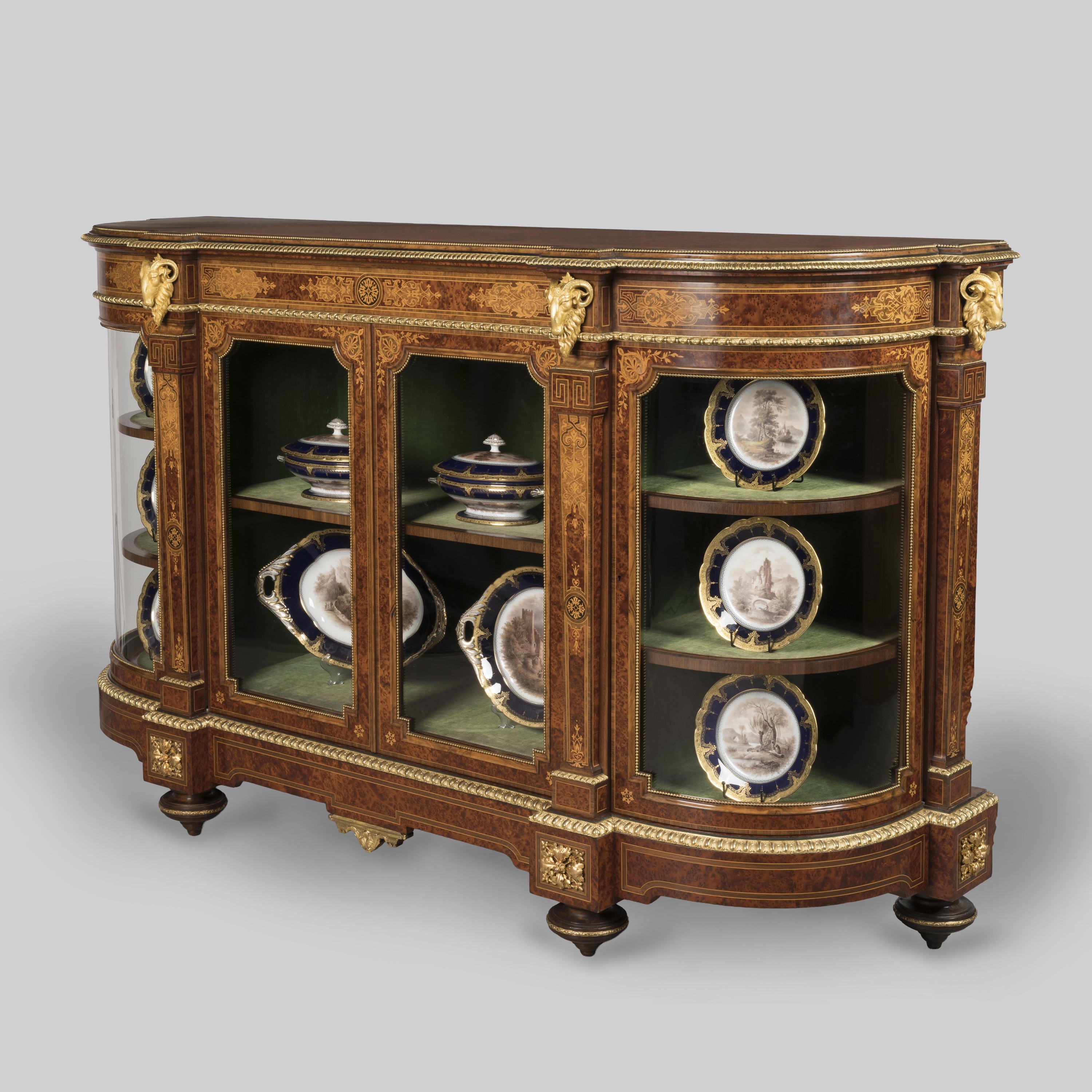
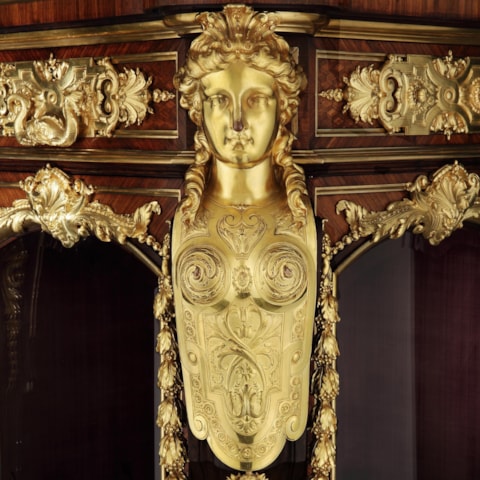
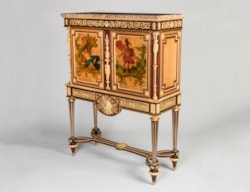
An Important Marquetry Side Cabinet, attributed to Holland & Sons, made for Whitbourne Hall in 1866. The cabinet bears many similarities to the royal furniture made for Marlborough House around the same time. Butchoff Antiques, London.
Jackson & Graham of Oxford Street was particularly associated with Louis XVI Classicism in revival form. The firm’s exhibition pieces were technically ambitious, and their work appeared at the Crystal Palace in 1851 and at later international exhibitions. Morel & Seddon, working in the 1820s and 1830s, supplied much of the furniture for Windsor Castle, often executing designs by A.W.N. Pugin, and produced the carved Liver Bird armchairs for Liverpool Town Hall in 1829 at a recorded cost of just over £501 for a set of forty. To these names should be added the Blake family of marquetry cutters, whose work from the 1820s onwards turns up in pieces by E.H. Baldock and others. The British Victorian trade was a network of interlocking workshops, and the best surviving pieces frequently passed through several hands before reaching the customer.
The Great Exhibition of 1851
The Crystal Palace did not invent the contradictions of Victorian furniture but it gathered them in one building. The most ambitious exhibits were the so-called "Virtuoso" pieces, made not for domestic use but to demonstrate a firm’s technical reach. Thomas Sopwith’s "Monocleid" cabinet, designed in the mid-1830s and exhibited at the Crystal Palace over twenty years later, took its name from the single key that operated its many locks at once; the design remained on the trade circuit and was copied into the 1840s and beyond. Gerrard Robinson exhibited carved sideboards whose panels held entire narrative scenes, the kind of object designed to be looked at for half an hour rather than glanced at over breakfast. Robinson kept making such pieces in the 1890s, long after taste had moved on. Jackson & Graham showed cabinets that combined Louis XVI Classicism with English execution, and several Indian and Chinese exhibits introduced to a mass British audience the lacquerwork, ivory inlay and bamboo forms that would feed the late-century vogue for the Anglo-Indian and the Aesthetic.
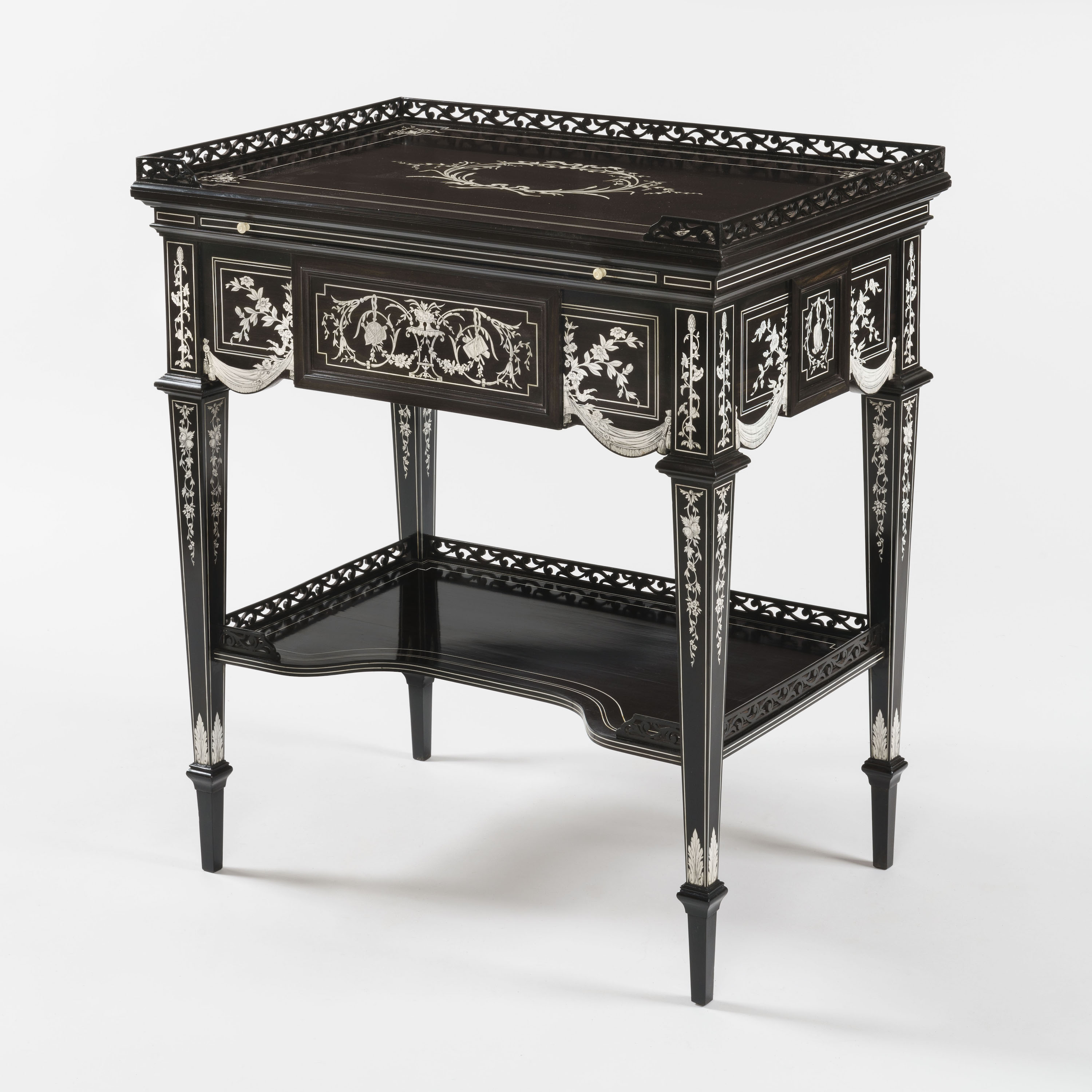
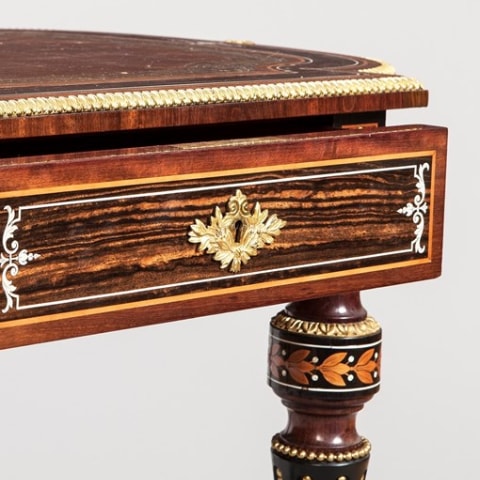
Absolutely faultess in execution, this ebony and ivory-inlaid Louis XVI style table attributed to Jackson & Graham represents the epitome of Victorian "virtuoso" furniture. The cabinetmaker, against all odds, has set himself the challenge of translating an 18th century ormolu-mounted table (today at Waddesdon Manor) in two dimensions simply using veneers and marquetry. Butchoff Antiques, London.
The reaction to all this was not entirely admiring. Henry Cole, who had organised much of the Exhibition, was among those who saw machine-replicated ornament as evidence of a coarsening of taste. So was the designer Owen Jones, whose response was more constructive. In 1856 Jones published "The Grammar of Ornament", a survey of decorative pattern drawn from Egyptian, Greek, Moorish, Indian, Chinese and medieval European sources, proposing a basis for design that was both historical and disciplined rather than the riot of mismatched ornament that had filled so many of the Crystal Palace exhibits. The institutional consequence was the founding of the South Kensington Museum in 1857, now the Victoria and Albert Museum, with the explicit aim of educating manufacturers and the public alike in what its founders considered correct principles. The Crystal Palace closed in October 1851, but its arguments about machine, ornament and taste remained in circulation for the rest of the century.
Material, Industry, and the Question of Taste
Mahogany held its position as the dominant Victorian timber, prized for its hardness, fine grain and the deep reddish patina it acquired with age. Rosewood, distinguished by its dark figured streaks and the floral scent released when freshly cut, was reserved for show pieces in the parlour and the smaller cabinet trade. Walnut found its way into bedroom suites, and oak became the timber of choice for Gothic Revival commissions and, later in the century, for the Arts and Crafts movement. The visible surface of all but the cheapest furniture was finished in French polish, a labour-intensive technique in which many thin layers of shellac dissolved in alcohol were rubbed onto the wood with a cloth-wrapped pad called a "rubber", building a glassy depth without burning the timber beneath. White or grey Carrara marble was set into washstand and dresser tops, and cast brass handles in teardrop or batwing form completed the standard hardware vocabulary.
The single most consequential interior innovation of the era was the coil spring, patented for furniture use in 1828. Set into a webbed seat frame and tied down beneath horsehair stuffing, the spring allowed for the deep tufted upholstery of the Victorian sofa and the gentleman’s library chair. Buttons pulled the upper cover down through the stuffing and anchored it to the frame, creating the puffed and indented surface that distinguishes Victorian seating from the harder forms of the previous century, with London upholstery firms such as Howard and Sons of Berners Street building reputations on the depth and longevity of their sprung seating. By the 1860s a deeply tufted parlour suite was within reach of any prosperous middle-class household.
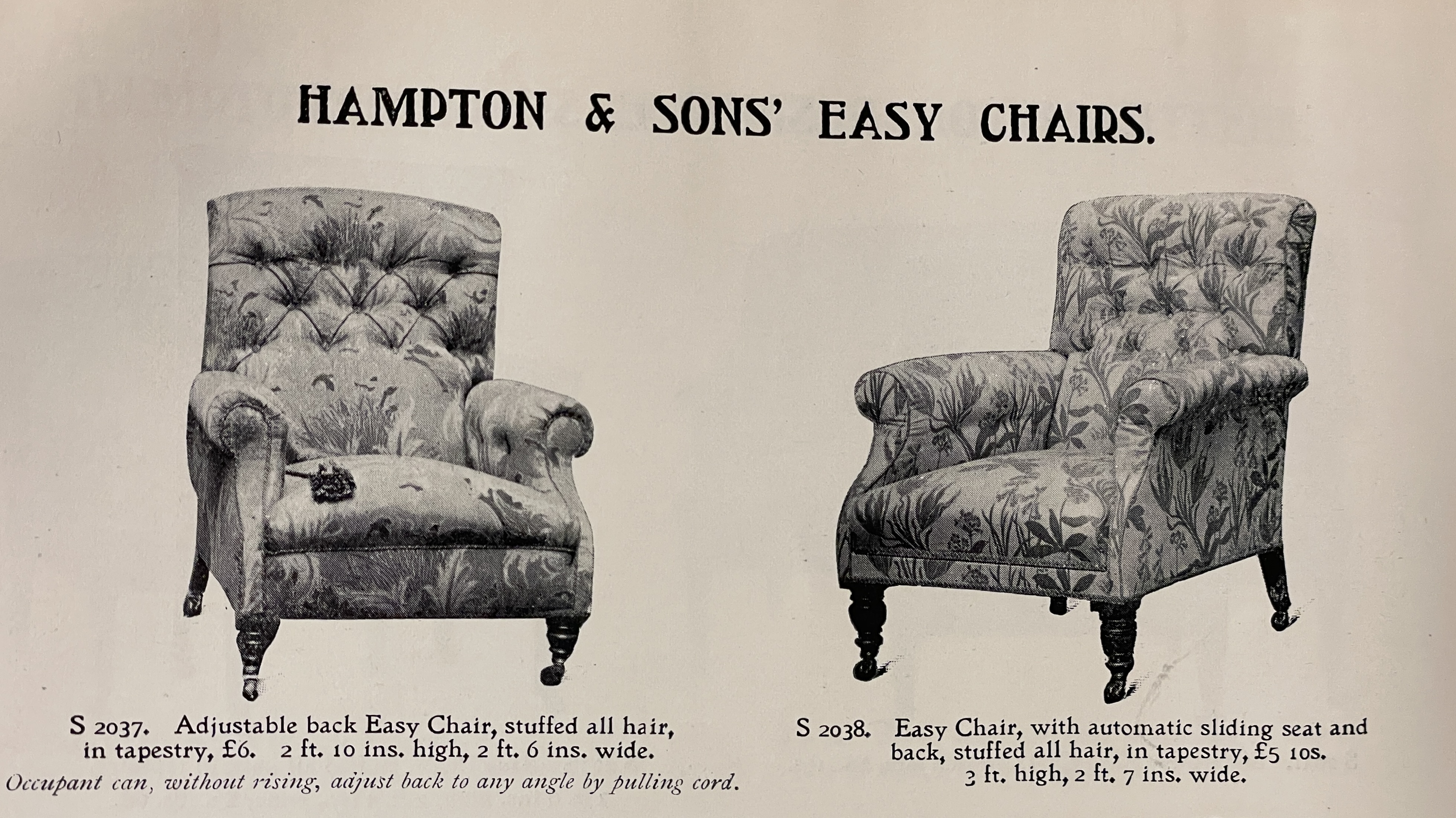
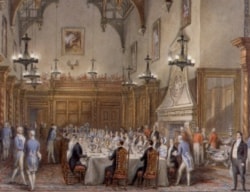
A catalogue from Hampton & Sons, showing the modern new coil sprung seating which was also famoulsy produced by competitors such as Howard & Sons. Catalogue scan from the Butchoff Antiques archive, London.
The industrial workshop transformed the production economy of furniture without entirely displacing the hand. The circular saw could cut veneers at a fraction of the cost and to a fraction of the thickness possible by hand. Steam-powered lathes produced turned legs and bobbin spindle work at volumes the workshop of 1830 could not have matched. The band saw, in widespread use from the 1850s, opened a more difficult possibility: mechanising the curved S-shaped components that had defined Rococo Revival cabinet making, work previously done with a hand-held bow saw. The cost of these gains was the slow displacement of the master cabinetmaker by the factory foreman. By the 1870s a single workman in a large London or Lancashire factory might do nothing but turning, or nothing but polishing, all day. The same machinery that produced a finely cut Gillows veneer also produced shallow paper-thin facings on cheap pine, painted to mimic flame-figured mahogany or, more brazenly, grained to imitate marble. The "honesty of materials" debate, audible in the criticism of the Crystal Palace and given its full intellectual form by John Ruskin, asked whether furniture should declare what it was, and would shape the next generation’s design reform.
The Reform Movement and the Aesthetic Turn
The first widely read response to the over-decoration of mid-Victorian taste came from Charles Eastlake, whose "Hints on Household Taste in Furniture, Upholstery and Other Details", published in 1868, sold steadily on both sides of the Atlantic for the better part of two decades. Eastlake argued for solid construction, simple geometry and a rejection of the factory-made imitations that had multiplied since the Crystal Palace. Furniture in what came to be called the Eastlake style favoured oak over rosewood and exposed joinery over French-polished surfaces. Chamfered edges replaced moulded ones, and decoration tended towards low-relief incised lines rather than the deep carving of the previous decades. It was a reform aimed squarely at the middle-class household.
The deeper intellectual argument came from William Morris, whose firm Morris, Marshall, Faulkner & Co. was founded in 1861 and reorganised as Morris & Co. in 1875. Morris’s hostility to factory production was not merely aesthetic but ethical, descending in a direct line from John Ruskin’s writings on the dignity of labour. He insisted on visible craftsmanship and on the medieval workshop model, in which the maker’s hand was present in every part of the object. The "Sussex" chair, a lightweight rush-seated armchair adapted from a country pattern and produced by Morris & Co. from the 1860s onwards, became the symbolic object of the Arts and Crafts movement: cheap to produce, easy to live with, and unmistakably the work of a hand rather than a machine.
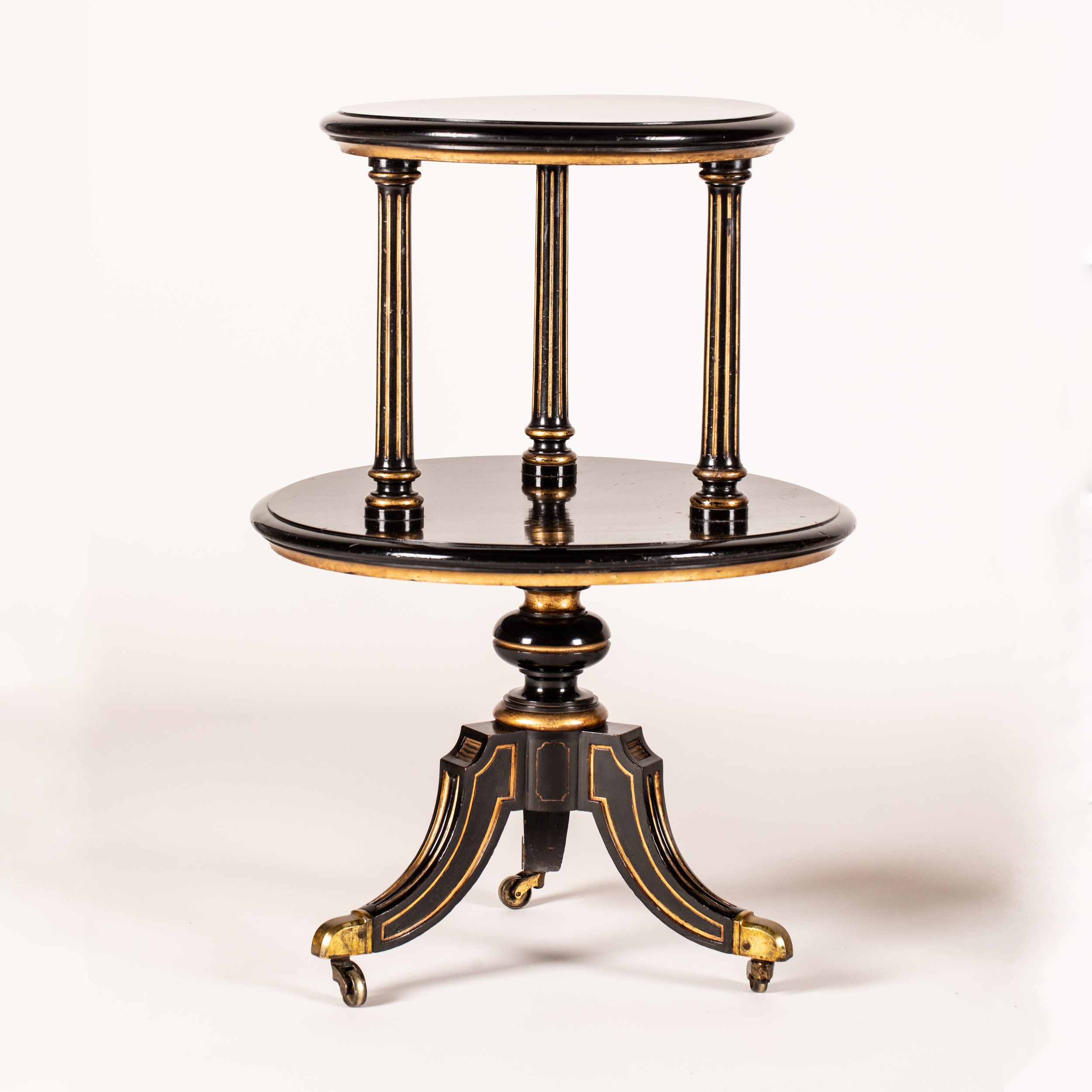
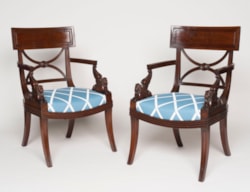
This black ebonised and lacquered table, one of a pair, with its incised ornament, replaced the dark and heavily carved furniture which was popular in the early Victorian period. Butchoff Antiques, London.
The Aesthetic Movement followed a different but related thread, drawing on the Japanese woodblocks and lacquerwork that began arriving in Britain in the 1860s and 1870s after the opening of Japanese trade. Designers such as E.W. Godwin worked in ebonised wood with sparse incised line and asymmetric form, in deliberate rejection of revival vocabulary; the Anglo-Japanese cabinet became a fixture of the more advanced drawing room. By the closing decades of the century the dense, dark, heavily carved furniture of the 1850s had ceased to be the unquestioned standard. Edwardian production, a pronounced lightening of touch already visible in the 1890s, would carry forward the discipline of the reform movement without its moralism. By 1900, ebonised forms, oak frames and pale upholstery had displaced the dense walnut and dark velvet of forty years earlier in the more advanced commissions.
Collecting Victorian Furniture Today
The Victorian market today is large and uneven. Anonymous mid-19th century trade furniture, plentiful in country auctions and provincial dealers’ rooms, sells at prices that often disappoint the consigning family; named workshop pieces, by contrast, have held their value and in many categories continued to appreciate. The difference is rarely visible at a casual glance. Both kinds of furniture may share the same dark mahogany, the same buttoned upholstery and the same revival vocabulary, but a Gillows dining suite stamped with the firm’s name and supported by a Lancaster archive entry occupies a different category entirely from an unattributed cabinet of similar form.
For collectors and interior designers approaching the period, a few points of close attention repay the effort. Maker stamps, brand burns and labels are the starting place: Gillows of Lancaster, Holland & Sons, Jackson & Graham and Edwards and Roberts sometimes marked their work, and the presence of a stamp can affect value. Nevertheless, quality remains of absolute importance whether a piece is stamped or not. The condition of the original finish matters almost as much. Old polish that has been stripped and replaced loses much of the lustrous depth that distinguished the surface in the first place, and overcleaned brass mounts read as later interventions. Provenance, where it can be documented through house sale records, commission ledgers and family inventories, makes the difference between an attribution offered with confidence and one offered with hope.
The strongest Victorian furniture, particularly the named cabinetwork of the principal London and Lancaster firms and the early Gothic Revival pieces of the Pugin circle, continues to occupy serious auction sales. Pieces of comparable quality from the eighteenth century are often unobtainable to all but the largest collectors; the best Victorian equivalents remain available through specialist dealers such as Butchoff Antiques.
Written by Rainier Schraepen