Vip access

 Favourites



















A Regency Mahogany Four Door Bookcase


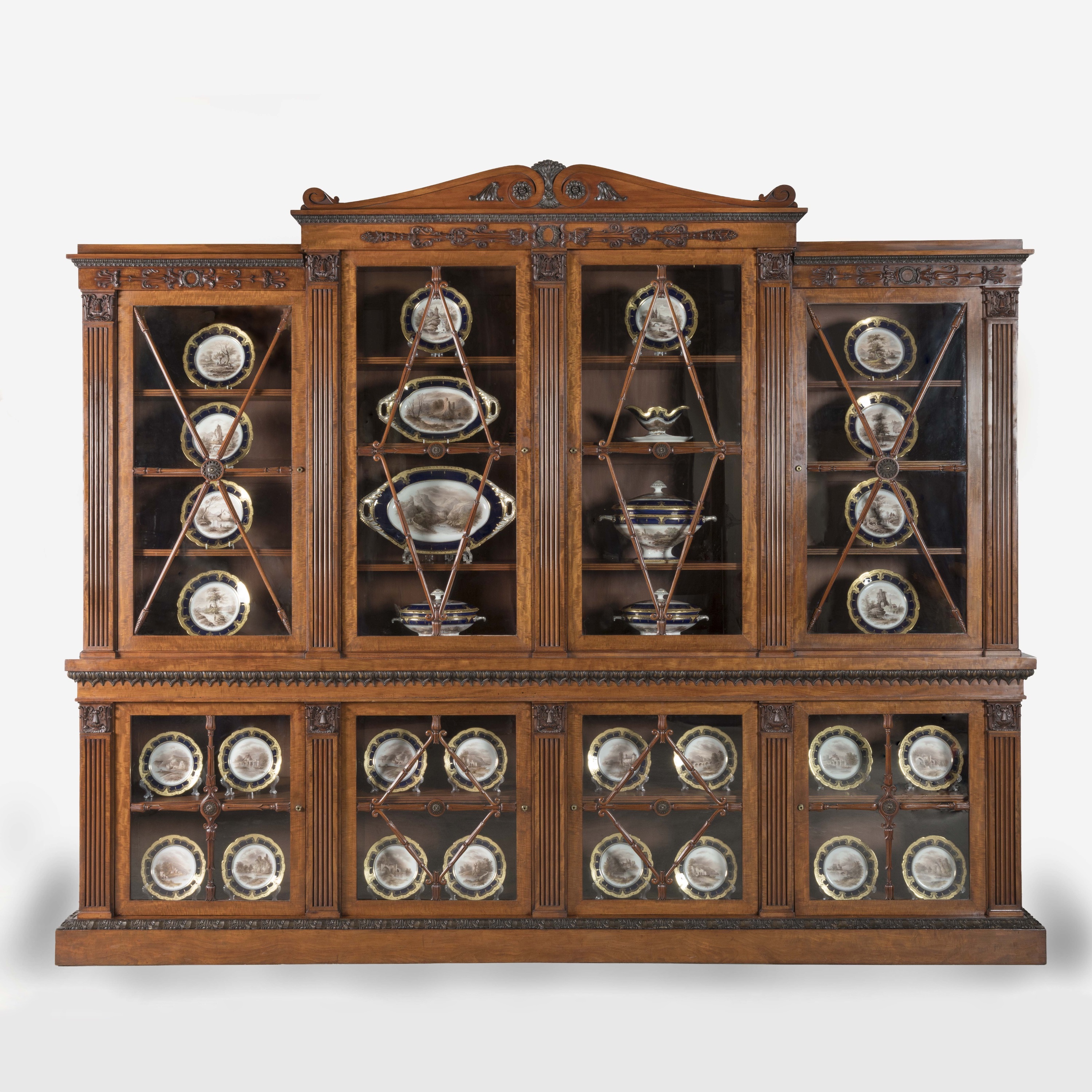


A Regency Mahogany Four Door Bookcase
Dimensions: H: 100.5 in / 255 cm | W: 124 in / 314 cm | D: 17.5 in / 44 cm

A Regency Mahogany Four Door Bookcase
Constructed from a striking flamed mahogany, with applied patinated carving and bronze mounts throughout; the central scrolled pediment atop with a radiating acroterion flanked by rosettes above a tripartite stepped frieze decorated with Victory laurels, the central pair of glazed doors with lozenge astragal mullions flanked by a single glazed door to either side with corresponding radiating astragals, each separated by fluted pilasters, enclosing an adjustable shelved interior; the lower register of conforming quadripartite division below a crisp patinated water leaf moulding, the square glazed doors with conforming cross and lozenge astragal mullions, dwarf pilasters, and each enclosing a single adjustable shelf. The locks stamped ‘J. Bramah / 14 Piccadilly.’
English, circa 1815
This bookcase undoubtedly represents the epitome of Regency period cabinetmaking, both in terms of its construction and its design. With a harmonious decorative scheme marrying the most fashionable design sources and incorporating both Greco-Roman and Egyptian revival elements, this bookcase was surely destined for clients of superlative taste and refinement.
The applied wreath mount to the upper frieze is a recurring Regency motif, while the use of naturalistic tendrils and lotus bud forms on the astragal bars and pilasters reflects the period’s inventive adaptation of Greco-Roman and Egyptian Revival elements. Related designs appear in Nicholson’s Practical Cabinet-Maker (1826), particularly the ‘Library Bookcase & Secretaire’ which employs a comparable use of pilaster detail and wreath ornamentation. The scrolled pediment echoes George Smith’s 1808 design for a ‘Dwarf Wardrobe’ (Collections of Design for Household Furniture), while the glazed doors, with their distinctive arrangement of diamond and cross motifs, present an uncommon variation on the traditional astragal scheme.
Bookcases with glazed upper as well as lower registers are exceedingly rare, and this unusual feature suggests it was designed to be equally useful as a display cabinet for costly items such as Grand Tour souvenirs or large porcelain collections. Indeed, the fact that the full depth of each shelf is finished to a high degree supports this theory, as bookcases typically only have the front edge veneered in costly veneers, as the bare shelves would be hidden from view.
The only other known glazed upper/lower bookcase, sharing several other formal features with the Butchoff example, is the Regency period display case in the South Sketch Gallery at Chatsworth House. It was likely supplied by Morel & Hughes and relates to another mahogany bookcase (incorporating a concealed door) ordered by the 5th Duke of Devonshire for his London home (probably supplied by Marsh & Tatham). The South Sketch Gallery display case did not start its life there, as it is absent in a photograph of c.1890. It first appears in a watercolour from 1822 by William Henry Hunt, in the morning room, suggesting the 6th Duke ordered it for the display of his mineral collection, referring to it as a “glass bookcase.”
Provenance:
Christie’s, London, 18 November 1993, lot 100
Comparative Literature:
Nicholson PA, Nicholson MA. The Practical Cabinet-Maker, Upholsterer, and Complete Decorator. London; 1826. New York Public Library digital edition.
Smith G. Collections of Design for Household Furniture. London; 1808. Illustrated in: Harris J. Regency Furniture Designs from Contemporary Source Books, 1803–1826. London; 1961:fig 176.
You may also like


A Good Regency Secretaire Bookcase
A French Revolving Library Bookcase
A Carved Mahogany Cabinet Bookcase in the George II Manner
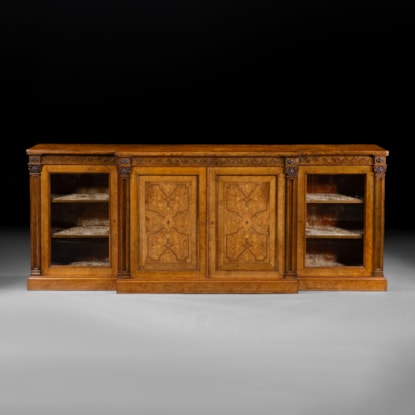
A Substantial Pollard Oak Library Bookcase
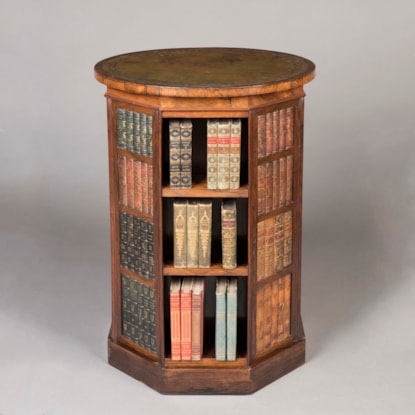
A Rosewood Revolving Bookcase Of the George IV Period
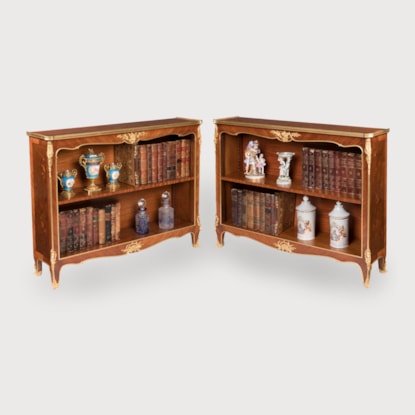
A Fine Pair of Ormolu-Mounted Open Bibliothèques
Recently viewed