Vip access

 Favourites



















Collection / Lighting / Chandeliers
A Pair of French 8-Light Chandeliers In the manner of André-Charles Boulle


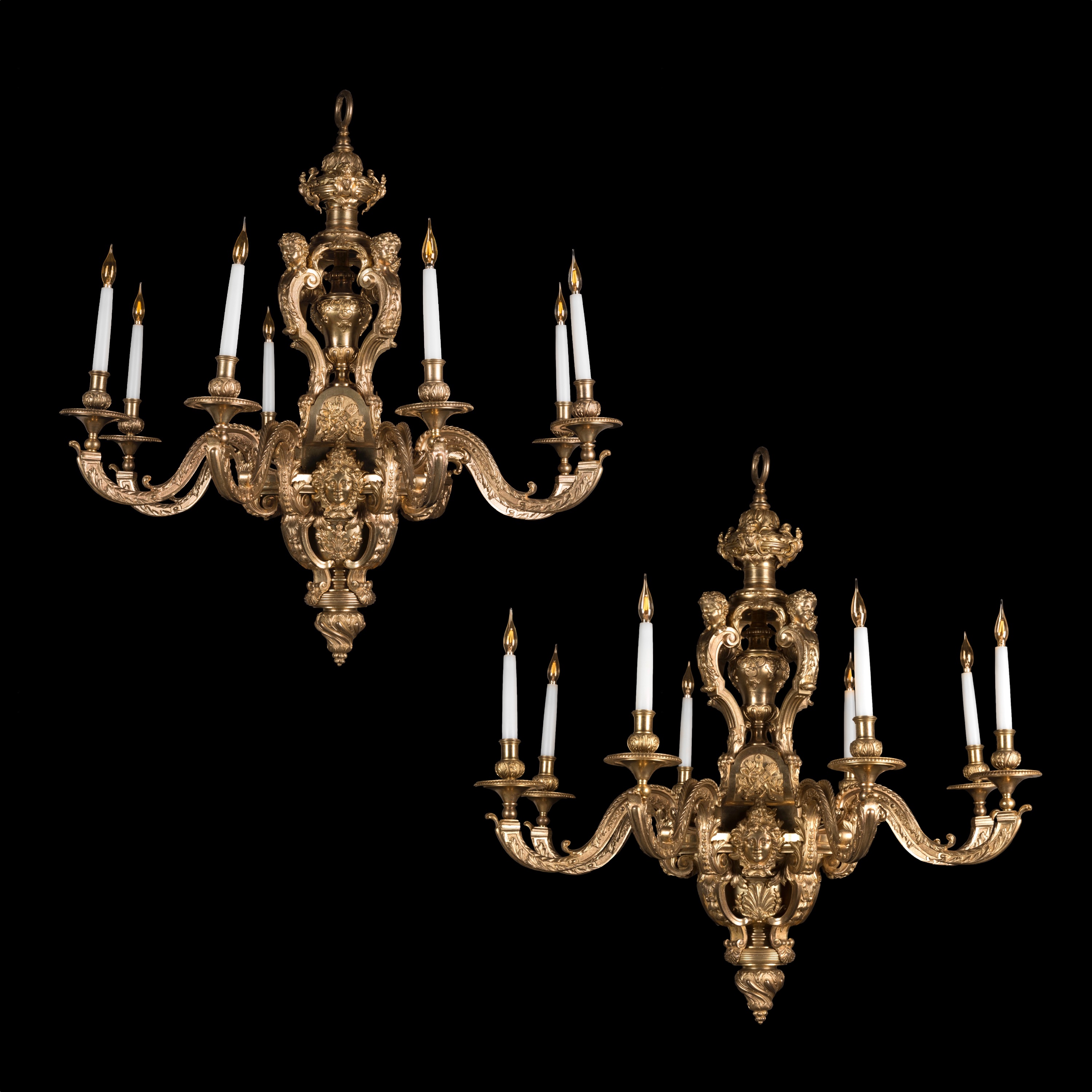


A Pair of French 8-Light Chandeliers In the manner of André-Charles Boulle
Dimensions: H: 39.5 in / 100 cm | Dia: 37 in / 94 cm
PRICE: £58,000

A Pair of French 8-Light Chandeliers
In the manner of André-Charles Boulle
Cast from bronze, hand-chased and mercury fire gilded, each chandelier having eight S-scroll arms with acanthus leaf decoration, the arms interspersed by a mask of Spring around the central stem, with trophies symbolic of love on the platform which supports the lion paw consoles terminating in Bacchus terms with a baluster vase at its centre.
French, circa 1890
The prototype for this chandelier was created c.1710-1720 by André-Charles Boulle, with important examples found in the Swedish royal collections and the Louvre (OA 5101). A period pair was created for Château de Rambouillet for the comte de Toulouse, one of Boulle's greatest clients. The château was later sold to King Louis XVI, with the chandeliers transferred to Château de Fontainebleau in 1804 during Napoleon's reign.
André-Charles Boulle (1642-1732)
André-Charles Boulle was received as a Maître Ébéniste in 1666, quickly becoming known as 'the most skilful artisan in Paris', and was appointed 'Ébéniste du Roi' in 1672, when he became a resident of the Louvre Palace, and was granted the especial privilege of being permitted to work in both bronze and wood. Although not the inventor of the method of inlaying the combination of ebony, tortoiseshell and brass, his ability and creativity in the medium became at once associated with the patronymic --'Boulle.' Many of his masterpieces are represented in national museums and prestigious Royal collections throughout the world.
Comparative literature:
Ottomeyer, Hans, Jean-Dominique Augarde, and Peter Pröschel. Vergoldete Bronzen : Die Bronzearbeiten Des Spätbarock Und Klassizismus. München: Klinkhardt & Biermann, 1986, p. 52 (fig. 1.6.6).
Ronfort, Jean Nérée. André Charles Boulle, 1642-1732: A New Style for Europe. Paris: Somogy; Frankfurt am Main: Museum für Angewandte Kunst Frankfurt, 2011, pp. 264-267 (cat. 31).
You may also like


A Pair of Sixteen Light Ormolu Chandeliers in the Gothic Manner
A Twenty Four Light Ormolu Chandelier
An Ormolu Lantern in the Louis XV Manner
A Late Georgian Chandelier by Messenger & Phipson
A Good Hall Lantern in the Louis XVI Manner
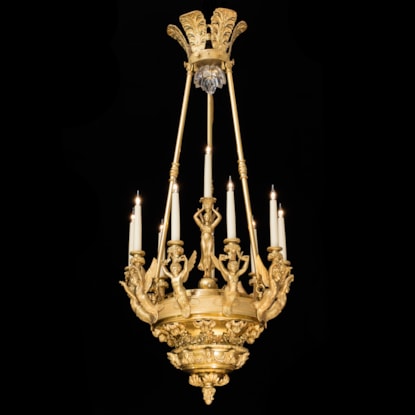
A French Empire Style Ormolu 10-Light Chandelier
Recently viewed