Vip access

 Favourites


















Collection / Commodes & Chests / Chest of Drawers
A French Commode in the Louis XV Manner Attributed to Zwiener


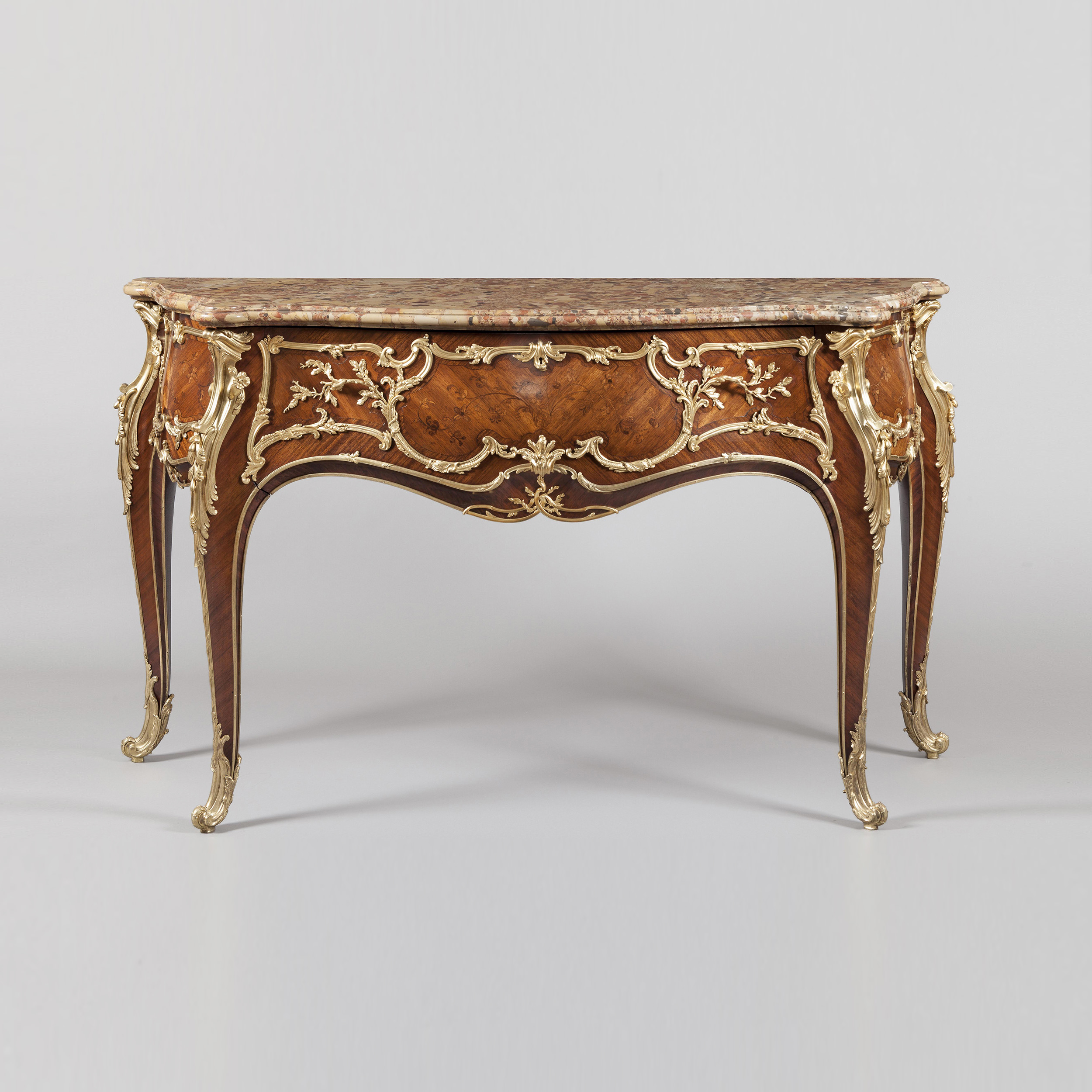


A French Commode in the Louis XV Manner Attributed to Zwiener
Dimensions: H: 37 in / 94 cm W: 63 in / 160 cm D: 24 in / 61 cm

A French Commode in the Louis XV Manner
Attributed to Zwiener
Of serpentine fronted, 'sauteuse' form, constructed in kingwood with fine marquetry foliate work, and dressed with gilt bronze mounts; rising from cabriole legs, with the swept bronze sabots issuing bound cannellures conjoining the scrolled espagnolettes at the shoulders; a single lockable drawer having a shaped apron, adorned with bronze mounts encloses foliate marquetry work, with conforming adornment and shaping to the sides; having a Brèche d'Alep shaped marble platform, with a double thumbnail moulding to the edge.
French, circa 1890
Zwiener of Paris
The Zwiener workshop in Paris, established by brothers Emmanuel (born Joseph-Emmanuel) Zwiener (1849-1925) and Julius Zwiener (1867-1922), ranks among the best haute luxe Parisian cabinetmakers of the late 19th century. Originally from Herford, Germany, they arrived in Paris by 1880 and set up a workshop at 12 rue de la Roquette.
Working in several styles fashionable in Paris at the time, they copied mainly Louis XV pieces from public collections, adapting them in their own exuberant interpretation of Rococo. At the Exposition Universelle in Paris in 1889, the firm received the gold medal and a note of high praise from the jurists: "dès ses débuts d'une Exposition universelle, il c'est mis au premier rang par la richesse, la hardiesse et le fini de ses meubles incrustés de bronzes et fort habilement marquetés". By personal request of the Kaiser, Julius Zwiener returned to Germany at the end of the century in 1895, where he became Hof-Ebenist (Court Cabinetmaker).
Back in Berlin, Zwiener made a suite of furniture for the Kaiser, which was exhibited to Germany's credit at the 1900 Paris Exhibition. The remaining brother in Paris, Emmanuel, sold the workshops to Jean-Henri Jansen, of the eponymous Maison Jansen, around this time, styling themselves as Maison Zwiener, Jansen successeur, producing furniture throughout the first quarter of the 20th century.
Zwiener almost certainly employed François Linke, who was six years younger and a fellow German-speaker. The Pankraz Gedenkbuch mentions Linke as "working in Paris with a German master".
Comparative Literature:
Meiner, Jörg. Berliner Belle Époque : Der Ebenist Julius Zwiener Und Die Kunstmöbel Für Den Hof Kaiser Wilhelms II. (1888-1918). Imhof, 2014, p. 38 (illus. fig. 40), showing a related secretaire by Zwiener.
You may also like


A Pair of French Antique Mahogany & Ormolu Commodes
A Fine Commode in the Louis XV Manner
A Very Fine Louis XVI Style Commode in the Manner of Riesener
A Fine Satinwood Serpentine Chest of Drawers Of the George III Period
A Fine Pair of Mahogany Wellington Chests Attributed to Gillows
A Burr Walnut Wellington Chest By Holland & Sons
Recently viewed