Vip access

 Favourites



















Collection / Dining Furniture / Dining Chairs
The Luton Hoo Dining Chairs


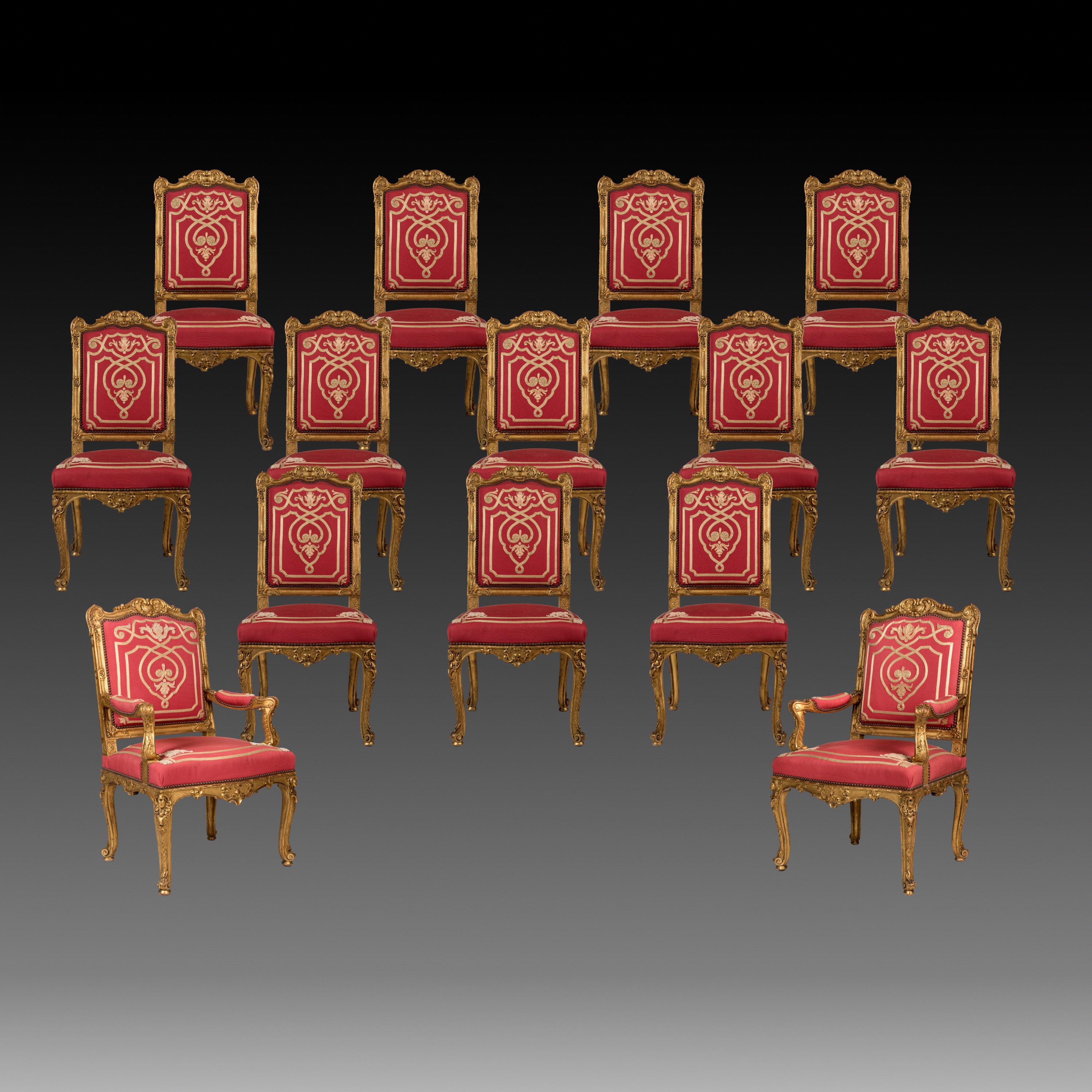


The Luton Hoo Dining Chairs
Dimensions: H: 43 in / 109 cm | W: 21 in / 53 cm | D: 20 in / 50 cm
PRICE: £90,000

The Luton Hoo Dining Chairs
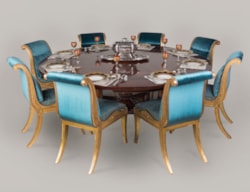
A set of fourteen giltwood dining chairs, consisting of two armchairs and twelve side chairs, of Régence style combining straight lines with fluid curves, the cabriole legs having scrolled feet, carved with stylized acanthus cabochons to the knees and further foliate decoration on the undulating apron, the backrests of rectilinear form with serpentine toprail with a shell cresting flanked by stylised acanthus leaves and having carved and scrolled ornament to the corners with floral relief carving among the crosshatched panelled uprights; the armchairs with padded armrests of scrolled form with conforming carved details.
English, circa 1850
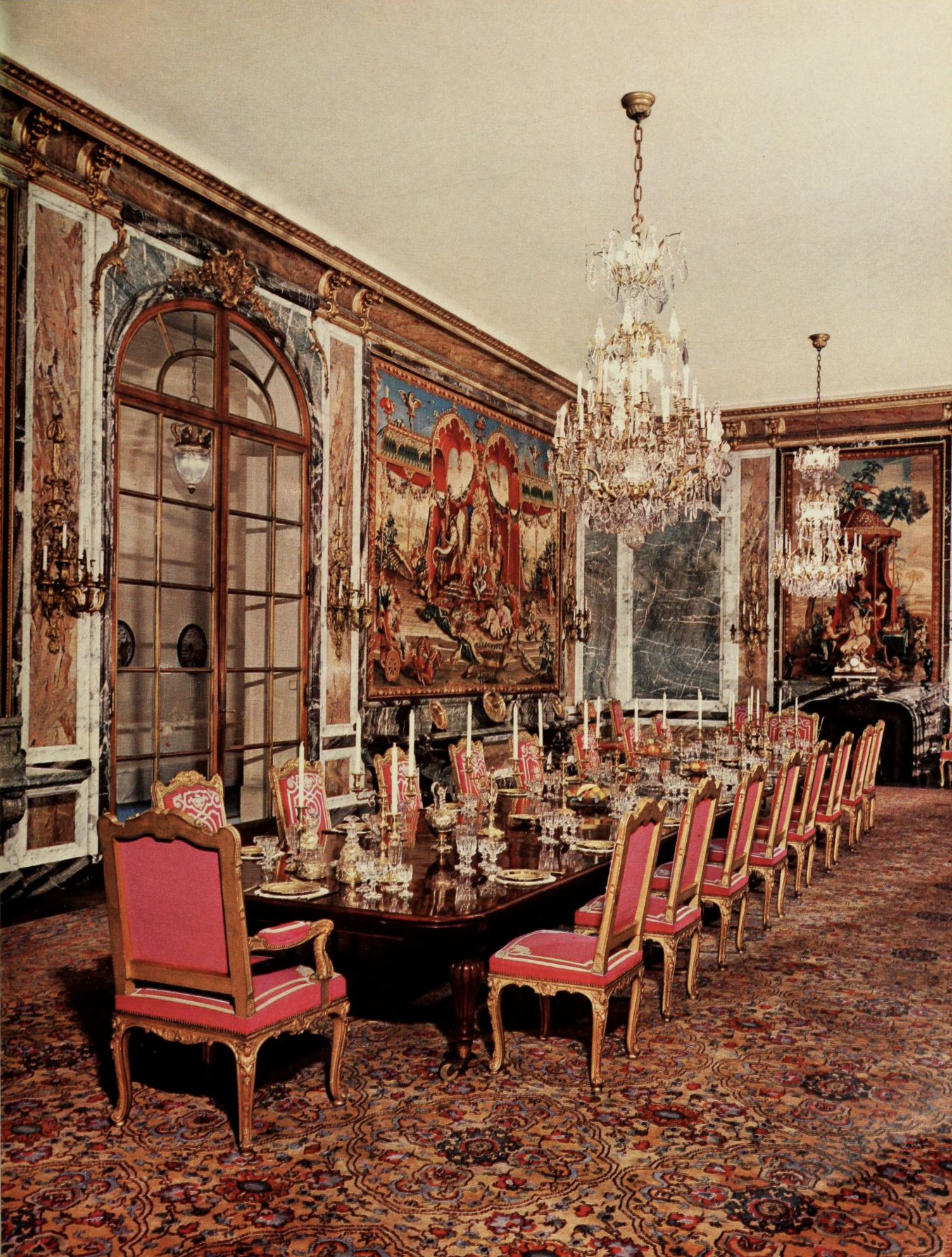
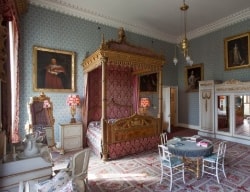
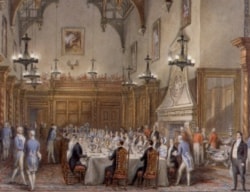
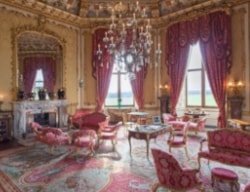
Pictured in the State Dining Room at Luton Hoo in 1975.
(from Luton Hoo: The Wernher Collection, by M. U. Smith,
‘Pride of Britain’ Series)
Provenance
Sir Julius Wernher, 1st Bt. (1850-1912), Luton Hoo, Bedfordshire, in the Dining Room, by whom bequeathed, through his widow Alice, Lady Wernher, subsequently Lady Ludlow (1862-1945), to their son
Sir Harold Wernher, 3rd Bt., G.C.V.O. (1893-1973), Luton Hoo, Bedfordshire, in the Dining Room (where documented in the 1949 inventory described as 'Louis XV') and by descent
Christie's, London 7th July 2000, Works of Art from the Wernher Collection, lots 135 and 136.
Luton Hoo
Sir Julius Wernher, having amassed an immense fortune through the South African diamond trade, acquired Luton Hoo in 1903 to complement his London residence, Bath House on Piccadilly. Determined that the house should provide a suitably magnificent setting for his expanding collection of fine and decorative arts, he commissioned a complete remodelling of the Robert Adam-designed interiors by the architects of London's Ritz Hotel. The result was an interior of notable opulence, conceived as a grand backdrop for a collection rivalled only by that of the Rothschild family in neighbouring Buckinghamshire.
At the time of his death, Wernher was counted among the wealthiest men in England, his fortune estimated at £12 million. A substantial memorial to him stands at the entrance to the Royal School of Mines in London, reflecting both his success and his philanthropic legacy. Today, a significant portion of his celebrated collection may be viewed at Ranger's House in Greenwich.
Régence Prototypes
Based on earlier 18th century prototypes, when famous makers such as Foliot were supplying furniture to King Louis XV, this set exemplifies the gradual introduction of curves, elegance, and rococo detail into fashionable seating furniture. They are stylistically related to a set of twelve caned beech chairs made for the King's Dining Room at the Chateau de Compiegne in 1739.
Born into a family of master carpenters and sculptors, Nicolas Quinibert Foliot (1706-1776) is known today as one of the most innovative craftsmen of his time. His workshop was undoubtedly one of the most prosperous and remarkably long-lasting for the 18th century, remaining active for nearly forty years. For much of his career, he supplied the most prominent figures at the French court, furnishing the palaces of Versailles, Compiègne, and Fontainebleau. He earned the prestigious title of Cabinetmaker to the Royal Furniture Repository.
You may also like


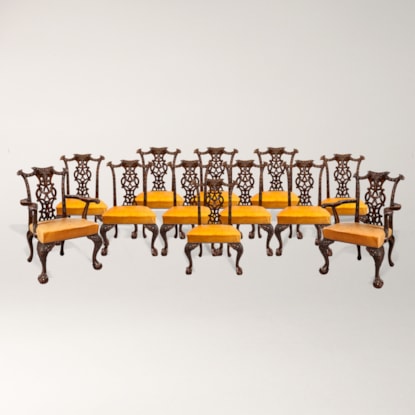
An Excellent Long Set of Carved Mahogany Dining Chairs
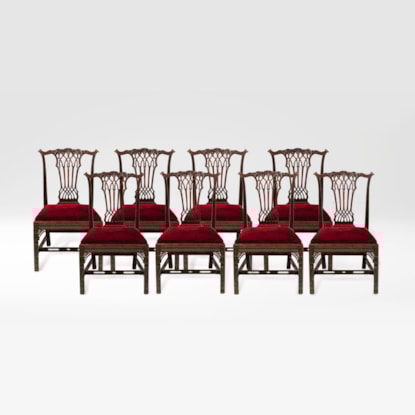
A Set of Eight Side Chairs in the Georgian Gothick Manner
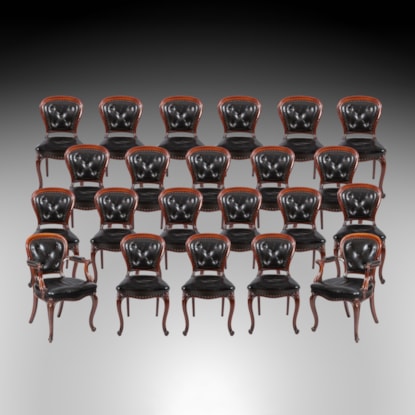
A Large Set of 22 Mid-19th Century Dining Chairs
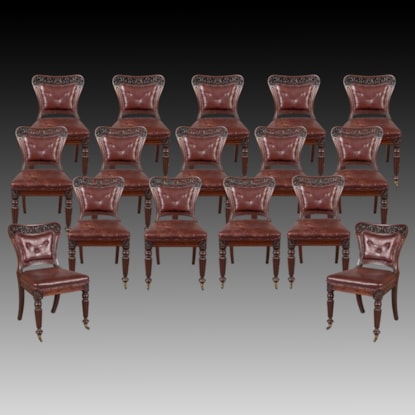
A Set of Sixteen Late Georgian Dining Chairs Attributed to Gillows
A Fine Set of Twelve George III Period Mahogany Dining Chairs
A Fine Set Of 10 George III Dining Chairs
Recently viewed