Vip access

 Favourites


















Collection / Lighting / Wall Lights
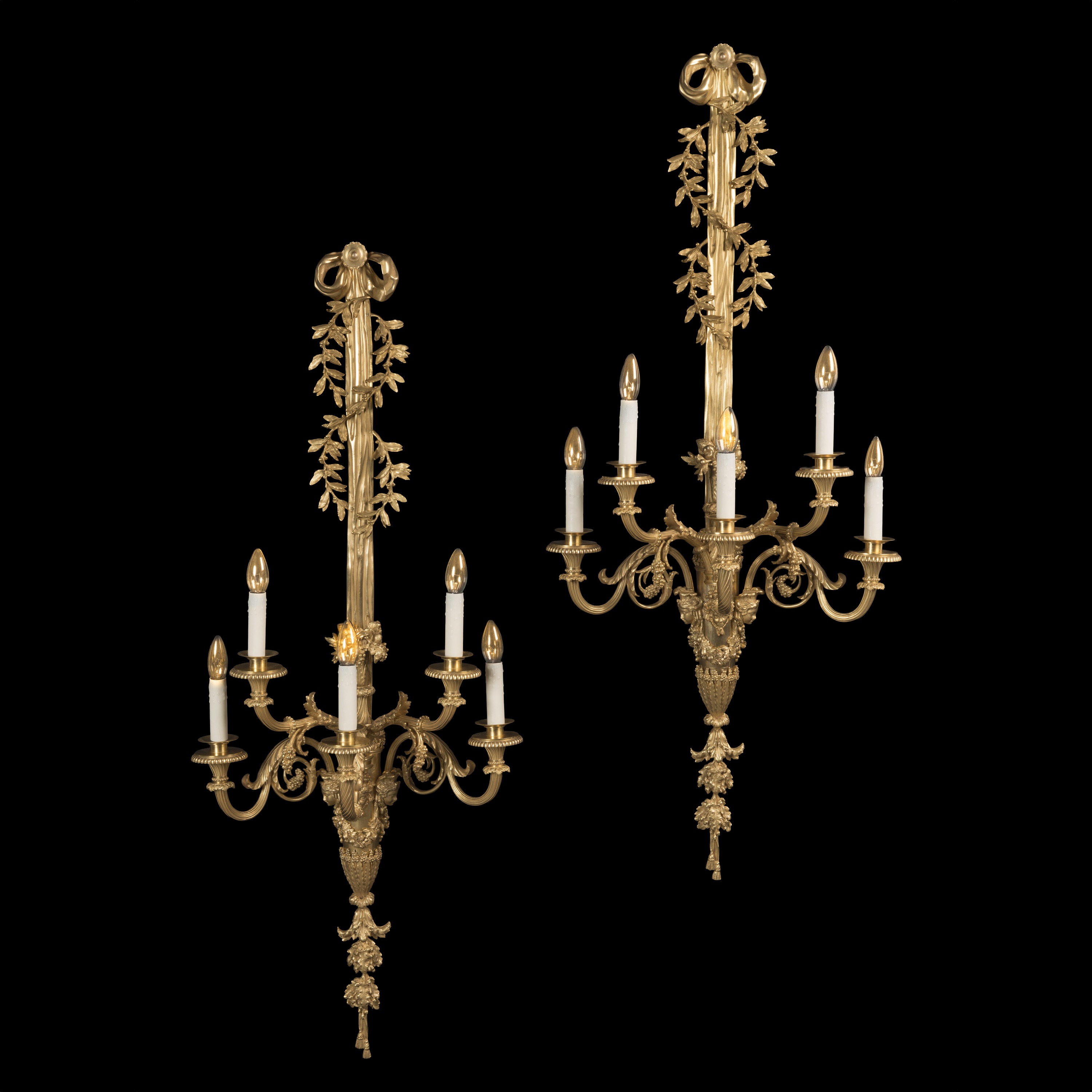
A Rare Oversized Pair of Ormolu Wall Lights in the Louis XVI Manner




A Rare Oversized Pair of Ormolu Wall Lights in the Louis XVI Manner
Dimensions: H: 53 in / 135 cm | W: 21 in / 53 cm | D: 12 in / 30 cm
PRICE: £45,000

A Rare Oversized Pair of Ormolu Wall Lights
in the Louis XVI Manner
Originally designed by Pierre-Philippe Thomire (1751-1843)
For the King’s Gaming Room
At Château de Saint-Cloud
Constructed in gilt bronze; the five arms of serpentine form issuing from slender fluted urn-shaped backplates dressed with floriate garlands and women's faces terminating in pendant fruiting garlands and tassels; the whole suspended from lovers' bow terminals.
French, circa 1885
This spectacular pair of palatial five-light wall lights is a masterful 19th-century interpretation of one of the most celebrated designs of the Ancien Régime. Executed on a grand scale roughly one-fifth larger than the 18th-century originals, this pair reflects the historic revival of Louis XVI craftsmanship championed by Empress Eugénie.
The historical model for these appliques was created in 1787 by the famous bronzier Pierre-Philippe Thomire under the direction of Jean Hauré. Commissioned for 5,388 livres, three identical pairs were delivered to the Château de Saint-Cloud for Louis XVI’s Gaming Room during a major redecoration project spearheaded by Marie-Antoinette. The design was detailed in the 1789 royal inventory as featuring a central vase topped with a cornucopia of fruits and flowers, surrounded by scrolled branches with gadrooned nozzles, and suspended from a trompe-l'œil ribbon sash.
Following the French Revolution, these lights were prized as examples of artistic excellence and were frequently relocated. Empress Eugénie famously installed one of the original pairs in her bedroom at Saint-Cloud, and ownership was later transferred to the Louvre Museum in 1901. Since 1974, they have hung in the Reception Room of the Petit Trianon at Versailles, while another rare Louis XVI pair is on view at the J. Paul Getty Museum. The enduring fame of Thomire’s design inspired premier 19th-century bronziers to reproduce the model, with notable copies now residing in the Wallace Collection, and another smaller pair signed and dated 1887 by Henry Dasson previously with Butchoff Antiques.
You may also like


A Pair of Louis XVI Style Wall Appliques
A Pair of French Ormolu Wall Appliques

A Pair of Russian Ormolu Wall Lights
Recently viewed