Vip access

 Favourites


















Collection / Tables / Round & Gueridon
An Exhibition Quality Centre Table Attributed to Jackson & Graham


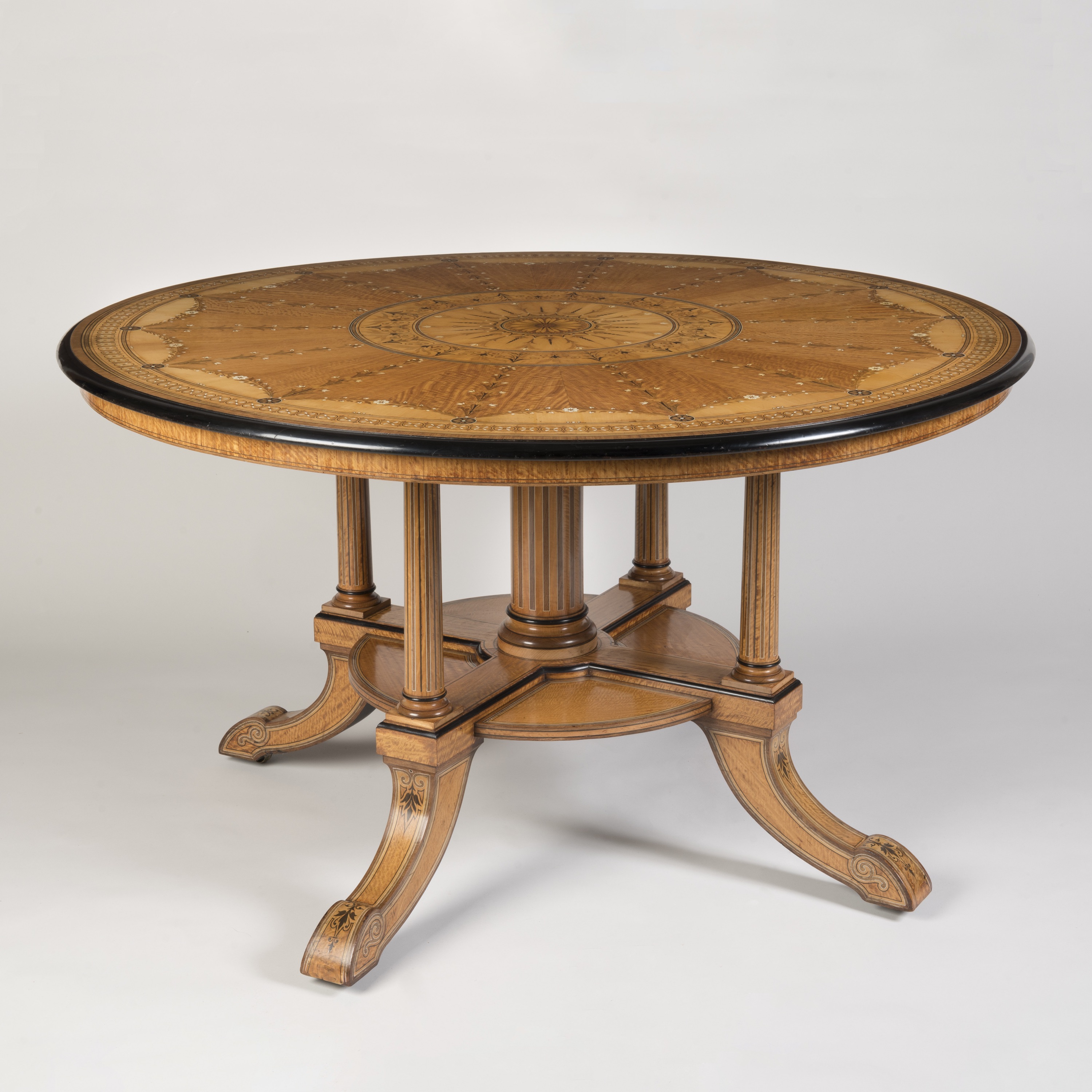


An Exhibition Quality Centre Table Attributed to Jackson & Graham
Dimensions: H: 30.5 in / 77.5 cm | Dia: 50 in / 127 cm

An Exhibition Quality Centre Table
Attributed to Jackson & Graham
Their display is 'Composed of the Choicest materials and exhibiting perfect workmanship'
--The Magazine of Art, 1867
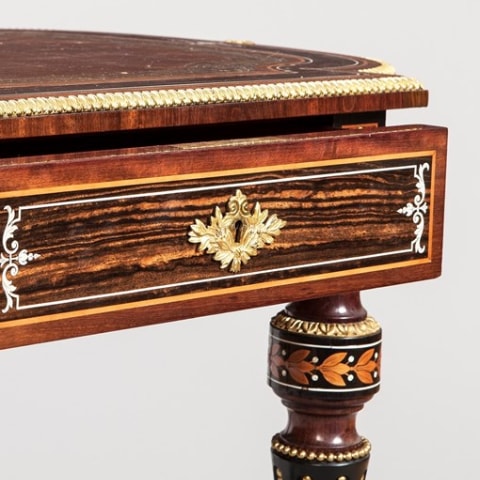
Constructed in Satinwood, with extensive use of holly, purpleheart, harewood and bone in the inlaid decoration, and having ebonised highlights. Of circular form, and rising from a quadrapartite swept footed base, supporting a cruciform platform connected by quadrant fans, with a central circular and ring turned column and four similar columns to the extremitie all inlaid with rectilinear faux-fluting. The top having an ebonised thumbail moulded edge and crossbanded with purpleheart, inlaid with striking concentric designs radiating outwrds from a central geometric flower, with reserves of foliate motifs taken from the design of Owen Jones, including berried mistletoe and scroling rinceaux.
English, circa 1870
This table belongs to an important group of furniture designed and made in London from the late 1860s to the early 1870s, including the tables presented at the 1867 Paris Exhibition and at the 1872 London Exhibition by the firm of Jackson & Graham.
A nearly identical table, although with less extensive marquetry, previously with Butchoff Antiques, is published in Christopher Payne's 'British Furniture 1820-1920: The Luxury Market,' p. 292-293
Jackson & Graham
The firm of Jackson & Graham was established in 1836 by Thomas Jackson and Peter Graham at 37 Oxford Street, London. Over the next fifty years, they produced furniture of exceptional quality and represented Britain at many of the international exhibitions of the nineteenth century.
Their clientele included Queen Victoria, Napoleon III, the Grand Khedive of Cairo, and the royal palace in Siam. The firm became renowned for its refined marquetry, the use of Wedgwood plaques, ivory inlay, rare timbers, and finely cast bronze mounts.
They collaborated with many of the leading designers of the period, including Owen Jones, Bruce Talbert, Alfred Lormier, and Eugene Prignot. By the mid-1850s, the firm employed 250 workers; by 1875, that number had risen to 600.
Celebrated exhibitors at the Great Exhibitions, they were frequent prize winners. At the Paris International Exhibition of 1878, the jury remarked: "the workmanship is so perfect that even with the aid of a magnifying glass scarcely the slightest imperfection is to be found."
In 1885, the company was absorbed by Collinson & Lock.
You may also like


A Pair of Étagères
A Pair of Tables Ambulantes In the Transitional Style
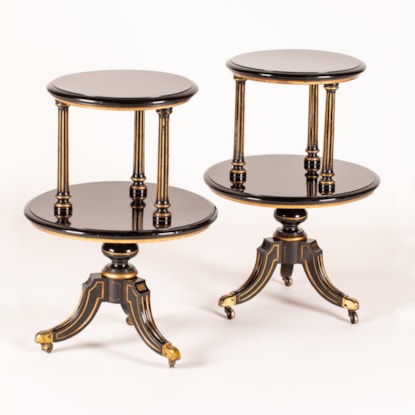
A Pair of Black Lacquered Étagères In the Early Aesthetic Manner
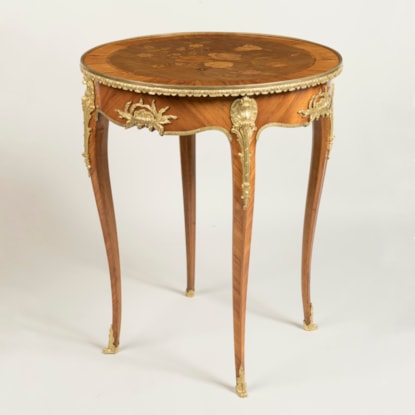
A Very Fine Marquetry Inlaid Occasional Table by François Linke

A Louis XVI Style Ormolu-Mounted Table
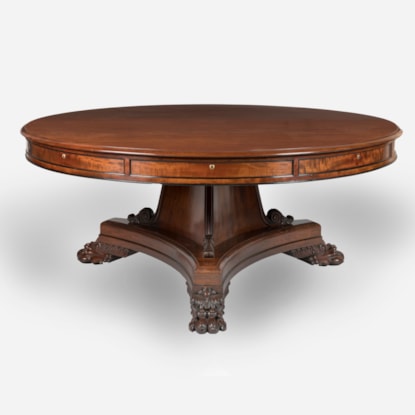
A Substantial Drum Table Attributed to Gillows
Recently viewed