Vip access

 Favourites


















Collection / Tables / Round & Gueridon
A Pair of William IV Period Amboyna Occasional Tables Attributed to T & G Seddon


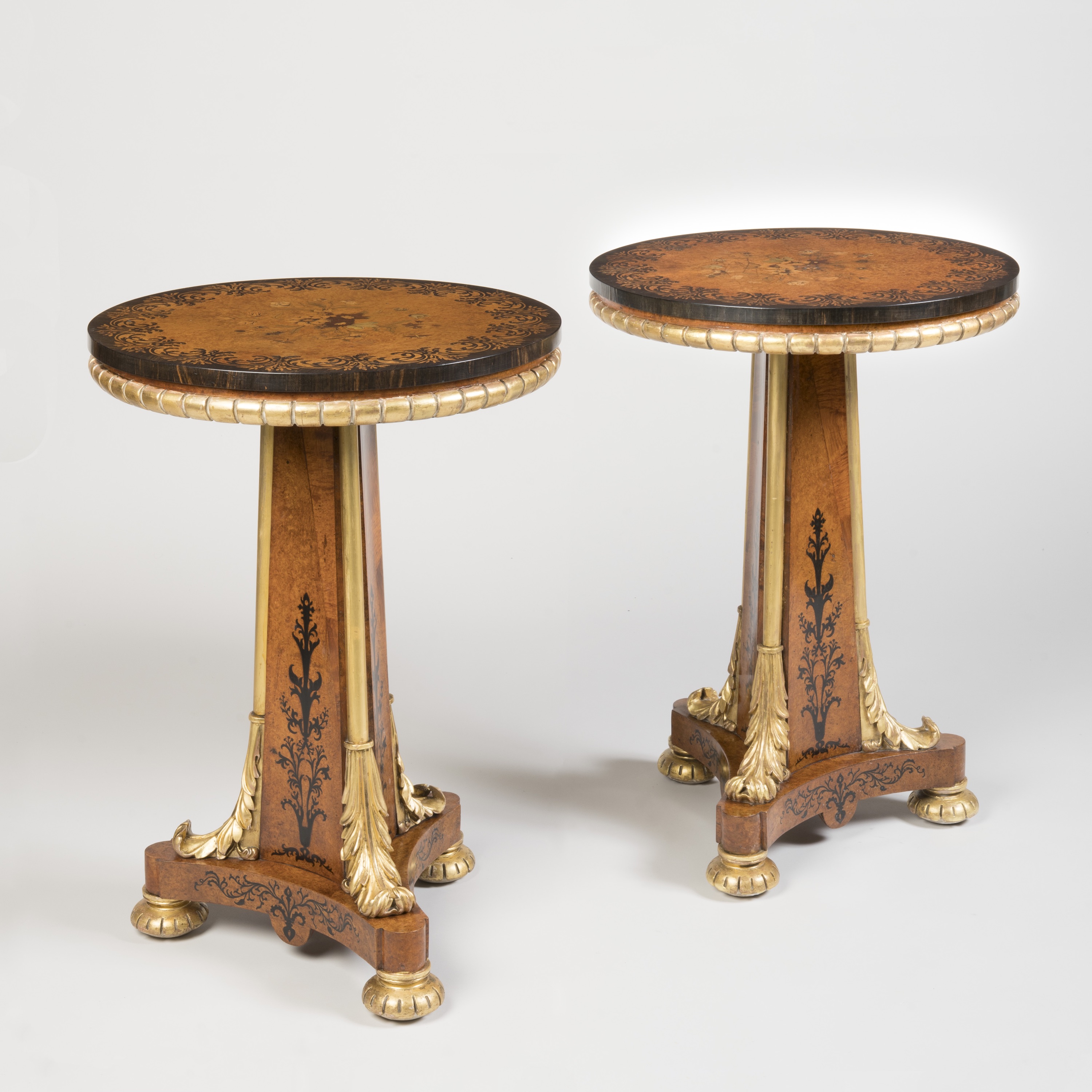


A Pair of William IV Period Amboyna Occasional Tables Attributed to T & G Seddon
Dimensions: H: 29 in / 74 cm | Dia: 20.5 in / 52 cm
PRICE: £45,000

A Pair of William IV Period
Amboyna Occasional Tables
Attributed to T & G Seddon
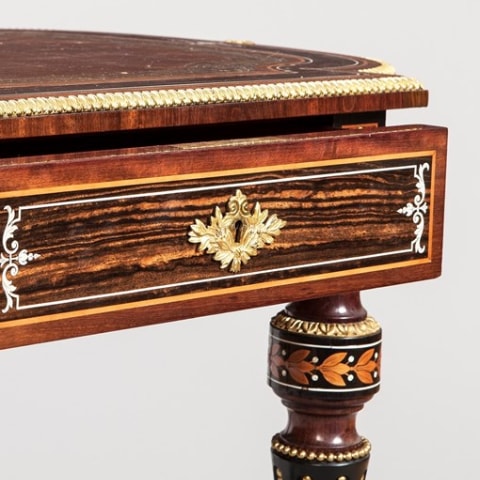
A striking pair of tables of exceptional quality, using the finest rare amboyna wood, inlaid with ebony marquetry and having parcel gilt details, each table supported on an incurved tripartite platform base with oblate giltwood bun feet, the tapering pedestal with cascading gilt foliate brackets flanking the floral marquetry inlaid sides on an amboyna ground. The circular tops with central floral marquetry bouquets executed in shaded specimen woods on an amboyna ground with an ebony border of foliate design.
English, circa 1830
A table made in the same workshop, and certainly by the same marquetry cutter, is illustrated in 'British Furniture 1820-1920' by Christopher Payne and was possibly made by Seddon shortly after Morel's departure in 1831.
According to furniture historian Christopher Payne, the design of these tables bridges the old and the new eras of English furniture, using amboyna to reflect the popular use of 'bois clair' in contemporary France, while simultaneously making an extensive use of carving and gilding. Likewise, the geometric floral marquetry reflects the earlier style of George Bullock, contrasted with the naturalism of the central bouquets which anticipate furniture later made by the Blake family. Undoubtedly related to the furnishing of Windsor Castle made by Morel & Seddon for George IV during the 1820s, the softer approach is akin to the firm's work for the 2nd Duke of Sutherland at Stafford House in London in the early 1830s.
T & G Seddon (fl. 1815-1870)
T. & G. Seddon were leading London cabinet makers and upholsterers with workshops first in Aldersgate Street and later Gray's Inn Road. The firm was established by brothers Thomas (1792-1864) and George (1797-1857) Seddon, nephews of George Seddon II, who inherited one of the largest furniture-making businesses in the capital.
In partnership with Nicholas Morel from 1827, they undertook the vast commission to refurnish Windsor Castle for George IV, employing designers such as A. W. N. Pugin and producing furniture in both Gothic and Neo-classical styles. The Seddons also received major commissions for Stafford House, Goldsmiths' Hall, Liverpool Town Hall, and the Morrison family at Basildon Park. After Morel's departure in 1831, Thomas and George continued to enjoy royal patronage, securing the royal warrant in 1832 and supplying furniture to William IV and Queen Victoria.
The firm remained innovative, with Thomas Seddon III contributing prize-winning designs and supporting the North London School of Drawing and Modelling under Prince Albert's patronage. Following George's death in 1857, the business continued under Thomas and later as Seddon & Co., working with designers such as John Pollard Seddon and William Burges. Their exhibits at the 1862 International Exhibition, including the celebrated "King René's Honeymoon Cabinet," reflected their central role in Victorian furniture design. By 1870, Seddon & Co. were recorded as exporters, their work ranging from royal palaces to international commissions.
Comparative Literature:
Christopher Payne, British Furniture 1820 to 1920: The Luxury Market, Antique Collectors' Club, 2023, pp. 71-72 (illus. p. 73 figs. 2.17a-c), showing a closely related table.
You may also like


A Good Centre Table in the Louis XVth Manner
A Louis XVI Style Occasional Table By Henry Dasson
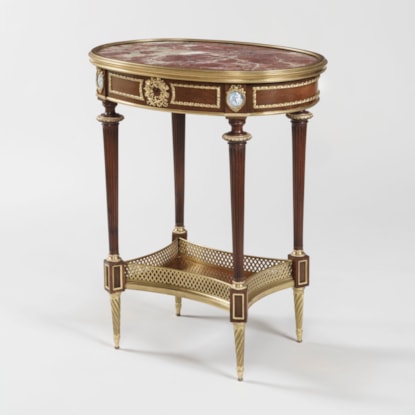
A Louis XVI Style Occasional Table
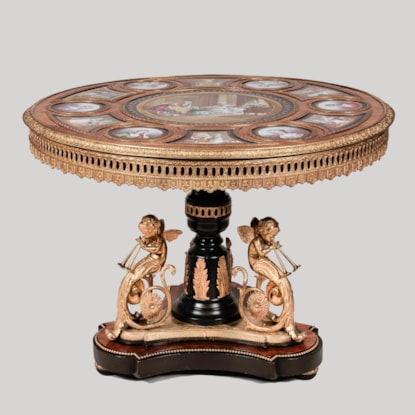
A Superb Gueridon Centre Table With Sèvres Style Porcelain Panels
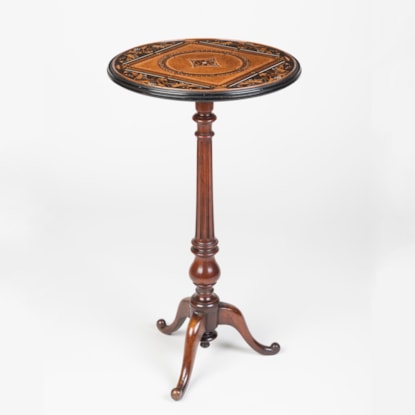
An Unusual Marquetry Top Table Attributed to Jackson & Graham
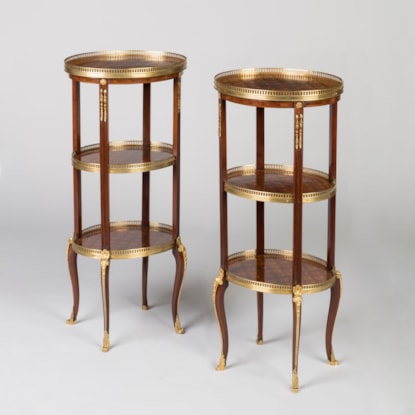
Pair of Tiered Occasional Tables In the Transitional Manner
Recently viewed