Vip access

 Favourites


















July 2026
Louis XV: The Triumph of Rococo Elegance

Louis XV: The Triumph of Rococo Elegance
When Louis XIV died in 1715, the court fled Versailles. The great palace was too cold, too vast, and too freighted with the dead king’s memory to suit the new regime of Philippe d’Orleans, regent for the child Louis XV. Courtiers returned to Paris and commissioned a new kind of townhouse. The hôtel particulier was conceived for a different sort of life: intimate rooms for private conversation, small salons for card parties and cultivated company, boudoirs for reflection, and dining rooms set apart from the kitchens by hidden service passages. The furniture required to equip these rooms had yet to be invented, and when it emerged it would define Louis XV furniture as we now know it: lighter, smaller, curved, and devoted above all to the pursuit of comfort.
Within twenty years, Parisian ébénistes and menuisiers had produced what would be recognised as the highest expression of French taste. The style is defined by the cabriole leg, the bombé front, the asymmetrical shell, and a concern with ease and privacy no previous century had thought to build into its furniture. It is also defined by the relationships that produced it: the cabinetmaker and the bronze-chaser, the guild craftsman and the merchant, the king’s mistress and the porcelain factory. The rocaille aesthetic reached every court in Europe, passed from fashion at the end of the eighteenth century, then returned in triumph in the nineteenth. Much of what the market today describes as Louis XV belongs to that second age rather than the first.
From Regence to Rocaille
The style did not arrive fully formed. It grew out of the Regence, the transitional period between 1715 and roughly 1730, when the heavy vocabulary of the Grand Siècle was gradually loosened. Charles Cressent, trained as a sculptor before becoming cabinetmaker to the Regent, gave these years their most inventive furniture: commodes with bombé fronts and sinuous cabriole legs, still broadly symmetrical but softened by a new fondness for curve and foliage. The cabriole leg, its profile drawn from the silhouette of a goat’s limb, replaced the turned baluster and the pegged stretcher. A chair could now stand on four curved legs without the heavy framing the previous age had required, and this single change did more to transform the silhouette of French furniture than any other.
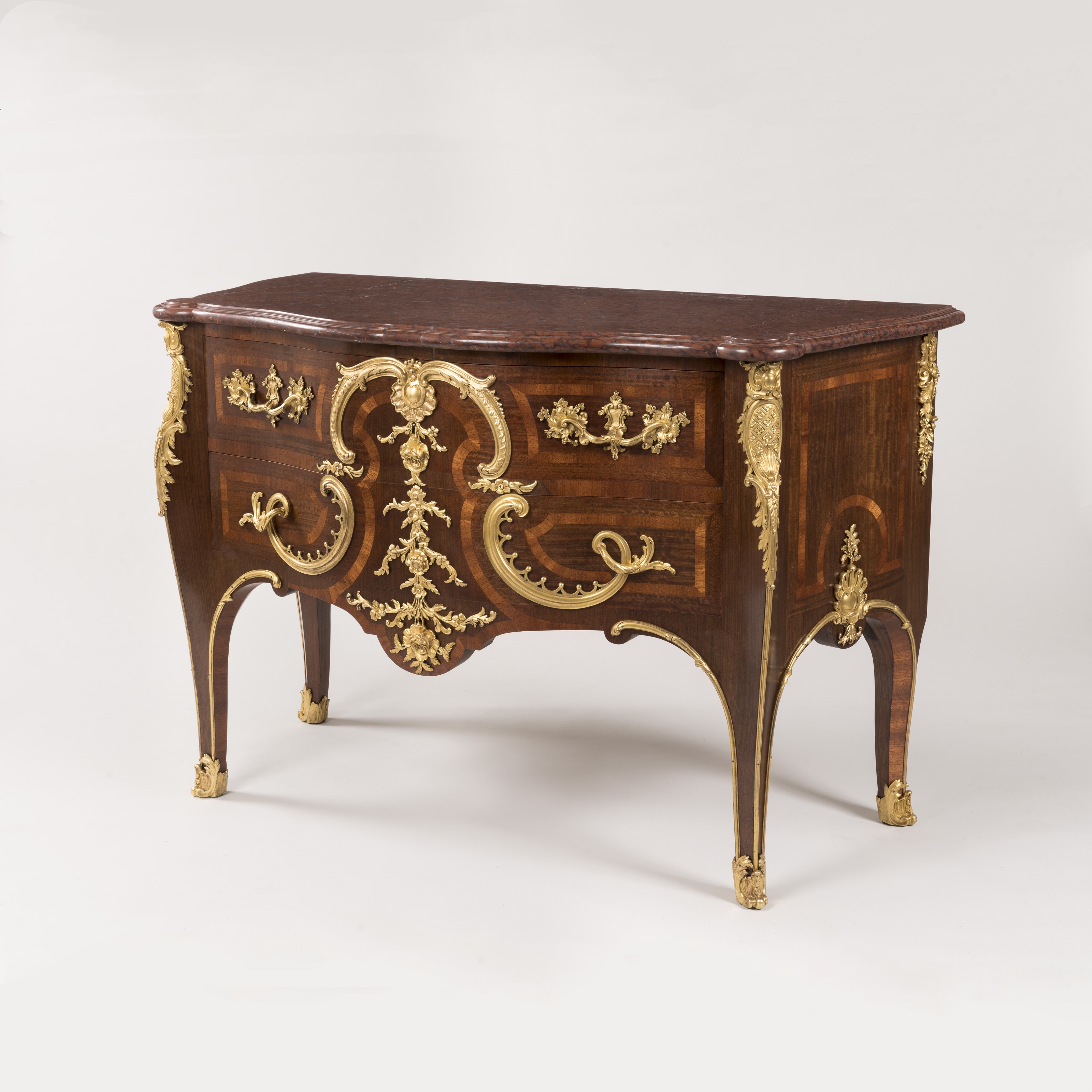
This commode has all the hallmarks of an original Charles Cressent design, who softened the rigid lines of the Louis XIV period by introducing curved bombé fronts, cabriole legs, and serpentine C-scrolls in the ornament. One of a pair, made by Durand, circa 1880, with Butchoff Antiques, London.
By the early 1730s the Regence had given way to the full Rococo. The shift is most often associated with Juste-Aurele Meissonnier, a Savoyard silversmith whose published engravings abandoned bilateral symmetry altogether. His chimneypieces and table settings proposed a balanced asymmetry he called contraste, and the taste spread rapidly from the luxury trades to cabinetmaking. Shells and rocaille ornament, named for the pebbled shellwork of earlier French garden grottoes, became the signature motifs of the new manner, joined by C-scrolls, S-scrolls, and the long acanthus leaves that flowed across the gilt-bronze mounts of the finest commodes. Chinoiserie and singerie, depicting idealised Chinese scenes and monkeys dressed as courtiers, added a note of exotic wit. By 1740, the style rocaille was the established language of the Parisian interior.
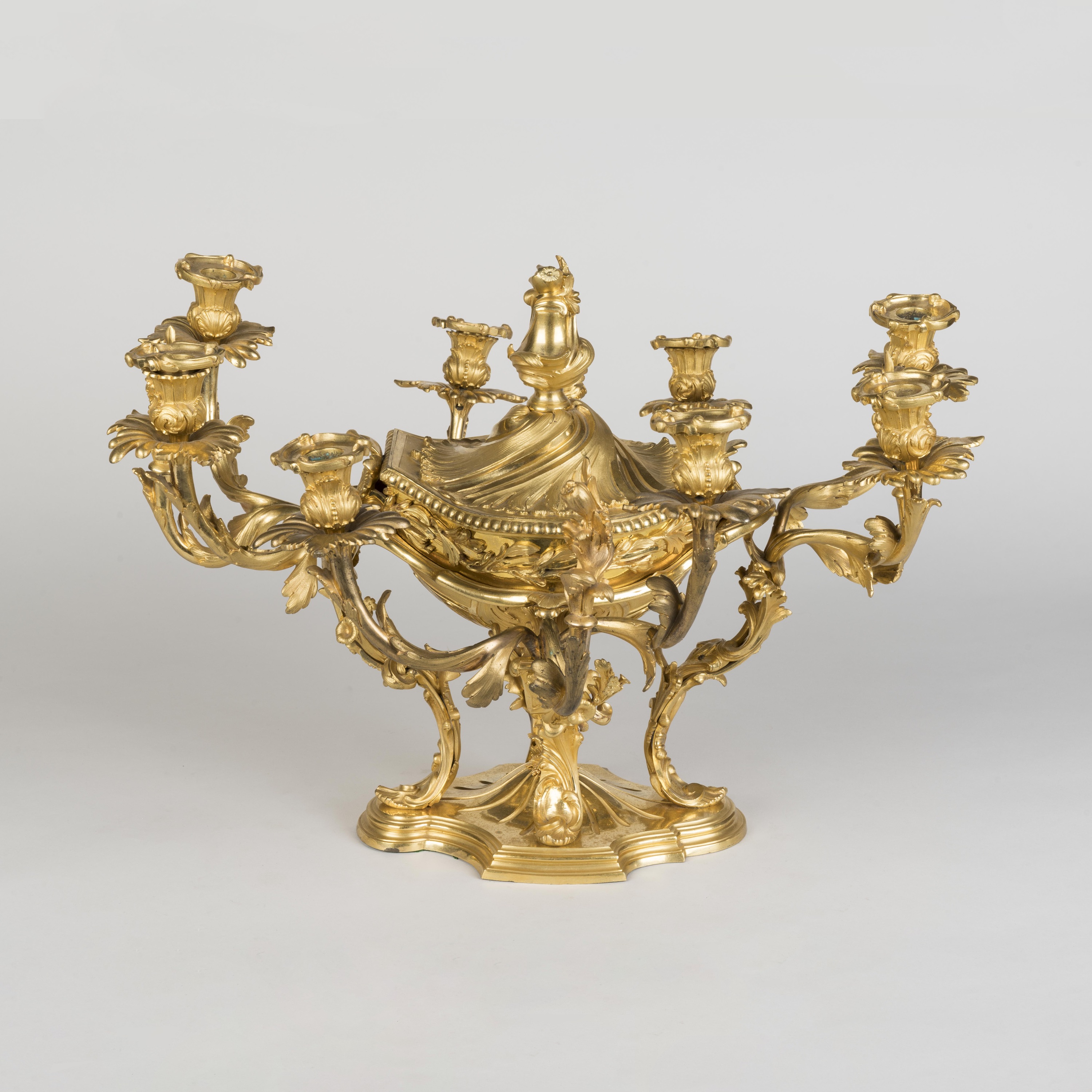
This ormolu Rococo centrepiece, with its curved arms, acanthus leaf decoration and balanced asymmetry is derived from Meissonier's published designs. Previously with Butchoff Antiques, London.
The Rococo did not last. By the early 1760s a reaction was underway. The discoveries at Herculaneum and Pompeii, widely published from 1757, introduced a vogue for antique precedent the rocaille could not accommodate. Curves began to straighten and commodes gained pilastered corners and fluted legs. By the close of the reign in 1774 the furniture being delivered to the royal residences was, in essentials, already the Louis XVI style. The transition is easy to read in the work of Jean-François Oeben, whose early pieces belong to the full Rococo and whose last works, completed by Riesener after his death, anticipate the classical restraint of the next reign.
The New Grammar of Comfort
If the old furniture of Versailles had been designed for ceremony, the new furniture of Paris was designed for conversation. Two words governed the thinking of the age, commodité and bienséance, and between them they produced an explosion of specialised forms.
The fauteuil, the open-armed upholstered armchair, was the workhorse of the salon. A fauteuil à la reine had a flat back, intended for placement against a wall; a fauteuil en cabriolet had a concave back that followed the spine and was drawn into the centre of the room. The bergère, deeper and wider, with closed upholstered sides and a loose seat cushion, offered an enveloping comfort unknown in the previous century. The marquise, broader still, was effectively a one-and-a-half-person seat designed to accommodate the hooped panier skirts worn at court. The duchesse brisée, made in sections that joined as a chaise longue, allowed a woman to recline during the morning toilette.
The case furniture was equally specific. The commode, invented under Louis XIV, reached its mature form under Louis XV. The bombé commode, with doubly curved front and sides, stood on high cabriole legs and was finished on every surface because it often stood in the centre of a room. It was the most prestigious piece an ébéniste could produce. The bureau plat, freed from stretchers and standing on cabriole legs, replaced the older writing cabinets and allowed a minister or scholar to work in the open, usually with a cartonnier alongside for papers and correspondence.
Smaller tables multiplied with the interior’s social demands. The chiffonnière held needlework; the table à jeu had a reversible top with a playing surface on one side and a marquetry panel on the other; the rafraîchissoir held wine and glasses at intimate suppers. The bonheur-du-jour, introduced at the end of the reign, was a light lady’s writing desk with a tiered superstructure of drawers, designed to be carried between bedroom and boudoir.
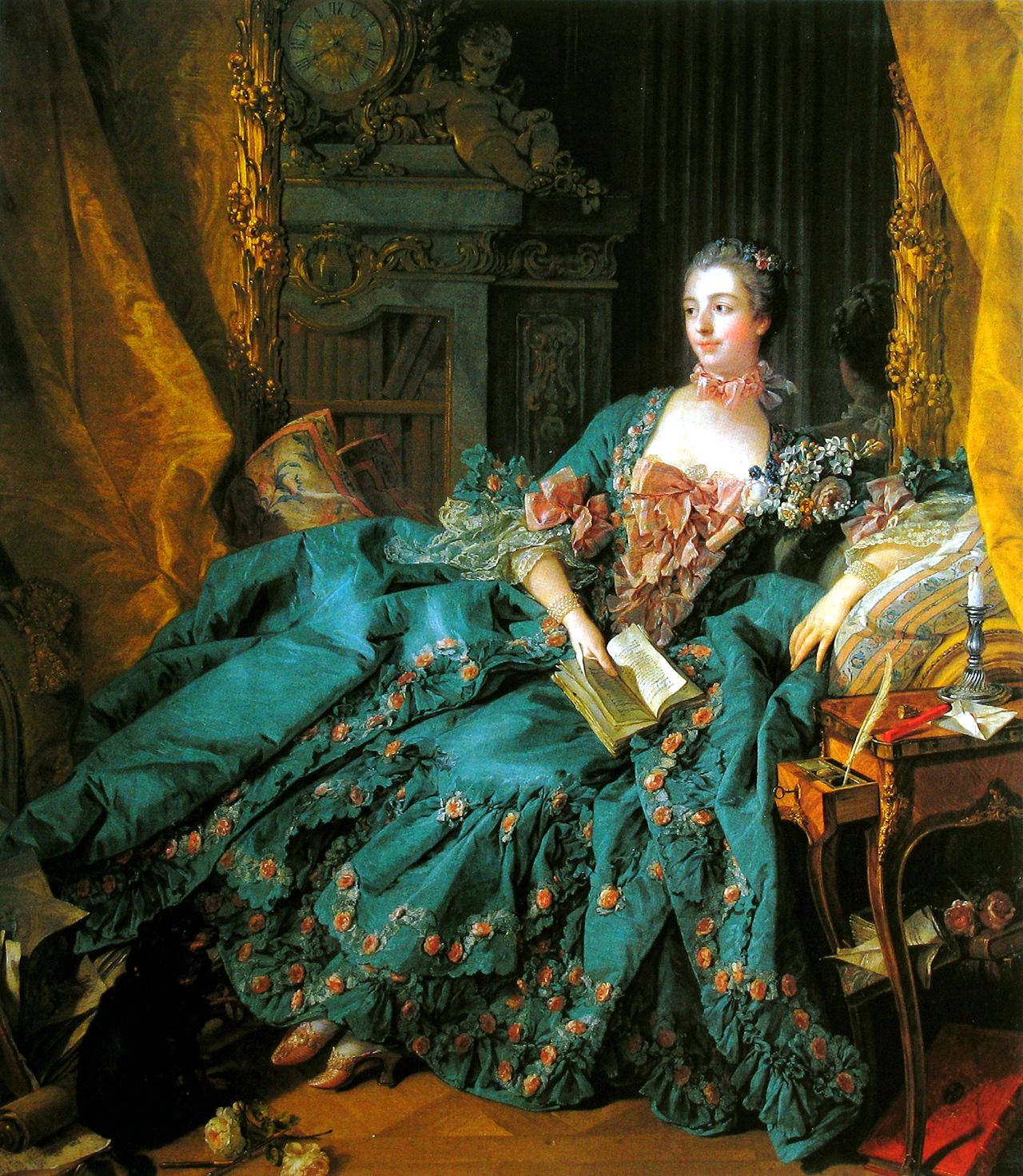
Madame de Pompadour, sitting next to a fashionable table à chiffonière, portrayed in 1756 by François Boucher (Alte Pinakothek, Munich).
The reign also made room for virtuoso mechanical furniture, the meubles à combinaisons. Jean-François Oeben, named ébéniste du roi in 1754 and granted a workshop in the Manufacture des Gobelins, built his practice around it. His desks contained hidden compartments released by concealed springs and writing surfaces that slid forward under a tambour shutter. The bureau à cylindre, the roll-top desk, was his most important invention. The form culminated in the bureau du roi, begun by Oeben in 1760 and completed by Riesener in 1769, a piece on which marquetry, mechanism, and gilt-bronze reached a pitch no later maker has surpassed.
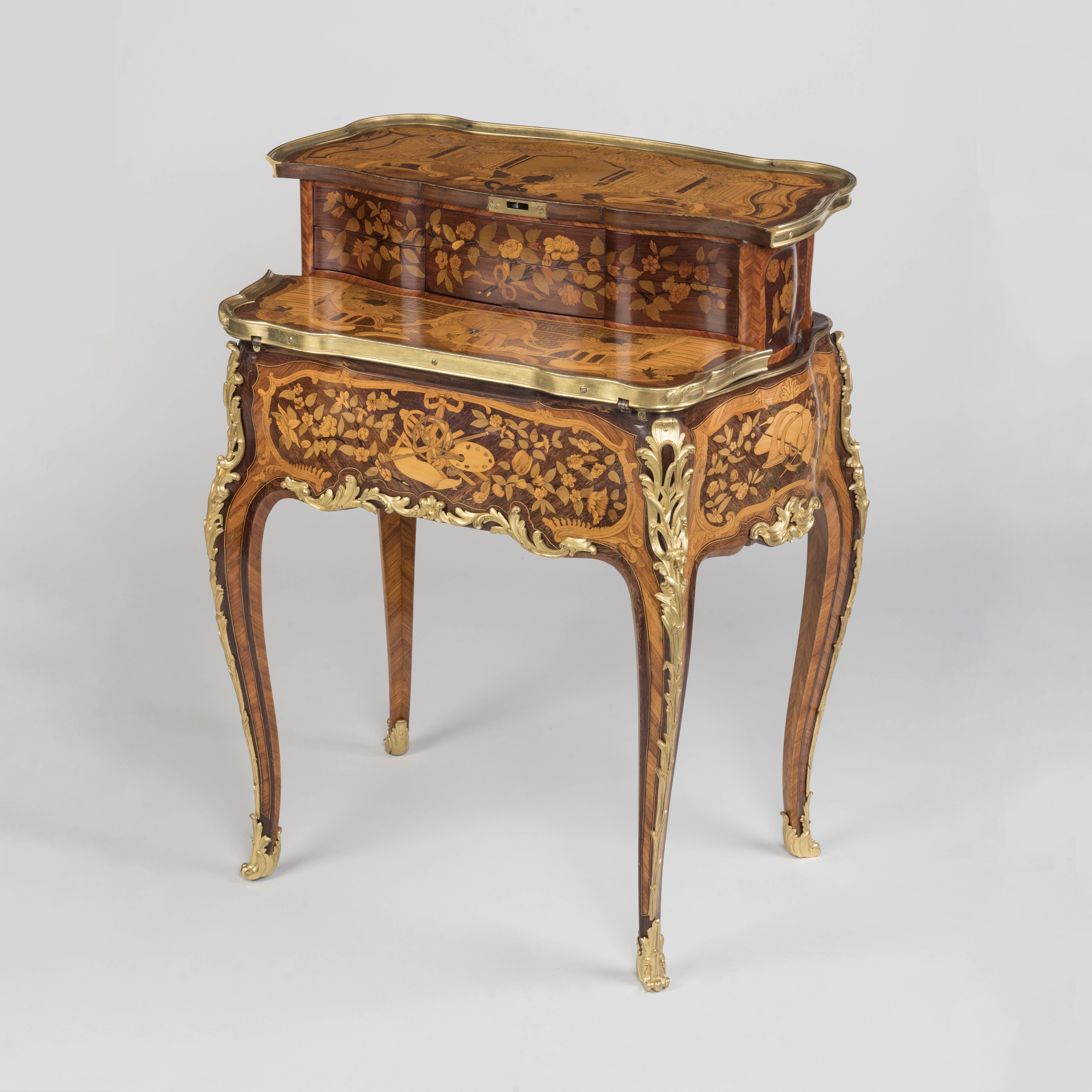
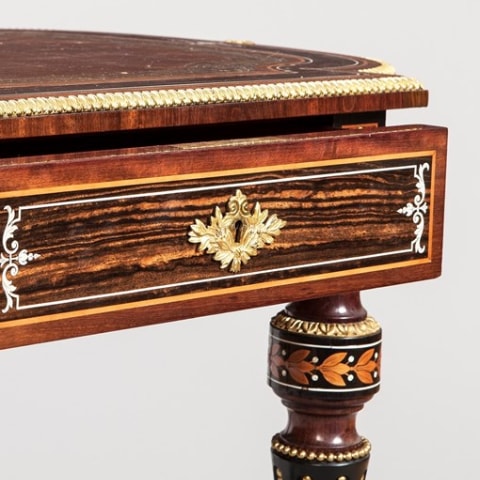
Louis XV furniture, especially that designe by Oeben, often incorporated mechanical marvels which allowed for a plethora of hidden compartments and special features, often using spring-loaded actions or clever lever systems. This 19th century table pays hommage to Oeben's example made for Madame de Pompadour'd bedroom at Versailles.
Ébénistes, Menuisiers, and the Guild Stamp
The production of Louis XV furniture was governed by one of the most rigorous craft guilds in Europe. The Corporation des Menuisiers-Ébénistes divided its masters into two strictly separated branches. The menuisier worked in solid wood, producing seat furniture, beds, consoles, and carved architectural elements whose surfaces were painted, gilded, or left in the natural grain. The ébéniste worked in veneer, laying thin sheets of exotic hardwoods over a stable oak carcase to produce commodes, secrétaires, and cabinets at the highest end of the market. A master of one branch could not legally practise in the other.
Candidates spent years as apprentices and journeymen before being admitted as masters on presentation of a chef-d’œuvre. Once admitted, they struck their name into the underside of every piece they produced. A second mark, JME, stood for jurande des menuisiers-ébénistes and was applied by the six jurés who inspected furniture before it left the workshop. The obligation to stamp became universal from 1743, and these two marks are the foundation on which serious attribution still rests. A piece without any stamp is not necessarily suspect, since the ébénistes du roi operating under direct royal patent were exempt from guild jurisdiction, but any piece bearing a stamp can usually be placed with some precision in the career of a known maker.
The named cabinetmakers of the period form the core of every French furniture reference library. Bernard II van Risen Burgh, stamped BVRB in capitals to preserve the commercial secrecy of his name, specialised in lacquer-mounted commodes and small tables supplied through the marchands-merciers to the court. His combination of Japanese or Chinese lacquer panels, chased gilt-bronze, and end-grain floral marquetry drew the leading merchants of luxury goods directly to his workshop. Pierre Migeon, patronised by Madame de Pompadour, was responsible for a large share of the small writing furniture of the mid-century. Jacques Dubois, admitted master in 1742, produced vividly coloured marquetry commodes and bureaux in the full Rococo manner. Martin Carlin, a German-born maker who married into the Oeben family, specialised in the jewel-like case pieces mounted with Sèvres porcelain plaques that defined the last fashionable years of the reign.
Among the menuisiers, Jean-Baptiste Tilliard, his son, and Nicolas-Quinibert Foliot supplied the crown with the seat furniture that formed the structural backbone of the Rococo salon, carved in beech and walnut and painted or gilded.
The Marchands-Merciers
The makers had one further master. The marchands-merciers were the luxury merchants of Paris, a trade corporation distinct from the craft guilds, and they occupied the commercial territory between the cabinetmaker and the client. Forbidden from making anything themselves, they combined objects from different sources, adding new mounts, panels, and finishes as fashion required. In practice they were the interior designers of the age, and during the reign of Louis XV they directed the Rococo style as effectively as any maker.
Lazare Duvaux, whose Paris shop supplied Madame de Pompadour and much of the court through the late 1740s and 1750s, is the best-documented figure of the trade. His surviving livre-journal, covering 1748 to 1758, records sales to the duc d’Orleans, the Prince de Conti, and dozens of other clients, and it is an essential primary source for the period. Duvaux would order an unmounted commode from BVRB, send it to a fondeur for gilt-bronze mounts, supply panels of lacquer or porcelain, and deliver the finished piece to the client’s hôtel with an itemised bill. His competitors, Thomas-Joachim Hébert earlier in the reign and Simon-Philippe Poirier at the end, operated on the same principle.
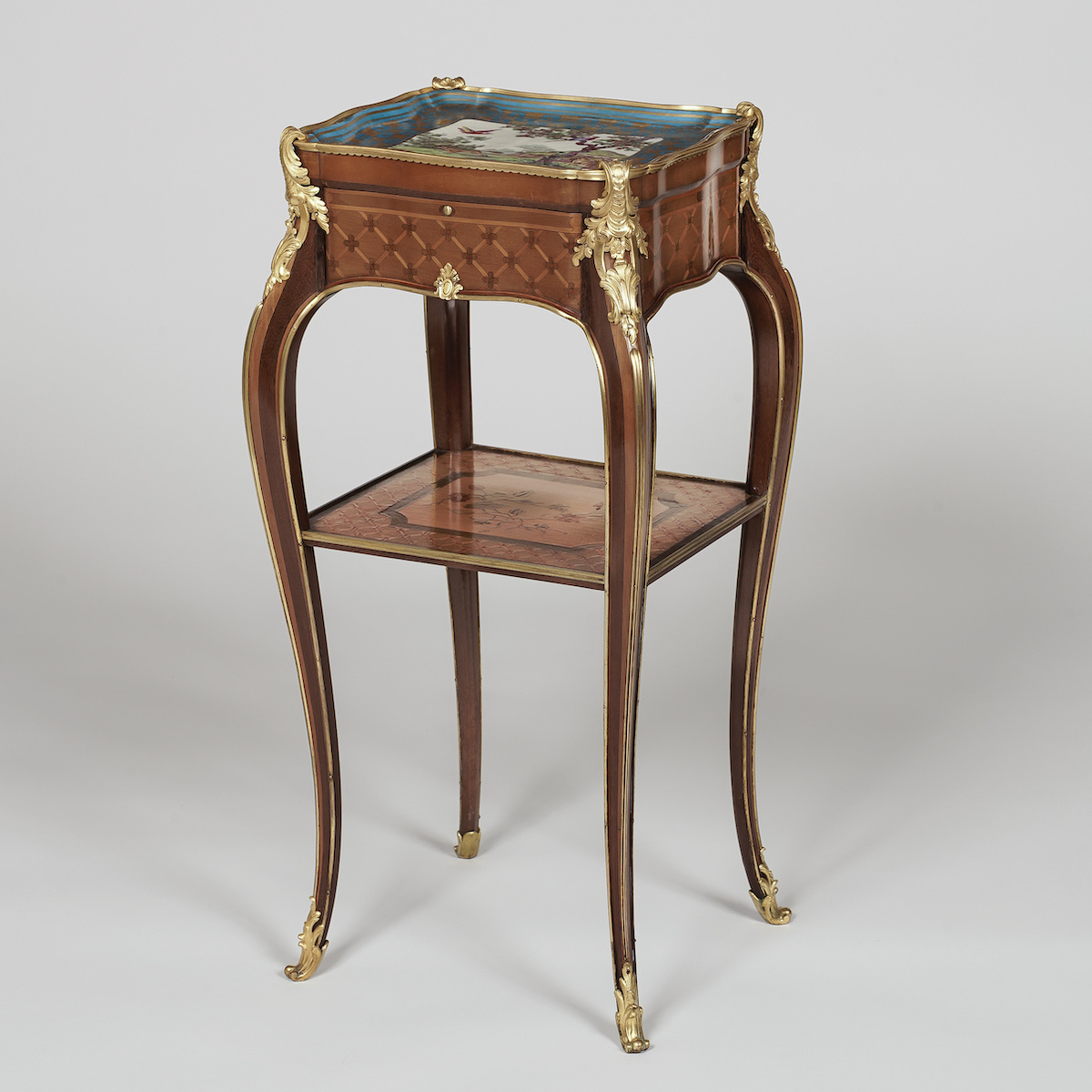
This porcelain-mounted table is a Louis XV design by Roger Vandercruse, who's furniture often incorporated custom-made porcelain plaques made by Sèvres on the request of Poirier. This version, made around a century later using all the same material and techniques, even incorporares an identical porcelain plaque to the prototype from the 18th century which can be seen at the Wallace Collection in London. Butchoff Antiques, London.
The marchands-merciers also made the international sourcing of materials possible, linking Parisian craftsmen to the trade routes that brought Japanese and Chinese lacquer screens to Europe through the Dutch East India Company. A screen might be purchased at Amsterdam, dismantled at the shop, and its panels cut down and fitted to French carcases made specifically to receive them.
Poirier’s contribution was the development of Sèvres-mounted furniture. From the late 1750s he commissioned porcelain plaques from the factory and had them set into tables, writing desks, and jewel cabinets by BVRB, Carlin, and later Roger Vandercruse Lacroix. The result had no precedent in European production, and it became the defining fashionable object of the last Louis XV years.
Materials, Mounts, and the Coloured Palette
The furniture has reached us in browns and soft gilt, a ghost of the original. Two and a half centuries of sunlight and oxidised varnish have muted the Louis XV palette almost beyond recognition. A commode by BVRB or Jacques Dubois, freshly delivered from the workshop, glowed. Its tulipwood and kingwood marquetry was still pink and violet, set against the clear yellow of stained holly and the sea-green of dyed sycamore. The bronze mounts caught the candlelight on fresh shellac. In a Rococo interior whose panelling was pale blue or rose, the furniture was part of the colour scheme, not a foil to it.
The preferred veneers came from the exotic hardwoods of Central and South America and the East Indies, supplied through Cadiz, Bordeaux, and Lorient. Bois de rose (tulipwood) and bois de violette (kingwood) were the staples, often laid together in geometric parquetry of diamonds, cubes, or sunbursts. The great innovation of the period was bois de bout, end-grain marquetry, in which wood was cut across the grain for a softer, more painterly effect. Oeben and his circle used it to compose the floral bouquets and trophies of musical instruments that define the marquetry of the reign.
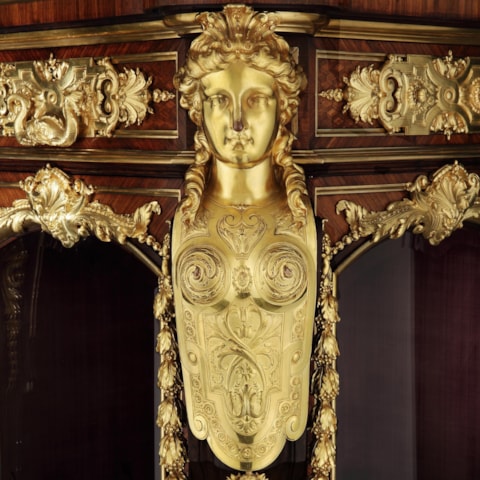
Gilt-bronze, or ormolu, gave Louis XV furniture its characteristic shimmer. The mounts were cast by fondeurs using the lost-wax process, chased by ciseleurs, and gilded by doreurs-sur-métaux using an amalgam of gold and mercury driven off the bronze by heat. The process was toxic and the lives of the gilders were short, but it produced a finish of extraordinary richness. A master mount from the mid-century carries three or four distinct textures within a single casting: matte, burnished, punched, and stippled. The gold lies on the surface with a soft, moonlight quality that later electroplated mounts have never reproduced. On the finest pieces the mounts were modelled from the same drawing that governed the marquetry.
Imported lacquer was the most expensive veneer. Japanese and Chinese screens, supplied by the marchands-merciers, were cut down and applied to commode fronts, their black or red grounds counterpointing the gilded bronze. Where imported lacquer was unavailable, the Parisian vernis Martin took its place. Developed by the four Martin brothers under a royal patent of 1730, it was compounded of resin, oil, and pigment, built up in thin layers, and polished to a glassy surface in vivid greens, reds, and blues.
Madame de Pompadour and the Politics of Taste
Louis XV installed Jeanne-Antoinette Poisson at Versailles as maîtresse-en-titre in 1745. For the next twenty years she ran what amounted to a cultural ministry, choosing architects, directing painters and sculptors, and taking charge of the decorative arts. Her residences at Bellevue, Crécy, and the Hermitage (at Versailles) became laboratories of taste that the aspirant class imitated.
Her most consequential intervention was the rescue of the Vincennes porcelain factory in 1756 and its removal to Sèvres, where it came under royal protection. She selected the rose pink, the celestial blue, and the deep apple green that became its signature grounds. The Sèvres-mounted furniture developed by Poirier and Carlin owed its existence to her patronage.
She was also the patron of the most radical Rococo. What Meissonnier had launched as a designer’s provocation became, under Pompadour, the official aesthetic of the French court and, through the ordinary operation of fashion, of every court in Europe. When she died in 1764 a reaction against the rocaille was already underway, but the style she had sponsored would shape the collective idea of eighteenth-century France for the next two centuries.
The Nineteenth-Century Revival
The Rococo was out of fashion for barely half a century. The Revolution and the Empire preferred the antique, but by the 1830s taste was turning, and the Paris Exposition Universelle of 1855 confirmed that the Louis XV style had returned in earnest. The demand that followed sustained an entire generation of workshops in the Faubourg Saint-Antoine.
The revival was not a mass-market imitation; the finest examples matched, and occasionally exceeded, the eighteenth-century originals. Henry Dasson (1825 to 1896), originally a bronzier, produced Louis XV pieces in which the ormolu was modelled, chased, and gilded with a precision the Rococo itself had not always achieved. François Linke (1855 to 1946) carried the tradition into the twentieth century, winning the gold medal at the Paris Exposition Universelle of 1900 for furniture that combined Louis XV form with the inventive sculptural mounts of his collaborator Léon Messagé. Paul Sormani supplied clients across Europe from a workshop on the rue Charlot. Alfred-Emmanuel Beurdeley built his firm’s reputation on close copies of the Louis XV pieces held in the French royal collections. Zwiener, Krieger, and Millet rounded out the field.
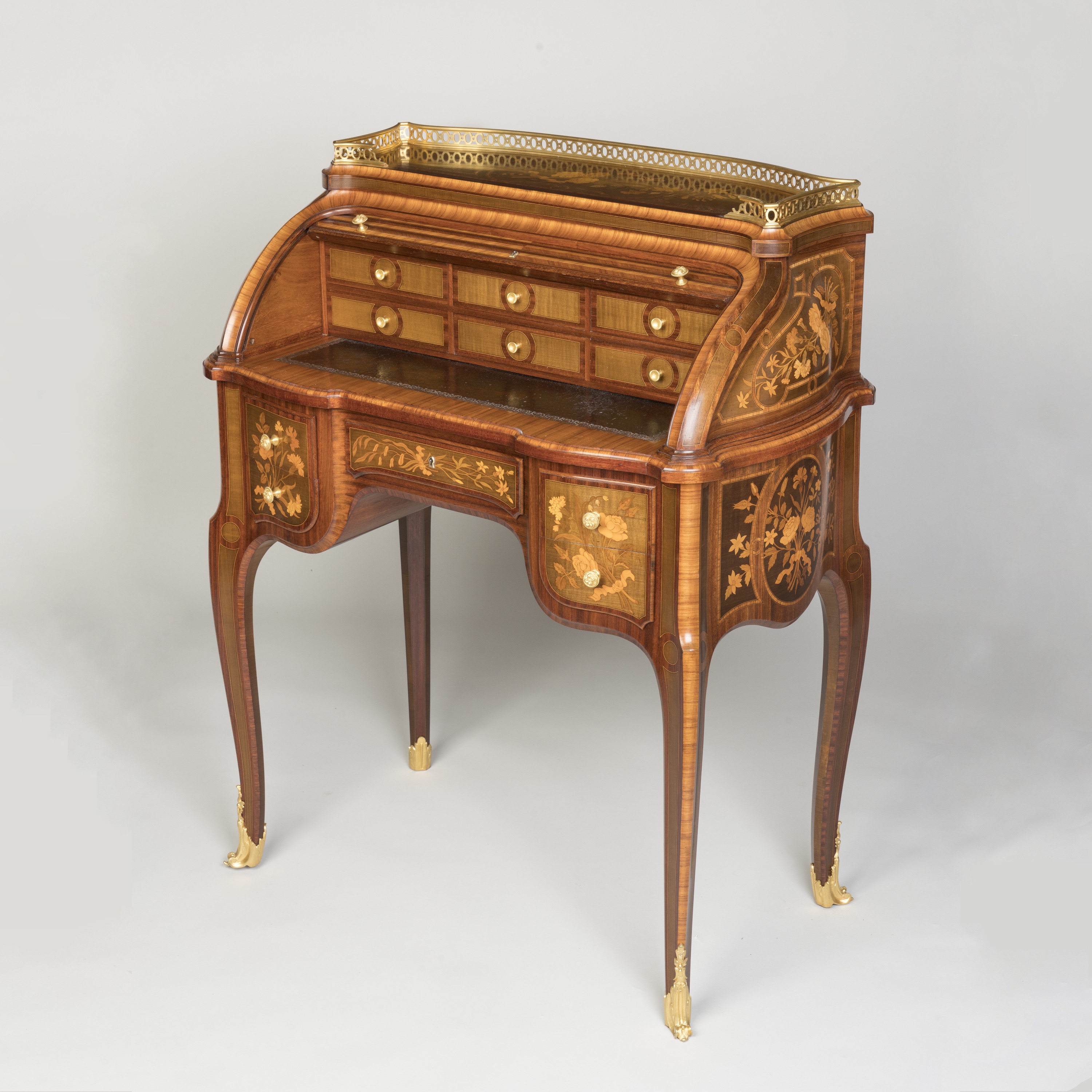
This exceptional bureau à cylindre by François Linke dates to the late 19th century, and is a version of the roll-top desk by Jean-François Oeben made around 1760 which can be seen at the Musée Nissim de Camondo. Made to the same standards using traditional techniques, the Parisian revival furniture of the Belle Époque was often valued more highly than their original 18th century counterparts.
A piece from one of these workshops is not a reproduction in the modern sense. The cabinetmakers worked from the same first principles as their eighteenth-century predecessors, used oak carcases and solid secondary timbers, and finished their bronzes by hand. A Linke commode of 1895 is a piece of Louis XV furniture made in 1895, not a fake of a piece made in 1755, and its value rests on its own qualities.
The distinction between the two periods still matters to collectors. An eighteenth-century commode stamped by BVRB or Dubois is a museum object, priced in the tens or hundreds of thousands of pounds. A revival piece by Linke, Dasson, or Sormani occupies a different but equally serious category. Eighteenth-century cabinet-work carries hand-sawn tool marks on rough undersides, hand-cut dovetails, and oak oxidised to a colour no staining reproduces.
The Furniture of Private Life
The Louis XV style has survived the collapse of the monarchy that produced it because it was the first style in the history of European furniture designed for the individual rather than the state. The Boulle of Louis XIV had served the glory of the Sun King. The Riesener of Louis XVI would serve the dignity of a philosophical age. The rocaille of Louis XV served the pleasures of a private room: the letter written at a bonheur-du-jour, the afternoon passed in a bergère. That shift of scale has kept the style in demand across two centuries, because the life it equipped, a life of comfort, conversation, and cultivated company, has never gone out of fashion.
written by Rainier Schraepen