Vip access

 Favourites





















November 2026
Collecting Antique Bronze Sculpture: A Connoisseur’s Guide

In 1699 Louis XIV commissioned Antoine Coysevox to produce two equestrian groups for the gardens at the Château de Marly. Coysevox carved Mercury and Fame riding the winged horse Pegasus, completing the marbles in 1702. The pair were moved to the Tuileries in 1719 and now stand inside the Louvre. Around 1880, the Parisian foundry of Eugène Cornu cast a faithfully reduced edition of the same compositions in bronze, mounted on bases of Rouge de Languedoc marble. A signed and provenanced pair of those Cornu bronzes can pass through the trade today as a serious collectable in its own right, valued for the quality of the 1880 casting as much as for its descent from Coysevox’s marbles.
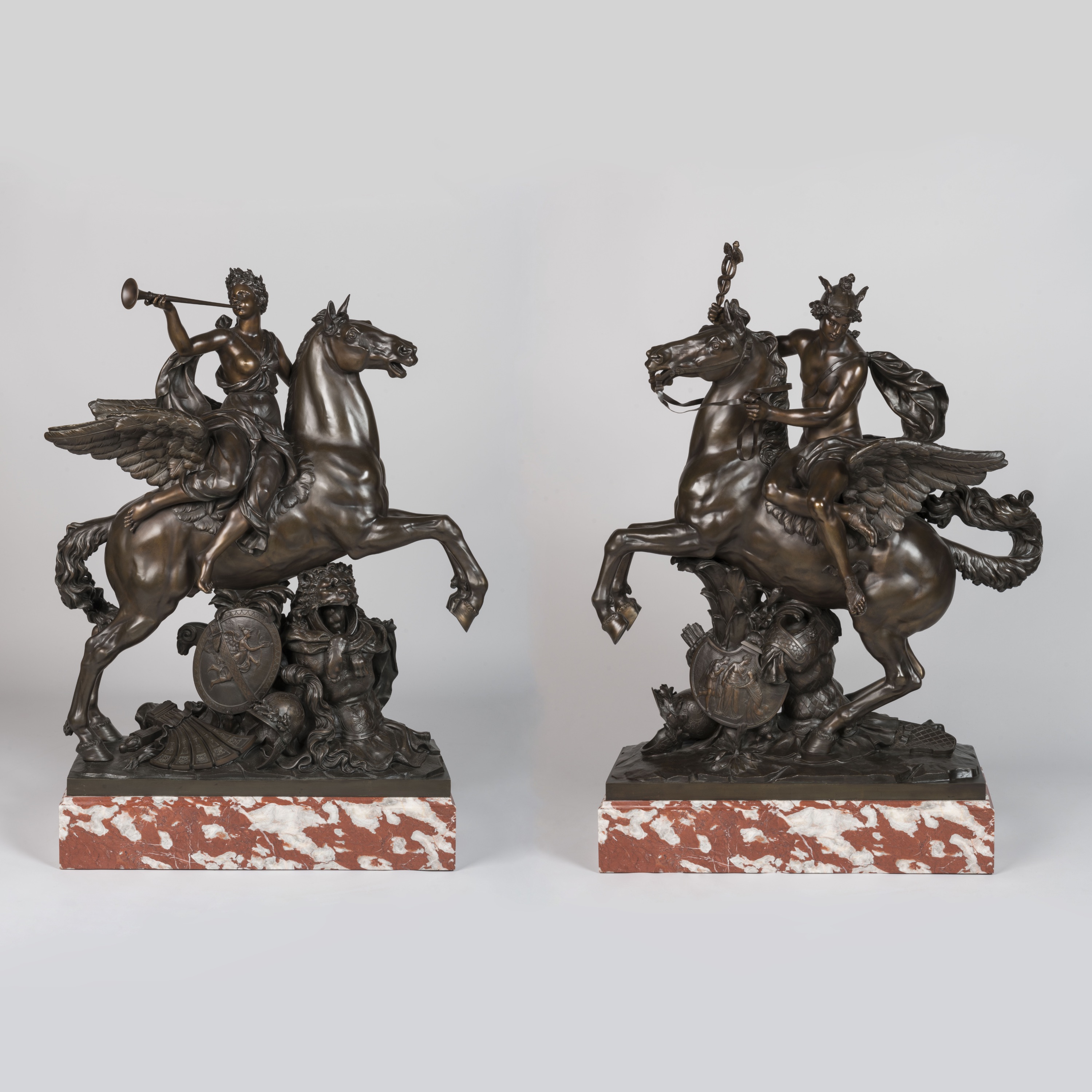
Mercury and Fame Seated on Pegasus, After Antoine Coysevox (1640-1720). Cast by Eugène Cornu (1827-1899) in the 19th century. Butchoff Antiques, London.
That single example contains almost everything a collector needs to think about. There is the original sculptor and the foundry that cast the later edition, separated by nearly two centuries. There is the journey from royal commission to private collection. There is a signature, a date, a foundry name, and a marble base whose stone is itself part of the attribution. And there is the question every serious buyer asks before parting with money: what divides one nineteenth-century bronze of significance from another that is merely decorative.
Antique bronze sculpture rewards a patient eye more than almost any other field of collecting. The rules are not difficult, but they are specific, and a connoisseur learns them in sequence: the history of the medium, the names of the sculptors and the foundries that brought it to the public, the meaning of the marks struck into the metal, and what the surface itself tells you about a piece before any catalogue description does.
From the Royal Foundries to the Drawing Room
In the seventeenth century, casting a bronze on Coysevox’s scale was a feat of state. Only the foundries attached to the French crown, working under the Bâtiment du Roi, could obtain the highest-grade copper from Sweden, and only those foundries had the engineering to pour an equestrian monument in a single attempt without leaving a cold shut, the structural seam that formed when molten metal cooled before the mould was full. Bronzes of the Grand Siècle were therefore objects of court, made in small numbers for Versailles, Marly and the Tuileries, in alloys whose composition was guarded as carefully as the recipes for porcelain at Sèvres a century later.
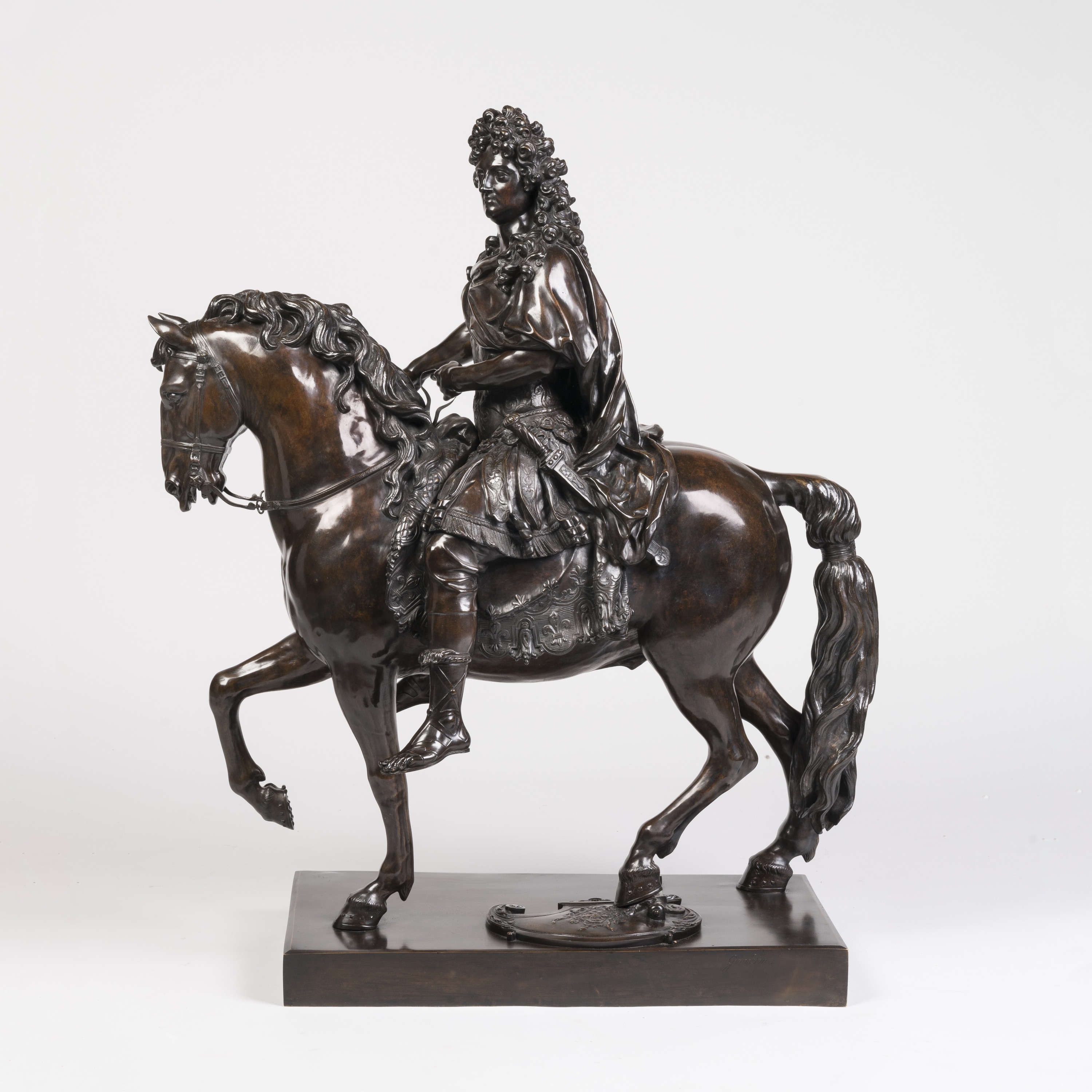
Commisioned by King Louis XIV and depicting him on horseback, the original 17th century bronze by François Girardon (1628-1715) stood 7 meters high and was an incredible technical feat. It was destroyed during the Revolution, and is only known through smaller scale later reductions like the one pictured here. Previously with Butchoff Antiques, London.
Italy ran a parallel trade, but on different terms. From the late seventeenth century into the early nineteenth, Roman workshops such as those of Francesco Righetti and Benedetto Boschetti specialised in reduced bronzes after the antique, casting Laocoön, the Dying Gaul, the Belvedere torso and the Borghese Vase for British and northern European travellers on the Grand Tour. A bronze of the Belvedere Apollo on a sienna marble base, carried back to a country house in Wiltshire or Yorkshire, was both a souvenir and a statement of classical learning. The Boschetti workshop was still producing such pieces in the 1850s, by which point its bronzes were appearing in country-house auctions as part of inherited collections rather than new purchases.
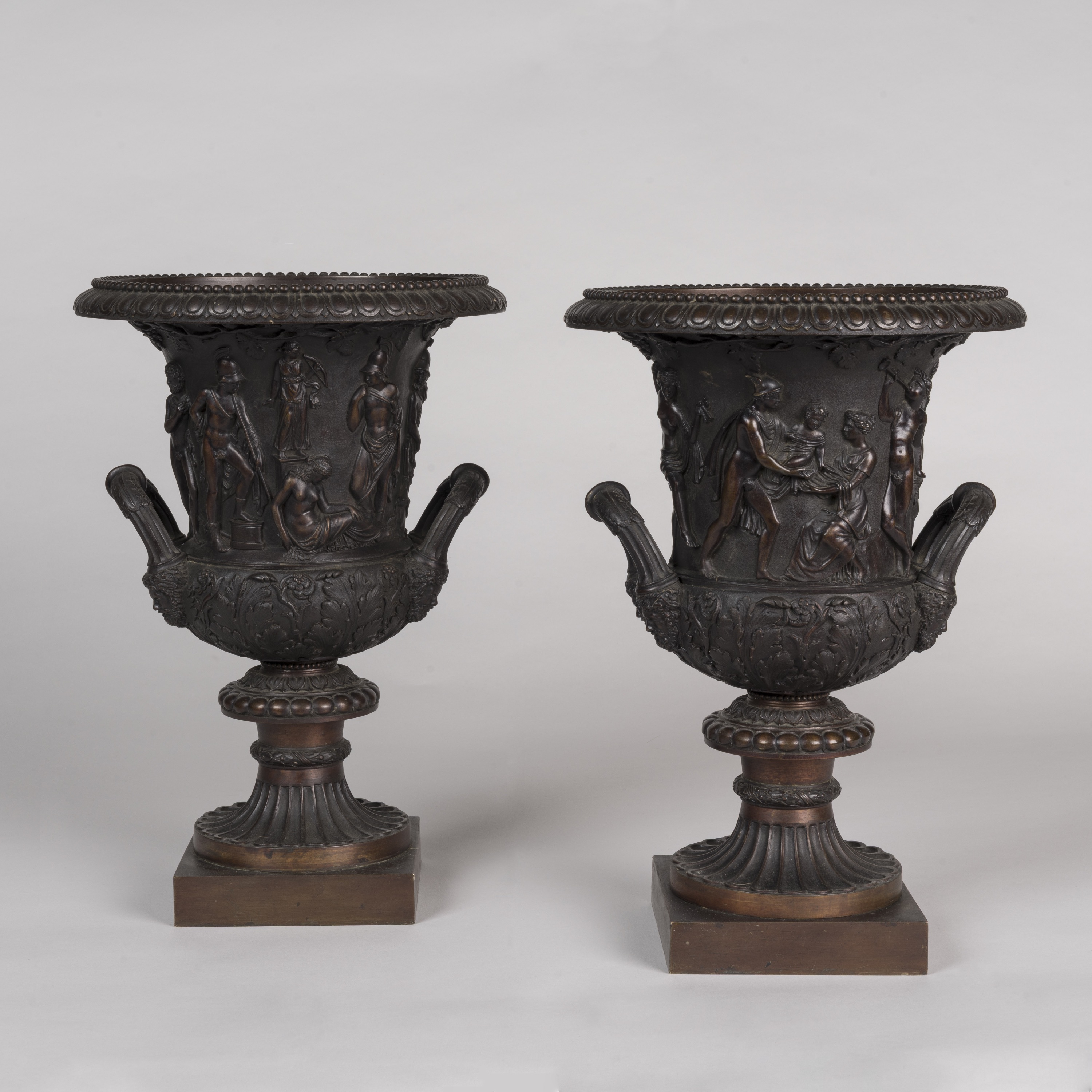
A Pair of Bronze Medici & Borghese Vases, circa 1890. Butchoff Antiques, London.
The decisive shift came in the 1830s. Achille Collas patented a mechanical reduction machine in 1836 capable of scaling a public monument down to a library bust without loss of anatomical truth, and within a generation the bronze had ceased to be the exclusive property of kings. A sculptor’s model that had once gone to a single patron could now be issued in six sizes, in editions of hundreds, signed by the artist and stamped by a named foundry. By the 1860s every major Paris sculptor worked under contract to one of the great editors, and the trade that supplied the drawing rooms of Paris, London and the spa towns of Germany ran on a scale that would have been unimaginable to Coysevox a hundred and fifty years earlier.
How Bronze Sculptures Are Cast and Finished
Two methods produced almost every antique bronze on the market. The first, and the older, is the lost-wax process, known to French foundries as cire perdue. The sculptor models the figure in wax over a refractory core, surrounds it with a heat-resistant mould, then bakes the assembly until the wax runs out. Molten bronze is poured into the cavity the wax has left behind, and once cool the mould is broken away. The method produces only one cast per mould but captures the artist’s hand with extraordinary fidelity; even the smallest mark left in the soft wax survives the journey into metal.
Sand casting dominated the editions of the mid-nineteenth century. The sculptor’s plaster or terracotta model was pressed into a frame of fine, slightly damp sand to form a mould, and the bronze was poured in sections that were then assembled. The process was efficient, repeatable and well suited to a foundry producing the same model in six sizes for an editorial catalogue. From the 1880s the lost-wax method returned to favour at foundries such as Valsuani and Hébrard, who used it to capture the loose, modelled surfaces that Rodin and Degas were giving their wax originals. A Valsuani Rodin retains the fingerprints of the artist; a sand-cast Barbedienne reduction, however accomplished, retains the impression of the foundry.
Whichever method was used, the bronze that emerged from the mould was unfinished. Visible seams had to be filed away, fine details recut, and the entire surface gone over by a chaser, or ciseleur, whose work distinguished one foundry from another as much as the casting itself. Patination came last. The patineur worked the surface with heat, acids and metallic salts to produce colour, ranging from the near-black “Medici” patina favoured for seventeenth-century court pieces to the rich chocolate browns and golden brass tones of the nineteenth-century salons. The colour grows into the metal through chemical reaction, which is why aggressive cleaning is so destructive. A bronze polished hard enough to remove the patina exposes the raw alloy beneath, bright and yellow, and the piece can lose ninety per cent of its value in an afternoon.
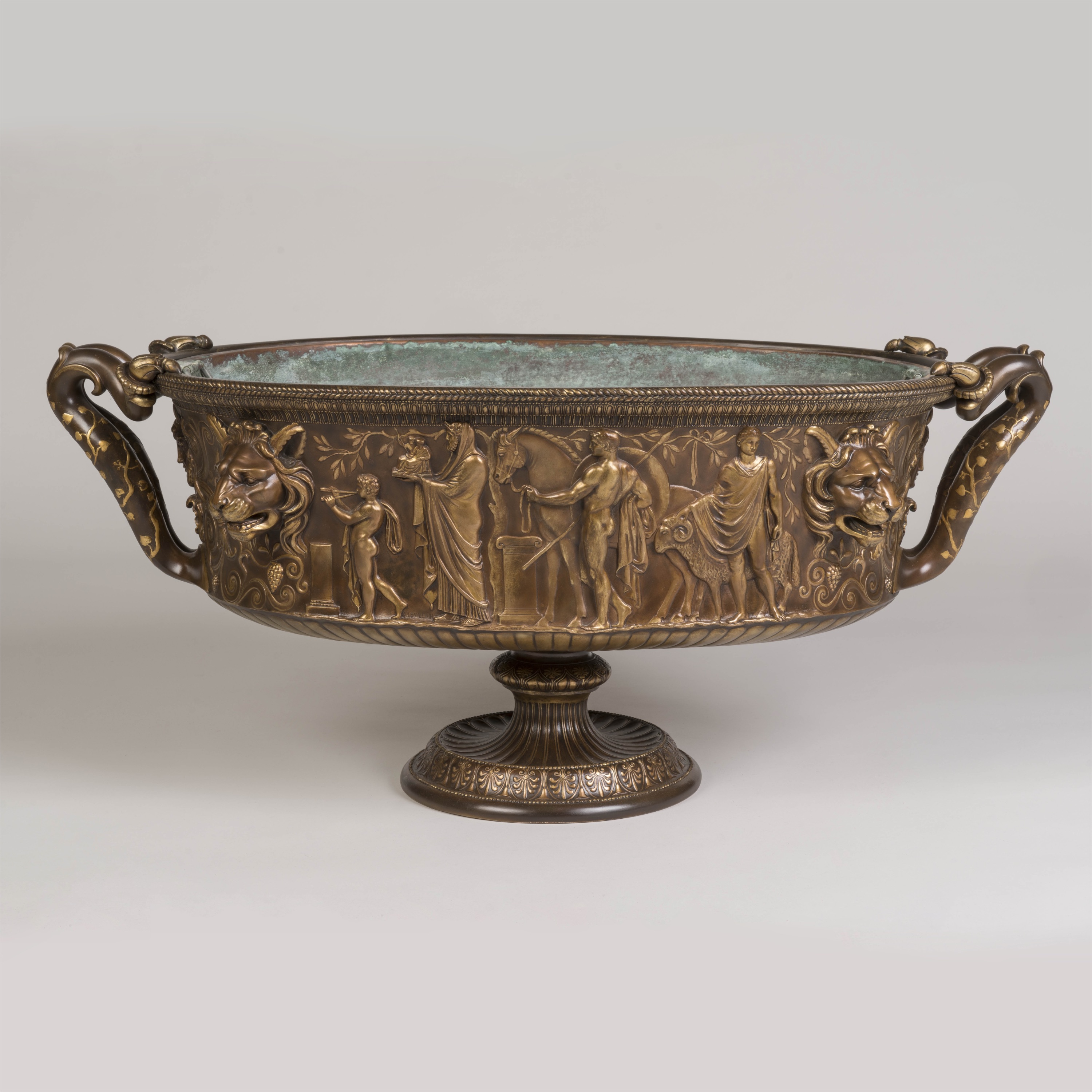
Cast at the Barbedienne foundry around 1880, with hand-chased details done by Charles Cauchois, the foundry's best 'ciseleur,' and with a striking patination to the surface. Previously with Butchoff Antiques, London.
The Animalier Sculptors
The dominant movement in nineteenth-century French bronze was Animalier sculpture, the depiction of animals as serious subjects of fine art rather than as accessories to allegorical or hunting scenes. The figure who established it was Antoine-Louis Barye, who spent years working from dissections in the Jardin des Plantes in Paris before producing tigers, lions and crocodiles whose anatomy was uncompromising and whose violence was unidealised. The Paris Salon jury rejected his work in 1837 as goldsmithing rather than sculpture, judging it too small and too literal in handling for fine art. Barye’s response was to open his own foundry, the Atelier Barye, and to cast and sell his models directly, in the process inventing the commercial market for bronze sculpture.
The generation that followed worked with extraordinary technical and observational rigour. Christophe Fratin, son of a taxidermist, brought a Romantic looseness to the movement, casting bears and monkeys in expressive, roughly modelled poses; his casts are noticeably lighter in weight than those of his contemporaries, the result of a thin-walled technique few other foundries attempted. Pierre-Jules Mêne ran his own foundry from the 1830s and specialised in horses, hunting dogs and pastoral subjects. The chasing on his harness and fur is crisp, and the signature, a clean flowing script, is unmistakable. Mêne’s polished finish and ready availability made his bronzes a fixture of the Parisian salons of the 1860s and 1870s.
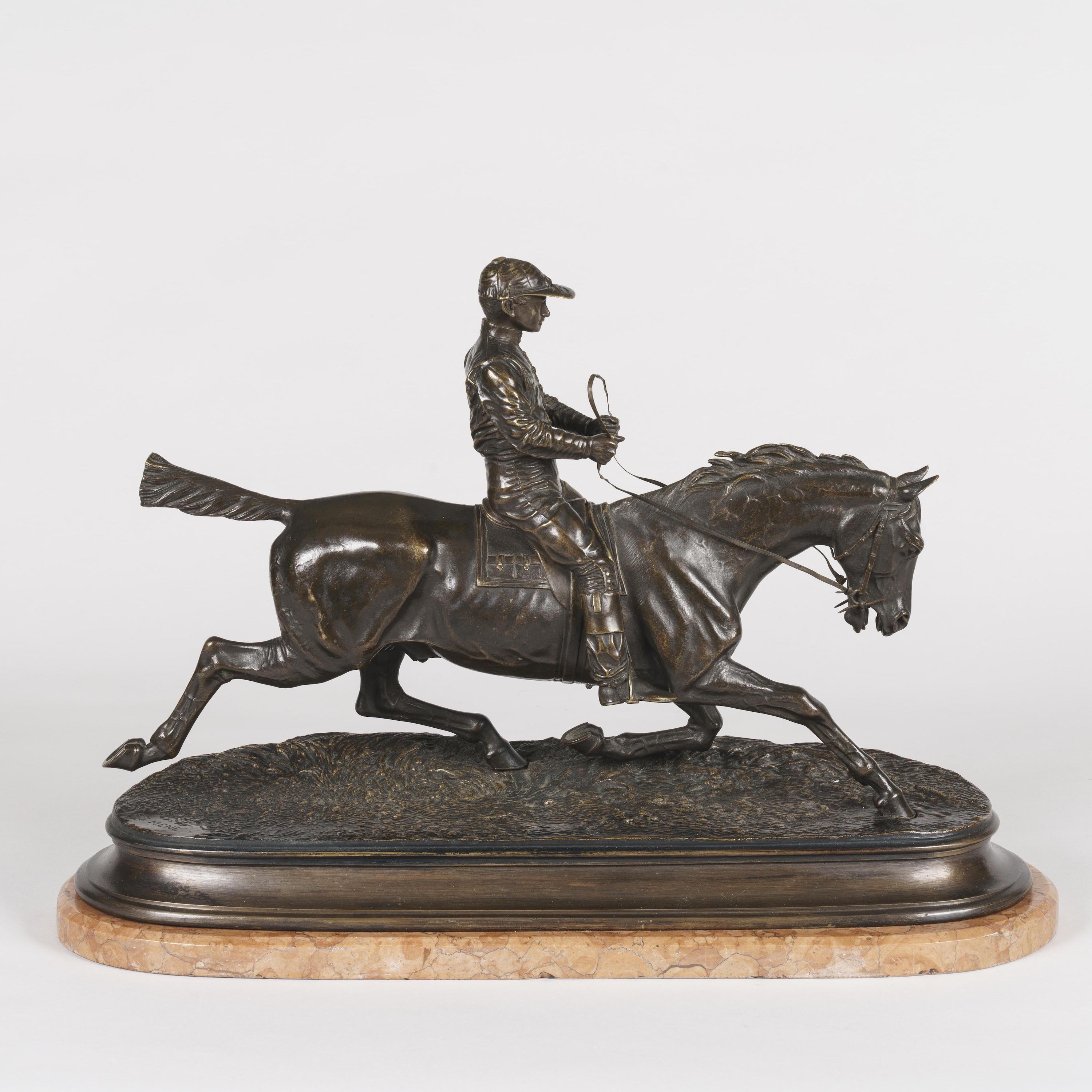
An Equestrian Sculpture, After Pierre-Jules Mêne, circa 1875. Butchoff Antiques, London.
Isidore Bonheur was the great equine sculptor of the period, and almost all his bronzes were cast by his brother-in-law Hippolyte Peyrol, whose foundry mark is often only a few millimetres tall and concealed under the base. Jules Moigniez specialised in birds, where his combination of meticulous foliage on the base and a distinctive lightly gilded patina makes his pheasants and herons recognisable across a sale room. Emmanuel Frémiet, Barye’s nephew, took the movement into the macabre and the historical, sculpting a gorilla carrying off a woman that scandalised the Salon of 1887 and a series of armoured medieval knights in which every rivet was based on a museum original. By the 1890s the Animalier school was no longer avant-garde, and the bronzes its leading figures had produced over the previous half-century were already established as a distinct collecting field.
The Foundry as Publisher
In the nineteenth-century bronze trade, the foundry was as much a publisher as a manufacturer. A sculptor would sign a contract granting an editor the right to issue a particular model in a defined number of casts and sizes, and the editor’s reputation and distribution reach determined how widely the work would travel. The market thus came to be dominated by a small number of named houses, and a foundry mark on a bronze functioned as a publisher’s imprint as much as a maker’s stamp.
Ferdinand Barbedienne ran the largest of these operations from 1838 onward, acquiring the rights to over a hundred Barye models and licensing many other sculptors besides. His catalogue listed around two thousand items in any given year, and he made aggressive use of the Collas reduction to issue a single sculpture in as many as six scales, from public-square monument down to desk ornament. Barbedienne casts are reliable in quality and clearly stamped, and they account for a significant portion of the antique bronzes traded in London and Paris today. The competing house of Susse Frères, founded in 1758 and the oldest foundry in France, took a more selective route, working with living artists on shorter editions and producing casts that are typically heavier and more individually finished. Thiébaut Frères handled the larger commissions, including most of Frémiet’s monumental work, while Hippolyte Peyrol cast almost the entire output of the Bonheur family.
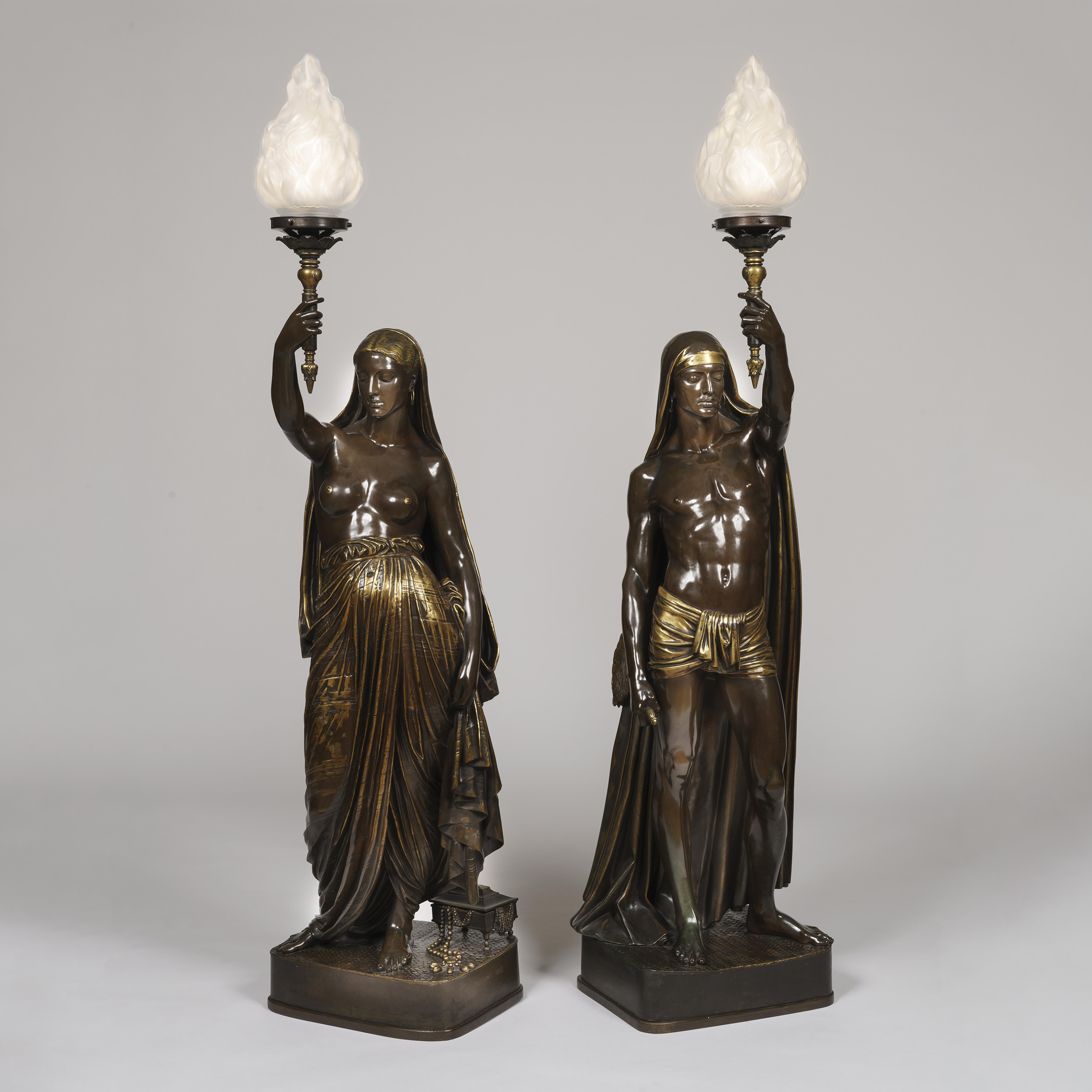
These figural torchères, made circa 1860, were available from Barbedienne in several sizes by using the mechanical reduction invented by Achille Collas. Butchoff Antiques, London.
Outside France, the bronze trade ran on different lines. In Rome, Benedetto Boschetti and the workshops around the Via dei Condotti continued to cast reductions of classical antiquities for Grand Tour visitors well into the second half of the nineteenth century, often combining bronze with the polychrome marbles of central Italy on a single base. In Vienna, Franz Bergman developed a distinctive line of cold-painted bronzes. The technique replaced the chemical patina entirely: pigment was applied in layers directly onto the finished cast, producing the vivid Orientalist scenes, exotic animals and erotic curiosities for which the Vienna bronzes remain known. A Bergman cast is recognisable by its painted finish and a small “B” stamp in an amphora-shaped cartouche on the base; most are modest in scale.
Reading the Marks: Signatures, Foundries and the Surmoulage
The signature on an antique bronze should be incised into the wax model and carried into the metal during casting; it should not look stamped or applied after the fact. Original signatures sit slightly proud of the surface, with their edges softened by the chasing process, while a flat, sharply machined signature is a warning sign. Comparison against a documented example in a catalogue raisonné is straightforward, and most French sculptors signed in cursive script along the base.
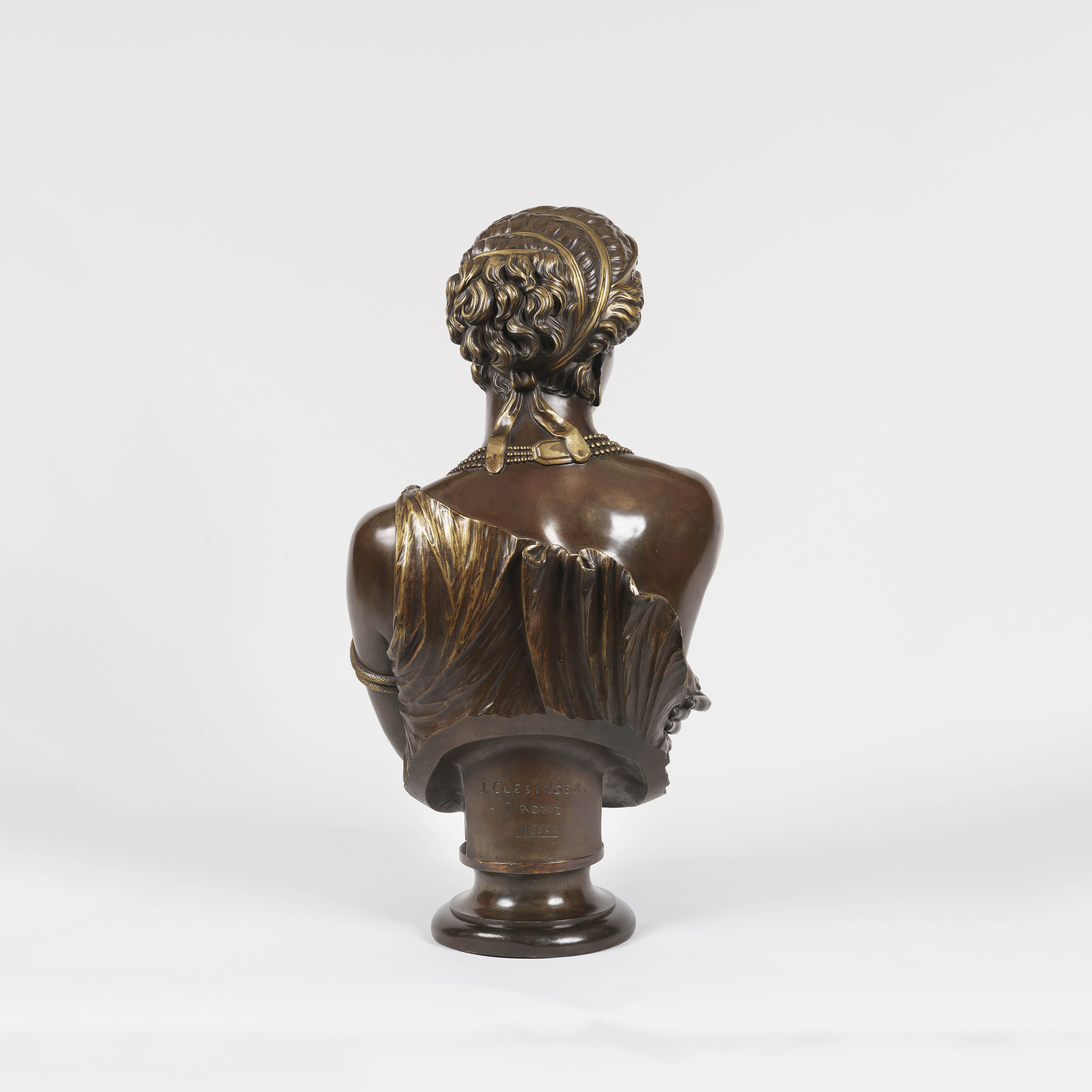
A Bust of 'Helen of Troy' Sculpted by J-B Clesinger, and cast by the Barbedienne Foundry. The back showing the sculptor's signature with the foundry name above it. Previously with Butchoff Antiques, London.
Foundry marks vary in form and prominence. Barbedienne struck a circular cachet incorporating the founder’s name and Paris address, and many of his casts also carry the small Collas reduction seal indicating that the model had been mechanically scaled from a larger original. Susse Frères used a discreet rectangular stamp, while Thiébaut Frères favoured an oval cachet. Peyrol’s mark is harder to find: a tiny incised stamp hidden under the base of a Bonheur bronze. The presence of such a mark, particularly in combination with the sculptor’s signature, raises the value of a piece considerably.
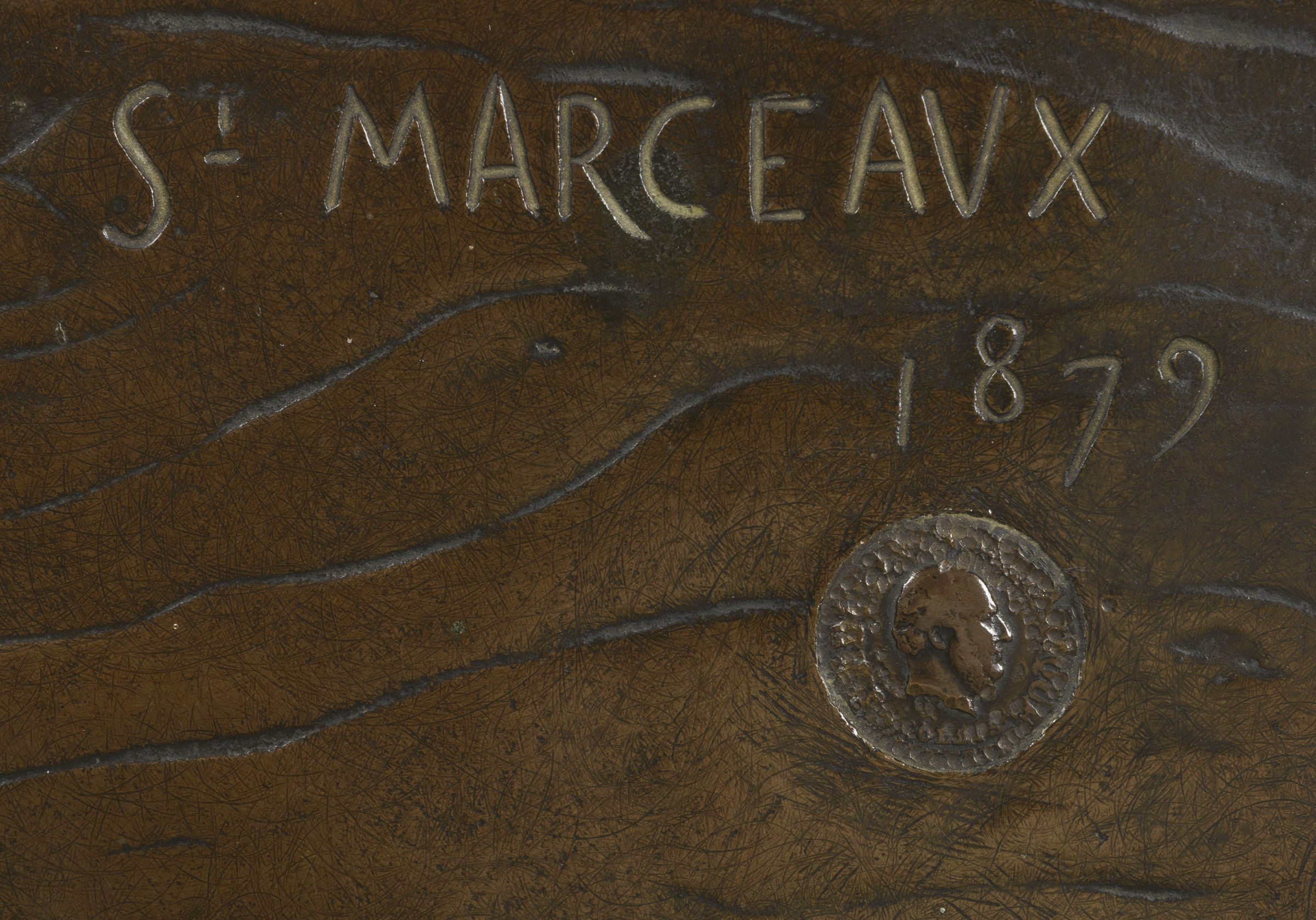
Detail of a bronze sculpture of Arlequin by René de Saint-Marceaux (1845-1915) with the Collas reduction seal underneath showing the inventor's face in profile. Butchoff Antiques, London.
The surmoulage is the most common pitfall in the field. It is a cast taken from an existing finished bronze rather than from the artist’s original model, and it is detectable by two characteristics. The first is shrinkage: molten bronze contracts by about one and a half to two per cent as it cools, so a surmoulage will always measure slightly smaller than the original at any given dimension. The second is surface softness. Where an original cast preserves the crisp tooling of the chaser, a surmoulage carries the slightly muffled forms of a finished surface taken at one remove; hair, fabric folds, eyelids and harness all read as faintly out of focus. A clean ping when the bronze is tapped, the so-called ring test, also helps to distinguish copper-rich antique alloys from later zinc-heavy reproductions, which give a dull thud.
A final consideration is whether a cast is a lifetime, posthumous or modern edition. Lifetime casts, supervised by the sculptor, command the highest prices; posthumous casts produced from original moulds remain serious objects but trade at lower levels. Since 1968, French law has required the date of casting to be inscribed on every new bronze, and any edition of more than a thousand is legally a reproduction rather than an original work. For pieces from before this rule, dating depends on the comparison of foundry marks, signatures and stylistic detail against documented chronologies.
Patina, Condition and the Question of Value
The patina is the most contested element of any antique bronze. The depth of colour and the variation across raised and recessed forms develop over decades and cannot be replicated by chemical treatment in any condensed period; even a skilled restorer working from the same recipes the patineurs used in 1880 will produce a surface that reads as new. Collectors learn to look for the natural irregularity of an original patina and to mistrust uniform, freshly applied colour, even when the underlying cast is genuine.
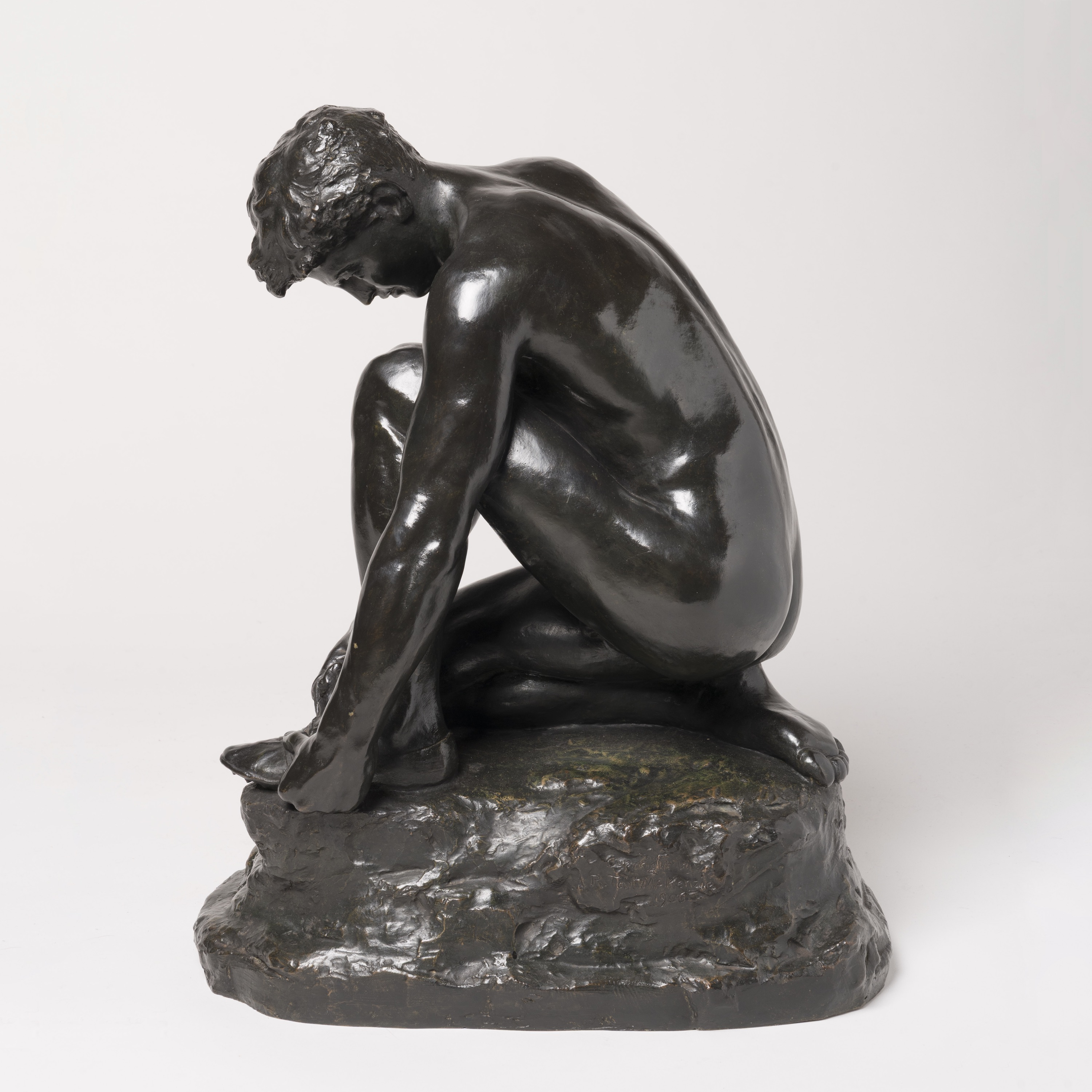
The Competitor by Robert Tait McKenzie (1867-1938), an early 20th century American bronze retaining a rich original patina. Butchoff Antiques, London.
Condition assessment extends beyond surface to structure. Bronze disease, a powdery green corrosion caused by chloride contamination, is active and progressive; left untreated it eats into the metal and disfigures the piece. A small spot is a treatable problem, but a piece riddled with it requires expert intervention before it can be displayed safely. The original base is also part of the work. A nineteenth-century Animalier bronze removed from its Belgian black marble plinth and remounted on Victorian oak loses both authenticity and value, and the same is true of a Grand Tour Italian bronze separated from its sienna or Rouge de Languedoc plinth.
Value, in the end, is the result of many factors weighed together. A signed lifetime Mêne with its original patina and base sits at the top of the market. A posthumous cast of a similar subject, unsigned and missing both its original patina and its base, may bring a tenth of the price. Most pieces fall somewhere in between, and the work of connoisseurship is to read each one accurately. The reward is a category in which the rules, once learned, will serve a collector for a lifetime, and in which a well-chosen object, like the Cornu reduction of Coysevox’s Mercury and Fame, can hold its place in a serious collection alongside any other form of fine art.
written by Rainier Schraepen